What information should be provided about protective case dimensions before a quotation?
Send protective case dimensions in millimetres, on three named axes, for the equipment as it will actually be packed - and then add the four numbers a shell comparison needs but a product drawing never contains: required clearance per axis, the lid-to-base split you need, the maximum external envelope for stowage, and your order quantity. The reason is that protective case dimensions are not one measurement but a set: internal length, width and height decide whether the kit fits, external length, width and height decide freight and stowage, wall thickness decides the shell family and the resin mass, and narrow internal width quietly disqualifies wide items in a cavity that tapers. On our 155 active models we publish external and internal dimensions and volumes on all 155, wall thickness on 148, lid and base depth on 100, narrow internal width on 36, net weight on 93 and a carton footprint on 64, so a quotation built on those fields is a firm answer rather than an estimate with a caveat.
Key points
- Send the packed envelope on three named axes in millimetres; a model name alone gets you the nearest catalogue cavity.
- Internal dimensions decide fit, external dimensions decide freight - a quotation needs both or it is guessing one of them.
- Wall thickness is published on 148 of 155 models and runs 2.0-6.0 mm; it is the figure that moves resin mass and price.
- Narrow internal width is published on 36 models and is the field that disqualifies a wide item in a tapering cavity.
- State quantity with the dimensions: logo, colour and OEM builds start at 300 units, a new mould at 3,000 per component.
- Pallet and container figures are not in the catalogue - they are calculated from the carton footprint against your pallet size.
- No tolerance band is published on any of the 155 listings, so a fit that hangs on 1 mm is a sample decision, not a datasheet one.
Why a quotation starts from protective case dimensions, not from a model name
A model name is a label attached to a mould; it carries no information about whether your equipment fits, whether the shipment will clear your pallet, or which of two shells is cheaper to make. That is why a quotation request built on a name comes back with a question rather than a price. Protective case dimensions are the exchange rate between your equipment and our tooling: the internal cavity says whether the kit fits at all, the external envelope says what it costs to move, the wall section says which shell family and how much resin, and the depth split says whether the lid closes over your tallest item without unloading the gasket channel.
The second reason is that our catalogue is a mould catalogue. It lists 155 active models across seven series, from a 120 mm long utility box to a shell with a 1,356 mm external length, and internal volume from 0.3 L to 139.5 L. When a buyer sends only a length, the nearest cavity is chosen by whoever is quoting, and the result is a price that is technically valid for the wrong case. When the same buyer sends the full dimension set, the answer is either a named model or a statement that the requirement is a custom route, which is a completely different number: an OEM build on existing tooling is quoted at 45 days, while a bespoke exterior geometry needs a new mould at 125 days and from 3,000 units per moulded component.
The nine protective case dimension fields to provide, and what each one decides
These are the fields we work from. Four of them exist on your side of the transaction (packed envelope, clearance, external limit, quantity) and five exist on ours, published per model so you can check the answer yourself before you commit. What to provide about protective case dimensions before a quotation is therefore not a long list - it is nine lines, each of which removes one assumption from the price.
| Line | What You Send | What We Publish | What It Decides |
|---|---|---|---|
| 1. Internal length, width, height | Packed envelope of the kit in mm, on named axes | All 155 models | Whether any catalogue shell fits at all |
| 2. Required clearance per axis | A number, not the word 'some' | Site rule: at least 20 mm per axis | Foam thickness, and therefore the size class |
| 3. Lid-to-base depth split | Where the tallest item must sit | 100 models (lid 16-320 mm, base 15-168 mm) | Whether the lid closes without loading the gasket |
| 4. Narrow internal width | Widest point of a tapered or angled item | 36 models, 70-308 mm | Pass or fail in a cavity that narrows between radii |
| 5. Maximum external envelope | Rack, locker, vehicle bay or airline limit in mm | All 155 models, 120-1,356 mm external length | Which of several fitting shells you can actually use |
| 6. Wall thickness preference | Stacking and handling duty, not a wish | 148 models, 2.0-6.0 mm | Shell family, resin mass and unit price |
| 7. Mass limit and carry method | Carried by hand, on a shoulder, or wheeled | Net weight on 93 models (100-15,320 g); 19 publish wheels | Series, hardware count and freight class |
| 8. Order and annual quantity | Trial order plus estimated annual usage | MOQ 1 standard shell, 300 for logo, colour or OEM, 3,000 per new mould component | Whether you are quoted a stock price or a tooling price |
| 9. Interior and identification | Photo or drawing of the packed kit | Pick-and-pluck, die-cut or CNC-cut foam, custom thickness by zone | Insert cost, lead time and whether the kit survives the movement chain |
Measure the packed envelope, not the product photo
The single most common error in a dimension set is measuring the item as advertised instead of as it travels. A transmitter with its antenna folded, a scope with the objective cap and lens hood on, a multimeter with leads coiled at their natural bend radius, a medical probe with its handle fitted - each of those states is larger than the one in the catalogue photograph, and all of them must be measured before protective case dimensions mean anything. Then name the datum: state which face each measurement runs from, and give the largest projection rather than the body size, because a 6 mm connector boot decides the case while the chassis does not.
Do it as a kit, not as a list of parts. Lay out everything that shares the case - batteries, charger, spares, documentation, cables - and record the footprint of the arrangement you would actually pack in the field with cold hands, then the height of the tallest standing item. A single combined number per axis is worth more than a spreadsheet of components, because the cavity is one box: if two items each need the middle of the lid, only one of them can have it.
Internal and external protective case dimensions: what the shell takes back
The difference between the external and internal rows is the wall, the rim, the hinge bosses, the handle shroud and the gasket channel, and it is not a constant percentage. The four published models below show why you compare internal figures with your own envelope instead of scaling from a case size you already know. On the 843 mm rolling shell the wall and the rim take back 103 mm of length and 74 mm of width; on a 470 mm engineering-PP shell they take back 5 mm and 50 mm. Anyone quoting from external numbers alone will be wrong in both directions, which is exactly the failure that shows up at incoming inspection rather than at purchase order.
| Model | External Mm | Internal Mm | Taken Back By The Shell | Wall Mm |
|---|---|---|---|---|
| WL4010 (KX-4010) | 400 x 360 x 100 | 390 x 315 x 88 | 10 mm length, 45 mm width, 12 mm height | 3.0 |
| WL707# (KX-707) | 470 x 360 x 148 | 465 x 310 x 140 | 5 mm length, 50 mm width, 8 mm height | 2.5 |
| WL8-5726 Trolley (KX-85726) | 576 x 363 x 257 | 520 x 296 x 210 | 56 mm length, 67 mm width, 47 mm height | 4.2 |
| WL8-8442 Trolley (KX-88442) | 843 x 592 x 415 | 740 x 518 x 364 | 103 mm length, 74 mm width, 51 mm height | 5.0 |
Clearance, usable volume and the lid that will not close
Clearance is the field buyers omit and manufacturers silently fill, so state it as a number. The working rule used across this site is at least 20 mm on each axis so that the insert, not the shell wall, absorbs movement, and more where controls, rings or connectors protrude. Then check the volume you will actually have rather than the volume advertised: internal volume is the cavity, usable interior volume is what is left once the foam exists, and the gap on our line is large - the WL8-8442 Trolley publishes 139.5 L internal against 111.6 L usable, and a WL4010 publishes 10.8 L against 9.3 L.
Depth is where the omission becomes physical. Two shells can share an internal height and behave completely differently, because internal depth is split between the closing half and the carrying half: across our catalogue, 100 models publish a lid depth between 16 mm and 320 mm and a base depth between 15 mm and 168 mm. A 90 mm item in a shell with a 27 mm base and a 71 mm lid sits in the closing half, which is the half that must not be loaded by the contents if the gasket channel is to stay compressed. That is a dimension argument, not a quality argument, and it is settled before the quotation if you send the split you need.
The packing figures a quotation needs after the shell is chosen
Once the model is fixed, the freight questions become arithmetic. A carton footprint and pieces per carton are published in our product data for 64 and 58 of the 155 models respectively, and those two numbers, set against your pallet size, are what pallet and container figures are built from. We publish them rather than asserting a pallet quantity, because pallet quantity depends on your deck - 1,200 x 1,000 mm and 1,200 x 800 mm give different answers on the same carton, and a number invented to fill a datasheet column is the reason a pallet is rejected at the dock.
| Model | Carton L X W X H Mm | Pieces Per Carton | Net Weight Each | What We Still Need From You |
|---|---|---|---|---|
| WL2005 (KX-2005) | 410 x 360 x 495 | 40 | 175 g | your pallet size and destination port |
| WL2305 (KX-2305) | 480 x 370 x 470 | 40 | 240 g | your pallet size and destination port |
| WL2805 (KX-2805) | 570 x 470 x 435 | 32 | 340 g | your pallet size and destination port |
| WL3207 (KX-3207) | 645 x 530 x 430 | 24 | 570 g | your pallet size and destination port |
| WL4010 (KX-4010) | 710 x 410 x 500 | 10 | 1015 g | your pallet size and destination port |
Fields we do not publish, and what that means for your quote
Three absences matter to a procurement. First, no tolerance band is published on any of the 155 listings, so if a fit depends on one millimetre it is a sample-and-measure decision rather than a datasheet one, and we will quote a sample before you commit to a tooling spend. Second, pallet quantity and container loading are recorded as calculated values rather than measured ones: the 20GP, 40GP and 40HQ figures come with the quotation once carton and pallet size are known. Third, no enclosure protection code, water, dust, ultraviolet or temperature figure is stated on any model, so if your specification requires one, it is quoted as accredited third-party testing on the configuration you intend to buy - which is a separate work package with its own price and lead time, not a line you can read off a catalogue.
The practical consequence is that a complete dimension set shortens the exchange by removing the questions we would otherwise have to ask, but it does not create claims we do not have. Send the nine fields and you get a firm unit price on a named model, an honest statement about which test figures exist, and a lead time. Send a name and a length and you get an estimate that will be revised after the first shipment.
Worked example: two models with the same name and different dimensions
This pair is the clearest reason to quote from protective case dimensions in millimetres rather than from a search result. Both shells are listed as WL4010, both publish a compressible gasket in a continuous moulded channel, and both are 400 mm long externally - but one is a 0 Series PP shell and the other a 1 Series engineering-PP shell, and the numbers that decide your purchase order are different on almost every line. An item 312 mm wide fits the first and not the second; a 355 mm locker accepts the second and not the first; the wall difference of 0.4 mm is part of why the mass is 225 g higher.
| Field | Kx-4010 | Kx-4010-2 |
|---|---|---|
| Model name | WL4010 | WL4010 |
| Series | 0 Series | 1 Series |
| Shell material | PP | Engineering PP |
| External mm | 400 x 360 x 100 | 400 x 350 x 100 |
| Internal mm | 390 x 315 x 88 | 388 x 307 x 90 |
| Wall thickness mm | 3.0 | 3.4 |
| Lid / base depth mm | 44.0 / 44.0 | 45.0 / 45.0 |
| Narrow internal width mm | 282.0 | 278.0 |
| Internal / usable L | 10.8 / 9.3 | 10.7 / 9.2 |
| Net weight g | 1015 | 1240 |
| Carton mm x pieces | 710 x 410 x 500 x 10 | 700 x 405 x 510 x 10 |
What comes back when you send the numbers, and on what terms
Send the nine fields and the reply is a named model or an explicit custom route, a unit price on EXW or FOB terms, the carton and pallet arithmetic, and a lead time - 45 days for an OEM build on existing tooling, 125 days when a new mould is needed, with MOQ from 300 units where a logo, a colour or an OEM build is involved and from 3,000 units per moulded component for new tooling. Standard shells and custom foam each carry a published minimum of 1 unit, which is how a sample stage is normally arranged before a production decision is taken.
Terms are fixed and stated early, because they decide whether we are the right supplier for you. KeXin New Materials (Guangdong) Co., Ltd. works wholesale and OEM / ODM only: there is no retail channel, prices are EXW or FOB, we do not quote DDP and we hold no overseas warehouse stock, so a landed cost is an FOB figure plus your own freight. Payment is a 30 percent deposit with the balance after inspection, and third-party factory audits are welcome. Contact Fred Zhao or the KeXin Sales Team, or WhatsApp +86 135 3588 0002.
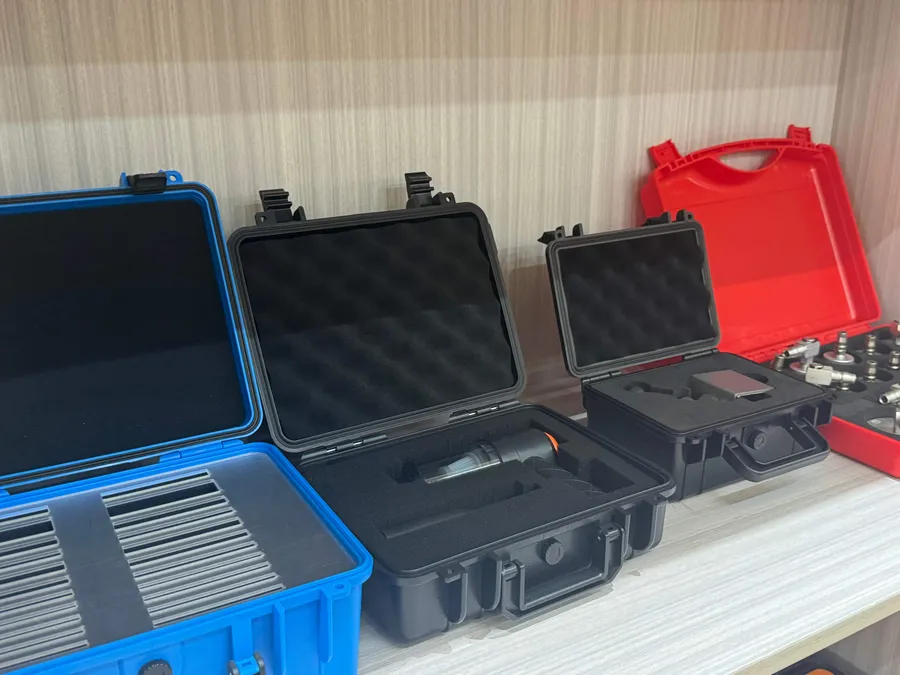
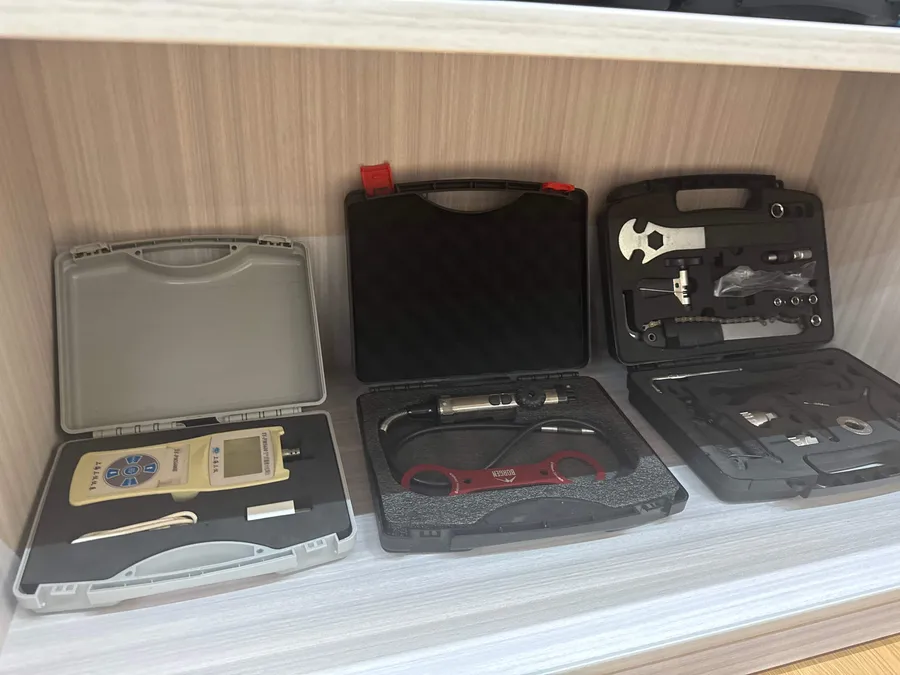
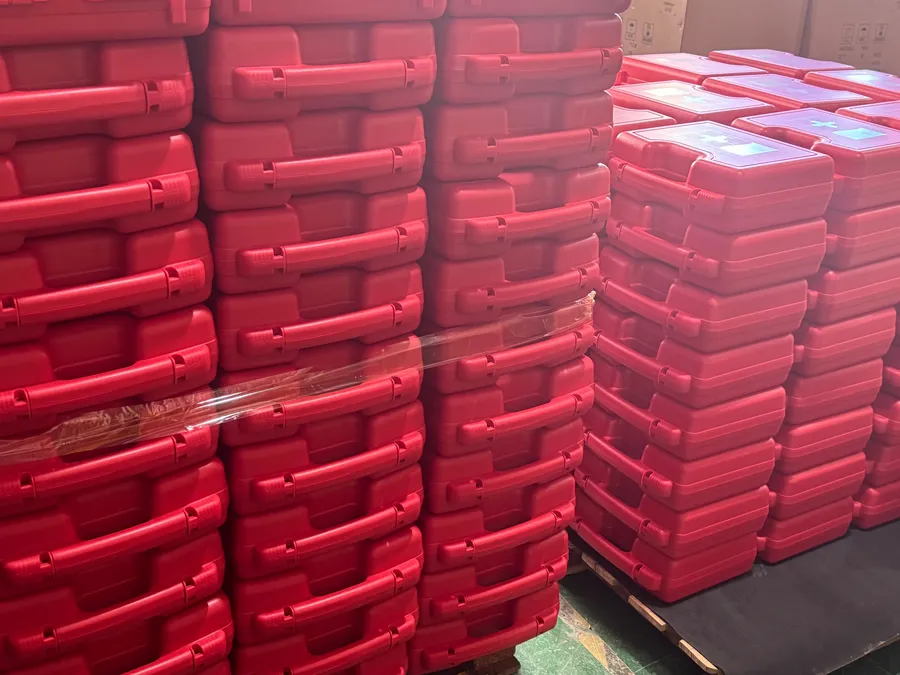
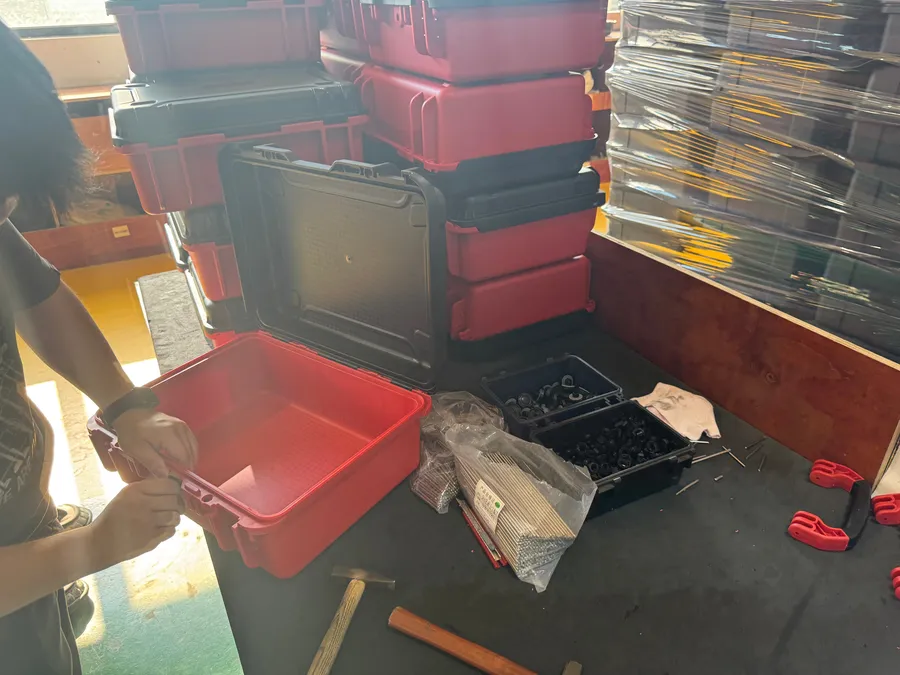
Applications
This matters most where the case is part of a movement chain rather than shelf packaging. In electronics & instruments and field & deployment and industrial equipment the same shell is specified differently because the handling, the environment and the verification requirement differ.
- Electronics & Instruments — Electronic assemblies rarely fail from a single large impact. They fail from repeated small shoc…
- Field & Deployment — Field deployment removes every assumption a depot specification makes: no forklift, no dry stora…
- Industrial Equipment — In an industrial setting the case is a working surface as much as a container, and its interior …
- Telecommunications — Communications equipment is never one object. It is a unit plus a set of accessories that determ…
Customisation
Everything described above is configurable on a standard shell: interior layout (pick-and-pluck, die-cut or CNC-cut), foam grade and thickness, colour, logo method, latch and lock count, pressure-equalisation valve, cable ports, document holder and identification plate. A bespoke exterior geometry requires a new mould — 125 days, from 3,000 units per moulded component.
Procurement considerations
| Question | What to send us |
|---|---|
| Which shell fits? | Equipment L × W × H as packed, plus required clearance per axis |
| What does it cost? | Order quantity and estimated annual quantity — the two drive different answers |
| Is tooling needed? | Whether an existing shell clears the envelope with usable foam depth |
| Lead time? | Your required delivery date, not just the order date |
| Certification? | The exact standard your tender names — we will say whether we can test to it |
| Freight? | Destination and preferred terms; carton and pallet data supplied with the quotation |
Comparison and selection guide
The tables on this page exist because a protective case is chosen by comparing three things: the envelope, the environment and the handling chain. Where no table applies, the rule below is.
| Situation | What To Do |
|---|---|
| Fastest | Standard shell plus CNC foam — typically 45 days from approved drawing. |
| Branded | Standard shell plus custom colour and logo — MOQ applies to the resin colour. |
| Bespoke geometry | New mould — 125 days, MOQ from 3,000 units per component. |
- Size on internal dimensions plus clearance, never on a product name.
- Choose the carrying method before the shell: it changes the series, not just the price.
- Specify the interior last, and decide up front whether the end user will reconfigure it.
What information should be provided about protective case dimensions before a quotation? relates to Logistics & Packing Guide. Related families: Custom Protective Cases / Electronics Cases / Equipment Transport Cases / Instrument & Equipment Cases / Military Protective Cases / Outdoor Protective Cases / Waterproof Cases / Rolling Cases. Related sectors: Electronics & Instruments / Field & Deployment / Industrial Equipment / Telecommunications. Continue in the Logistics & Packing Guide cluster.
This page is written from our own production data. If your requirement differs, send the dimensions and we will tell you which of the 155 models fits, or whether a custom route is needed.



