How should case weight be specified in a protective case RFQ?
Specify case weight in a protective case RFQ as a named block of lines, not as an adjective. Write, in order: the measurement basis (empty shell, shell with its interior, or packed carton), a maximum per case rather than a target, the unit and decimal place you want used throughout, the payload mass as it will actually travel, the packing arithmetic you want quoted back - net weight per case, pieces per carton and the sum of the two - the verification method and the stage at which the figure is recorded, and the constraint that makes the number matter. Require an answer on every line, either a figure or the words not stated. Our own file shows why the wording decides the result: a net weight is published on 93 of 155 models, from 100 g on KX-1204 to 15,320 g on the KX-88442 trolley, a gross weight appears on none of them, and the word lightweight covers all 93.
Key points
- Name the basis on every weight line: empty shell, shell plus interior and packed carton are three different numbers.
- Write a maximum per case, not a target. A ceiling is enforceable on goods-in; a target is a preference you cannot inspect.
- 93 of our 155 listings publish a net weight and none publishes a gross weight, so gross must be a quotation line.
- Fix the unit and decimal place once at the top of the block - grams below 2 kg, kilograms above - or compare badly.
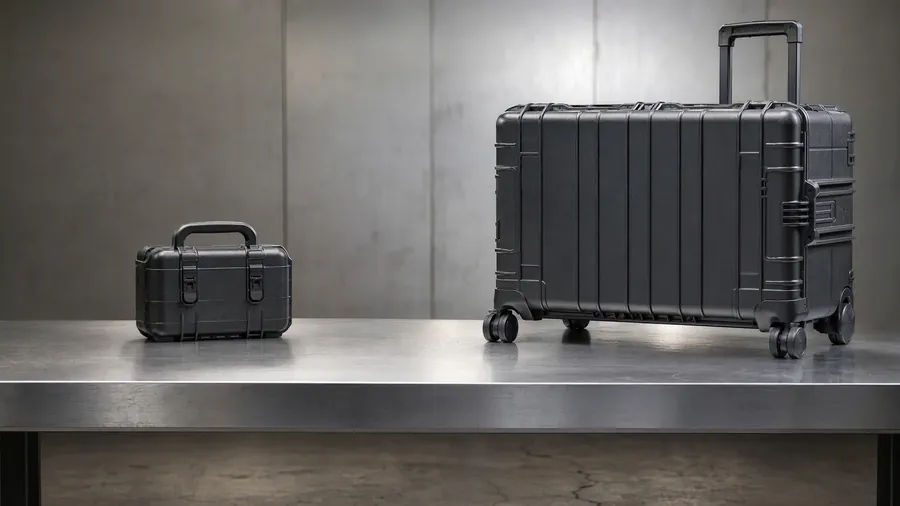
- Same length is not same mass: five listings at 280 mm external length publish 340 g to 940 g across the group.
- Ask for carton arithmetic - net per case times pieces per carton - because pallet and container masses are not measured.
- Put the payload mass and the handling constraint in the block, or the supplier is designing against a number nobody gave.
Weight is a measured output, not a drawn dimension
Case weight behaves differently in an enquiry from every other line on the sheet, and it is worth understanding why before you write a number down. Dimensions are an input: you measure the equipment, you state a cavity with a clearance, and a competent supplier either meets it or says they cannot. Mass is an output: it is the result of a tool, a wall section, a resin, the hardware fitted and the interior ordered in front of it, and only the manufacturer can tell you what it comes to. A weight line in a protective case RFQ therefore has to do two jobs at once - state a limit you can enforce, and name the basis on which the supplier's figure will be produced and checked.
Skip that and one enquiry returns three incomparable quotations. Ask for a lightweight case and one supplier answers with the empty shell, one with the shell plus its foam, and one with a packed carton including the corrugate and pallet they happened to choose. Across our own catalogue the spread makes the point plainly: 93 of 155 listings publish a net weight, running from 100 g on KX-1204 to 15,320 g on the KX-88442 trolley with a median of 1,480 g, and 57 of those 93 sit under 2 kg. Every one of those is lightweight in somebody's language, and the difference between them is a freight invoice, a handling limit or a rejected delivery.
The seven lines a weight block should contain
Put these seven lines near the top of the enquiry, keep them in the same order for every supplier, and keep them there for change orders on tooling you already own. Lines one to three control what the number means. Line four is the input only you can supply. Lines five and six are what make two quotations comparable and what makes the figure checkable when the goods arrive. Line seven tells the engineer which trade-off to make when the first answer misses. Copy the left-hand column as your line labels and insist on an answer for each, including the ones that feel obvious - the obvious lines are where the assumptions hide.
The right-hand column is the useful part, because it is what a supplier fills in for you when a line is blank, and the default assumption is almost always the cheapest one available. Where a bidder cannot state a figure, ask them to write the reason in the same cell: either the value depends on a configuration not yet chosen, or on a measurement not yet taken. Both answers are worth having before you sign rather than after the container is booked.
| Line | What You State | What The Supplier Returns | If Omitted |
|---|---|---|---|
| 1. Measurement basis | Empty shell, shell with interior, or packed carton - named, never implied | One figure on the named basis, with exclusions listed | Whichever basis is cheapest to quote |
| 2. Maximum per case | A ceiling in your unit, against the shipped configuration | Their measured figure and the margin below your ceiling | Whatever the tool produces, then a debate after delivery |
| 3. Unit and decimals | Grams below 2 kg, kilograms above, one decimal, fixed at the top | Every mass in the unit you set, unconverted | 1.5 kg and 1,500 g in the same document, read as different products |
| 4. Payload mass | Contents as packed, with accessories, and where the mass sits | Confirmation the interior supports it within line 2 | An interior engineered for a load nobody declared |
| 5. Packing arithmetic | Net weight per case, pieces per carton, and the sum of the two | All three, or the reason one is unavailable | A carton mass that cannot be cross-checked against anything |
| 6. Verification | Who weighs it, on what, at first article and at delivery | The figure for the configuration ordered, before mass production | A catalogue number carried over from a similar shell |
| 7. Binding constraint | Who lifts it, how often, and which freight band prices it | Whether hardware, wall or interior must change to meet it | A case that passes the scale and fails the handling |
Name the basis, because one word covers three numbers
The single highest-value line in the block is the boring one. Our file records a net weight and records no gross weight on any of the 155 listings, and it publishes no carton tare, so a supplier who answers a weight question with one unlabelled figure has chosen a basis on your behalf. Ask for the basis to be written beside the number and for the exclusions to be listed - interior, accessory pockets, divider panels, corrugate, pallet, shrink film. Each is a real mass and only some of them belong in the figure you intend to enforce on goods-in.
This matters most where the weight line feeds freight cost, because the number a forwarder prices is rarely the number on your datasheet. Chargeable mass is the greater of actual mass and the mass implied by the cube, and the gap between the two is large for empty shells. On our 58 listings that publish both a net weight and a pieces-per-carton figure, a carton cube worked on the divisor of 5,000 that couriers commonly use exceeds the summed net weight on every single row, by a median factor of about 2.3 and in one case by more than eleven times. Quoting freight from a net weight alone under-prices almost any case shipment, and the RFQ line that prevents it asks for both numbers rather than one.
What a published net weight actually covers
In our catalogue a net weight is a model-level record taken from our own production or incoming-material data, and it is published on 93 listings. The 62 that publish none are the entire 8 Series, which is why an enquiry on those shells should expect a measured figure for the configuration ordered rather than a catalogue number. The field describes the case, not the shipment: nothing in it accounts for a custom interior, and no separate mass is published for foam, so a buyer who needs a shell-only figure and a case-with-interior figure has to ask for both as two lines and accept that the second is a quotation output rather than a listing entry.
Hardware is the visible part of the difference. Wheels appear on 19 listings; those same 19 carry a telescopic handle and are also the 19 recorded as not stackable, and among weighed models their median published net weight is 8,500 g against 1,200 g for the 74 unwheeled listings that publish a weight. A seal is recorded on 66 of the 93 weighed models. None of that makes a wheeled shell better or worse - it makes the hardware list part of the weight line, and it is the reason a maximum belongs against a named configuration rather than against a model name.
| Published Net Weight Band | Listings | Median In Band | Examples From Our File |
|---|---|---|---|
| Under 250 g | 3 | 175 g | KX-1204 at 100 g, KX-2005 at 175 g |
| 250 to 500 g | 12 | 340 g | KX-1905 at 250 g up to KX-62109 at 470 g |
| 500 g to 1 kg | 17 | 830 g | KX-2808-2 at 527 g up to KX-3508 at 995 g |
| 1 to 2 kg | 25 | 1,395 g | KX-4010-2 at 1,240 g up to KX-4318 at 1,970 g |
| 2 to 5 kg | 16 | 2,920 g | KX-64114 at 2,100 g up to KX-85021 trolley at 4,912 g |
| 5 to 10 kg | 13 | 6,140 g | KX-85022 at 5,012 g up to KX-96127 trolley at 8,540 g |
| Over 10 kg | 7 | 10,660 g | KX-97227 trolley at 10,000 g up to KX-88442 trolley at 15,320 g |
Ask for the packing figures as arithmetic you can check
The line that makes weight comparable between suppliers is not the case mass, it is the carton. Ask for net weight per case, pieces per carton, and the sum of the two, and you get three numbers that can be reconciled against each other before anything ships. Our catalogue publishes a carton footprint on 64 listings and pieces per carton on 58, ranging from one large shell per carton to 40 pieces of the smallest models, and every listing that publishes a pieces-per-carton figure also publishes a net weight - so those 58 rows are fully checkable. The table below is that arithmetic done only on published values.
Read the last row before you write your own requirement. KX-95419 publishes 3,600 g per shell in a carton of 550 x 485 x 755 mm, which is a fifth of a cubic metre of space carrying 3.6 kg of goods; the shipment is priced on its cube long before the plastic on the scales matters. Two further masses must be requested rather than expected: pallet quantity is recorded as not measured on all 155 listings, with the note that it is calculated from the carton footprint against the buyer's pallet size, and container loading for 20 ft, 40 ft and 40 ft high-cube is likewise recorded as figures supplied with the quotation. Put your pallet dimension and your usual order quantity in the same block, or accept a mass that belongs to somebody else's warehouse.
| Model | Net Weight Per Case | Pieces Per Carton | Sum Of Published Net Weights | Carton Footprint Mm |
|---|---|---|---|---|
| KX-2005 | 175 g | 40 | 7.00 kg | 410 x 360 x 495 |
| KX-2405 | 293 g | 20 | 5.86 kg | 475 x 415 x 280 |
| KX-2805 | 340 g | 32 | 10.88 kg | 570 x 470 x 435 |
| KX-4321 | 2,330 g | 12 | 27.96 kg | 885 x 515 x 650 |
| KX-6621 | 6,420 g | 3 | 19.26 kg | 665 x 500 x 650 |
| KX-85022 | 5,012 g | 1 | 5.01 kg | 495 x 375 x 245 |
| KX-95419 | 3,600 g | 1 | 3.60 kg | 550 x 485 x 755 |
Size does not predict mass, so write a ceiling
Buyers routinely assume a length implies a mass, and the catalogue says otherwise. Five listings share an external length of 280 mm and publish 340 g, 527 g, 800 g, 890 g and 940 g, because their depths run from 53 mm to 165 mm and their published walls from 2.1 mm to 5.0 mm. Three listings share 400 mm and publish 1,015 g, 1,240 g and 1,480 g. The most instructive pair is the two listings recorded under KX-4010: external envelopes of 400 x 360 x 100 mm and 400 x 350 x 100 mm, published nets of 1,015 g and 1,240 g, walls of 3.0 mm and 3.4 mm. Two boxes you would call the same size differ by 22 per cent on the scale.
That is the argument for writing a maximum rather than describing a size and hoping. State the ceiling against the shipped configuration - the shell, the interior you intend to buy, the hardware you have chosen - and let the supplier engineer to it. Then use the tolerance line honestly: a figure such as plus or minus 5 per cent covers run-to-run variation on a tool that already exists, and it does not cover a design change, a resin substitution or an interior you add later. If you want both, write two lines, because a tolerance that quietly absorbs a redesign is not a tolerance, it is an approval you gave in advance.
Verification wording that survives goods-in
A weight line with no verification clause is a statement of intent. Write who takes the figure, against what, and at which stage, in the same block: the supplier's figure for the ordered configuration before mass production, your own check on a sample of cartons at delivery, and the record you expect to receive with the shipment. Be clear-eyed about what a catalogue can support: the published net weight is a model-level record from production or incoming-material data, not a per-unit certificate on every box, and any buyer whose acceptance test depends on a per-lot record should say so in the enquiry and have it priced as a line item rather than assumed.
Sequence it the same way a dimension block is sequenced. Approve the mass on the first article, then release production; on a bespoke interior that is a single-piece path, while an OEM sample against an existing mould is a 45-day programme and a new mould is 125 days. Weigh what actually ships rather than what arrived from the mould shop, because the interior, the label set and the accessory pocket are all downstream of the shell and all of them sit on the scales. One further habit costs nothing and saves an argument: record the mass of your payload as packed on the same day you draw the cavity, so that the case figure and the contents figure can be added together against your handling limit.
Decide which constraint is binding before you set the number
Three constraints turn case weight into a real requirement, and each one wants a different line in the block. A handling constraint - who lifts this case, how often, and whether one person or two does it - responds to per-case mass and to handle and wheel configuration; 57 of our 93 weighed listings sit under 2 kg, so the light end of the range answers that constraint before any engineering conversation starts. A freight constraint responds less to the case than to the cube, which is why line five matters more than the adjective in the subject line. A storage constraint - rack depth, shelf load, a stacked column in a container - responds to per-case mass multiplied by stack height, and it interacts with the 19 wheeled shells that our file records as not stackable.
Buyer type changes which of the three you write first. A distributor stocking catalogue sizes starts from published figures and asks which listings meet the shelf and the carton, so the important line is the sum of net weight per carton against their own pallet. An OEM programme with a carry limit writes a maximum per case as a requirement with headroom and asks which line binds first - wall section, hardware or interior. A buyer replacing a case that failed in service should write the constraint that was breached, not the mass that was quoted, because the complaint is rarely the figure on the datasheet; it is grams in the wrong place, on a shell nobody asked to be lifted a stated number of times by one person.
Customisation, and what actually moves a quoted mass
A weight requirement can usually be met without new tooling, and knowing which lever you are pulling keeps the conversation cheap. The interior is the first lever: custom foam is quoted from one piece against a stock shell, and die-cut or CNC-cut layouts change both protection and mass. Wall section is the second - published figures run from 2.0 mm to 6.0 mm across 148 listings, with 7 publishing none - and it is a tool property rather than a purchase option, so a wall change on an existing shell is a question for the manufacturer, not a line item. Hardware is the third: wheels, a telescopic handle, a seal channel and padlockable latches each add mass that you can specify on or off, and the published difference between wheeled and unwheeled shells is measured in kilograms rather than grams.
The levers that change mass also set the commercial path. Colour and logo move the minimum to 300 pieces, an OEM or private-label programme is quoted from 300, and a new mould is quoted from 3,000 pieces per component, which is the point at which a weight target stops being an engineering question and becomes a tooling decision. If your requirement is genuinely a mass rather than a case, say so in the block and ask the supplier which lever they propose to pull; a quotation that answers a mass problem with a new tool has either not read line seven or is quoting you the more expensive one.
What we do not state, and the terms around the quotation
A weight block should travel with an honest statement of what the answer will not contain. We publish no gross weight for any model, so gross is quoted per configuration on request. We record pallet quantity and container loading as not measured, because both are calculated from the carton footprint against your pallet and your order quantity. We publish no ingress-protection code for any model, and our listings record stack load, load capacity and protection rating as not measured, with accredited testing against a named procedure quoted per configuration as a separate work package; impact is stated only as that model's published wall thickness, with no drop height claimed without a test. If your specification needs a test report, put it in the RFQ as a priced line so it is not mistaken for something included by default.
Commercially we work wholesale and OEM only. Terms are EXW or FOB; we do not sell retail, we do not quote DDP, and we hold no overseas warehouse, so the freight leg, clearance and any onward delivery stay with you or your forwarder - which is exactly why the packing and chargeable-mass lines above belong in your enquiry rather than in a supplier's assumption. Send the weight block with the payload figure and the handling constraint attached, and you will get back a number you can enforce and compare with the next one. For a quotation review, contact Fred Zhao or the KeXin Sales Team, or reach us on WhatsApp +86 135 3588 0002. KeXin New Materials (Guangdong) Co., Ltd.
Customisation
Everything described above is configurable on a standard shell: interior layout (pick-and-pluck, die-cut or CNC-cut), foam grade and thickness, colour, logo method, latch and lock count, pressure-equalisation valve, cable ports, document holder and identification plate. A bespoke exterior geometry requires a new mould — 125 days, from 3,000 units per moulded component.
Procurement considerations
| Question | What to send us |
|---|---|
| Which shell fits? | Equipment L × W × H as packed, plus required clearance per axis |
| What does it cost? | Order quantity and estimated annual quantity — the two drive different answers |
| Is tooling needed? | Whether an existing shell clears the envelope with usable foam depth |
| Lead time? | Your required delivery date, not just the order date |
| Certification? | The exact standard your tender names — we will say whether we can test to it |
| Freight? | Destination and preferred terms; carton and pallet data supplied with the quotation |
Comparison and selection guide
The tables on this page exist because a protective case is chosen by comparing three things: the envelope, the environment and the handling chain. Where no table applies, the rule below is.
| Situation | What To Do |
|---|---|
| Fastest | Standard shell plus CNC foam — typically 45 days from approved drawing. |
| Branded | Standard shell plus custom colour and logo — MOQ applies to the resin colour. |
| Bespoke geometry | New mould — 125 days, MOQ from 3,000 units per component. |
- Size on internal dimensions plus clearance, never on a product name.
- Choose the carrying method before the shell: it changes the series, not just the price.
- Specify the interior last, and decide up front whether the end user will reconfigure it.
How should case weight be specified in a protective case RFQ? relates to Logistics & Packing Guide. Related families: Custom Protective Cases / Equipment Transport Cases / Rolling Cases / Military Protective Cases / Electronics Cases / Tool Cases. Related sectors: field and industrial equipment. Continue in the Logistics & Packing Guide cluster.
This page is written from our own production data. If your requirement differs, send the dimensions and we will tell you which of the 155 models fits, or whether a custom route is needed.