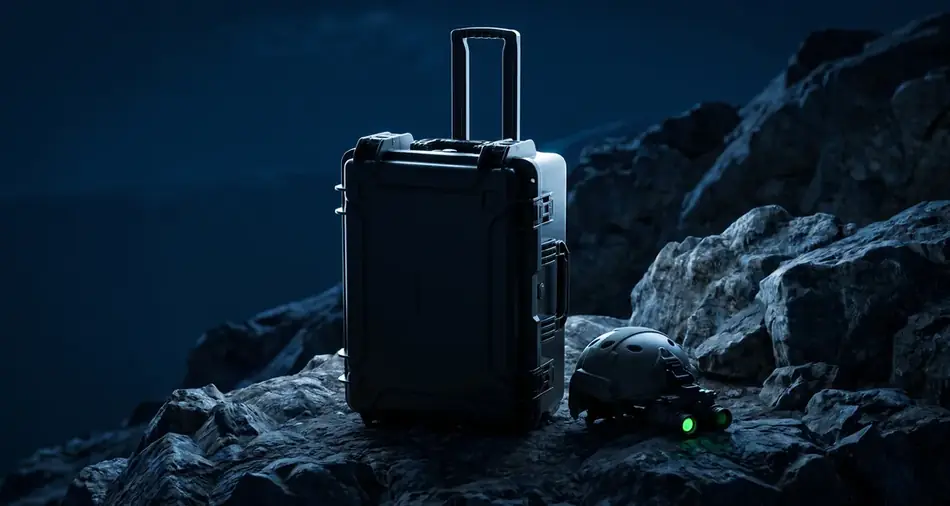
How should case handles be specified in a protective case RFQ?
Specify case handles by field, not by photograph. A handle line that can be quoted and inspected states six things: the handle type on each face, whether the type is inside the external dimension or added to it, the extended travel height if a telescopic unit is wanted, where the grip sits relative to the latch line and the lid depth, how many hands the case is meant to be lifted by, and the order quantity with the delivery term. The reason those six lines matter is that a handle is not a free-standing option in our catalogue: our published file records exactly two handle values, and the telescopic one is welded to a wheel decision that also turns stacking off on every model that carries it.
Key points
- Our file records two handle values across 155 listings: fixed folding on 136 and telescopic plus fixed folding on 19, with a fixed folding handle present on all 155.
- The 19 telescopic listings are exactly the 19 wheels listings, exactly the T Series and exactly the 19 that state stackable as false.
- Telescopic handle extended height is published on 11 of the 19 rolling listings, from 240 mm to 485 mm; the other eight are confirmed against the ordered configuration.
- Handle count, grip geometry, handle material and any case handle load rating are published on none of our 155 listings, so they belong on your drawing.
- Empty mass is the number a grip serves: 93 of 155 listings publish it, from 100 g to 15,320 g with a median of 1,480 g, and your contents sit on top.
- A bolt-on handle change on existing inserts is configuration work at 45 days from a MOQ of 300; a new moulded handle is 125 days from 3,000 pieces per component.
What a handle line on an RFQ actually has to communicate
Case handles in a protective case RFQ are usually written as a single adjective, and that is the line which later fails at inspection. A quotable handle statement names the type on each face of the shell, says whether the handle sits inside the external envelope or is added outside it, gives the extended travel if a telescopic unit is required, places the grip against the latch line and the lid depth, states how many hands are expected to lift the loaded case, and carries the quantity with the delivery term. Six lines, and every one of them can be checked against a drawing or a sample rather than against a photograph in a catalogue.
The commercial reason to be that specific is that a handle decision is a tooling decision in disguise. Custom hardware is recorded as available on all 155 of our listings, so colour, logo on the grip cover, an added padlock hasp or a bolt-on grip fitted to existing moulded inserts is configuration work on a tool we already own. Moving a grip to a face that was moulded without an insert, or adding a telescopic stanchion where no wheel channel exists, is a new mould. The first path samples in 45 days; the second is a 125-day programme, and only your handle sentence tells us which one you are asking for.
The two handle values our published file records
Our file states a handle type per listing and nothing more. Across 155 models the field takes exactly two values: fixed folding on 136 listings and telescopic plus fixed folding on 19. There is no listing that carries a telescopic grip without also carrying the fixed folding one, which is why a rolling shell in our range can still be lifted by two people at the sides instead of only pulled at the handle. The same 19 listings are exactly the 19 that publish two wheels, exactly the T Series, and exactly the 19 that publish stackable as false, while all 136 wheel-free listings publish stackable as true. Handle material, grip length, mounting pattern and handle count are recorded on none of the 155.
Read the middle column as the honest limit of what a catalogue can tell you. Where our file is blank, the correct RFQ behaviour is to put the requirement on the drawing and require every supplier to confirm it in writing against that drawing, rather than to accept an image of a similar shell as evidence.
| Field | Published In Our File | What The Rfq Line Should Say |
|---|---|---|
| Handle type | Yes, as one of two values: fixed folding on 136 listings, telescopic plus fixed folding on 19 | Type per face, and whether the same shell keeps a side grip in addition to the rolling handle. |
| Handle count | No listing states a number of grips | Required grip count and the faces they sit on, taken from your lifting procedure. |
| Handle position on a case drawing | Not published; positions are drawing-stage decisions | Coordinates or a dimensioned sketch, including clearance from latches and hinge line. |
| Telescopic handle extended height | Published on 11 of 19 rolling listings, 240 mm to 485 mm | Target operator height band, and confirmation the figure is measured on this shell. |
| Grip geometry and material | Not published on any listing | Grip cross-section and overmould requirement if gloves or cold climates are involved. |
| Case handle load rating | Not published; stack load and load capacity are recorded as not measured | The loaded mass the grip must serve, and how the rating should be evidenced. |
| Shoulder strap | Recorded as a manufacturer option with no published value on any listing | Whether attachment points are required, and where. |
How many handles does a protective case have
The most common question in this area, how many handles does a protective case have, has no published answer for any of our 155 models, and we would rather say that plainly than invent a number. The file records a handle type, not a grip count, and grip count and grip position are drawing-stage decisions on a custom order. What the file does state is that a fixed folding handle is present on all 155 listings and that a telescopic unit is added on the 19 T Series shells, so the minimum written guarantee is one folding grip on every shell and two carrying methods on a rolling one.
The practical consequence is that if your procedure assumes a second grip opposite the first, for a two-person lift of a loaded shell, that assumption has to be written into the order. Counting handles on a product photograph is how a mismatch appears between the sample you approved and the pallet you receive, and it is also how a supplier who is quoting honestly ends up being compared unfavourably against one who simply shows a nicer image.
Telescopic handle extended height: eleven published figures, eight deliberately blank
Telescopic handle extended height is the field most catalogues do not carry, and our own file carries it on 11 of the 19 rolling listings. The published values are 240 mm on two models, 295 mm on five, 310 mm on two, and single listings at 385 mm and 485 mm, giving a median of 295 mm. The remaining eight rolling listings, WL8-5021 Trolley, WL8-5022, WL-5126 Trolley, WL8-5424 Trolley, WL8-5427 Trolley, WL9-6027 Trolley, WL9-6127 Trolley and WL6-6232 Trolley, publish no height. Those blanks are not an oversight and they are not zero: the height for those SKUs is confirmed against the configuration ordered, and rounding a figure up to make a page look complete is exactly how a sample and a batch stop agreeing.
The list below is reproduced from the published file, model by model, so it can be quoted line for line in an RFQ.
| Model | Telescopic Handle Extended Height Mm | Net Mass G | Longest External Mm |
|---|---|---|---|
| WL9-7227 Trolley | 485 | 10000 | 720 |
| WL8-5726 Trolley | 385 | 5600 | 576 |
| WL8-6830 Trolley | 310 | 10160 | 677 |
| WL8-6836 Trolley | 310 | 10600 | 677 |
| WL8-5827 Trolley | 295 | 7800 | 588 |
| WL8-5835 Trolley | 295 | 8520 | 588 |
| WL8-6136 Trolley | 295 | 8500 | 612 |
| WL8-8434 Trolley | 295 | 14030 | 843 |
| WL8-8442 Trolley | 295 | 15320 | 843 |
| WL8-7336 | 240 | 10660 | 733 |
| 8-8337 | 240 | 10866 | 830 |
Case handle load rating: what we do not state and what to ask any supplier for
No listing in our file publishes a handle load rating, and stack load and load capacity are recorded there as not measured, so a case handle load rating is not something we will assert for a configuration we have not run. The number that a grip genuinely has to serve is available from other fields, however: the empty mass published on 93 of our 155 listings, which spans 100 g to 15,320 g with a median of 1,480 g, plus the mass of the contents and the foam. Ten listings in the whole catalogue are already above 8,000 g empty, and every one of those is a rolling model, so the shells that get pulled on wheels are also the shells whose grips carry the most.
Where a tender needs a rating, the honest sequence is the same one we use for wheels: state the loaded mass the handle must serve, ask for the value together with the method used to derive it and the specimen it was derived on, and if a documented result is required, commission accredited third-party testing of the ordered configuration as a separate priced work package with the method, the specimen condition and the laboratory agreed before the work starts. A rating lifted from a component datasheet describes the handle part, not the handle mounted on your shell with your contents in it, and that difference is the whole of the engineering question.
Handle position on a case drawing, lid depth and the latch line
Handle position on a case drawing is where a specification stops being a preference and becomes a manufacturable instruction. Two published fields decide whether a grip has room to sit. The first is the shell envelope: the longest external axis in our file runs from 120 mm to 1,356 mm with a median of 432 mm, and a folding grip needs flat rim wall to sit in without standing proud of the dimension you quoted. The second is the lid depth, published on 100 of 155 listings from 16 mm to 320 mm with a median of 97.5 mm; on the rolling range it is published on 14 listings and runs from 42 mm to 320 mm with a median of 225 mm.
Lid depth is the field buyers forget when they specify handles, because a deep lid is carried on its own grip and it is the heaviest single sub-assembly a person lifts. WL8-8442 Trolley publishes a 320 mm lid on a shell that is 15,320 g empty, and 8-8337 publishes 280 mm on 10,866 g. Specify the carry for the lid separately from the carry for the closed case, and place the grip clear of the latch line so a folded handle does not foul a closed latch or block a padlock hasp. Our file records the latch count as specified per configuration and states the lock feature on all 155 listings as a standard padlock hasp accepted by the latch body, so a handle that covers the hasp is a drawing error, not a moulding limit.
Keeping a fixed folding handle on a rolling shell
A fixed folding handle is recorded on every one of our 155 listings, including the 19 that also carry a telescopic unit, and that overlap is a deliberate carrying strategy rather than a catalogue artefact. A two-wheel shell is tipped and pulled, which means the base leaves the floor and the case is supported by two corners and a handle leg; on a stair run, a floor seam or a soft shoulder, the case has to be lifted, and a lift is a two-handed operation on anything heavy. The heaviest rolling listings in our file are WL8-8442 Trolley at 15,320 g and WL8-8434 Trolley at 14,030 g empty, and no side grip would be usable there if the telescopic unit had replaced it.
The price of that rolling capability is recorded in the same file: stackable is false on all 19 telescopic and wheeled listings and true on all 136 fixed-folding-only listings, and pallet figures for our models are calculated from the carton footprint against your pallet size rather than stated per listing. So a handle specification that asks for the telescopic grip is also a storage specification, and the two should be approved by the same person on your side before the RFQ goes out.
Handle specification lines to put on the RFQ, in the order we can quote them
Write the handle block as eight lines. One: model reference or external envelope in millimetres. Two: handle type per face, and whether a folding grip must remain on a rolling shell. Three: extended telescopic height, or the operator height band you want it fitted to. Four: grip count and handle position on the drawing, dimensioned clear of latch line and hinge line. Five: loaded mass the grip must serve, stated as empty shell plus contents. Six: colour, logo on the grip cover and any padlock hasp or shoulder strap attachment requirement. Seven: quantity for the first order and annually, with the delivery term. Eight: what has to be evidenced at receiving, and whether an independent inspection is part of the plan. Send those eight lines and a supplier can answer each one with a yes, a no or a price, which is the only form of quotation that survives a comparison.
Two of those lines decide the calendar. Anything that fits existing moulded inserts, including grip colour and added hasps, is configuration work on an existing tool, sampled in 45 days from a minimum order of 300 pieces. Moving a grip to a face with no insert, or adding a telescopic stanchion and its wheel channel, is a new mould at 125 days with a minimum from 3,000 pieces per component. We work on wholesale and OEM terms only, EXW or FOB, with a 30 percent deposit and the balance cleared after inspection; we do not retail, do not quote DDP and hold no overseas warehouse, and third-party factory audits are welcome.
What we do not publish about handles, stated as a list
So that this page can be used as evidence rather than as reassurance, the negative list is explicit. We publish no handle count, no grip geometry, no handle material, no mounting pattern and no handle load rating for any of the 155 models in our file. We publish no shoulder strap value, no gross weight and no pallet quantity, and we record stack load and load capacity as not measured. Our impact notes give a wall thickness figure and state that no drop height is claimed without a test, which is as far as our own documentation goes.
What we do publish is quotable today: handle type per listing, the coupling between telescopic grip and wheels, stackability, external and internal dimensions, wall thickness on 148 of 155 listings, net mass on 93, lid and base depth on 100 each, and the telescopic heights in the table above. A handle specification built on those fields can be inspected at receiving. One built on adjectives cannot, which is the entire reason to write it properly in the RFQ.
Customisation
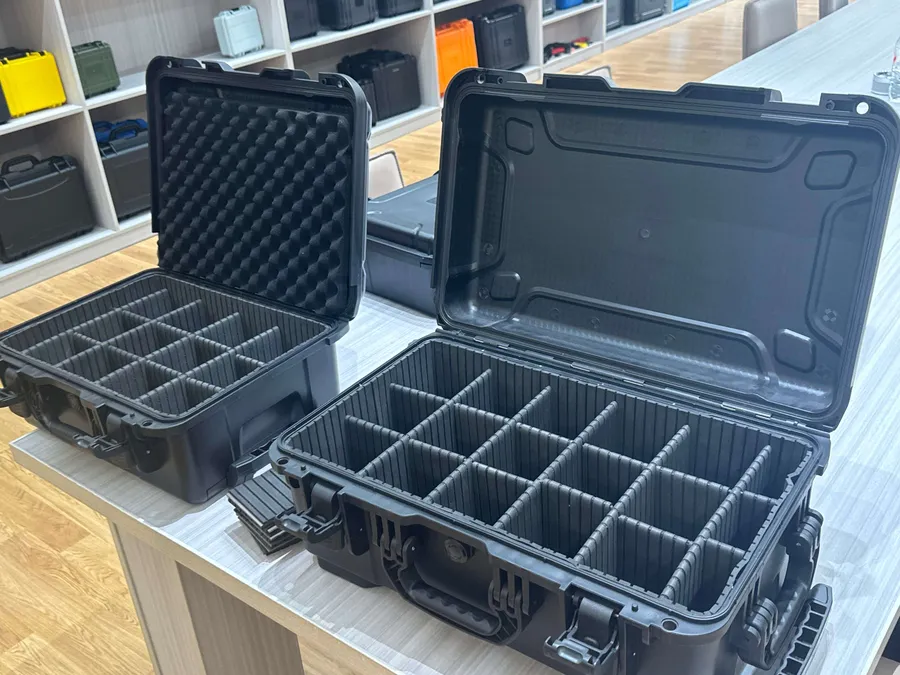
Everything described above is configurable on a standard shell: interior layout (pick-and-pluck, die-cut or CNC-cut), foam grade and thickness, colour, logo method, latch and lock count, pressure-equalisation valve, cable ports, document holder and identification plate. A bespoke exterior geometry requires a new mould — 125 days, from 3,000 units per moulded component.
Procurement considerations
| Question | What to send us |
|---|---|
| Which shell fits? | Equipment L × W × H as packed, plus required clearance per axis |
| What does it cost? | Order quantity and estimated annual quantity — the two drive different answers |
| Is tooling needed? | Whether an existing shell clears the envelope with usable foam depth |
| Lead time? | Your required delivery date, not just the order date |
| Certification? | The exact standard your tender names — we will say whether we can test to it |
| Freight? | Destination and preferred terms; carton and pallet data supplied with the quotation |
Comparison and selection guide
The tables on this page exist because a protective case is chosen by comparing three things: the envelope, the environment and the handling chain. Where no table applies, the rule below is.
| Situation | What To Do |
|---|---|
| Airport and road transfer | Check the external dimensions against cabin and boot constraints, not just the internal volume. |
| Rough ground | Larger wheels and a wider track matter more than shell volume. |
| Stored upright | Confirm the case can stand on its base with the handle retracted in your racking. |
- Size on internal dimensions plus clearance, never on a product name.
- Choose the carrying method before the shell: it changes the series, not just the price.
- Specify the interior last, and decide up front whether the end user will reconfigure it.
How should case handles be specified in a protective case RFQ? relates to Logistics & Packing Guide. Related families: Rolling Cases / Custom Protective Cases / Equipment Transport Cases / Military Protective Cases. Related sectors: field and industrial equipment. Continue in the Logistics & Packing Guide cluster.
This page is written from our own production data. If your requirement differs, send the dimensions and we will tell you which of the 155 models fits, or whether a custom route is needed.