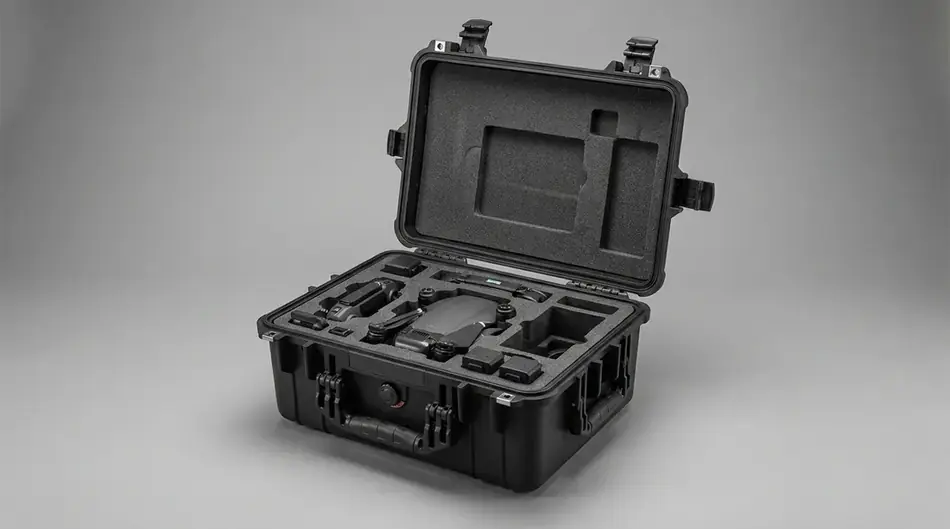
Drone Equipment Transport Packaging?
Drone Equipment Transport Packaging is a three-level problem, and the level most buyers skip is the one that decides the freight bill. Level one is the unit shell that holds the folded airframe, level two is the separate shell or tray for batteries, controller and payload, and level three is the export carton and pallet plan that carries both. Size level one on the folded airframe with the gimbal still mounted, because a gimbal hanging below a fuselage is what turns out a shallow shell. Our library catalogues 59 of its 155 moulded shells under the drone case category, with internal lengths up to 650 mm and only three of those 59 above 600 mm, so a large industrial airframe folded at 700 mm across is a long-format shell problem rather than a drone-shell problem. On the packaging data we can quote from: export carton dimensions are published on 64 models and pieces per carton on 58, so KX 6-4120 ships 6 per 750 x 425 x 640 mm carton while KX 9-6127 ships one per 640 x 625 x 280 mm carton. What we do not publish is any performance result: no ingress code, no free-fall height, no temperature range, no stack load and no thermal or battery containment figure for any model, and no pallet or container loading either - those are calculated for the order from the recorded carton.
Key points
- Size the airframe shell on the folded drone with the gimbal mounted, then check that the internal depth beats the fuselage height plus a foam wall on both faces, not just on one.
- 59 of our 155 shells are catalogued under the drone case category; 24 of those have an internal length of 500 mm or more and only three reach 600 mm or above.
- A deep-base moulding puts the airframe below the closure line: KX 5321 and KX 6621 both publish 43 mm of lid over 149 mm of base, and KX 9-7227 publishes 42 mm over 168 mm.
- Batteries travel in their own pocket or their own shell. We publish no thermal, fire or battery containment figure for any model, and no air-cargo approval either.
- Carton data is the commercial part of the specification: 64 models publish carton dimensions and 58 publish pieces per carton, with counts running from 1 to 40.
- No pallet-loading quantity is published for any model, so a fleet pallet is built for the order from the recorded carton footprint against your pallet size.
Drone Equipment Transport Packaging: What A Fleet Order Actually Packs
Drone Equipment Transport Packaging covers more than the case the aircraft arrives in. A working survey or inspection kit is usually six loads: the folded airframe with its gimbal, a set of flight batteries, the radio controller or ground station, an RTK base or a rover, a laptop or tablet for planning, and a bag of spares - propellers, pins, filters, antennas, chargers and cables. Some crews also carry a payload that is swapped in the field: a mapping camera, a LiDAR head, a thermal module or a speaker. Packing all six into one shell is possible and is usually a mistake, because the heaviest and hardest item in the mix then travels against the most fragile one.
A fleet order compounds this. A dealer taking twenty kits does not want twenty identical boxes, they want a shell that can be issued and recovered, a carton that stacks predictably, and a pallet plan that a forwarder can price. That is why this page treats the subject as three levels rather than as one product: the unit shell, the sub-kits that travel beside it, and the export packing that carries both. Each level has its own published data and its own cost line, and a quotation that lumps them together cannot be compared with another supplier's.
Our product library holds 155 moulded shells with published internal dimensions, and 59 of them are catalogued under the drone case category. Across those 59, 24 have an internal length of 500 mm or more, only three reach 600 mm or above - KX 8-7319 and KX 8-7323 at 650 mm and one further shell at 600 mm - and none reaches 700 mm. The wider library does hold long-format shells with internal lengths to 740 mm and one to 1280 mm, but those are catalogued under equipment transport and long equipment rather than under drones, and the very long ones have a narrow section that suits a mast, a boom or a tripod rather than a folded airframe.
Published Internal Envelopes For Drone Kits
The table lists drone-catalogued shells that a kit is commonly built around, using the figures exactly as they appear in our product database. Empty mass is published on 93 of the 155 shells overall, so several rows say not published rather than guessing; lid and base depth are recorded on 100 shells, and on every one of those 100 the two halves add up to the internal depth, which is what makes the closure line readable from a datasheet. A narrow internal width is recorded on 36 shells across the library, and only one row below carries one: KX 4716 lists 345 mm of nominal internal width against a narrow width of 308 mm, which is the passage a load actually has to fit through.
| Model | Internal Mm | Lid Plus Base Mm | Wall Mm | Empty Mass G | Material | Gasket Recorded |
|---|---|---|---|---|---|---|
| KX 4716 | 458 x 345 x 150 | 75 + 75 | 2.5 | 1680 | Engineering PP | none recorded |
| KX 6-4120 | 378 x 307 x 187 | not published | 4.0 | 2640 | ABS | compressible gasket |
| KX 6-4621 | 430 x 288 x 186 | not published | 4.7 | 3000 | ABS | compressible gasket |
| KX 6-4819 | 454 x 325 x 173 | not published | 3.5 | 2800 | ABS | compressible gasket |
| KX 6-5522 | 507 x 385 x 190 | not published | 5.3 | 4860 | ABS | compressible gasket |
| KX 8-4818 | 437 x 308 x 164 | not published | 4.5 | not published | Engineering PP | compressible gasket |
| KX 4821 | 447 x 312 x 194 | 144 + 50 | 4.5 | 3670 | Engineering PP | compressible gasket |
| KX 5321 | 481 x 373 x 192 | 43 + 149 | 5.8 | 4810 | Engineering PP | compressible gasket |
| KX 8-5823 | 500 x 400 x 210 | 165 + 45 | 4.75 | not published | PP | compressible gasket |
| KX 8-6224 | 538 x 408 x 220 | 175 + 45 | 5.0 | not published | PP | compressible gasket |
| KX 9-6127 | 545 x 545 x 210 | 165 + 45 | 4.8 | 8540 | PP | compressible gasket |
| KX 8-6830 | 595 x 460 x 255 | 210 + 45 | 4.8 | 10160 | PP | compressible gasket |
| KX 9-7227 | 590 x 435 x 210 | 42 + 168 | 6.0 | 10000 | Engineering PP | compressible gasket |
| KX 8-7323 | 650 x 430 x 210 | 160 + 50 | 5.0 | not published | PP | compressible gasket |
Three Packaging Levels, Quoted As Three Lines
Level one is the airframe shell. It is chosen from the folded length, folded span and the height including a mounted gimbal, plus a foam allowance of roughly 20 mm per axis. A compact folding quad that packs to about 220 x 90 x 90 mm with props folded sits comfortably in KX 4716 at 458 x 345 x 150 mm, which leaves room to lay the controller flat beside it - though KX 4716 also publishes a narrow internal width of 308 mm against its nominal 345 mm, so a load wider than 308 mm will not pass the narrow point however well it fits the drawing. A larger enterprise airframe at around 430 x 380 x 170 mm folded needs KX 6-5522 at 507 x 385 x 190 mm or KX 8-5823 at 500 x 400 x 210 mm, and the choice between those two is decided by the width margin, not by the marketing name of the shell.
Level two is the sub-kit. Batteries, charger, controller, spare props and payload modules travel in their own shell or their own tray. This is where a fleet is usually mispacked: batteries loose in a lid tray against a metal prop collar is a preventable problem, and it is solved by a separate pocket with a lip rather than by a thicker wall. A shallow shell such as KX 4710 at 458 x 345 x 90 mm takes flight batteries on edge in routed channels, which is why we usually quote an airframe shell and a companion battery shell as two line items on one order rather than as one deep case.
Level three is the export packing. The unit shells are packed into master cartons and the cartons onto pallets, and this is where the money is in a fleet order. Our library publishes carton dimensions on 64 of the 155 shells and pieces per carton on 58, with counts from 1 to 40. For the drone-relevant shells the recorded figures are wide apart: KX 4821 and KX 5021 each ship 6 per 765 x 485 x 650 mm carton, KX 6-4120 ships 6 per 750 x 425 x 640 mm, KX 6-4621 ships 6 per 740 x 485 x 685 mm, KX 5321 ships 3 per 530 x 440 x 635 mm, KX 6-5522 ships 3 per 565 x 450 x 665 mm, KX 6621 ships 3 per 665 x 500 x 650 mm, KX 9-5419 ships one per 550 x 485 x 755 mm, KX 9-6127 one per 640 x 625 x 280 mm and KX 9-7227 one per 715 x 515 x 280 mm.
Airframe, Gimbal And Why The Depth Split Matters
A folded airframe is not a brick. The fuselage is the flat part, and the gimbal and camera hang below or protrude in front, and the obstacle in transit is always that protrusion rather than the body. Two consequences follow. First, the internal depth you need is the fuselage height with the gimbal mounted, plus a wall of foam under the gimbal and a wall above the top face - not the fuselage thickness alone. Second, the closure line matters: on a lid-heavy moulding the gimbal sits in a shallow well and the joint between lid and base passes across the loaded case, so any stack pressure on the lid is delivered toward the protruding part rather than into the base wall.
On the 100 shells where we publish both halves, lid depth plus base depth equals the internal depth exactly, so you can read this off the datasheet before you order. Most shells are lid-heavy: KX 4821 lists 144 mm of lid over 50 mm of base, KX 8-5823 lists 165 over 45, KX 8-6224 lists 175 over 45 and KX 8-6830 lists 210 over 45. A minority are base-heavy, and for a drone those are usually the better fit: KX 5321 lists 43 mm of lid over 149 mm of base, KX 6621 the same 43 over 149, and KX 9-7227 lists 42 mm of lid over 168 mm of base. In a base-heavy shell the airframe and its gimbal sit inside the moulding that goes on the floor, the closure line passes above it, and a second case or a carton stacked on top presses on the empty lid rather than on the camera.
The alternative to reading the split is to accept it and design around it: put the airframe in the base, route a gimbal well with support under the fuselage rather than under the gimbal arm, and use a lift-out tray in the lid for batteries and props so the lid carries nothing dense. We build both versions; the base-heavy shell is simply more forgiving when a crew packs a case at a landing zone in the dark.
Batteries, Chargers And The Limits Of What A Case Can Be Blamed For
Flight batteries are the item a buyer most often asks a case to solve, and a case cannot solve them. Our published protection records for the batteries-adjacent question are construction fields only: a compressible gasket is recorded on 124 of the 155 shells and 31 record none, wall thickness is published on 148 models from 2.0 mm to 6.0 mm, and no model publishes a fire, thermal or battery containment figure of any kind. We publish no air-cargo approval for any shell either. What a case can legitimately do for a battery is keep the terminals away from metal, keep cells separated so one failing cell does not load its neighbour, keep the pack from sliding, and give a crew a defined place to put a damaged pack apart from the rest of the kit.
The layout we therefore quote for batteries is: individual routed cells, terminals up, a foam wall between adjacent packs, no metal fastener in the battery zone, and a pocket geometry that keeps a pack from inverting in transit. Chargers and adapter boards go in a separate pocket, not in the same cavity as loose cells. Propellers - especially carbon props with hard tips - go in their own channel or in a separate shell; a prop tip pressed against a battery wrap by a case that was dropped into a vehicle boot is the classic field failure, and it is a layout problem rather than a shell problem.
Any requirement that a battery must survive a specified environment, a specified temperature range or a specified transport regulation is a specification you should route to the battery and its packaging, not to the outer shell. We will state what our shell does and does not publish, and if your programme needs an accredited test on a specific shell, gasket and latch configuration, we will arrange it as a separate work package with its own lead time and its own cost line.
Ground Station, RTK Base And Payload Loads
The controller and the ground station are shallow, dense loads with sticks, a screen and antennas that stick out. A shell in the 400 to 460 mm internal length band with 90 to 115 mm of internal depth suits them: KX 6-4112 at 393 x 280 x 112 mm with a 3.8 mm wall and 1,820 g of empty mass is a common choice, and KX 8-4818 at 437 x 308 x 164 mm is the version for a controller with a large tablet mounted, because the extra depth lets the tablet travel on its own foam face instead of under the lid. An RTK base or a rover with its tripod pole is a different shape again - a body around 150 mm across plus a folded pole - which is where a long-format shell earns its place.
Interchangeable payloads want their own pocket per module, with the mount plate and the ribbon connector relieved rather than supported. A mapping camera, a LiDAR head and a thermal module are three items with three different optical faces, and they should never share a cavity. Where a crew carries one body and two payloads, our usual answer is one airframe shell plus one payload shell of the same footprint so they stack, rather than a single oversized case with a mixed interior; matched footprints are what make the pallet plan in the next section work at all.
Accessories that decide whether a kit closes rather than whether it protects deserve a line in the specification: a multi-bay charger with its leads, a spare set of antennas, a set of ND filters, a coiled adapter loom, a pair of safety glasses and a tool driver. Each is small, each is hard, and together they are the reason a lid will not seat. We ask for them in the brief and we give them a defined row rather than a spare corner.
Export Cartons And Pieces Per Carton
For any order above a handful of units the carton is the commercial document, not the case. Forwarders price volume and handling from the carton footprint and the number of units inside it, and a supplier who cannot state both is asking you to guess your landed cost. Our library records export carton dimensions on 64 models and pieces per carton on 58; where the library holds no record, the carton is quoted for the order rather than estimated from a neighbouring moulding, because two shells that differ by 20 mm of length can differ by a third of a carton.
Read the table below as an illustration of how fast the unit economics change with shell size. A fleet of compact-kit shells at 10 per carton and a fleet of large airframe shells at 1 per carton are two different freight calculations on the same nominal order, and the difference is not recoverable from a unit price. Where a shell is one-per-carton, ask whether the carton is being used as packaging or as a shipping unit: a 715 x 515 x 280 mm carton holding one case is a shipping unit and has to be handled as one.
| Model | Internal Mm | Pieces Per Carton | Carton Mm |
|---|---|---|---|
| KX 4312 | 420 x 260 x 104 | 10 | 615 x 440 x 560 |
| KX 6-4112 | 393 x 280 x 112 | 10 | 705 x 430 x 650 |
| KX 6-4120 | 378 x 307 x 187 | 6 | 750 x 425 x 640 |
| KX 4821 | 447 x 312 x 194 | 6 | 765 x 485 x 650 |
| KX 5021 | 465 x 315 x 196 | 6 | 765 x 485 x 650 |
| KX 6-4621 | 430 x 288 x 186 | 6 | 740 x 485 x 685 |
| KX 5321 | 481 x 373 x 192 | 3 | 530 x 440 x 635 |
| KX 6-5522 | 507 x 385 x 190 | 3 | 565 x 450 x 665 |
| KX 6621 | 587 x 434 x 192 | 3 | 665 x 500 x 650 |
| KX 9-6127 | 545 x 545 x 210 | 1 | 640 x 625 x 280 |
| KX 9-7227 | 590 x 435 x 210 | 1 | 715 x 515 x 280 |
Pallet And Container Planning For A Drone Fleet
We do not publish a pallet-loading quantity for any model, and we do not publish a container loading either; both are calculated for the order from the recorded carton footprint against your pallet size, and 20 GP, 40 GP and 40 HQ figures are supplied with the quotation. That is a deliberate position rather than a gap in the paperwork. A pallet plan that is copied from a generic table is wrong the moment a shell changes, and in a drone order the shells do change, because the airframe, the battery shell and the ground-station shell are three different mouldings travelling together.
Stackability is the field people misread most. Across the library 136 shells are recorded as stackable and the 19 that are not are exactly the 19 that publish two wheels and a telescopic handle - the wheels and handle occupy the face a fixed shell would rest on. Fourteen of the 59 drone-catalogued shells are in that wheeled group, including KX 8-6830 at 595 x 460 x 255 mm and 10,160 g empty, KX 9-7227 at 590 x 435 x 210 mm and 10,000 g, and KX 9-6127 at 545 x 545 x 210 mm and 8,540 g. A pallet that mixes stackable shells with wheeled shells has to be built around the wheeled ones, and a fleet plan that ignores that ends up with cases standing in the aisle.
The practical fleet pattern we quote most is a common footprint. Choose the airframe shell and the accessory shell so their carton footprints divide into the same pallet grid, keep one shell size per role across the order, and let the interior change between roles rather than the moulding. Fifty kits built on two mouldings and four foam layouts stack on one pallet plan; fifty kits built on five mouldings and five foam layouts need five plans, and nobody at the depot can tell them apart on the day.
What We Publish And What We Do Not
Across all 155 models we publish internal and external dimensions, wall thickness, lid and base depth where recorded, empty mass where recorded, shell material, hardware configuration, the gasket field, stackability and export carton data where recorded. We publish no ingress code, no water or dust test result, no free-fall height, no impact figure, no temperature range, no ultraviolet figure, no stack load, no load capacity, no electrostatic shielding figure, no thermal or battery containment result and no air-cargo approval for any shell. In our own records those fields are held as not measured, with a note that accredited testing can be quoted per configuration.
Three fields in particular should not be read as results. A wall thickness is a moulding dimension, not an impact claim. A compressible gasket in a continuous moulded channel is a construction fact recorded on 124 shells, not a rating, and 31 shells record no gasket at all. A stackable flag describes whether the geometry allows cases to stand on each other, not how much weight the lower one carries. Where a specification, an insurance schedule or a tender document names a standard or a level, send us the exact wording with the exact shell and hardware build and we will tell you whether testing can be arranged and what it will cost.
We also publish no customer names, no operator names, no order volumes and no delivery references, and we make no statement about where our shells stand against anyone else's in a market ranking. Where this page needs a number that the library does not hold, it says so. That is a policy rather than a habit: a fleet plan built on an assumed carton or an assumed pallet quantity fails at the loading door, and the failure costs more than the missing figure.
Customisation, MOQ And Lead Times
Interior work is the fast path and needs no new tooling. We cut foam to a layout - pick and pluck, die-cut and CNC-cut in PE, EVA or EPE, as top foam, base foam, egg-crate or convoluted faces, layered builds, lift-out trays or a custom cut by zone - and we configure latches, a padlock provision in the latch body, a pressure-equalisation valve, a document holder, a shoulder strap and a hardware set on a standard shell. Minimum order on a stock shell and on a custom foam cut is 1 unit, which is what makes a prototype layout cheap to iterate before a fleet order.
Custom colour, custom logo and OEM hardware start at 300 units, and OEM work on an existing mould is quoted at 45 days from first sample. A new moulded exterior starts at 3,000 units per moulded component and 125 days, and for drone kit that is the route only when the airframe genuinely does not fit the published envelopes - which happens with the largest enterprise platforms, since the drone-catalogued range tops out at 650 mm of internal length. Private-label programmes use the same 300-unit level for logo, colour and packaging.
To brief a drone order we need the folded dimensions and mass of the airframe with the gimbal mounted, the battery count and cell format, the controller and ground-station dimensions, the payload modules, the number of units in the first order and in a year, and whether the kit is hand-carried or wheeled. With those inputs we can name a shell per role, tell you whether the depth clears the gimbal, say where the closure line falls, confirm whether the carton is recorded for that model and quote on EXW or FOB terms.
Procurement Notes Before Ordering
KeXin New Materials (Guangdong) Co., Ltd. supplies wholesale, OEM and ODM buyers only, on EXW or FOB terms. There is no retail channel, no delivered-duty-paid quotation and no overseas warehouse stock, so a landed cost is built from the FOB figure plus your own freight and clearance. Payment is a 30 per cent deposit with the balance settled after inspection and before shipment, and third-party factory audits are welcome on appointment. Carton dimensions and pieces per carton accompany the quotation for the models where they are recorded; pallet build and container loading are calculated for the order.
Contact Fred Zhao or the KeXin Sales Team, WhatsApp +86 135 3588 0002. Send the folded airframe drawing or a photograph of the packed kit and we will return a named envelope per role, a depth and closure-line check, a proposed foam layout, the recorded carton figures and a price. The three answers that move a drone quotation most are the annual quantity, whether the fleet mixes shell sizes, and whether the units are wheeled - those three decide whether you are buying a carton plan or a pallet plan, and that is where a fleet order is won or lost.
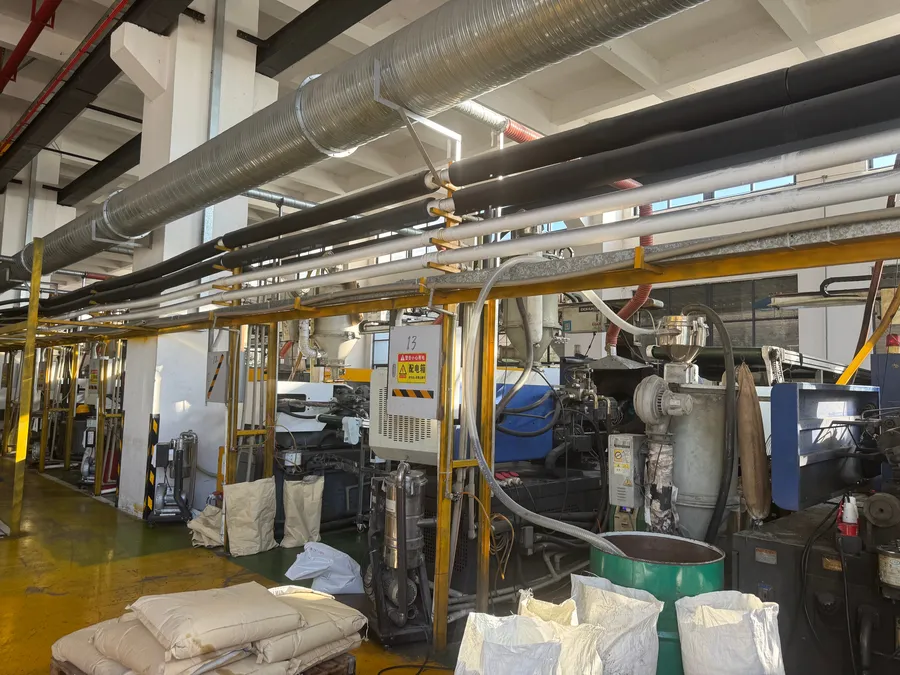
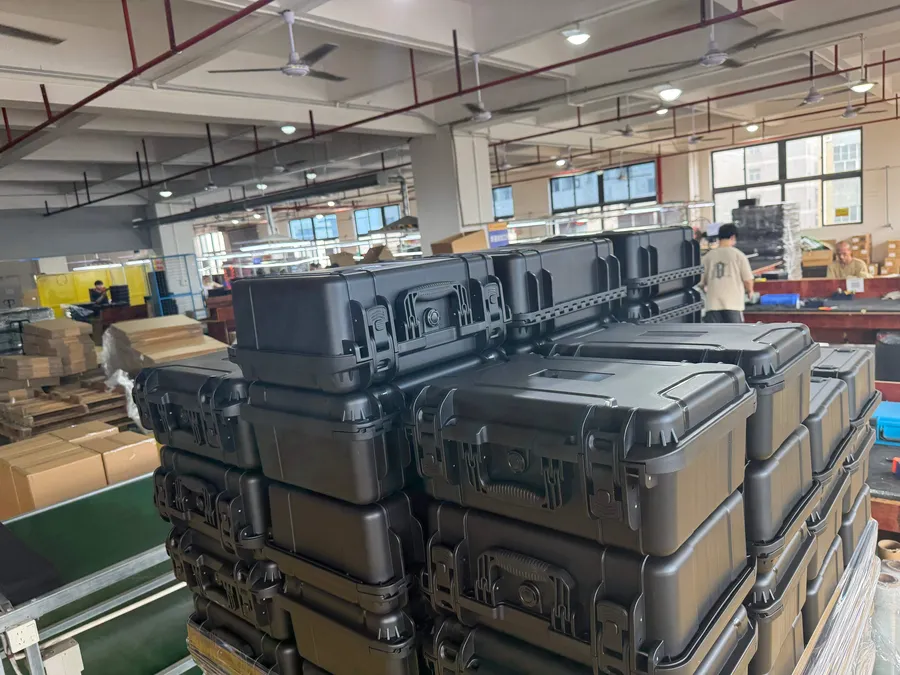
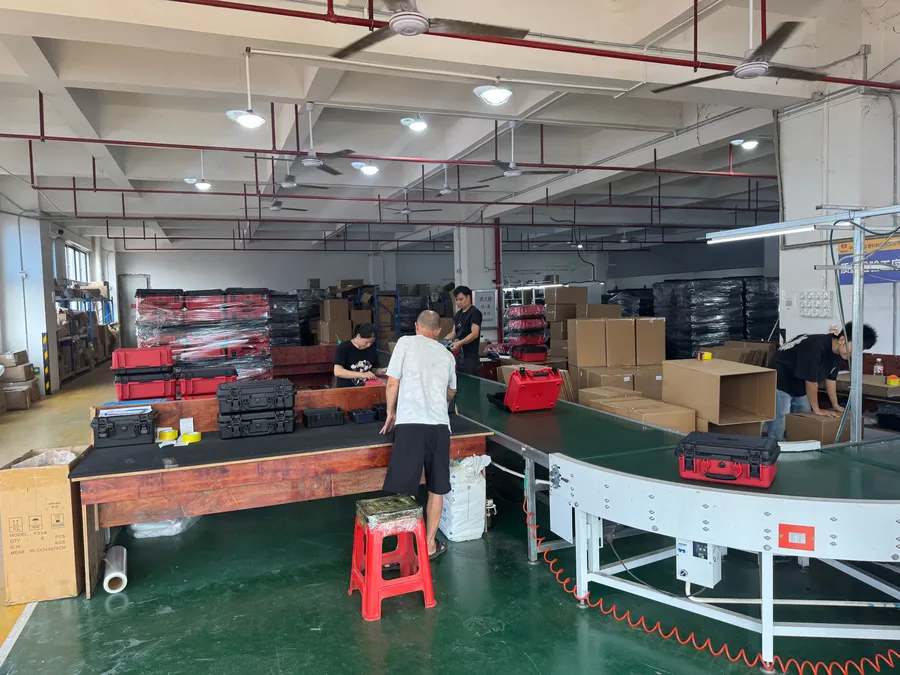

Customisation
Everything described above is configurable on a standard shell: interior layout (pick-and-pluck, die-cut or CNC-cut), foam grade and thickness, colour, logo method, latch and lock count, pressure-equalisation valve, cable ports, document holder and identification plate. A bespoke exterior geometry requires a new mould — 125 days, from 3,000 units per moulded component.
Procurement considerations
| Question | What to send us |
|---|---|
| Which shell fits? | Equipment L × W × H as packed, plus required clearance per axis |
| What does it cost? | Order quantity and estimated annual quantity — the two drive different answers |
| Is tooling needed? | Whether an existing shell clears the envelope with usable foam depth |
| Lead time? | Your required delivery date, not just the order date |
| Certification? | The exact standard your tender names — we will say whether we can test to it |
| Freight? | Destination and preferred terms; carton and pallet data supplied with the quotation |
Comparison and selection guide
The tables on this page exist because a protective case is chosen by comparing three things: the envelope, the environment and the handling chain. Where no table applies, the rule below is.
| Situation | What To Do |
|---|---|
| Folded or fixed | Measure the airframe in its folded transport configuration, then add 20 mm. |
| Battery count | Each battery needs its own pocket, not a shared compartment. |
| Ground station | Controllers, tablets and monitors are best in a separate lid layer. |
- Size on internal dimensions plus clearance, never on a product name.
- Choose the carrying method before the shell: it changes the series, not just the price.
- Specify the interior last, and decide up front whether the end user will reconfigure it.
Drone Equipment Transport Packaging? relates to Logistics & Packing Guide. Related families: Drone & UAV Cases / Equipment Transport Cases / Electronics Cases / Custom Protective Cases / Rolling Cases. Related sectors: field and industrial equipment. Continue in the Logistics & Packing Guide cluster.
This page is written from our own production data. If your requirement differs, send the dimensions and we will tell you which of the 155 models fits, or whether a custom route is needed.