What affects case stackability for a hard-shell equipment case?
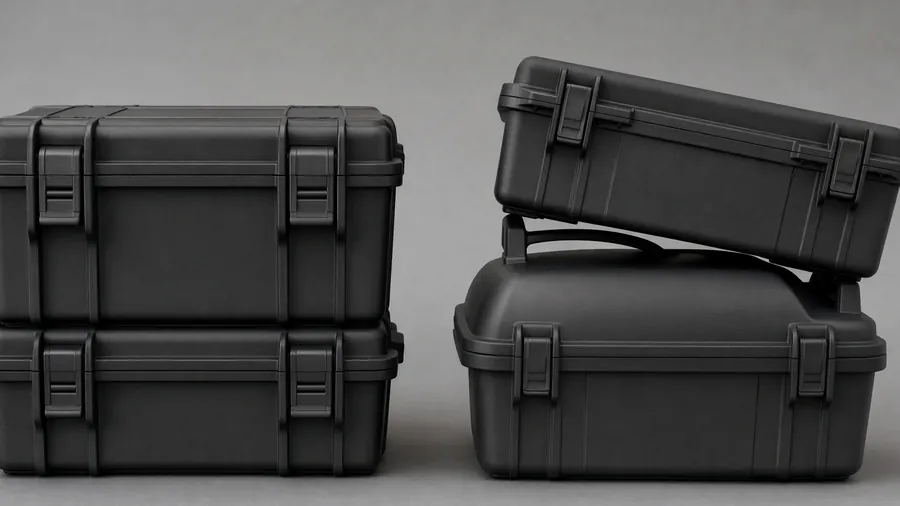
Stackability on a hard-shell equipment case is decided by a short list of published fields rather than by how solid the case looks, and the first is a flag: our 155-model file records stackable as true on 136 listings and false on 19, and those 19 are exactly the shells that carry two wheels and a telescopic handle, whose base is given over to wheel bosses instead of a flat stacking face. Everything else follows from geometry the file does publish - the external plan area that sets the column footprint, the lid-depth and base-depth split that decides whether mass sits below the closure line, and the wall thickness, stated on 148 listings from 2.0 mm to 6.0 mm, that resists creep under the weight above. What the file explicitly does not publish is any load figure: stack load and load capacity are captured as not measured on all 155 listings, so this page explains what affects whether a case stacks and how it behaves in a column, and quotes a rated stack height for the exact build as a separate piece of work rather than inventing one.
Key points
- The stacking answer is a published flag, not an impression: stackable is true on 136 of 155 listings and false on 19, so the first check on any datasheet is which way that one line reads.
- The 19 non-stackable cases are precisely the wheeled ones - two wheels plus a telescopic handle replace the flat stacking base with bosses and hardware.
- Footprint sets the column: computed from published external dimensions the plan area runs from 0.011 square metres on KX-1204 to 0.55 on KX-814641, and it is that contact area that divides into your pallet.
- Mass belongs below the line: lid depth is published on 100 listings, and an inverted split such as KX-6621 at a 43 mm lid over a 149 mm base stacks far more predictably than a 320 mm lid on KX-88442.
- Wall resists creep: 148 listings publish a wall from 2.0 mm to 6.0 mm, all 24 listings below 3.0 mm are also shells with no gasket, and seven listings state no wall figure at all.
- No stack load is published: stack load and load capacity are recorded as not measured on all 155 listings, so a kg limit or a safe height for a loaded column has to be commissioned.
- Same plan, different stack: KX-88421 and KX-88442 share an 843 x 592 mm footprint, and only the shorter flat-topped KX-88421 is published as stackable.
Stackability is a published flag before it is a physical property
The mistake that distorts every stacking conversation is treating stackability as a vague adjective - this box looks sturdy, so it must stack. In our data it is a discrete recorded field. Across 155 injection-moulded thermoplastic shells, stackable is stated as true on 136 listings and false on 19. That single line is the answer to the buyer's first question, and it is worth more than any photograph, because it is set by the moulding rather than by impression. Read it on the datasheet of the exact model before you reason about anything else.
What the flag does not do is quantify a limit. It tells you the shell is intended to bear a case above it on a designed stacking surface; it does not tell you how many, how heavy or for how long. Those are governed by the geometry and wall fields covered below, and by the load question the file deliberately leaves open. The honest sequence is: check the flag, then read the geometry that explains it, then commission any number the flag does not carry.
The wheeled exception: why 19 of 155 are published as non-stackable
The 19 listings published as non-stackable are not a random sample of the range. Every one of them is a shell carrying two wheels and a telescopic handle, and the reason is physical rather than commercial. A case stacks because a flat, reinforced face on the base transfers the load of the case above down through the walls and corner posts. A wheeled shell spends that same base area on wheel bosses, an axle housing and the telescopic handle channel, so the underside that would have located the column above it is no longer there. Stacking on that base means resting a case on hollows and hardware.
These are also the heaviest and deepest lids in the file. KX-88442 publishes 843 x 592 x 415 mm external, a 320 mm lid over a 44 mm base, a 5.0 mm wall and 15,320 g empty; KX-86830 gives 595 x 460 x 255 mm internal at 10,160 g with a 310 mm handle; KX-97227 gives 590 x 435 x 210 mm internal on a 6.0 mm wall with a 485 mm telescopic height. The trade is explicit and published both ways: you buy a rolling case to move one heavy box across a yard, and you give up the flat stacking face that the other 136 keep. Plan a fleet that mixes both types as two stacking classes, not one.
Footprint: the external plan that decides the column
Stacking is a footprint problem before it is a strength problem. The contact area a case presents to the one below it, and to the one above it, is set by its published external length and width, and that same rectangle is what divides into a pallet or a container floor. Computed from published external dimensions the plan area runs from about 0.011 square metres on the 120 x 90 mm KX-1204, through 0.17 on KX-84818 and 0.33 on KX-6621, to 0.55 on the long KX-814641 at 1,356 x 408 mm and 0.50 on KX-88442 at 843 x 592 mm. A footprint close to a quarter of a square metre is where column planning gets easy, because it tiles without much overhang; very large or very long footprints start to fight standard pallet geometry.
A long, thin case is a special caution. KX-814641 is published as stackable and its 553,248 mm plan is the largest contact area in the file, but with only 154 mm of external width it is a column that wants restraint rather than a free-standing stack - the length resists tipping one way and offers nothing the other. Where a footprint does not divide cleanly into your pallet, the fix is a configuration or a tool decision to be raised at quotation, not a stacking technique, and we publish no pallet-loading figure to plan from; carton footprint against your pallet is what the freight sheet is built on.
Lid and base split: keeping the mass below the closure line
How a shell's total height is divided between lid and base changes how it behaves in a column, and the file publishes that split on 100 of 155 listings. Sixty-five of those have a deeper lid than base and six are inverted. The inverted builds are the friendlier stackers because almost all the mass sits below the closure line, so the case above rests on a deep, wall-supported base rather than across a tall lid. KX-6621 at a 43 mm lid over a 149 mm base and KX-5321 at the same 43/149 split on a 5.8 mm wall are the clear examples; KX-97227 is a wheeled 42/168 build that keeps its heaviest 10,000 g low even though it is not a stacking case.
The opposite shape is the tall-lid shell. KX-84430 puts a 230 mm lid over a 45 mm base, and KX-88442 a 320 mm lid over 44 mm. Stack another case on those and the upper load presses across a deep, relatively unsupported lid panel; the lid bows, latch compression shifts and - if the shell carries a gasket - the first thing that stops working is the seal. Where a column is planned, read lid depth separately from total height, and where you can choose between a 43/149 build and a 230/45 build at a similar cavity, prefer the one that keeps the lid shallow and the mass low.
Wall thickness and material: what resists creep under a loaded column
A stack that is square in week one can still sag by month six if the shell creeps under constant load, and creep is mostly a wall-and-material story. Wall thickness is published on 148 listings from 2.0 mm to 6.0 mm with a median of 3.9 mm. At the stiff end sit KX-6621 and KX-97227 at 6.0 mm and KX-5321 at 5.8 mm in engineering polypropylene, and the 5.0 mm class that covers most larger military shells. At the thin end are 24 listings below 3.0 mm - small tactical boxes such as KX-2005 at 2.0 mm - which are fine for a light, short column and poor for a tall warehouse stack of dense payload. Seven listings state no wall figure at all, so for those the section has to be measured before a height is set.
Two limits keep this honest. First, wall thickness is a stiffness input, not a crush rating: the file publishes no compressive strength, so a 6.0 mm wall resists deformation better than a 2.0 mm wall but neither carries a quotable kilogram limit. Second, the thin-wall group and the no-gasket group overlap almost perfectly - all 24 listings under 3.0 mm also record no gasket - so the lightest, thinnest shells are exactly the ones you would least want bearing a heavy loaded stack. Where the column is tall and the payload dense, the wall and the resin are the first specification choices, not the last.
What affects case stackability and what the datasheet says about it
Read the table as a checklist of the published fields that move the stacking answer, using real listings across the size range. Every figure is a published specification for the named model, so the comparison is only valid against your own pallet, your own column height and the payload you actually put inside.
| Model | Stackable | Wheels / Telescopic | External Mm | Plan Area Sq M | Lid / Base Mm | Wall Mm |
|---|---|---|---|---|---|---|
| KX-1204 | Yes | No / No | 120 x 90 x 40 | 0.011 | 16 / 16 | 2.6 |
| KX-84818 | Yes | No / No | 463 x 370 x 181 | 0.17 | Not published | 4.5 |
| KX-5321 | Yes | No / No | 525 x 434 x 214 | 0.23 | 43 / 149 | 5.8 |
| KX-6621 | Yes | No / No | 662 x 495 x 210 | 0.33 | 43 / 149 | 6.0 |
| KX-814641 | Yes | No / No | 1,356 x 154 x 408 | 0.55 | 100 / 40 | 5.0 |
| KX-88421 | Yes | No / No | 843 x 592 x 212 | 0.50 | 145 / 44 | 5.0 |
| KX-88442 | No | Yes / Yes | 843 x 592 x 415 | 0.50 | 320 / 44 | 5.0 |
| KX-97227 | No | Yes / Yes | 720 x 500 x 270 | 0.36 | 42 / 168 | 6.0 |
The number the flag does not carry: stack load is not measured
Stackable being true is not the same as stackable to a stated weight, and this is where a careless specification quietly breaks. In our file stack load is recorded as not measured on all 155 listings, and load capacity is recorded as not measured on all 155 as well. There is no published kilogram figure, no recommended column height and no racking load anywhere in the 155-model data, because none has been tested. Anything that reads like a stack rating in a product name or a sales line is therefore borrowed from somewhere else and cannot be defended.
What we will do instead is state the fields we hold - the flag, the footprint, the lid-and-base split, the wall and the resin - and, where a contract or a racking system needs a load figure, quote accredited testing of the exact shell and configuration as a separate work package with the method and sample condition agreed first. The same caution applies to empty versus loaded: a stackable flag and a stiff wall describe the shell, but a dense payload stacked tall under months of static load is the loaded-column problem, and it is the weakest case in the batch, not the sample on your desk, that sets the safe height.
Where these stacking limits decide the layout
The stacking class of a case drives a different amount of planning depending on the buyer. Warehouse and distribution consignments move identical columns, so the flag and the footprint are the whole decision: pick the 136 stackable shells, keep a wheeled model out of any tier that will be loaded, and tile a footprint that divides into the pallet. Field and defence programmes rebuild the same stack at each site, so the lid-and-base split and the wall matter as much as the flag, because a tall-lid shell that was tolerable in a rack becomes a bowed lid after weeks of vehicle vibration.
Mixed fleets are where the mistake is most expensive. A purchase that orders the rolling KX-86830 or KX-88442 for mobility, plus stackable flat-top shells of the same footprint for storage, has to be run as two stacking rules, not one. Distributors and integrators shipping a demonstration case in a container need the external plan area for the freight arithmetic, since it is the rectangle that occupies the floor, not the internal cavity. In every case the underlying principle is the same published data: the flag, the wheels, the footprint, the lid split and the wall.
Customising for stacking: configuration against new tooling
Where the published stacking flag or geometry does not suit your column, the options sort cleanly into configuration and tooling. Changing resin colour, adding or removing hardware that does not touch the base face, selecting a sibling that is already published as stackable, or fitting a custom interior that keeps mass low is work on an existing mould: about 45 days to a first sample from a minimum of 300 pieces. But changing the stacking face itself - relocating or removing wheel bosses, adding a locating rim where the tool has none, or shifting a footprint by enough to alter the moulding - is a change to the shell: roughly 125 days and about 3,000 pieces per component.
The distinction is worth settling before an enquiry, because it is the difference between a spares-and-configuration order and a tooling project. If the goal is simply a footprint that divides cleanly into a standard pallet, ask first whether an existing model already publishes a plan area close to your target - across the 155 listings many do - and only then consider a new tool. Send your pallet size, target column height and payload mass, and the reply comes back with the published flag, footprint, lid split and wall for named models plus an explicit note of which fields are measured and which are recorded as not measured.
Procurement notes and what we do not claim about stacking
So a silence cannot be read as a specification, here is the explicit list. No stack load, load capacity, recommended stack height, crush figure or racking rating appears anywhere in our 155-model file; stack load and load capacity are recorded as not measured on all 155, and pallet-quantity and container-loading fields are likewise recorded as not measured, supplied for your specific build at quotation rather than assumed. Stackability is published as a true-or-false flag only. Ingress, temperature range and ultraviolet resistance are recorded as not measured across the range, and no IP code is stated for any model. Where your racking or freight contract names a number we do not hold, we say so and price accredited testing separately.
Commercially the frame does not move. KeXin New Materials (Guangdong) Co., Ltd. is the manufacturer of these shells and works wholesale and OEM or ODM only, quoted EXW or FOB, with no retail orders, no DDP terms and no overseas warehouse. Standard listings start at one piece as a sample against a wholesale account and custom foam at one piece; logo, colour and OEM hardware start near 300 pieces; a new mould near 3,000 pieces per component. Payment is a 30 percent deposit with the balance after your inspection, and third-party factory inspection is welcome. Enquiries to Fred Zhao or the KeXin Sales Team, WhatsApp +86 135 3588 0002. Written by KeXin New Materials (Guangdong) Co., Ltd.
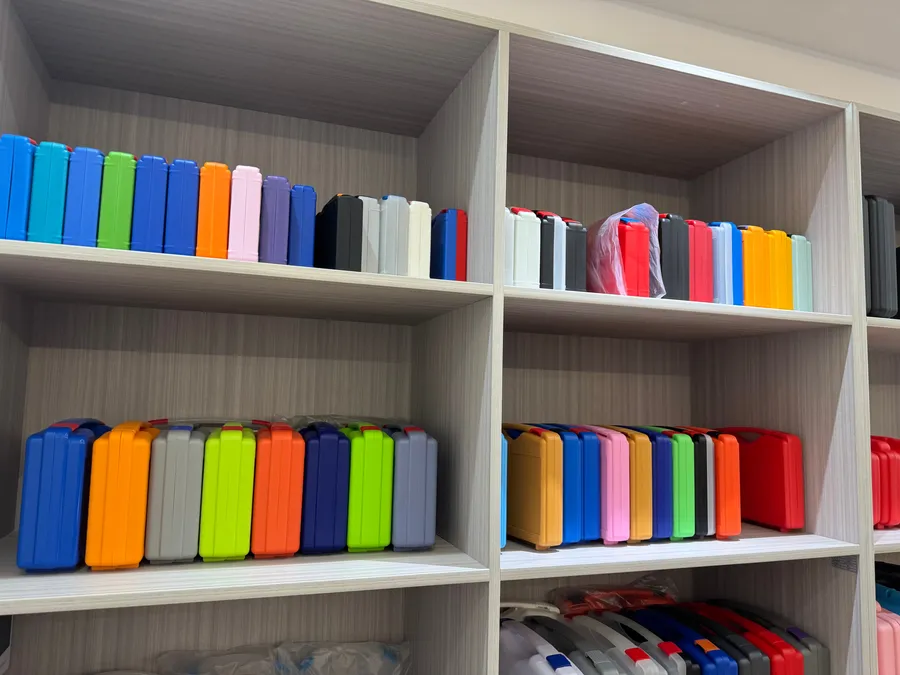
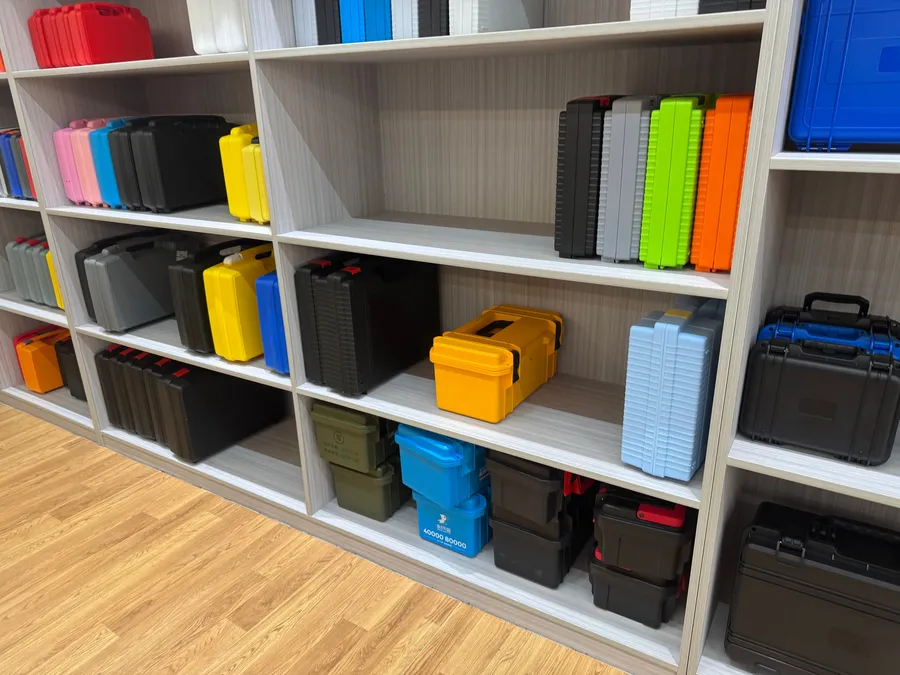
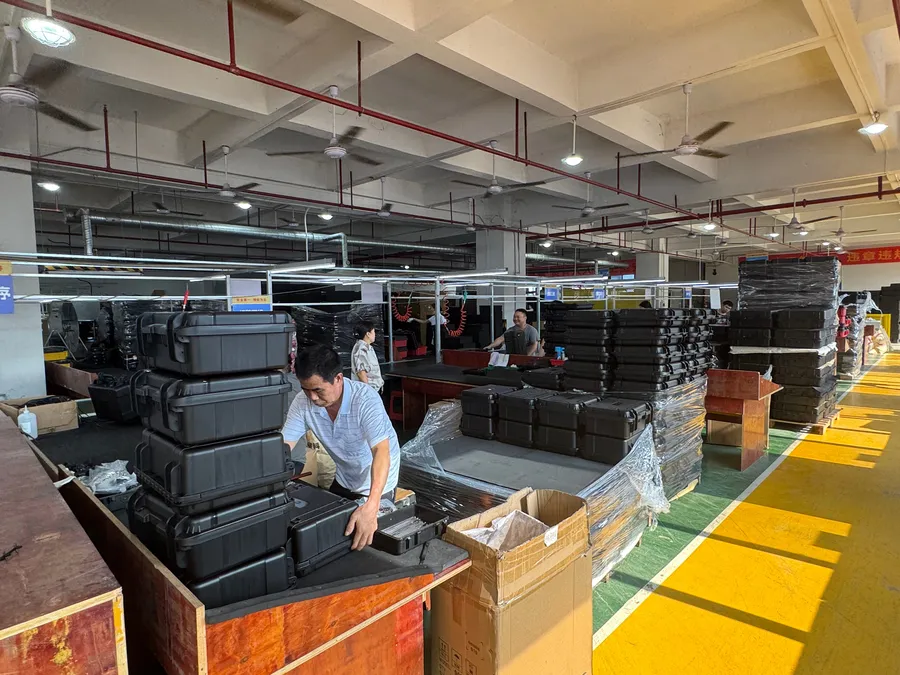
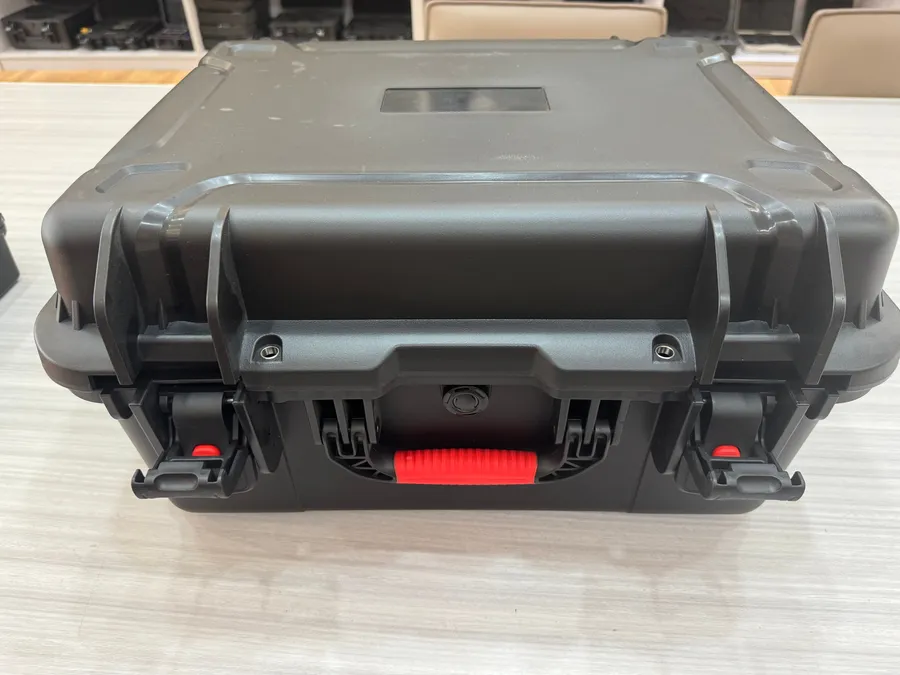
Customisation
Everything described above is configurable on a standard shell: interior layout (pick-and-pluck, die-cut or CNC-cut), foam grade and thickness, colour, logo method, latch and lock count, pressure-equalisation valve, cable ports, document holder and identification plate. A bespoke exterior geometry requires a new mould — 125 days, from 3,000 units per moulded component.
Procurement considerations
| Question | What to send us |
|---|---|
| Which shell fits? | Equipment L × W × H as packed, plus required clearance per axis |
| What does it cost? | Order quantity and estimated annual quantity — the two drive different answers |
| Is tooling needed? | Whether an existing shell clears the envelope with usable foam depth |
| Lead time? | Your required delivery date, not just the order date |
| Certification? | The exact standard your tender names — we will say whether we can test to it |
| Freight? | Destination and preferred terms; carton and pallet data supplied with the quotation |
Comparison and selection guide
The tables on this page exist because a protective case is chosen by comparing three things: the envelope, the environment and the handling chain. Where no table applies, the rule below is.
| Situation | What To Do |
|---|---|
| Sea freight | Sealed configuration plus desiccant; salt spray is a handling issue, not a material issue. |
| Air freight | Mass and external dimensions drive cost more than volume. |
| Repeated movement | Replaceable latches, hinges and gaskets; keep a spares kit with the first order. |
- Size on internal dimensions plus clearance, never on a product name.
- Choose the carrying method before the shell: it changes the series, not just the price.
- Specify the interior last, and decide up front whether the end user will reconfigure it.
What affects case stackability for a hard-shell equipment case? relates to Logistics & Packing Guide. Related families: Equipment Transport Cases / Custom Protective Cases / Military Protective Cases / Rolling Cases / Electronics Cases / Outdoor Protective Cases / Long Equipment Cases / Instrument & Equipment Cases. Related sectors: field and industrial equipment. Continue in the Logistics & Packing Guide cluster.
This page is written from our own production data. If your requirement differs, send the dimensions and we will tell you which of the 155 models fits, or whether a custom route is needed.


