How do buyers compare case load capacity across protective case suppliers?
Case load capacity is compared on published fields, because almost nobody publishes the number itself. On our own file of 155 active models, the two fields built to carry it - a stacking load in kilograms and a payload capacity in kilograms - are recorded as not measured on 155 of 155 listings, along with pallet quantity and container loading. So the comparison a buyer can actually run is a publication audit: does the supplier state wall thickness (ours: 148 of 155 listings, 2.0 mm to 6.0 mm, median 3.9 mm), empty shell mass (93 of 155, from 100 g to 15,320 g, median 1,480 g), a stackable yes or no (155 of 155, 136 true and 19 false), the carton footprint and pieces per carton (64 and 58 of 155, median 10 pieces), and the depth split between lid and base (100 of 155). Then attach one document: a test report that names the method, the applied load, the dwell time, whether the specimen was empty or loaded, how many units were put on the rig, and what counted as a pass. A supplier who answers the eight fields and produces that report is comparable. A supplier who answers with the phrase high load capacity is not, and neither are we until the configuration you order has been measured.
Key points
- Ask for the stack load rating per model by name: stacking load and payload are recorded as not measured on our 155 listings, so a rival figure needs a report attached.
- Wall thickness is the closest published proxy and still not a rating - 148 of our 155 listings carry it, from 2.0 mm to 6.0 mm, median 3.9 mm, and it says nothing about where the load lands.
- Empty mass tracks wall bands: the 24 models under 3.0 mm median 551 g, the 30 models at 5.0 mm and above median 7,800 g, so a mass figure is a second read of the same shell rather than a new claim.
- Stackability is the only load-adjacent yes/no we publish for every SKU: 136 of 155 true and 19 false, and the 19 are exactly the wheeled T-series shells.
- Pallet and carton fields behind a stack figure are the arithmetic you cannot check without them: carton footprint on 64 of 155 listings, pieces per carton on 58, from 1 to 40 with a median of 10.
- What a load test report should state: method, applied load, dwell time, specimen state, unit count, pass criteria and lab accreditation, filed against the configuration bought.
- If your tender names a grade we do not hold, we say so in the quotation and price accredited third-party testing for the ordered configuration as a separate work package.
What a case load capacity figure is actually describing
A load figure only carries information if four questions are answered with it: which load, on which geometry, in which state, and for how long. Static stack load means the weight of the column above sits on the case for hours in a warehouse or a container. Handling load means the same shell is lifted by its lid, dragged over a kerb, or dropped from a trolley, which is a short, sharp event on a different part of the moulding. Neither is a payload figure, which describes what you put inside. A supplier who prints one number and lets those three meanings blur is selling you the least useful version of their data.
This is why we treat the question 'what is your case load capacity' as unanswerable in a catalogue. The interesting variable is your stack height, your content mass and your road vibration profile, none of which a case maker can know at quotation stage. What a case maker can know, and what belongs on the sheet, is the geometry and the material facts of the shell, plus a test method carried out on a specimen of the build you are actually buying.
The eight fields we ask every supplier to fill in
Send the same eight lines to every quote on the desk and make the supplier fill them in rather than describe their products in their own words. Two of the eight will usually come back empty at every supplier, including ours, and knowing that in advance stops a comparison from being decided by whichever vendor was boldest about a blank line.
The table below is populated with our own file, so you can see what a realistic answer looks like and where the honest answer is 'not measured'. The third column is what to insist on when the field cannot be filled from a catalogue.
| Field On The Sheet | Our 155-Model File Publishes | Demand From Any Supplier |
|---|---|---|
| Stacking load, kilograms | Recorded as not measured on 155 of 155 listings | Method, applied load, dwell time, number of units, and the pass criterion - or no figure at all |
| Payload or content capacity, kilograms | Recorded as not measured on 155 of 155 listings | State whether the figure is the shell, the shell with foam, or the assembled kit as shipped |
| Wall thickness | 148 of 155 listings, from 2.0 mm to 6.0 mm, median 3.9 mm | Which wall - base, lid or side - and the tolerance band you will accept at inspection |
| Empty shell mass (net) | 93 of 155 listings, from 100 g to 15,320 g, median 1,480 g | The definition: bare shell, shell plus foam, or shell plus hardware and carton |
| Gross mass as shipped | 0 of 155 listings | The packing scope, because freight is billed on a different definition than a datasheet usually is |
| Stackable, yes or no | 155 of 155 listings: 136 true, 19 false | Whether stacking needs an interlocking rim, and how tall a column they will stand behind in writing |
| Carton footprint and pieces per carton | Carton dimensions on 64 of 155, pieces on 58, values from 1 to 40, median 10 | Both numbers together, otherwise your pallet plan is arithmetic nobody can check |
| Pallet quantity and container loading | Not measured on 155 of 155; our file states pallet count is calculated from carton footprint against your pallet, and 20GP, 40GP and 40HQ figures are supplied with the quotation | Whether the figure assumes wrap, interleaves, a locked column set, or a floor-loaded container |
Publication rates: our own file as the benchmark
The method we recommend is a count rather than a description. For each supplier, record how many of their listed models carry each field and put the percentage next to the field name. Ours, read from the same file: external and internal dimensions 155 of 155; wall thickness 148; empty mass 93; gross mass 0; stackable flag 155; moulded feet stated 155; gasket or no-gasket stated 155, of which 124 publish a compressible gasket in a continuous moulded channel; carton footprint 64; pieces per carton 58; narrowest internal width 36, ranging from 70 mm to 308 mm; lid and base depth 100; stacking load 0; payload capacity 0; pallet quantity 0; container loading 0.
Read as a set, those rates tell you something useful about the industry rather than about us. Geometry gets published by everybody, mass gets published by most, hardware presence gets published by most, and everything that describes behaviour under load gets published by nobody, because behaviour figures cost test money per configuration. A vendor whose rates match ours on the first group and beat ours on the last group is not more transparent; they are quoting a number they have not had to defend.
Wall thickness as a proxy for load capacity, and where it stops working
Wall thickness is the field buyers reach for first, and it does carry real information. Grouping our 148 listings that publish it: 24 models sit below 3.0 mm and their published empty mass medians 551 g; 50 models sit between 3.0 mm and 3.9 mm at a median of 1,270 g; 44 models sit between 4.0 mm and 4.9 mm at 3,000 g; and 30 models sit at 5.0 mm and above at 7,800 g. The thick-wall group is 91 models with a median of 4.5 mm spanning 3.5 mm to 6.0 mm. Series medians show the same ladder: 2.5 mm on the seven 1-series shells, 3.0 mm on the 23 compact 0-series shells, 4.2 mm across the 62 8-series shells, 5.0 mm across the 19 T-series shells, where one listing states 6.0 mm.
Where it stops working is the part that gets a purchasing file into trouble. Wall thickness is a material allowance; a stack is carried by geometry. Compare KX-88442, external 843 by 592 by 415 mm against internal 740 by 518 by 364 mm with a 5.0 mm wall: the envelope allowance is 103, 74 and 51 mm per axis, far more than twice the wall, because ribs, rim, taper and hardware bosses live in that space. KX-89616 does the same thing on a long shell, 956 by 408 by 154 mm outside against 880 by 350 by 140 mm inside. Two shells can share a 5.0 mm wall and have completely different stack behaviour, which is why we answer load questions with the drawing of that model rather than with a line average across 155 models.
Empty mass, and the hole in the middle of the catalogue
Empty mass is the honest second read, and it has a gap exactly where it matters. Of the 62 models in the 8 series - the range that spans a longest external axis from 275 mm to 1,356 mm with a median internal volume of 22.4 litres - wall thickness is published on 58 listings and empty mass on none of them, with no carton data either. The largest shells in our own catalogue are therefore the least weighted ones. Where mass is published, the top of the non-wheeled range reads KX-6621 at 6,420 g, KX-6922 at 6,140 g with an empty wall field, KX-65522 at 4,860 g, KX-5321 at 4,810 g and KX-5723 at 4,680 g. The wheeled T range carries the heaviest published shells, from 4,912 g to 15,320 g, median 8,500 g.
Gross mass is published on 0 of 155 listings, which is a deliberate position rather than an oversight: a gross figure means a packing scope, and packing scope is agreed order by order. Ask any supplier which definition they used before accepting a gross number into a freight model. And note the inference trap in the other direction: a heavy shell is not automatically a strong shell, and a light one is not automatically weak, because mass also records size. That is why the comparison that survives an audit is mass read against published dimensions and the wall figure, not mass alone.
Stacking geometry: footprint, rim, feet and one yes or no
The load path in a stack runs from the feet or rim of the upper case into the corresponding bearing area of the case below. On our file, moulded feet are stated as present on 155 of 155 listings, and the stackable flag is the one behavioural field we do publish for every SKU: 136 true and 19 false, and the 19 false are precisely the T-series shells that carry two wheels and a telescopic handle. If your storage plan assumes a column of cases, those 19 are out of the column before any load figure is discussed.
Footprint decides what a pallet can hold and how square a column stands. The largest base area in our file is 843 by 592 mm, shared by KX-88442, KX-88434 and KX-88421; then 956 by 408 mm on KX-89616, 610 by 610 mm on KX-96127 and 733 by 505 mm on KX-87336; down to 120 by 90 mm on the smallest listing, KX-1204. The lid and base depth split, published on 100 of 155 listings with lid depths from 16 mm to 320 mm and base depths from 15 mm to 168 mm, tells you where the flat panel is - and a flat panel is the surface a load should never be allowed to sit on.
Pallet and carton fields behind a stack figure
Any real load figure on your site is built, not borrowed. The load sitting on the bottom case equals the number of cases per layer times the number of layers above it, times the mass of one packed case, and the mass of one packed case is the published shell mass plus your content plus the foam you specified. Of those four inputs a supplier supplies at most two: shell mass, published on 93 listings, and carton footprint and pieces per carton, published on 64 and 58 listings. Pieces per carton runs from 1 to 40 in our file with a median of 10, and 9 listings ship one case per carton, which is the group where a carton-based pallet plan and a case-based stack plan diverge completely.
That arithmetic is also why our file records pallet quantity as not measured on all 155 listings with the note that it is calculated from the carton footprint against your pallet size, and why container loading for 20GP, 40GP and 40HQ is supplied with the quotation instead of the catalogue. A generic pallet count printed for a shell we will not see loaded is a number with your assumptions missing from it. Send us your pallet dimensions and your content mass and the figure becomes ours to defend.
What a load test report should state before it changes your decision
One document can settle a load comparison that ten catalogue pages cannot. Ask any supplier for the report behind their figure and check that it names the method and the standard version they worked to, the applied load in kilograms or kilonewtons, how long that load dwelled, whether the specimen was empty or ballasted to a stated content mass, the conditioning before the test, the number of units tested and their serial traceability, the contact arrangement - platen, rim, or stacked on a real case below - and the pass criterion that ended the test. If the report does not state your configuration, it is evidence about somebody else's build.
Where a specification or a tender names a grade or a figure we do not currently hold, the answer in our quotation is plain: we do not have a report for that, and we will price accredited third-party testing of the configuration you order as a separate work package, with the report belonging to that build. We would rather lose an order line than carry a grade into a batch that nobody measured, and a supplier who never once tells you which line they cannot cover is telling you how their quotations are written.
Where case load capacity decides the choice, application by application
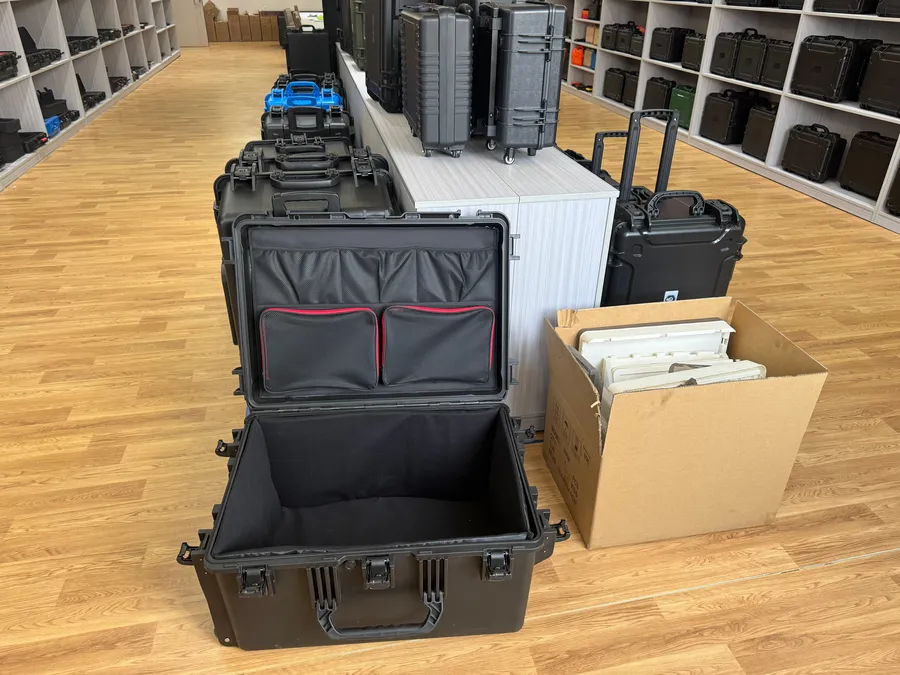
For electronics and instrument kits carried by one person and stored on shelving, the payload conversation is mostly about the interior: the case itself is a small fraction of the mass and shelf loading is a rack question. For field and military transport the column is the case fleet itself - palletised layers, a vehicle floor, a container sea passage - and the geometry fields above are the ones that decide whether the load arrives undamaged. For ammunition storage boxes on an armoury shelf or stacked in a magazine, the stackable flag and the rim geometry matter more than any printed kilogram.
Long equipment sits in its own category again. KX-814641 lists 1,356 mm on its longest external axis with an internal 1,280 by 350 by 140 mm; KX-89616 lists 956 by 408 by 154 mm. Both are published with a fixed folding handle, no wheels and stackable true, and neither is a one-person item - these are carried by two people and stored flat, so a stack figure is a storage-room question rather than a transport one. For drone and medical payloads, content mass swamps shell mass, which is exactly the situation where a test with the specimen ballasted to your stated content is worth the money.
Custom work, and what actually changes the load path
Custom hardware, custom foam, custom colour and custom logo are available across all 155 listings, and the foam layout is where most of the interior load behaviour is set: our file states that shock protection requires a specified foam layout and that the shell alone is not a shock figure. A denser base foam under a heavy instrument changes how the content meets the shell. It does not change the stack field, and it does not make a wall figure into a rating. Changing the rim, the feet or the rib pattern, by contrast, is a mould question, not an order note.
The commercial frame is fixed and worth stating before a launch plan is built on it. OEM on an existing mould quotes at 45 days to first sample from a MOQ of 300 pieces; a new mould runs 125 days with a MOQ from 3,000 pieces per component; custom colour and custom logo sit at 300 pieces. Payment is a 30 percent deposit with the balance after inspection, terms are EXW or FOB, we work wholesale and OEM or ODM only, we do not sell retail, we do not quote DDP and we hold no overseas warehouse. Third-party factory inspection is welcome, and accredited testing is quoted as its own work package so it can be scoped to the configuration rather than inherited from a sibling model.
Procurement notes on load comparisons
Put the eight fields into the purchase order text, not into the email thread, and make the last page of the quotation the publication-rate table you filled in. Before batch acceptance, run one witnessed stack trial at your own stack height with your own ballast on a pre-production sample from the actual tool: it costs a day and it settles a question no catalogue has ever answered. At receiving inspection, sample the wall figure with a caliper on a cut-up or an inconspicuous flange against the stated tolerance, and check that the rim seats rather than the lid panel when two units are stacked on the floor.
Two further lines are worth adding to the RFQ because they change what a load figure means in service: whether the interior foam is included in the quoted mass, and whether the stackable claim assumes aligned rims or free-form placement. Keep every test report filed against the configuration and the production batch it came from, not against the series page. Serial-traceable evidence is the difference between a document that protects you in a warranty claim and a PDF that nobody can act on.
What we do not publish about load, protection or grades
Stated plainly, so nobody reads our silence as a claim: stacking load and payload capacity are recorded as not measured on all 155 listings; pallet quantity and container loading likewise; waterproof and dust resistance figures, ultraviolet figures and temperature ranges are recorded as not measured on all 155; no IP code is stated anywhere in our catalogue and none is implied by a wall thickness, a gasket or a hardware description. Impact resistance is stated as a wall-thickness fact with no drop height attached, and shock protection is stated as dependent on a specified foam layout.
Corrosion resistance is the one behavioural field we record as measured across the file, because a thermoplastic shell has no ferrous corrosion path. Sealing is stated as present or absent per model, 124 of 155 listings publishing a compressible gasket in a continuous moulded channel and 31 publishing none offered on that shell. If a procurement needs a behavioural figure that is not in this list, the route is a test on the ordered configuration, commissioned and witnessed - not a page rewrite.
Customisation
Everything described above is configurable on a standard shell: interior layout (pick-and-pluck, die-cut or CNC-cut), foam grade and thickness, colour, logo method, latch and lock count, pressure-equalisation valve, cable ports, document holder and identification plate. A bespoke exterior geometry requires a new mould — 125 days, from 3,000 units per moulded component.
Procurement considerations
| Question | What to send us |
|---|---|
| Which shell fits? | Equipment L × W × H as packed, plus required clearance per axis |
| What does it cost? | Order quantity and estimated annual quantity — the two drive different answers |
| Is tooling needed? | Whether an existing shell clears the envelope with usable foam depth |
| Lead time? | Your required delivery date, not just the order date |
| Certification? | The exact standard your tender names — we will say whether we can test to it |
| Freight? | Destination and preferred terms; carton and pallet data supplied with the quotation |
Comparison and selection guide
The tables on this page exist because a protective case is chosen by comparing three things: the envelope, the environment and the handling chain. Where no table applies, the rule below is.
| Situation | What To Do |
|---|---|
| Fastest | Standard shell plus CNC foam — typically 45 days from approved drawing. |
| Branded | Standard shell plus custom colour and logo — MOQ applies to the resin colour. |
| Bespoke geometry | New mould — 125 days, MOQ from 3,000 units per component. |
- Size on internal dimensions plus clearance, never on a product name.
- Choose the carrying method before the shell: it changes the series, not just the price.
- Specify the interior last, and decide up front whether the end user will reconfigure it.
How do buyers compare case load capacity across protective case suppliers? relates to Logistics & Packing Guide. Related families: Custom Protective Cases / Equipment Transport Cases / Military Protective Cases / Ammunition Storage & Transport Boxes / Field Equipment Cases / Electronics Cases / Rolling Cases / Long Equipment Cases. Related sectors: field and industrial equipment. Continue in the Logistics & Packing Guide cluster.
This page is written from our own production data. If your requirement differs, send the dimensions and we will tell you which of the 155 models fits, or whether a custom route is needed.


