How do buyers compare case wheels across protective case suppliers?
Case wheels are compared by counting the wheel fields a supplier actually puts in writing, because photographs tell you nothing you can specify against. In our own file of 155 active models, wheels are stated on all 155 as a yes or no - 19 true and 136 false - and the wheel count is stated on all 155 as well: every one of the 19 carries exactly two wheels and none carries four. Everything a wheel is made of goes quiet: no listing publishes a case wheel diameter, a wheel width, a tread or wheel material, a bearing type, a brake, or a load rating per wheel, and no gross shipping mass appears on any of the 155. What is published around the wheels is worth reading too: all 19 rolling shells state a fixed folding handle alongside the telescopic one, 11 of the 19 state an extended handle travel of 240 mm to 485 mm, 19 of 19 state empty shell mass from 4,912 g to 15,320 g, 18 of 19 state a compressible gasket, and all 19 state stackable as false - against 136 of 136 wheel-free listings stating stackable as true. So the comparison is not which supplier has nicer castors. It is who will write down the count, the diameter, the material, the replaceability and the stacking consequence before you place the order.
Key points
- Count published fields, not photographs: our file states wheels on all 155 listings as yes or no, with 19 rolling shells, and 19 of 19 publish exactly two wheels.
- Ask for the two numbers nobody writes: case wheel diameter and material are absent from every one of our 155 listings, so a rival catalogue with those fields is ahead, not lazy.
- Two versus four is a moulding decision, not an option line: no shell in our file is offered with four wheels, because the tipping geometry and the base bosses are cast in the tool.
- Wheels and the stacking trade are one purchase: all 19 rolling listings publish stackable as false while 136 of 136 wheel-free listings publish true, which is a pallet plan change, not a handle preference.
- You still have to lift it: the 19 rolling shells publish empty mass from 4,912 g to 15,320 g with a median of 8,500 g, and wheels stop helping at the first stair, kerb or soft surface.
- Anti-static and ESD case wheels are a component specification: we publish no electrical figure for any wheel and would commission accredited third-party testing on the ordered configuration.
- The same footprint ships both ways: KX-88442 and KX-88434 roll on an 843 by 592 mm plan while KX-88421 keeps that plan wheel-free and stackable, so wheels are a choice per build, not per size.
What case wheels actually buy, and what they quietly cost
A wheel converts a two-person lift into a one-person pull, but only on ground that is continuous, hard and flat, and only for as long as the operator is willing to keep the shell tilted. Our rolling range is 19 of 155 listings, all of them the T series, and each publishes two wheels plus a telescopic handle plus a fixed folding handle - the last point matters, because a case with only a telescopic grip cannot be lifted into a vehicle by a second person at the side. The cost side is equally concrete: all 19 publish stackable as false, which removes them from every column stack and pallet plan, and the empty shell mass in that range runs from 4,912 g to 15,320 g with a median of 8,500 g, which is what someone lifts when the surface changes.
This is why a wheel comparison decided on appearance goes wrong. The decision is a route question - corridor, apron, loading bay, then a stair or a gravel shoulder - and the fields that describe it are published or unpublished in a fairly predictable pattern across the industry. Our recommendation to buyers is to run the count on the same sheet for every supplier, then insist on the written numbers behind any wheel they are proud of.
The seven wheel fields to demand from every supplier
Put these seven lines on one sheet and send it to everyone in the tender. Two of them you can fill in from our file today; five of them are blank for us and, we would bet, blank for most of the industry, which is precisely why they belong on the sheet. A supplier who returns six of seven has a component specification with a part number behind it. A supplier who returns two has a shell with something bolted on the back.
The third column is the ask we would make of any manufacturer, including ourselves, and it is the difference between a wheel that survives a full batch and a wheel that becomes your warranty claim three months into service, when the replacement part cannot be matched.
| Field On The Sheet | Our 155-Model File Publishes | Demand From Any Supplier |
|---|---|---|
| Wheel count per case | 155 of 155 as a number: 2 on the 19 rolling shells, 0 on the other 136 | The count on the drawing you are approving, not on the hero photograph |
| Case wheel diameter and material | 0 of 155 listings - no diameter, no width, no tread or wheel polymer is recorded anywhere in the file | Measured diameter and width in millimetres, the wheel polymer, and whether it is solid, hollow or foam-filled |
| Bearing type and rolling resistance | 0 of 155 listings | Bore, bush or race; whether it spins freely after 200 km of cart floors; and what it costs to replace |
| Load rating per wheel or per case | 0 of 155 listings, and no stacking or payload figure either | The method behind the rating, the dwell time, the specimen state and the report number |
| Axle, housing and replaceability | Custom hardware is available on 155 of 155; no axle or fastener detail is recorded | Whether the wheel is a serviceable bolt-on part or moulded into the base, and the spare part code |
| Fixed or swivel castors, brake or none | 0 of 155 listings state a caster type or a brake | Trailing versus swivel, and a brake if your route includes a ramp - stated per model, not per series |
| Handle travel that works with the wheels | Telescopic handle on 19 of 155; an extended height on 11 of those 19, from 240 mm to 485 mm, median 295 mm | Extended and retracted height, number of stages, and where the latch sits relative to the lid hinge |
Two wheels versus four wheels on a case
Our file is unambiguous on this point: every rolling listing publishes two wheels, and no listing publishes four. A two-wheel layout is a tilt-and-drag geometry - the shell goes onto its wheels at an angle, the contents shift toward the base, and the case stands parked on the handle, the wheels and the moulded feet, which our file states as present on all 155 listings. A four-wheel layout stands upright and can be pushed rather than pulled, which is friendlier to a loaded interior, but it needs four bosses in the base, a swivel or trailing caster selection, and it eats the stacking rim that a column stack depends on.
Neither layout is better in the abstract; they belong to different routes. What buyers should insist on is that the number be written down, because the count is the field that predicts everything else: tipping angle, whether the case can be pushed through a doorway without catching, whether it stands on a shelf edge, and whether it can be column-stacked at all. If a supplier offers you four wheels on a shell whose drawings were cut for two, ask which drawing the batch will be built to.
Publication rates: what a wheel specification looks like in practice
The comparison method we recommend is a rate, not an adjective. From our own file: wheels stated 155 of 155, wheel count stated 155 of 155, telescopic handle present 19, fixed folding handle present 155, extended handle height 11, empty shell mass 19 of 19 in the rolling range and 93 of 155 across the file, wall thickness 18 of the 19 rolling listings, compressible gasket stated 18 of 19 rolling listings, carton dimensions 6 of 19 and pieces per carton 6 of 19, each of those six at one case per carton. Blank across the file: gross shipping mass, wheel diameter, wheel width, wheel material, bearing, brake, caster type, per-wheel rating and any cycle count.
Read the blanks together and they tell you something structural about this market. The wheel is a bought-in component that most case makers specify by catalogue picture rather than by measurement, so the drawing pack is where the honesty shows. A supplier whose rates look like ours on the shell fields and beat ours on the wheel fields has an actual hardware specification; a supplier whose wheel figures look complete across every model while the shell fields stay thin has a marketing problem in the opposite direction.
The rolling range, model by model, as published
Eight of the 19 T-series listings, exactly as the file records them. The point of printing these side by side is not to sell the biggest one; it is to show how unevenly the useful fields are filled even inside one narrow range. KX-5126 is the instructive row: it publishes wheels, a telescopic handle and an empty mass, but no gasket and no wall thickness, which is a sealing conversation and a stiffness conversation that a buyer has to have before ordering rather than after receiving.
One more field worth reading across the rows is the extended handle height. Five listings sit at 295 mm, two at 240 mm, two at 310 mm, one at 385 mm and one at 485 mm, and eight of the 19 publish nothing at all. That is a fit-to-operator number for a person who will drag the case daily, so treat an empty cell as an open question in the RFQ rather than as a defect.
| Model | Wheels Published | Extended Handle Height | Empty Shell Mass | External Footprint | Internal Volume | Gasket Stated | Carton Stated |
|---|---|---|---|---|---|---|---|
| KX-88442 | 2 | 295 mm | 15,320 g | 843 by 592 mm | 139.5 litres | Yes | No |
| KX-88434 | 2 | 295 mm | 14,030 g | 843 by 592 mm | 108.9 litres | Yes | No |
| KX-87336 | 2 | 240 mm | 10,660 g | 733 by 505 mm | 86.6 litres | Yes | No |
| KX-97227 | 2 | 485 mm | 10,000 g | 720 by 500 mm | 53.9 litres | Yes | Yes, 715 by 515 by 280 mm at 1 per carton |
| KX-96127 | 2 | not published | 8,540 g | 610 by 610 mm | 62.4 litres | Yes | Yes, 640 by 625 by 280 mm at 1 per carton |
| KX-66232 | 2 | not published | 7,940 g | 615 by 440 mm | 56.6 litres | Yes | Yes, 620 by 465 by 355 mm at 1 per carton |
| KX-85021 | 2 | not published | 4,912 g | 495 by 370 mm | 22.1 litres | Yes | No |
| KX-5126 | 2 | not published | 5,610 g | 510 by 395 mm | 32.4 litres | None offered on this shell | Yes, 520 by 405 by 270 mm at 1 per carton |
The size ceiling, and the footprint that ships both ways
Buyers often assume rolling hardware simply scales with the shell. Our file says the opposite twice. First, the rolling range spans 463 mm to 843 mm on the longest external axis, with internal volumes from 22.1 to 139.5 litres and a median of 56.6 litres - so wheels stop at a length that is set by the tool, not by ambition. Second, the two longest shells in the catalogue, KX-814641 at 1,356 mm and KX-89616 at 956 mm on the longest axis, are published without wheels and with stackable as true, because a shell that long will not track straight through a doorway and is carried by two people at the folding handles.
The clearest illustration is a shared plan. KX-88442 and KX-88434 roll on a base of 843 by 592 mm and publish stackable as false; KX-88421 keeps the same 843 by 592 mm plan at 212 mm deep, publishes zero wheels and stackable as true. Same footprint, opposite answer, because rolling hardware is a decision per build. And if your fleet needs rolling considered on a size our T range does not reach, the shortlist to hand any supplier is the five wheel-free listings that publish an empty mass of 4,000 g and above - KX-6621 at 6,420 g, KX-6922 at 6,140 g, KX-65522 at 4,860 g, KX-5321 at 4,810 g and KX-5723 at 4,680 g.
Wheels and the stacking trade nobody prices
This is the field that turns a hardware conversation into a freight conversation, and it is published as a clean yes or no: 136 of 155 listings state stackable as true and 19 state false, with a perfect correspondence - the 19 are exactly the shells with two wheels and a telescopic handle. Once a shell cannot be column-stacked, the pallet plan, the rack plan and the container plan all change, and the case usually travels in a single layer with the void above it paid for in freight.
Six of the 19 rolling listings publish a carton and all six record one case per carton, which is the honest picture of how these shells ship; the other 13 confirm packing per order rather than copying a sibling figure. When you compare suppliers, ask them to state the stacking consequence of their own wheel option on the same line as the wheel option. A quotation that offers wheels and keeps a stackable claim is describing a mould that does not exist, and that is worth catching before a sample is approved rather than after a container is booked.
What you still have to lift when the ground runs out
Wheels are only useful on the surfaces that come first in a plan and last in reality. A kerb, a stair, a soft shoulder, a mud apron, a lift threshold or a vehicle tailboard ends the useful run, and the empty shell mass is what a person then handles: 4,912 g to 15,320 g across our 19 rolling listings with a median of 8,500 g, before contents and foam. Compare that with the wheel-free end of the file, where the published mass starts at 100 g on KX-1204 and reaches 6,420 g on the largest non-rolling shells, and the choice stops being about hardware at all.
The practical rule we give buyers is to map the route end to end before choosing. If more than one interruption breaks the smooth surface, price the case as a lift, and let the wheels be a convenience rather than the reason. Moulded feet are stated on all 155 listings, so a parked rolling shell stands on wheels, feet and handle, which is stable on a flat floor and worth checking on an inclined one at sample stage.
Anti-static and ESD case wheels: what to ask for
Electronics and medical buyers ask for conductive or dissipative wheels more often than they ask for any other wheel attribute, and it is the field where a comparison most often turns into a misunderstanding. Our file records no electrical figure for any wheel on any of the 155 listings, so we do not offer an anti-static or ESD case wheels claim from a catalogue. A conductive wheel is a compound choice, and the path only exists if it runs wheel, axle, boss and shell in one continuous circuit - conductive wheels on a thermoplastic shell with an insulating boss are not a bonding path, however the brochure reads.
Ask every supplier four things instead: the target resistance range they are claiming and against which method it was measured, whether the figure is per wheel or per assembled case, whether the gasket and hardware interrupt the path, and whether the report is traceable to the production batch. If a tender names a requirement we do not already hold, we say so plainly in the quotation and price accredited third-party testing of the ordered configuration as a separate work package, so the evidence belongs to your build rather than to a series page.
Where rolling hardware earns its place
All 19 rolling listings sit in the equipment-transport, military-transport and medical-equipment namespaces of our catalogue, and they are the shells that carry the largest published internal volumes in the file - up to 139.5 litres on KX-88442. That is where the rolling layout pays: one person moving a large, dense kit across a corridor, a hangar floor, a loading bay or a hospital storage room, where the surface is continuous and the mass is the reason a second person would otherwise be needed.
It is the wrong answer where the fleet palletises or racks, because the stacking flag is false for the whole group, and where the route is short and rough, because the empty mass simply moves the problem from the wheels to the arms. For long equipment the geometry rules it out anyway: the 1,356 mm and 956 mm shells in our file are two-person lift items with no wheels at all.
Customising wheels: configuration work versus a new mould
Custom hardware is recorded as available across all 155 listings, and hardware material is stated as metal or polymer by configuration rather than fixed per model. What counts as configuration work is anything that does not cut new bosses or breach the sealing rim: substituting an equivalent bought-in wheel of the same fixing, wheel colour, a bolt-on fitting to existing moulded inserts, and the choice between the wheel and no-wheel configurations we already run. What counts as a moulding change is adding a wheel boss where the tool has none, moving a boss outside the gasket line, or converting a two-wheel shell into a four-wheel one - the last of those also removes the stacking rim.
The commercial frame is fixed, so plan around it rather than hoping: OEM on an existing mould quotes at 45 days to first sample from a MOQ of 300 pieces; a new mould runs 125 days with a MOQ from 3,000 pieces per component; custom colour and custom logo sit at 300 pieces. Payment is a 30 percent deposit with the balance after inspection, terms are EXW or FOB, we work wholesale and OEM or ODM only, we do not sell retail, we do not quote DDP and we hold no overseas warehouse. Third-party factory inspection is welcome, and we would rather a buyer brings their own inspector than discovers at receiving that a wheel was unspecified.
Procurement notes, and what we do not publish about wheels
Write the wheel into the purchase order line rather than the email: count, whether the diameter and material are stated or explicitly noted as unspecified, the handle type alongside it, and the stacking consequence you accepted. Order a spares kit per quantity band - wheels, stanchion assemblies and grip covers are serviceable items and a spare costs almost nothing against a grounded case. At receiving inspection, spin-check a sample for bearing drag and side play, confirm the telescopic stages latch cleanly at every height, and verify that the folded handle still seats flat. The latch count is recorded on our file as specified per configuration rather than per model, which is another line to nail down in writing.
What we do not publish, stated so our silence cannot be read as a claim: no wheel diameter, width, tread or material, no bearing type, no brake or caster type, no per-wheel or per-case load rating, no cycle count, and no gross shipping mass on any of the 155 listings. No IP code is stated anywhere in our catalogue and none is implied by a wheel, a gasket or a telescopic handle. Shock protection is recorded as dependent on a specified foam layout and impact resistance is recorded as a wall-thickness fact with no drop height claimed, so a rolling configuration inherits neither a rating nor a promise.
Customisation
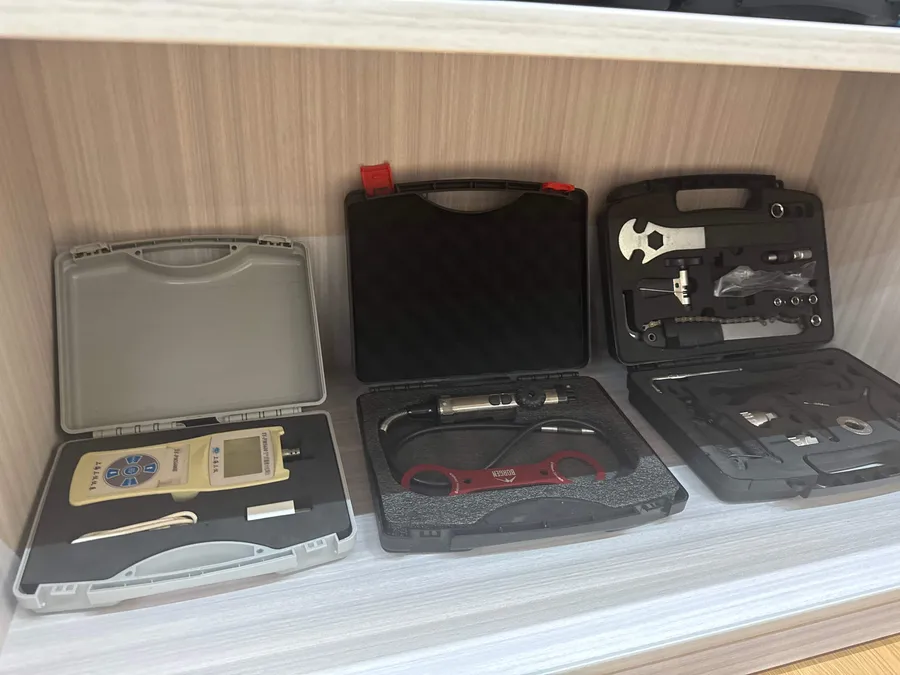
Everything described above is configurable on a standard shell: interior layout (pick-and-pluck, die-cut or CNC-cut), foam grade and thickness, colour, logo method, latch and lock count, pressure-equalisation valve, cable ports, document holder and identification plate. A bespoke exterior geometry requires a new mould — 125 days, from 3,000 units per moulded component.
Procurement considerations
| Question | What to send us |
|---|---|
| Which shell fits? | Equipment L × W × H as packed, plus required clearance per axis |
| What does it cost? | Order quantity and estimated annual quantity — the two drive different answers |
| Is tooling needed? | Whether an existing shell clears the envelope with usable foam depth |
| Lead time? | Your required delivery date, not just the order date |
| Certification? | The exact standard your tender names — we will say whether we can test to it |
| Freight? | Destination and preferred terms; carton and pallet data supplied with the quotation |
Comparison and selection guide
The tables on this page exist because a protective case is chosen by comparing three things: the envelope, the environment and the handling chain. Where no table applies, the rule below is.
| Situation | What To Do |
|---|---|
| Airport and road transfer | Check the external dimensions against cabin and boot constraints, not just the internal volume. |
| Rough ground | Larger wheels and a wider track matter more than shell volume. |
| Stored upright | Confirm the case can stand on its base with the handle retracted in your racking. |
- Size on internal dimensions plus clearance, never on a product name.
- Choose the carrying method before the shell: it changes the series, not just the price.
- Specify the interior last, and decide up front whether the end user will reconfigure it.
How do buyers compare case wheels across protective case suppliers? relates to Logistics & Packing Guide. Related families: Rolling Cases / Military Transport Cases / Military Protective Cases / Equipment Transport Cases / Custom Protective Cases / Medical Equipment Cases / Drone & UAV Cases / Electronics Cases / Long Equipment Cases / Field Equipment Cases. Related sectors: field and industrial equipment. Continue in the Logistics & Packing Guide cluster.
This page is written from our own production data. If your requirement differs, send the dimensions and we will tell you which of the 155 models fits, or whether a custom route is needed.