How should case latches be specified in a protective case RFQ?
Specify case latches as a closure system, not as a part. An RFQ that can be priced and inspected names seven things on one page: the latch count and their positions along the front edge, the lid depth the closures have to pull down, whether the shell carries a gasket channel, the wall thickness the latch anchors engage, whether the latch must accept a padlock, the opening routine the user follows, and whether spare latches ship with the batch. Our own file sets the boundary. Latch count is recorded as specified per configuration on all 155 models, the latch body is recorded as accepting a standard padlock on all 155, and no listing states a latch type, a latch material, a tensile figure or a cycle count. Lid depth, which decides how much the closures hold, is published on 100 models from 16 mm to 320 mm with a median of 97.5 mm, and a gasket channel is recorded on 124 models against 31 with none.
Key points
- Write the latch line as a closure requirement with a count and positions, not as a part description, because count is configured per order on all 155 models.
- Tie the count to lid depth: 11 models carry a lid of 200 mm or more, and a deep lid loads every closure differently from a 16 mm flap.
- State the gasket decision in the same paragraph, since 124 models record a channel and 31 record none, and a latch sets the compression on that line.
- Name the wall the latch anchors bite into; it is published on 148 models from 2.0 mm to 6.0 mm with a median of 3.9 mm, and no frame is recorded anywhere.
- Say whether the latch must take a padlock; our file records that the latch body accepts a standard padlock on all 155 models.
- Add the opening routine: gloves, one hand, a bench or a vehicle tailgate. It decides the latch style far more than appearance does.
- Order spare latches with the batch, because a latch is a wear part and a case without a working closure is out of service.
A latch RFQ specifies a closure, not a part number
The most common weakness in a protective case RFQ is a latch line that describes an appearance. A sentence such as fit sturdy latches reads as a requirement but prices as nothing, because it leaves the count, the positions, the anchor, the seal interaction and the padlock question to the supplier. Those five decisions are the ones that actually change the quotation, and every one of them belongs to the buyer. Our published file is deliberately narrow at this point: on all 155 models the latch is recorded as count specified per configuration, and no listing states a latch type, a latch material, a tensile figure or a cycle count. That is not an omission to be papered over. It is the honest statement that a closure is configured for the order.
A closure specification is therefore a paragraph about behaviour. How many points hold the lid down, where they sit along the front edge, how much lid they have to pull against a gasket, what the anchors bite into, whether the case may be padlocked in transit, how the user opens it with gloves on, and what happens when one latch wears out. Answer those seven in the RFQ and the reply can be checked at goods-in. Answer them with an adjective and the reply can only be compared on price, which is the one field every bidder controls.
The seven lines a latch specification needs
Keep the seven lines together on one page and issue them under a revision number, because a latch change is rarely isolated: a new count moves the positions, a deeper lid changes the load at each point, and a padlock requirement can change the hardware entirely. The middle column is what to write; the right column is why the supplier cannot price without it. Two lines deserve more precision than the rest, the count and the gasket decision, because those are the two that most often get left to the sample stage, where they are expensive to move.
None of the seven requires a drawing to begin. A purchaser can write all seven from the model datasheet, a photograph of how the case is used and the packing plan. Drawings refine positions once a shortlist exists, and at that point the RFQ becomes a specification document that both sides can point to when a sample is approved.
| Rfq Line | What To Write | Why It Cannot Be Assumed |
|---|---|---|
| 1. Latch count | Number of closure points, for example two, three or four, and the reason for the number | Count is configured per order on all 155 models, so it is a buyer decision |
| 2. Latch positions | Spacing along the front edge, and whether the corners need a point | Positions set the gasket compression pattern and the opening feel |
| 3. Lid depth to be held | The published lid and base split of the model, or the split you require | Depth is the lever each closure resists at full open |
| 4. Gasket decision | Whether the lid must carry a compressible gasket in a moulded channel | A latch sets the compression line on a sealed shell |
| 5. Anchor and wall | The published wall of the model, and the fixing zone if it is known | No frame is recorded on any model, so the anchor engages the wall |
| 6. Padlock requirement | Whether the latch body must accept a standard padlock, and the shackle size used | It changes the hardware line and the security routine |
| 7. Opening routine and spares | Gloves, one or two hands, bench or tailgate, and whether spares ship with the batch | It decides the latch style and the service plan |
Latch count is a spacing decision, and the lid sets the load
Count is the first line because it is the one that converts a lid into a closing problem. A latch has to hold the lid down against a gasket, resist the twist of a lifted corner, and survive being opened by someone in a hurry. The lid it works against is published: lid depth on 100 of the 155 models runs from 16 mm to 320 mm with a median of 97.5 mm, and base depth on the same 100 runs from 15 mm to 168 mm with a median of 44 mm. On 65 of those 100 the lid is deeper than the base, which means the part being closed is a box rather than a flap.
Eleven models carry a lid of 200 mm or more, from KX-84825 and KX-86127 at 200 mm up to KX-88442 at 320 mm, and those are the shells where a two-point closure has to be argued rather than assumed. Edge span matters in the same breath: the longest external edge on the file runs from 120 mm to 1,356 mm with a median of 432 mm, and 43 models are at or above 500 mm. A 1,356 mm front edge held by two points and a 120 mm edge held by two points are not the same closure, even when the same hardware family is fitted to both.
| Model | Lid / Base Mm | Wall Mm | Gasket Channel | Padlock Accepted | Published Mass |
|---|---|---|---|---|---|
| KX-1204 | 16 / 16 | 2.6 | no | yes | 100 g |
| KX-1905 | 25 / 15 | 3.0 | yes | yes | 250 g |
| KX-4312 | 52 / 52 | 3.5 | yes | yes | 1,170 g |
| KX-84430 | 230 / 45 | 4.2 | yes | yes | not published |
| KX-85021 | not published | 4.5 | yes | yes | 4,912 g with two wheels |
| KX-88442 | 320 / 44 | 5.0 | yes | yes | 15,320 g with two wheels |
| KX-97227 | 42 / 168 | 6.0 | yes | yes | 10,000 g with two wheels |
Sealing is a latch decision, not a separate one
On a sealed case the latch and the gasket are one system, because the closure is what compresses the seal. Our file records a compressible gasket in a continuous moulded channel on 124 of the 155 models, and 31 record that no seal is offered on that shell. Where a channel exists, the latch points have to produce an even compression line along the whole perimeter, and the corners are where that line is hardest to hold. A count that suits a two-point opening on a bench case is not automatically the count that keeps a 230 mm lid flat on a gasketed shell.
Two further facts change the brief on sealed shells. Pressure equalisation is available as a configuration option, and no valve is published on any specific model, so a procedure that requires one must name it. And because 36 listings publish a narrowest internal width alongside the internal box, a latch that intrudes into the cavity at the front wall can conflict with a full-width contents plan. That is a drawing question, but it is cheaper to raise it with the RFQ than after the foam is cut.
What the latch anchors bite into: the wall, and only the wall
A latch is only as secure as the material its anchor engages, and in our range that material is always the shell wall. Wall thickness is published on 148 of the 155 models, from 2.0 mm to 6.0 mm with a median of 3.9 mm. Twenty listings sit at or below 2.5 mm, among them KX-2005 at 2.0 mm and KX-705 at 2.1 mm, while 56 listings are at or above 4.5 mm and two reach 6.0 mm, KX-6621 and the rolling KX-97227. Seven models publish no wall figure, and on those the anchor question is answered from a sample.
There is no second structure to rely on. The frame field reads none on all 155 listings, so no metal mid-frame or rim rail is recorded anywhere in the range. Shell material is published on every model: polypropylene on 94, engineering polypropylene on 38, ABS on 22 and one stated as PP or ABS. A latch on a 2.1 mm polypropylene wall and a latch on a 5.0 mm wall are different closure decisions, and the RFQ should say which one it is asking for rather than leaving the supplier to guess from the photograph.
Padlockability and what a security line can honestly say
Security wording is where latch RFQs tend to overreach. The published position in our file is one sentence, recorded as measured on all 155 models: the latch body accepts a standard padlock. That is a fitting fact, not a rating, and it does not become a rating when it appears in a tender. We publish no lock rating, no tamper figure and no forced-entry statement for any model, and an RFQ that asks for one is asking for a test programme rather than a catalogue line.
The useful way to write the security line is operational. State the padlock shackle diameter your organisation actually uses, whether the case travels on a vehicle where the padlock is inspected at each handover, and whether the padlocks are keyed alike across a fleet. Those three details decide whether the latch body you order suits your routine. If your procedure needs a hasp or a seal tag in addition, say so in the same line, because an added hasp in an existing boss is configuration work while a new fixing position is not.
Selection guide: matching the closure to the way the case is used
For electronics and instrument kits used on a bench, the closure question is about feel and access rather than strength. KX-1204 at 120 x 90 x 40 mm carries a 16 mm lid in a 2.6 mm wall with no gasket at 100 g, and on that shell two points are enough; the padlock capability is recorded but is rarely used. KX-1905 at 190 x 190 x 45 mm adds a gasket channel and a 25 mm lid over a 15 mm base in a 3.0 mm wall at 250 g, so the same two points now have to hold a compression line as well as a lid.
For field and military transport the load per latch rises sharply. KX-84430 holds a 230 mm lid over a 45 mm base in a 4.2 mm wall, and KX-88442 holds a 320 mm lid at 15,320 g on two wheels. Those briefs should state a count that reflects the lid depth, name the padlock routine and confirm that the closure is worked in gloves. KX-97227 is the useful exception: a 42 mm lid over a 168 mm base in a 6.0 mm wall, where the latches carry the contents while the hinge carries almost nothing.
Storage boxes and rolling cases complete the picture. KX-4312 pairs equal 52 mm lid and base depths in a 3.5 mm wall, a box that is opened from above on a shelf and closed many times a shift, so the spares plan matters more than the count. The 19 wheeled models are all recorded as not stackable and all carry a telescopic handle, which means their latches also hold a lid through tilting and dragging rather than only through lifting, and the brief should say so.
Customising latches and the commercial frame around them
Custom hardware is available on all 155 models, and the hardware material line reads metal or polymer by configuration rather than fixed per model. On an existing mould, the latch work that leaves the load path alone is configuration work: finish, colour, the choice between configurations already running, and an added hasp in an existing boss. Moving the latch points, changing the count in a way that needs new bosses, or altering the front wall to suit a different closure is a mould decision, and it should be quoted as one rather than as a fitting.
The commercial ladder is fixed. Standard models ship from one piece, while custom colour, custom logo and an OEM programme start at 300 pieces. A first sample on existing tooling runs 45 days; a new mould runs 125 days with a minimum from 3,000 pieces per component. Payment is a 30 percent deposit with the balance against inspection before shipment, on EXW or FOB terms. We work wholesale and OEM, do not sell retail and do not quote DDP, so the freight leg stays with you or your forwarder, which is one more reason the closure brief should be complete before the order is placed.
Procurement notes: order text, inspection and the blanks
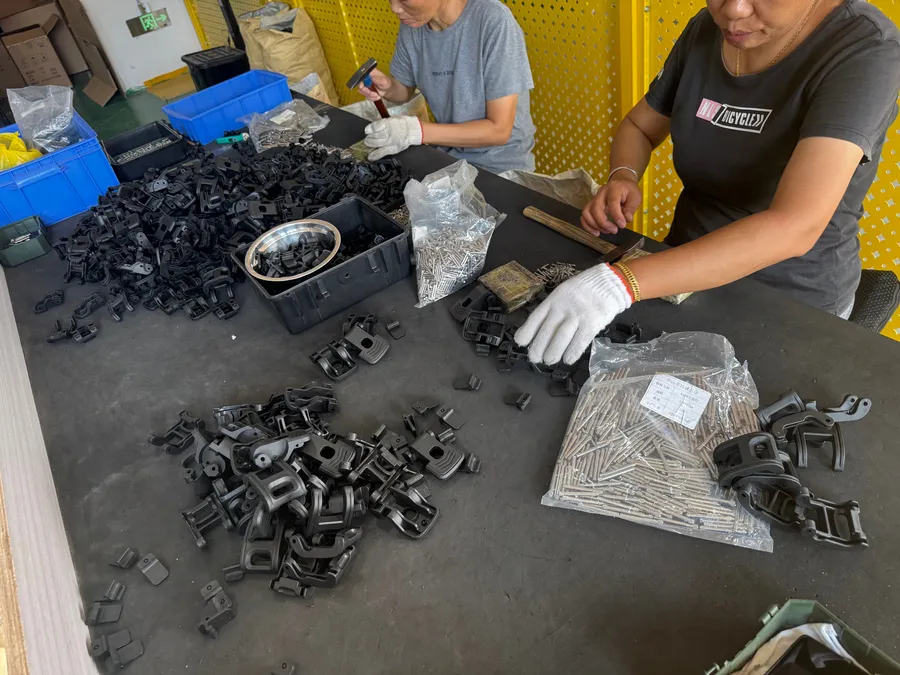
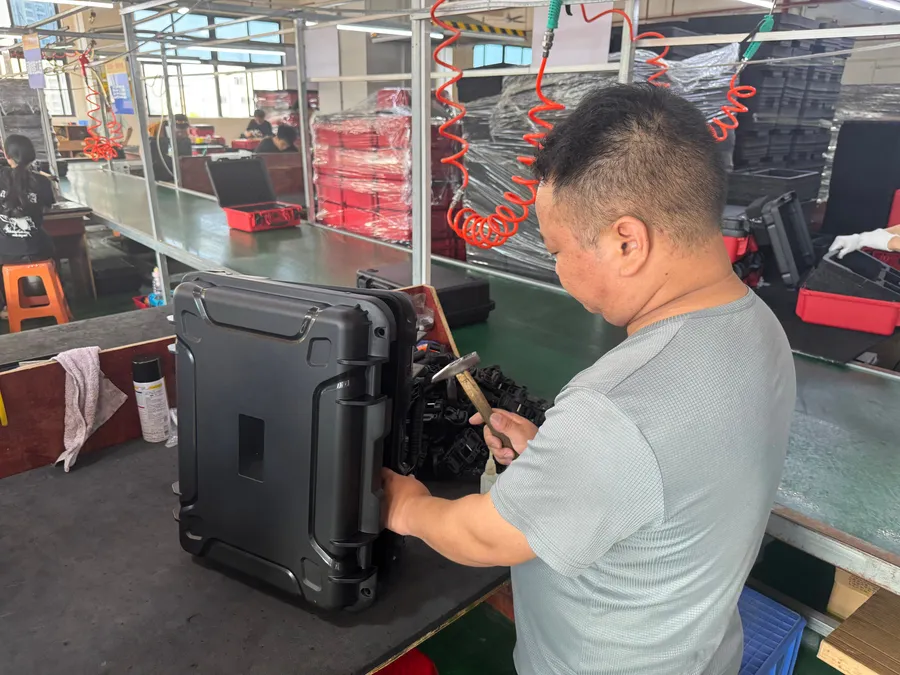
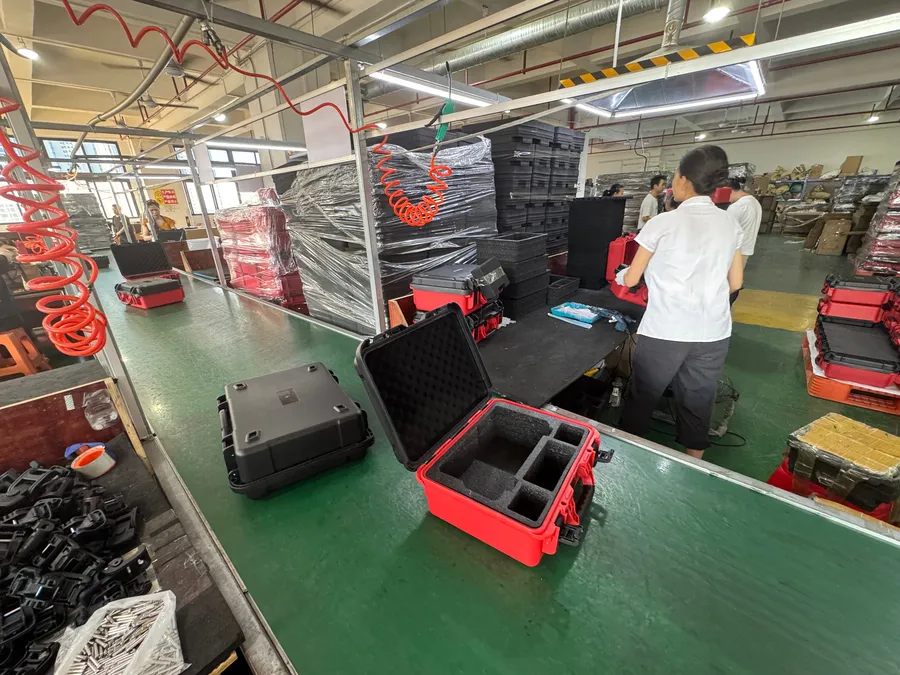
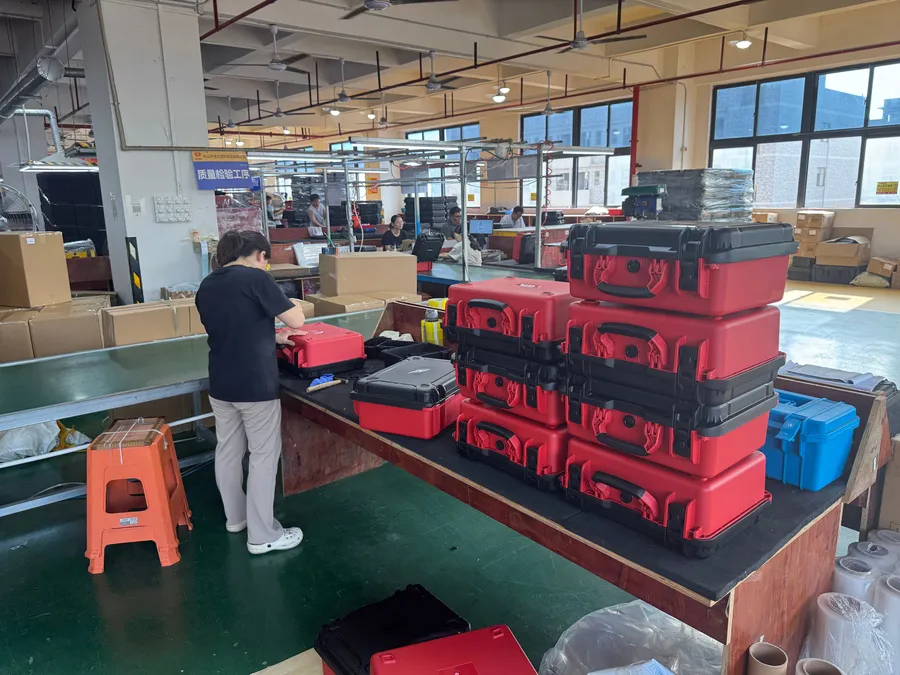
Move the closure out of the email thread and into the purchase order line. The order text should carry the latch count, the positions, the padlock requirement, the gasket decision, the wall at the anchor, the spare quantity and the acceptance check. At receiving, close every fifth case and look for a uniform compression line at the seal face, then open and close each latch twice to feel for play in a fresh fixing. Mould flash in a catch and a latch that needs force on first use are assembly artefacts that appear on the first shots after a maintenance cycle, which is when an objection is cheapest to raise.
Be equally clear about the blanks. We publish no ingress-protection code, no payload, no stack load and no temperature range for any model, and no latch type, material, tensile figure or cycle count. Where your tender names a procedure, accredited third-party testing against that procedure can be commissioned as a separate work package and quoted per configuration. Send the seven lines and the order terms, and the reply will answer the closure question field by field. For a quotation review, contact Fred Zhao and the KeXin Sales Team on WhatsApp at +86 135 3588 0002. KeXin New Materials (Guangdong) Co., Ltd.
Customisation
Everything described above is configurable on a standard shell: interior layout (pick-and-pluck, die-cut or CNC-cut), foam grade and thickness, colour, logo method, latch and lock count, pressure-equalisation valve, cable ports, document holder and identification plate. A bespoke exterior geometry requires a new mould — 125 days, from 3,000 units per moulded component.
Procurement considerations
| Question | What to send us |
|---|---|
| Which shell fits? | Equipment L × W × H as packed, plus required clearance per axis |
| What does it cost? | Order quantity and estimated annual quantity — the two drive different answers |
| Is tooling needed? | Whether an existing shell clears the envelope with usable foam depth |
| Lead time? | Your required delivery date, not just the order date |
| Certification? | The exact standard your tender names — we will say whether we can test to it |
| Freight? | Destination and preferred terms; carton and pallet data supplied with the quotation |
Comparison and selection guide
The tables on this page exist because a protective case is chosen by comparing three things: the envelope, the environment and the handling chain. Where no table applies, the rule below is.
| Situation | What To Do |
|---|---|
| Fastest | Standard shell plus CNC foam — typically 45 days from approved drawing. |
| Branded | Standard shell plus custom colour and logo — MOQ applies to the resin colour. |
| Bespoke geometry | New mould — 125 days, MOQ from 3,000 units per component. |
- Size on internal dimensions plus clearance, never on a product name.
- Choose the carrying method before the shell: it changes the series, not just the price.
- Specify the interior last, and decide up front whether the end user will reconfigure it.
How should case latches be specified in a protective case RFQ? relates to Logistics & Packing Guide. Related families: Custom Protective Cases / Equipment Transport Cases / Instrument & Equipment Cases / Military Protective Cases / Tool Cases. Related sectors: field and industrial equipment. Continue in the Logistics & Packing Guide cluster.
This page is written from our own production data. If your requirement differs, send the dimensions and we will tell you which of the 155 models fits, or whether a custom route is needed.


