How do buyers compare case stackability across protective case suppliers?
Case stackability is compared on published geometry, because no supplier - including us - publishes a stack rating. On our file of 155 active models the one stackability field we do state for every SKU is a yes or no: 136 models are marked stackable and 19 are not, and the 19 are exactly the wheeled T-series shells that also carry a telescopic handle, so the honest first cut is that a wheel is what removes a case from the column. Beyond that flag, stackability is a shape question, not a strength question, so you compare it on the fields that describe shape: moulded feet (stated present on 155 of 155), external footprint (155 of 155), the lid and base depth split (100 of 155, lid from 16 mm to 320 mm and base from 15 mm to 168 mm), wall thickness as a material allowance (148 of 155, 2.0 mm to 6.0 mm, median 3.9 mm) and empty shell mass where published (93 of 155, 100 g to 15,320 g, median 1,480 g). A stacking load in kilograms is recorded as not measured on all 155 listings, and so is payload, pallet quantity and container loading. So the comparison a buyer can actually run is: does the supplier give you the feet, rim, footprint and depth fields for the model you are buying, and will they put a column height in writing against your own loaded mass? Two suppliers who both print stackable yes are not comparable until you see which rim sits on which, at what footprint, and whether the claim assumes an empty shell or one packed with your content.
Key points
- Ask for the stackable flag per model by name: it is the one stackability field we publish for all 155 SKUs, 136 true and 19 false, and the 19 are exactly the wheeled T-series shells.
- Stackability is shape before strength: moulded feet are stated on 155 of 155 listings, external footprint on 155, and those two fields decide more about a stable column than any printed kilogram.
- The lid and base depth split, published on 100 of 155 listings with lids from 16 mm to 320 mm, tells you where a stacked load should never land - the flat lid panel is not a bearing surface.
- A stacking load in kilograms is recorded as not measured on all 155 listings, so any supplier figure needs a report naming method, applied load, dwell time and specimen state, filed against the model bought.
- Footprint is pallet arithmetic too: our largest external base is 843 by 592 mm, and a square 610 by 610 mm shell stacks and palletises differently from a long 956 by 408 mm one.
- Empty mass is a second read of the same shell, not a new claim: the 74 non-wheeled listings that publish it median 1,200 g while all 19 wheeled T shells publish mass from 4,912 g to 15,320 g.
- If your procedure names a stack rating we do not hold, we say so in the quotation and price accredited third-party testing of the ordered configuration as a separate work package.
What a case stackability claim is actually describing
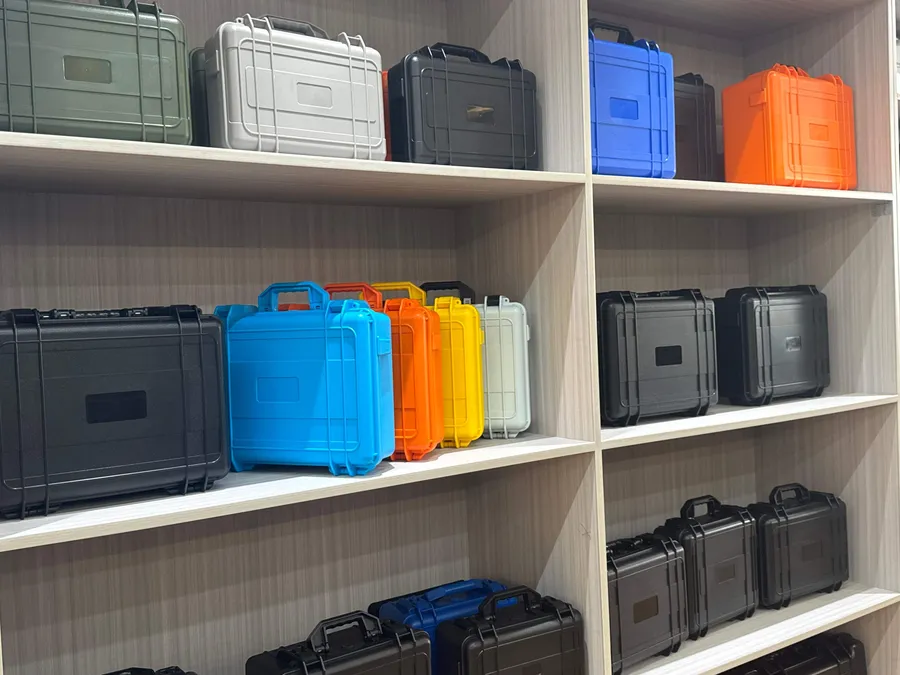
Stackability is a word buyers use for two different promises, and the confusion starts there. The first promise is geometric: does this shell physically sit on another shell of the same model without rocking, sliding or resting its lid panel on the case below. That is a question about feet, rim, taper and footprint, all of which a moulding drawing answers and a catalogue can publish. The second promise is structural: does the lower case survive the column above it, loaded, for a stated time. That is a load question, and it is the one almost nobody answers, because it costs a test per configuration. When you compare case stackability across suppliers, you are usually comparing the geometric claim dressed up as the structural one.
We treat the geometric half as publishable and the structural half as not. On our file every model states whether it is stackable, carries moulded feet and gives its external footprint, so a buyer can reason about a column. No model states a stacking load in kilograms, because we have no measured value for it and we will not invent a series-wide number. That asymmetry is the whole method of this page: compare what shape data a supplier gives you, and treat every strength figure as a report request rather than a spec line.
The five fields we ask every supplier to fill in
Send the same short table to every quote on the desk and make the supplier complete it for the exact model you are buying. Two of the five lines will usually come back blank from everybody, including us, and knowing that in advance stops a comparison being decided by whichever vendor was boldest about an empty cell. The third column is what to insist on when a field cannot be filled from a catalogue alone.
| Field On The Sheet | Our 155-Model File Publishes | Demand From Any Supplier |
|---|---|---|
| Stackable, yes or no | 155 of 155: 136 true, 19 false, and the 19 are exactly the wheeled T-series shells | Whether the answer changes once the case is loaded with your content, and how tall a column they will stand behind in writing |
| Moulded feet, present or not | Stated present on 155 of 155 listings | What the feet sit on when stacked - feet into feet, feet into a recess, or rim to rim |
| External footprint, length by width | 155 of 155; largest base 843 by 592 mm, a square 610 by 610 mm option, smallest 120 by 90 mm | The footprint of the packed carton too, not just the bare shell, if you plan pallets by carton |
| Lid and base depth split | 100 of 155; lids from 16 mm to 320 mm, bases from 15 mm to 168 mm, 29 of those symmetric | Which surface the load meets when two units stack - the rim or a flat lid panel |
| Stacking load in kilograms | Recorded as not measured on 155 of 155 listings | Method, applied load, dwell time, specimen state, unit count and pass criteria, or no figure at all |
| Wall thickness (material allowance) | 148 of 155, from 2.0 mm to 6.0 mm, median 3.9 mm | Which wall - base, lid or side - and the tolerance you will check at incoming inspection |
| Empty shell mass, net | 93 of 155, from 100 g to 15,320 g, median 1,480 g | The definition: bare shell, shell with foam, or shell with hardware and carton |
The one stackability field every supplier should give you: yes or no
Stackability as a yes or no is the field we are willing to publish for every SKU, and it is also the field most suppliers hide inside a phrase like 'nestable and stackable design'. On our 155 listings, 136 say true and 19 say false, and the 19 false are not a random sample - they are the entire wheeled T range, every one of which also carries a telescopic handle. Read the other way: every one of our 136 non-wheeled shells, across the 0, 1, 6, 7, 8 and 9 series, is flagged stackable, and none of the 19 T-series shells is. That is a clean rule of thumb a buyer can apply to any catalogue: a protruding wheel set and a handle tube are what take a case out of a stack column, because they make a flat, stable bearing impossible on the lid.
But a flag is a permission, not a rating. It says 'you may put one of these on another'; it does not say how many, how heavily loaded, or for how long. When you compare two suppliers who both print stackable true, the flag has told you nothing that separates them - you have to move to the geometry fields next. And if a supplier prints stackable true on a shell that visibly carries a wheel housing on its top face, ask them to explain the bearing surface, because that is where the promise is being made on faith.
Feet, rim and the load path inside a column
A stack carries load through a path, not through an area. The weight of the column above reaches the case below wherever the two shells actually touch, and on a moulded case that is meant to be the feet or the rim, never the middle of a lid panel. We state moulded feet as present on 155 of 155 listings, which is the least we can honestly promise - it tells you a bearing feature exists, not how much it takes. What you ask a supplier to draw for you is the stacking interface: are the feet on the base of the upper case designed to land in matching recesses on the lid of the case below, or do they meet rim to rim on an open frame. The first resists a column shifting in transit; the second can walk sideways on a truck floor.
This is also why we will not convert a wall thickness into a stack story. Grouping our 148 listings that publish wall thickness, the shell material allowance runs from a thin 2.0 mm on small compact cases to 6.0 mm on the largest 9-series shells, median 3.9 mm. But the thickness that matters for a column is the wall around the rim and the foot, which is a ribbing decision inside the mould, and two cases with identical published wall can stack very differently because the load path is set by where the ribs and feet sit, not by the average plastic allowance.
Lid and base depth: the field that shows you where the load must not land
Depth split is the underused stackability field. On 100 of our 155 listings we publish a separate lid depth and base depth. Across those, lid depths run from 16 mm to 320 mm and base depths from 15 mm to 168 mm, and only 29 of the 100 are symmetric with lid equal to base. Why it matters: in a deep-lid shell such as the wheeled KX-88442, which lists a 320 mm lid over a 44 mm base, almost the whole height is the lid, so when two stack, the lower case is mostly lid panel under the upper case's feet. That is a geometry you must check, not assume. On a shallow-lid case the rim carries the load almost immediately and the flat panel is largely protected.
The compact end shows the opposite pattern. KX-1204 lists a 16 mm lid and 16 mm base, a 120 by 90 by 40 mm external shell with 2.6 mm walls and a 100 g empty mass - a small case that stacks rim-on-rim all day and whose column behaviour is dominated by how you ballast it inside, not by the shell. Between these poles the depth split is your quick read of whether a model is built so a stack load reaches a structural rim or a vulnerable panel, which is exactly the kind of comparison a spec sheet should let you make without a test.
Footprint: how a case stacks and how it palletises are the same shape
Footprint does double duty: it decides how square a column stands and how many fit on a pallet. The largest external base area in our file is 843 by 592 mm, shared by three big shells, and near it sit a 733 by 505 mm base on the 8-series field cases and a genuinely square 610 by 610 mm option, KX-96127, which is a wheeled, non-stackable shell. A square footprint stacks cleanly in any rotation and wastes little pallet deck; a long, narrow one such as KX-89616 at 956 by 408 mm gives you a stable column only along one axis and forces a specific pallet orientation. Down at the compact end the smallest footprint is 120 by 90 mm on KX-1204, where a column can be tall and still sit inside one hand.
Because footprint links the stack question to the pallet question, we also publish carton footprint on 64 listings and pieces per carton on 58, with per-carton counts running from 1 to 40 and a median of 10. The nine listings that ship one case per carton are all large single-unit shells, six of them from the wheeled T range, and that is exactly where a carton-based pallet plan and a case-based stack plan stop agreeing - the big shells go on a deck one at a time, so their stack behaviour is your column design, not their carton design.
Why we do not publish a stacking load, and what to ask for instead
The number most buyers actually want - how many kilograms the bottom case carries in a column of loaded shells - is recorded as not measured on all 155 listings, alongside payload capacity, pallet quantity and container loading. That is a position, not a gap in our spreadsheet. Our file states the policy plainly: where no test record exists for a model and configuration we will not state a value, and accredited testing can be commissioned as a separate work package. A generic stack figure printed for a shell we have not seen loaded with your content would be a number with your assumptions missing from it, and it would not survive an incoming-inspection audit.
What settles a stackability comparison instead is one document per supplier. Ask for the report behind any load figure they do print and check it names the method and standard version they worked to, the applied load in kilograms, how long that load dwelled, whether the specimen was empty or ballasted to a stated content mass, the conditioning beforehand, the number of units tested and their traceability, and the pass criterion. If the report describes somebody else's configuration, it is evidence about their build, not yours, and it should not move your decision.
Where stackability decides the choice, application by application
For electronics and instrument kits that one person carries and stores on shelving, stackability is mostly a shelf question: the case is a small part of the mass and the column is short, so the yes or no flag plus the footprint is usually enough. For field and equipment transport the fleet itself is the column - palletised layers on a vehicle floor or in a container - so the feet, rim and depth fields are the ones that decide whether a load arrives undamaged, and the 19 wheeled T shells are out of the column before any load figure is discussed. For ammunition storage boxes on a shelf or stacked in a store, the stackable flag and the rim geometry matter more than any printed kilogram.
Long equipment is its own case. KX-89616 lists a 956 by 408 mm footprint with 880 by 350 by 140 mm inside and a 5.0 mm wall, and the 8-series long shell KX-814641 runs 1,356 mm on its longest axis; both are flagged stackable true with no wheels, but they are carried flat by two people and stored on edge, so their stack behaviour is a storage-room design question rather than a transit one. For wheeled transport you already know the answer from our file: none of the 19 T shells stacks.
Custom work, and what actually changes a stack
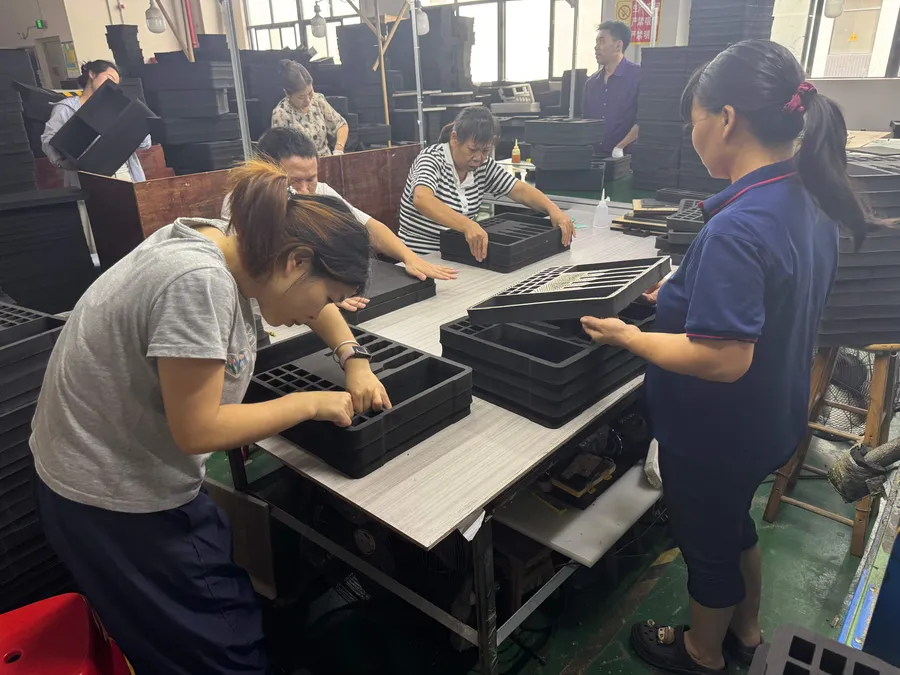
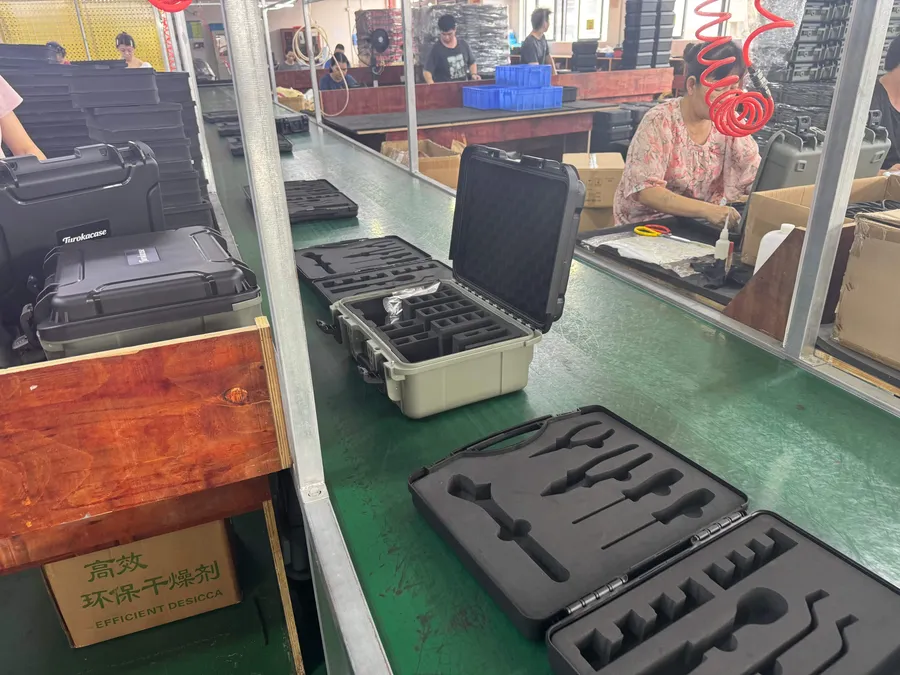
Custom hardware, custom foam, custom colour and custom logo are available across all 155 listings, and most of what a buyer changes affects the interior, not the stack. A denser base foam under a heavy instrument changes how the content meets the shell and how a loaded case behaves in a column, but it does not turn a wall thickness into a rating. The features that do change stackability - the rim, the feet, the rib pattern, a taller or shallower lid - are mould decisions, not order notes, which is why they belong at the tooling conversation and not at the packing list.
The commercial frame is fixed and worth stating before a launch plan rests on it. OEM on an existing mould quotes at 45 days to first sample from a minimum order of 300 pieces; a new mould runs 125 days with a minimum from 3,000 pieces per component; custom colour and custom logo sit at 300 pieces. Payment is a 30 percent deposit with the balance after inspection, terms are EXW or FOB, we work wholesale and OEM or ODM only, we do not sell retail, we do not quote DDP and we hold no overseas warehouse. Accredited testing is quoted as its own work package so it can be scoped to the exact build you order.
Procurement notes on stackability comparisons
Put the five fields into the purchase-order text rather than the email thread, and make the last page of every quotation the completed table so the blank cells line up across vendors. Before batch acceptance, run one witnessed stack trial at your own column height with your own ballast on a pre-production sample from the actual tool - it costs a day and settles a question no catalogue answers. At receiving inspection, stand two units together on the floor and check that the rim and feet seat rather than a flat lid panel, and confirm the stackable flag against what you were billed.
Two extra RFQ lines change what a stackability claim means in service: whether the column was evaluated empty or loaded, and whether a stackable claim assumes aligned feet or allows free placement. Keep every report filed against the configuration and production batch it came from, not the series page. A supplier who can complete the geometry fields, name the bearing surface, and hand you a test against your own content is comparable; a supplier who answers only with the word stackable, including us until your configuration is measured, is not.
Customisation
Everything described above is configurable on a standard shell: interior layout (pick-and-pluck, die-cut or CNC-cut), foam grade and thickness, colour, logo method, latch and lock count, pressure-equalisation valve, cable ports, document holder and identification plate. A bespoke exterior geometry requires a new mould — 125 days, from 3,000 units per moulded component.
Procurement considerations
| Question | What to send us |
|---|---|
| Which shell fits? | Equipment L × W × H as packed, plus required clearance per axis |
| What does it cost? | Order quantity and estimated annual quantity — the two drive different answers |
| Is tooling needed? | Whether an existing shell clears the envelope with usable foam depth |
| Lead time? | Your required delivery date, not just the order date |
| Certification? | The exact standard your tender names — we will say whether we can test to it |
| Freight? | Destination and preferred terms; carton and pallet data supplied with the quotation |
Comparison and selection guide
The tables on this page exist because a protective case is chosen by comparing three things: the envelope, the environment and the handling chain. Where no table applies, the rule below is.
| Situation | What To Do |
|---|---|
| Fastest | Standard shell plus CNC foam — typically 45 days from approved drawing. |
| Branded | Standard shell plus custom colour and logo — MOQ applies to the resin colour. |
| Bespoke geometry | New mould — 125 days, MOQ from 3,000 units per component. |
- Size on internal dimensions plus clearance, never on a product name.
- Choose the carrying method before the shell: it changes the series, not just the price.
- Specify the interior last, and decide up front whether the end user will reconfigure it.
How do buyers compare case stackability across protective case suppliers? relates to Logistics & Packing Guide. Related families: Custom Protective Cases / Equipment Transport Cases / Military Protective Cases / Field Equipment Cases / Ammunition Storage & Transport Boxes / Rolling Cases. Related sectors: field and industrial equipment. Continue in the Logistics & Packing Guide cluster.
This page is written from our own production data. If your requirement differs, send the dimensions and we will tell you which of the 155 models fits, or whether a custom route is needed.


