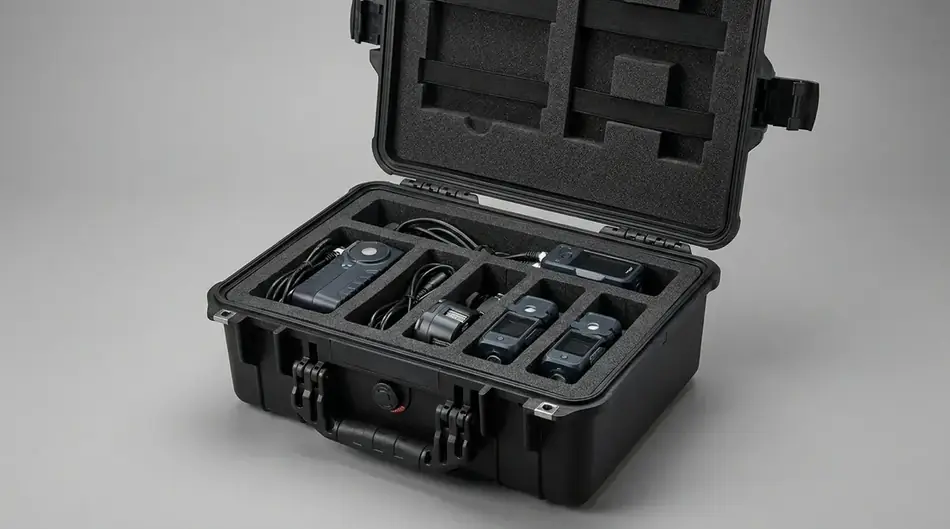
Communication Equipment Transport Packaging Solutions?
Short answer: a communication-equipment packaging solution is three decisions, not one box. Level one is the unit shell that holds the radio, module, tester or antenna; level two is the master carton that carries several shells; level three is the pallet and container plan that carries the cartons. Specify each level from published data rather than from a catalogue family name. Our library gives internal and external dimensions for all 155 shells, wall thickness for 148, empty mass for 93, export carton dimensions on 64 models and pieces per carton on 58. For a handheld fleet, KX 3218 at 308 x 230 x 172 mm internal ships 12 per 645 x 530 x 550 mm carton, while KX 4010 at 390 x 315 x 88 mm ships 10 per 710 x 410 x 500 mm carton. For a repeater or base-station module, KX 6-5522 at 507 x 385 x 190 mm and KX 6621 at 587 x 434 x 192 mm each ship three per carton. For a wheeled field kit, KX 9-6027 at 502 x 337 x 214 mm ships one per 580 x 250 x 415 mm carton. No model publishes an ingress code, a free-fall height, a temperature range, a stack load or an electrostatic shielding figure, so a tender that names one of those needs a test on the exact build.
Key points
- Packaging is a three-level decision: the shell protects the unit, the carton protects the shells, and the pallet plan protects the shipment. Each level has its own published data and its own cost.
- Carton data is published on 64 of the 155 models and pieces per carton on 58, so quote freight from the listed carton rather than from a case volume converted on the back of an envelope.
- One shell per subsystem with keyed foam beats one large shell with loose parts, because a connector or an antenna port is what usually fails between sites.
- A recorded gasket is a construction field, not an ingress rating: 124 of the 155 shells record one, and no model publishes an ingress code or a water and dust result.
- Stackable records the geometry of a shell, not a load rating: KX 3218 records stackable, while KX 9-6027 and KX 8-5022 record non-stackable because both publish wheels and a telescopic handle.
- Custom colour, logo and OEM hardware start at 300 units, OEM work on an existing mould at 45 days, and a new moulded exterior at 3,000 units per component and 125 days.
Three Packaging Levels, And Why They Are Specified Separately
Buyers often ask for a communication equipment case when what they actually need is a packaging system. The two are not the same. A shell with cut foam protects one unit against the handling between a store and a site. It does not protect a stack of cartons on a pallet, and it does not answer the question of how many units fit in a container. Those are separate levels with separate data, separate failure modes and separate costs, and a quotation that mixes them is hard to compare with another supplier's.
Level one is the unit shell. It is chosen from the packed dimensions of the equipment, the mass, the carrying method and the interior layout. Level two is the master carton. It is chosen from the shell's external dimensions, the number of units that can be packed without void fill becoming a handling problem, and the carton strength needed for the pallet stack. Level three is the pallet and container plan. It is chosen from the carton footprint, the stack height and the door height of the container. Each level can be changed without changing the other two, which is why they should be quoted as separate lines.
Communication kit fails in three predictable places, and only one is the shell. A connector fails when a coiled lead pushes an SMA, N-type or BNC plug into a transceiver port. A display or an antenna port fails when something heavy rests on it. A shell fails when it is asked to carry a load that its wall and rim were not designed for. The packaging system addresses all three: foam and compartments address the first two, and the carton and pallet plan address the third. A single case with no carton and no pallet plan leaves two of the three unmanaged.
Level One: The Unit Shell That Meets The Equipment
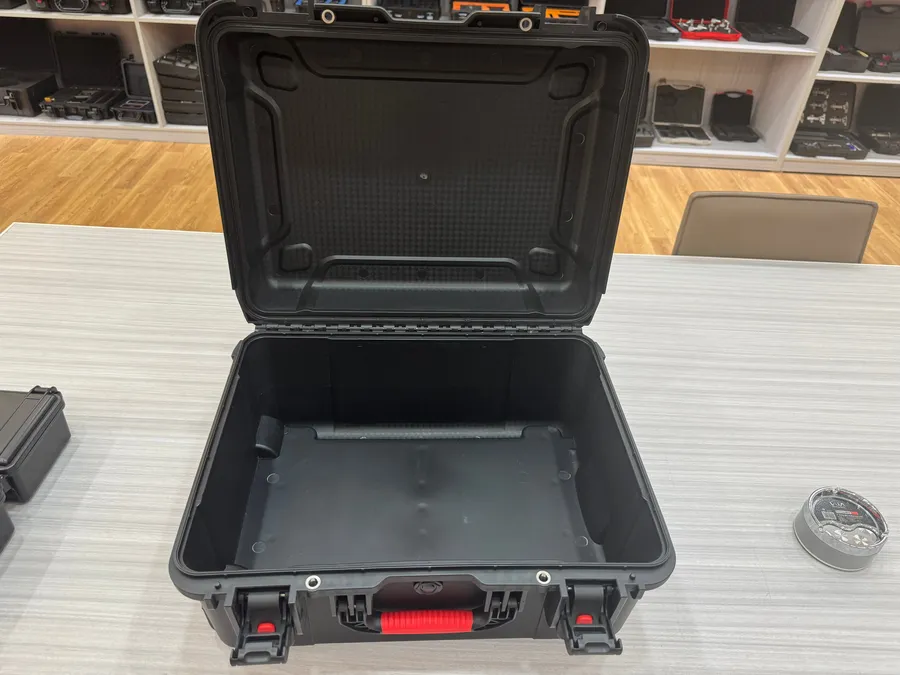
The unit shell is sized on the packed equipment, not on the equipment category. A handheld radio fleet is a shallow-load problem: a charging station, handsets in their boots, spare batteries, speaker mics and a bag of adapters. KX 4010 at 390 x 315 x 88 mm internal, KX 4312 at 420 x 260 x 104 mm and KX 3218 at 308 x 230 x 172 mm cover that range, with KX 3218 giving the most height for handsets left in their boots. A repeater or a base-station module is deeper and heavier, and KX 6-5522 at 507 x 385 x 190 mm, KX 6621 at 587 x 434 x 192 mm and KX 8-6220 at 538 x 408 x 180 mm are the published envelopes that suit it.
A fibre or cable test kit has its own shape: an instrument with a screen, a set of adapters, a launch cable and a cleaning kit. KX 4312 at 420 x 260 x 104 mm and KX 4613 at 455 x 338 x 116 mm are the usual starting points, with the screen faced away from anything that can press on it and a routed channel for the patch cords. An antenna and feeder kit is a long-load problem, and KX 9-6027 at 502 x 337 x 214 mm, KX 8-6127 at 530 x 360 x 248 mm and KX 8-6220 at 538 x 408 x 180 mm are the published options, with KX 9-6027 adding wheels and a telescopic handle for a long carry.
The seal field needs a careful reading. A gasket is recorded on 124 of the 155 shells, in a continuous moulded channel, and 31 record none. That is a construction fact: it tells you whether a compressible gasket is part of the build. It does not tell you what the shell will do in water or dust, because no ingress code and no water or dust result is published for any model. If the route requires a sealed case, ask what the gasket is and how it seats, then decide whether the exact shell, gasket and latch build needs to be tested. The answer is a test report, not a phrase on a quotation.
Level Two: The Master Carton And The Numbers That Make It Useful
The master carton is where a packaging solution becomes a freight calculation. Our library publishes carton dimensions and pieces per carton for the models where the export packing has been recorded, and those two figures are what a forwarder needs. The table below takes eight communication-relevant shells and lists the recorded carton exactly as published. Where a field is blank, the model has no recorded carton in the library and the carton must be quoted for the order rather than assumed from a neighbouring size.
Read pieces per carton before unit price. KX 3218 ships 12 units per 645 x 530 x 550 mm carton, KX 4010 ships 10 per 710 x 410 x 500 mm carton, and KX 4312 ships 10 per 615 x 440 x 560 mm carton. The larger shells drop quickly: KX 6-4621 ships 6 per 740 x 485 x 685 mm carton, KX 6-5522 and KX 6621 ship 3 each, and KX 9-6027 and KX 8-5022 ship one per carton. A buyer comparing two shells on unit price alone may be comparing a 12-per-carton item with a 3-per-carton item, which is a different freight and handling cost per unit.
The carton is also the first place where void fill matters. A shell that is much smaller than its carton needs blocking, and blocking adds labour and removes the volume advantage. A shell that fills its carton needs a carton strong enough for the pallet stack, because the shell's own stacking rim does not carry the carton above it. Neither of those decisions can be made from a case photograph; they are made from the carton dimensions, the pieces per carton and the pallet plan. That is why the three levels are quoted separately.
| Model | Internal Mm | Pieces Per Carton | Carton Mm |
|---|---|---|---|
| KX 3218 | 308 x 230 x 172 | 12 | 645 x 530 x 550 |
| KX 4010 | 390 x 315 x 88 | 10 | 710 x 410 x 500 |
| KX 4312 | 420 x 260 x 104 | 10 | 615 x 440 x 560 |
| KX 6-4621 | 430 x 288 x 186 | 6 | 740 x 485 x 685 |
| KX 6-5522 | 507 x 385 x 190 | 3 | 565 x 450 x 665 |
| KX 6621 | 587 x 434 x 192 | 3 | 665 x 500 x 650 |
| KX 9-6027 | 502 x 337 x 214 | 1 | 580 x 250 x 415 |
| KX 8-5022 | 463 x 370 x 230 | 1 | 495 x 375 x 245 |
Level Three: Pallet, Stack And Container
The pallet is planned from the carton, not from the shell. Take the carton length, width and height and build a footprint that divides into a standard pallet size without an overhang, then set a stack height within the pallet and product limits. Our library does not publish a pallet-loading quantity for any model, so a pallet build is quoted for the order from the recorded carton. Treat any pallet number you see elsewhere as a plan to be checked against the actual carton, because a carton that overhangs a pallet loses the load path through its corners.
Stackability is a per-model field, and it describes geometry rather than strength. KX 3218, KX 4010, KX 4312, KX 6-4621, KX 6-5522 and KX 6621 record stackable. KX 9-6027 and KX 8-5022 record non-stackable because both publish wheels and a telescopic handle, and those parts occupy the face a fixed shell would rest on. No model publishes a stack load. If a pallet plan depends on cases carrying cases, that plan needs a load path that does not rely on an unmeasured capacity.
Container loading follows the same logic. Build the pallet first, then divide the usable container volume by the pallet volume, and check the door height against the loaded pallet height. A carton plan that looks efficient on paper can fail at the door, and a pallet that is stable in the warehouse can be unstable once the container is braked and the load shifts. The calculation and the waste points are set out in our container-loading guide, which uses the same published carton data as this page. The communication-specific point is that a fleet order usually mixes shell sizes, so the pallet plan has to accommodate more than one carton footprint.
Packaging Configurations Compared
The table compares five configurations a communication buyer can order. It is not a product list; each row is a way of combining the three levels. The published-data column says what can be quoted from the library, and the last column says where the configuration usually fits. A configuration that needs a carton or a pallet figure the library does not hold is not unavailable, but it has to be quoted for the order rather than copied from a similar model.
| Configuration | What It Covers | Published Data | Where It Fits |
|---|---|---|---|
| Shell only, hand-carry | One radio set, tester or terminal carried by a person | Internal envelope, wall, empty mass, seal field | Field issue, site visits, single-unit replacement |
| Shell plus custom foam | One instrument with adapters, cables and a screen | All shell fields plus the foam layout quoted from the packed kit | Fibre testers, spectrum analysers, satellite terminals |
| Shells in a master carton | A small fleet moving as one shipment | Carton dimensions and pieces per carton on the models that record them | Dealer stock, depot replenishment, project issue |
| Multi-unit shells in one carton | Identical handheld kits packed for transport | Carton and pieces per carton, where recorded | Radio fleets, event communications, training sets |
| Palletised cartons | Export volume moving by sea or road | Carton data plus stackability; pallet build quoted per order | Distributor orders, annual contracts, tender deliveries |
Choosing By Fleet Size, Route And Handling
For a first order under about 20 units, the simplest solution is a stock shell with a custom foam cut and the recorded carton. The buyer gets a repeatable unit without tooling, and the carton data is enough to compare two freight quotes. At that scale the main risk is not the packaging but the layout: a foam cut made from a photograph rather than a measured kit tends to leave a connector or a charger without a pocket, and the gap is discovered when the first case is packed. Send the actual equipment dimensions and a photograph of the packed layout before the foam is cut.
For a fleet of 20 to 200 units, standardise on one or two shells rather than one shell per equipment type. The reason is operational: a depot that holds one foam layout, one carton size and one colour code can issue and recover kits without a lookup table. KX 3218 and KX 4010 cover a handheld fleet, while KX 6-5522 and KX 6621 cover the deeper modules. At this scale custom colour and logo become available from 300 units, which is useful for identifying a fleet or a project without adding a label that falls off.
For an order above 200 units, the pallet and container plan becomes the main cost lever. The shell choice still matters, but the difference between a 3-per-carton shell and a 12-per-carton shell is now multiplied across the order. Plan the pallet from the carton, check the container door height, and decide whether the order ships as cartons on a pallet or as a mixed pallet of two shell sizes. If the route is air freight, check the carrier's rules for the equipment and any batteries in the kit, because we publish no air-cargo approval for any case.
Foam, Compartments And Cable Management
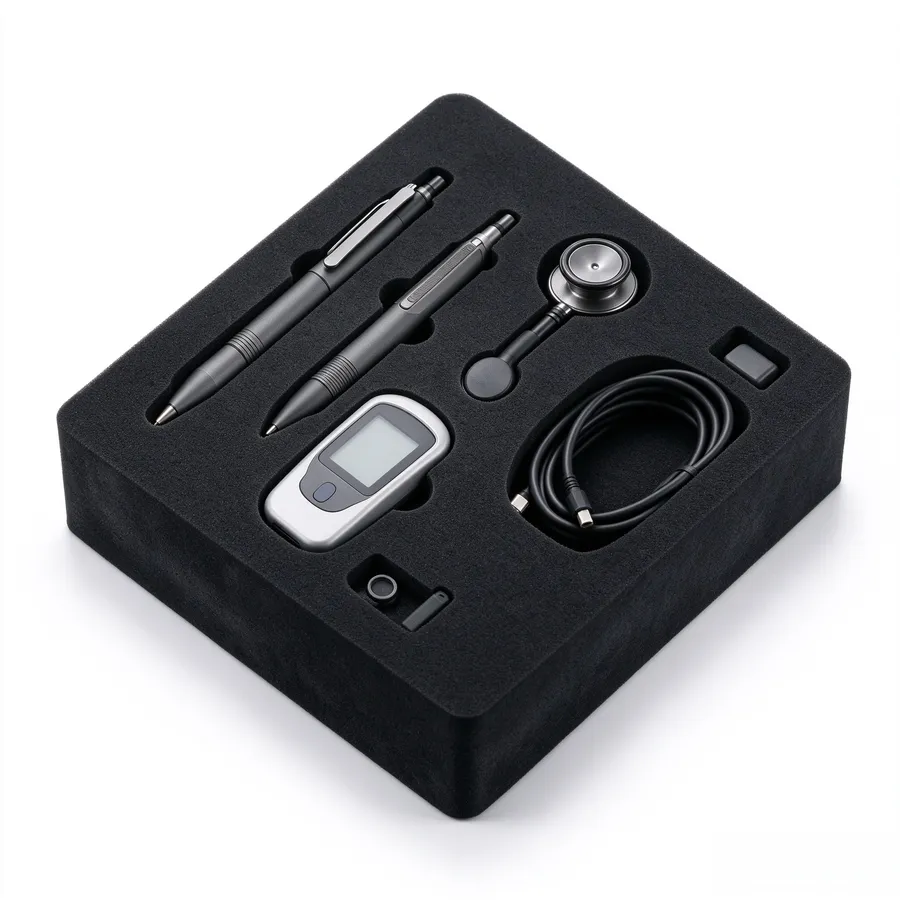
The interior is what turns a shell into a communication case. Our published foam options are pick and pluck, die-cut, CNC-cut, EVA, PE and EPE, arranged as top foam, base foam, egg-crate or convoluted faces, layered builds, or a custom cut by zone. For radio kit the useful build is one pocket per handset, a relieved pocket for the charger with its lead coiled at a working radius, a row of small pockets for adapters and batteries, and a routed channel for the speaker mic cable so it cannot pull on a connector. For a fibre tester the screen gets a relieved face and the adapters get individual pockets rather than a shared tray.
Layer the interior rather than digging one deep hole. A three-layer build with a firm base, a lift-out tray for sub-assemblies and a lid face for consumables keeps the heavy item low and makes a missing part visible at issue. It also lets a crew reconfigure without replacing the case: the tray changes, the shell stays. For antennas and feeders, the long item sets the internal length and the connector ends need their own relief so the shell is not loaded through the connector body. Add about 20 mm per axis for the foam wall, the gasket land and the moulding draft when converting equipment dimensions into internal dimensions.
We publish no electrostatic shielding figure for any model, and no humidity or barrier specification. A buyer who needs those properties should say so in the specification and ask for a test or a separate packaging component that provides them. Foam is a mechanical interface, not an electrical or environmental one, and a case that holds a module securely can still leave an electrostatic requirement unanswered. The honest packaging solution separates the mechanical question from the electrical one instead of implying that one answers the other.
Customisation, MOQ And Lead Times
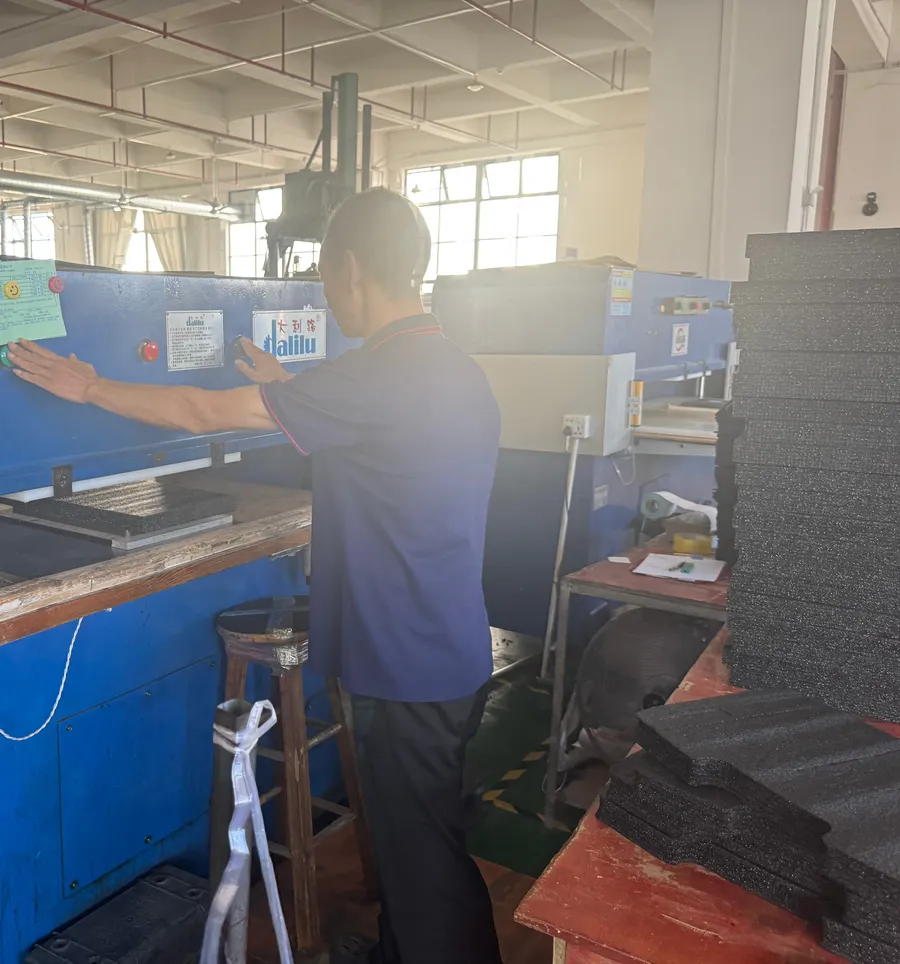
Interior work is the fast path and needs no new tooling. We cut foam to a layout, add lift-out trays, pluck tops, egg-crate faces and routed channels, and configure latches, a padlock provision, a pressure-equalisation valve and a document holder on a standard shell. Custom colour, logo and OEM hardware start at 300 units. OEM work on an existing mould is quoted at 45 days from first sample. A new moulded exterior starts at 3,000 units per moulded component and 125 days, which is the route only when no published envelope clears the equipment.
For a communication fleet, the most useful customisation is often the least visible: a fixed foam layout repeated across every unit, a colour per role, and a label position that survives a depot. Those changes keep the published envelope and the recorded carton, so the logistics data does not change when the interior does. A buyer who changes the shell instead restarts the carton and pallet calculation, which is why the foam-and-label route is usually the better first order and the new-mould route the later one.
A quotation request should carry the packed equipment dimensions, the mass, the number of units in the first order and in a year, the route, the carton or pallet requirement, and the date the units are needed. With those inputs we can name an envelope, say whether the carton is recorded for that model, and quote on EXW or FOB terms. Without them the only honest answer is a range, and a range is not a packaging solution.
What We Do Not Claim
We do not publish an ingress code, a free-fall height, an impact figure, a temperature range, an ultraviolet figure, a stack load, a load capacity or an electrostatic shielding figure for any of the 155 models. Those fields are recorded as not measured for the model and configuration. A gasket field, a wall thickness and a stackable flag are construction facts, and none of them converts into a performance result. If a tender names a standard, tell us the exact standard and the exact build; we will say whether testing can be arranged and quote accredited third-party testing as a separate work package.
We also do not publish customer names, order volumes or delivery references. The configurations on this page are built from our own product database and from the packing data recorded for the models, not from a client's shipment. Where a figure is missing, the page says so rather than filling the gap with a typical value. That is a deliberate policy: a packaging plan built on an assumed carton or an assumed stack load fails at the container door, and the failure is more expensive than the missing number.
Procurement Notes Before A Packaging Order
KeXin New Materials (Guangdong) Co., Ltd. supplies wholesale, OEM and ODM buyers only, on EXW or FOB terms. There is no retail channel, no delivered-duty-paid quotation and no overseas warehouse stock, so a landed cost is built from the FOB figure plus your own freight and clearance. Payment is a 30 per cent deposit with the balance after inspection before shipment. Carton dimensions and pieces per carton are supplied with the quotation where they are recorded for the model, and a pallet plan is quoted from the carton rather than assumed.
The three questions that change a packaging quotation most are the annual quantity, the mix of shell sizes and the route. A single-size pallet is cheaper to plan than a mixed pallet, a sea shipment tolerates a taller stack than an air shipment, and a hand-carry fleet needs wheels and a lighter shell rather than a denser carton. Put those three answers in the request and the quotation can be compared line by line with another supplier's. Leave them out and the comparison becomes a comparison of assumptions.

Applications
This matters most where the case is part of a movement chain rather than shelf packaging. In telecommunications and electronics & instruments and field & deployment the same shell is specified differently because the handling, the environment and the verification requirement differ.
- Telecommunications — Communications equipment is never one object. It is a unit plus a set of accessories that determ…
- Electronics & Instruments — Electronic assemblies rarely fail from a single large impact. They fail from repeated small shoc…
- Field & Deployment — Field deployment removes every assumption a depot specification makes: no forklift, no dry stora…
Customisation
Everything described above is configurable on a standard shell: interior layout (pick-and-pluck, die-cut or CNC-cut), foam grade and thickness, colour, logo method, latch and lock count, pressure-equalisation valve, cable ports, document holder and identification plate. A bespoke exterior geometry requires a new mould — 125 days, from 3,000 units per moulded component.
Procurement considerations
| Question | What to send us |
|---|---|
| Which shell fits? | Equipment L × W × H as packed, plus required clearance per axis |
| What does it cost? | Order quantity and estimated annual quantity — the two drive different answers |
| Is tooling needed? | Whether an existing shell clears the envelope with usable foam depth |
| Lead time? | Your required delivery date, not just the order date |
| Certification? | The exact standard your tender names — we will say whether we can test to it |
| Freight? | Destination and preferred terms; carton and pallet data supplied with the quotation |
Comparison and selection guide
The tables on this page exist because a protective case is chosen by comparing three things: the envelope, the environment and the handling chain. Where no table applies, the rule below is.
| Situation | What To Do |
|---|---|
| Battery isolation | Separate pockets, terminals up, with a physical barrier between cells and connectors. |
| Cable management | Dedicated coiled-cable channels rather than a shared compartment. |
| Field repair | Reserve a small loose compartment for spare fuses, connectors and seals. |
- Size on internal dimensions plus clearance, never on a product name.
- Choose the carrying method before the shell: it changes the series, not just the price.
- Specify the interior last, and decide up front whether the end user will reconfigure it.
Communication Equipment Transport Packaging Solutions? relates to Logistics & Packing Guide. Related families: Communication Equipment Cases / Electronics Cases / Equipment Transport Cases / Custom Protective Cases. Related sectors: Telecommunications / Electronics & Instruments / Field & Deployment. Continue in the Logistics & Packing Guide cluster.
This page is written from our own production data. If your requirement differs, send the dimensions and we will tell you which of the 155 models fits, or whether a custom route is needed.