How can case size affect logistics efficiency?
Case size affects logistics efficiency because every step in a supply chain measures the outside of the box, not the equipment inside it. A larger external envelope means fewer units per carton, less stable pallet stacking, more wasted cube in a container, and more floor space at each handling node. The internal volume is only useful if it is close-fitted to what actually goes inside, because the difference between an oversized and a well-sized case is paid in freight, pallet slots and depot time. Across our catalogue of 155 models the external longest side ranges from 120 millimetres to 1,356 millimetres and the internal volume from 0.3 litres to 139.5 litres, and the models that pack efficiently are the ones where the outer dimension is chosen to nest with its neighbours rather than to fit only the product photograph. Buyers who pick the smallest shell that clears the equipment envelope plus a working margin, and who prefer stackable geometry over wheeled geometry when the end user can carry the case, consistently move more useful units in fewer shipments than buyers who size on the interior alone.
Key points
- Logistics measures the external envelope and the carton footprint, so pick the smallest shell that clears the equipment.
- Stackability turns vertical cube into usable capacity; 136 of our 155 models are marked stackable.
- Wheels and telescopic handles add outer volume, so use them only when the end user needs to roll the case.
- Pallet fit and container figures are calculated from the carton footprint against your pallet, not fixed claims.
- Right-sizing to the equipment envelope with about 20 mm of clearance beats the next size class on flow and cost.
Why size is a logistics variable, not just a fit variable
A case is selected for what goes inside it, but it is moved, stacked, warehoused and invoiced on the strength of what is outside it. That mismatch is the whole reason size behaves like a logistics lever. A pallet, a shipping container, a truck bay and a depot shelf each have a fixed geometry, and they reward the case whose external footprint tiles cleanly against them. The internal volume that a buyer optimises for does not appear in any of those calculations; the supplier's outer carton dimensions and the number of finished cases nested in each carton are what appear. The practical implication is that the sizing conversation should happen with the packing data on the table, not with a foam layout alone.
Our catalogue makes the point concrete: internal volume runs from 0.3 to about 139.5 litres and the external longest side from 120 to 1,356 millimetres across 155 models. Two cases with similar interiors can have very different shipping behaviour depending on whether their outer rims nest, whether latches and handles sit inside the box profile or stand off it, and whether the shell is designed to take weight on its lid.
The two sizes that decide flow
It is worth separating the internal envelope, which is about protecting the equipment, from the external envelope, which is about moving it. The internal envelope has to clear the equipment in its transport configuration with room for the foam, so a working margin of about 20 millimetres per axis is the kind of figure a buyer aims for. The external envelope then has to tile against a pallet and a carton, and that is where the next size class up costs you: a case that just clears the equipment fits a dense nesting carton, while a case chosen for comfort often drops you into the next carton and halves your pieces per carton. The difference between a 40-unit carton of a small case and a single-unit carton of a larger case is not a rounding error; it is the bulk of the freight bill and most of the pallet slots.
Packing density and pallet fit
Packing density is where case size converts most directly into logistics efficiency. A stackable shell whose lid takes weight lets a packer build a stable column, which means a pallet is filled to its height limit rather than its footprint limit. A shell that does not stack forces a single layer and wastes the vertical space the load could have used. On our published packaging, a WL2005 nests forty pieces into a 410 by 360 by 495 millimetre carton, while a WL5723 ships one to a carton and a WL9-7227 trolley ships one at 715 by 515 by 280 millimetres. Same task of carrying equipment, entirely different pallet and container behaviour, because size and stackability together decide the packing density.
| Size Class | Example | External Mm | Stackable | Pieces Per Carton | Flow Effect |
|---|---|---|---|---|---|
| Compact utility | WL2005 | 195 x 170 x 46 | Yes | 40 | Tiles densely, fills pallet height, low freight per unit |
| Mid instrument | WL6-3317 | 328 x 232 x 167 | Yes | 8 | Fewer per carton; footprint still regular for stacking |
| Large single case | WL5723 | 572 x 405 x 227 | Yes | 1 | One-off carton; efficiency rests on stack height |
| Rolling trolley | WL8-8442 | 843 x 592 x 415 | No | 1 | Wheels block stacking; single layer, high cube use |
Handling footprint at each node
Size also decides how much working space a case demands at every place it is touched. A small case can be picked, scanned and shelved one-handed at a distribution node; a large trolley needs two hands or a hand truck, a wider aisle to turn in, and a floor position rather than a shelf, because 19 of our 155 models ship with wheels and a telescopic handle and are meant to be rolled, not stacked. That is a legitimate design choice for a depot or a field point where the operator moves the case by hand across short distances, but it changes the flow: rolling cases do not reclaim vertical space, and their outer wheel housings push the billable footprint up even when the interior is modest.
The trade-off is a service level one rather than a pure cost one. If the last metre of a journey is a person pulling a case along a corridor, the wheels earn their volume. If the last metre is a forklift moving a pallet, a stackable boxy shell with no protrusions wins on flow, because it tiles cleanly and lets the pallet carry more units to the same destination.
How to right-size a case for a logistics flow
Start from the equipment in its transport configuration, add the foam allowance and roughly 20 millimetres of clearance per axis, and then look for the smallest existing shell that clears that envelope, because each size class you cross is another jump in outer carton and another drop in pieces per carton. Where the same kit could go in one large case or in two stacked smaller cases, price both against the destination: two nested small shells often beat one big shell by sea, and the arithmetic can flip by air if the extra carton void outweighs the nesting gain. Prefer a stackable shell unless the end user genuinely needs to roll the case. And before you commit, read the published outer dimensions, not the internal volume, because those are the numbers your forwarder will plan against.
Where case-size discipline matters most
The penalty for oversized cases is paid hardest in high-frequency distribution: field equipment, communications and radio kits, optronics and instrument sets, medical kits and spares that move repeatedly between a central store and many destinations. In those flows a few centimetres of unnecessary external size multiply across dozens of shipments, and stacking discipline can be the difference between filling a container and shipping air. Deployment-scale cases for drones and battery sets, or long equipment cases for masts and survey gear, behave differently: the outer geometry is set by the item itself, so efficiency comes from nesting, stackable rims and internal organisation rather than from shrinking the shell. The defence and field categories we sell into, which span 45 models under defense equipment cases and 71 under equipment transport cases, cover both of those patterns.
Customisation and modularity effects
Size is not only about the shell; it is about how a case is re-used. A modular interior, a fixed carrier for the primary item plus a pluck layer above it, lets one case size serve several similar items over its life, which means a fleet can standardise on fewer outer dimensions and pack better overall. A single expensive CNC cut tuned to one exact envelope can be the wrong logistics choice precisely because the next version of the equipment needs a new case. When we quote custom work the shell usually stays as-is: a printed logo or a body colour change sits on the existing geometry and keeps the same carton, at a 300-piece minimum each; a new mould at 3,000 pieces per component and about 125 days creates a new external size and therefore a new packing calculation. The freight and flow consequences of a custom mould need the projected carton numbers before the decision, not after.
Procurement notes: sizing questions to ask
Treat the supplier's answers about size as packing data, not specifications. Ask for external dimensions, net weight and stackability per model, all of which we publish. Ask for the outer carton dimensions and pieces per carton, and expect them per configuration. Ask how the case tiles against your standard pallet and what that implies for pallet quantity, and expect the pallet and container figures, the 20GP, 40GP and 40HQ numbers, to be calculated from the carton footprint and supplied with the quotation rather than quoted from memory. Confirm the terms, which for us are wholesale or OEM on ex-works or free-on-board basis, and plan the main-carriage and destination side with your forwarder. We do not sell retail, we do not offer delivered-duty-paid pricing, and we hold no overseas warehouse stock, so an efficiency plan has to be built around a direct factory-to-destination shipment sized on these real dimensions.
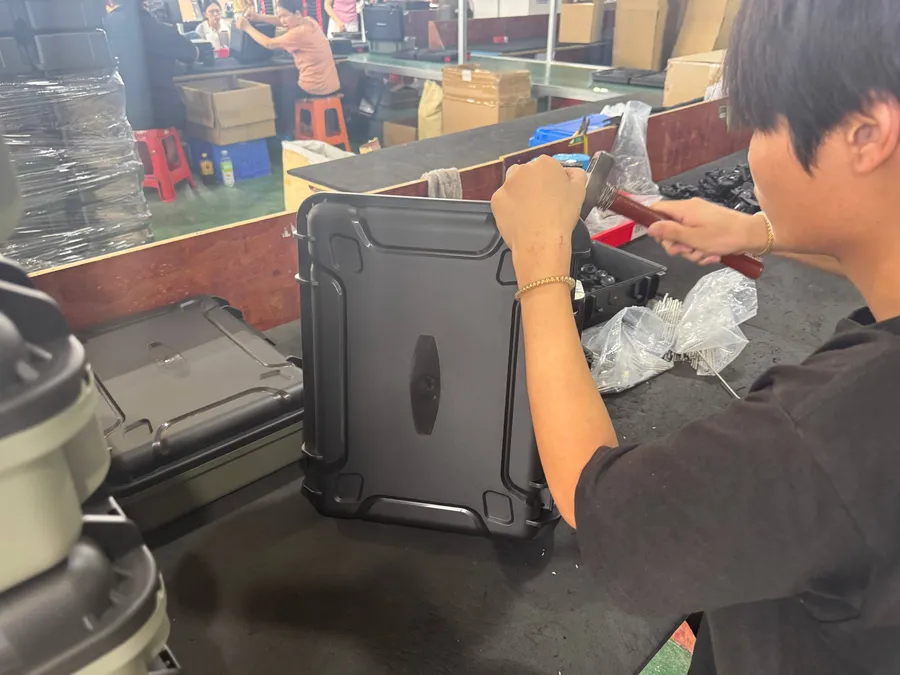
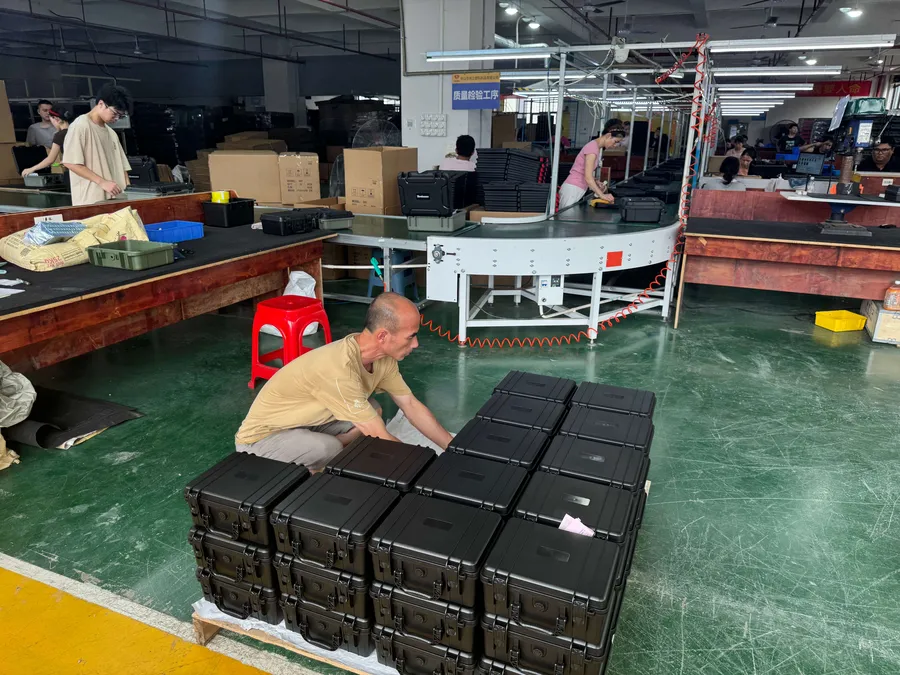
Customisation
Everything described above is configurable on a standard shell: interior layout (pick-and-pluck, die-cut or CNC-cut), foam grade and thickness, colour, logo method, latch and lock count, pressure-equalisation valve, cable ports, document holder and identification plate. A bespoke exterior geometry requires a new mould — 125 days, from 3,000 units per moulded component.
Procurement considerations
| Question | What to send us |
|---|---|
| Which shell fits? | Equipment L × W × H as packed, plus required clearance per axis |
| What does it cost? | Order quantity and estimated annual quantity — the two drive different answers |
| Is tooling needed? | Whether an existing shell clears the envelope with usable foam depth |
| Lead time? | Your required delivery date, not just the order date |
| Certification? | The exact standard your tender names — we will say whether we can test to it |
| Freight? | Destination and preferred terms; carton and pallet data supplied with the quotation |
Comparison and selection guide
The tables on this page exist because a protective case is chosen by comparing three things: the envelope, the environment and the handling chain. Where no table applies, the rule below is.
| Situation | What To Do |
|---|---|
| Free-drop height | With a 50 mm base foam layer, a 15 kg assembly sees a markedly lower peak deceleration than with 20 mm. Where the case is handled by hand off a vehicle, we specify the deeper base. |
| Stacking | A case that will be shipped stacked needs a wall thickness and rim geometry that carries the load through the shell, not through the lid. |
- Size on internal dimensions plus clearance, never on a product name.
- Choose the carrying method before the shell: it changes the series, not just the price.
- Specify the interior last, and decide up front whether the end user will reconfigure it.
How can case size affect logistics efficiency? relates to Logistics & Packing Guide. Related families: Defense Equipment Cases / Equipment Transport Cases / Military Transport Cases / Rolling Cases. Related sectors: field and industrial equipment. Continue in the Logistics & Packing Guide cluster.
This page is written from our own production data. If your requirement differs, send the dimensions and we will tell you which of the 155 models fits, or whether a custom route is needed.