What affects case handles for a hard-shell equipment case?
Four things decide it: the mass a person actually puts a hand under, the shell envelope that decides where a grip can be moulded, the tooling line the handle belongs to, and whether the same case must also stack, rack and be lifted two-handed. On our published 155-model file the handle field takes exactly two values - fixed folding on 136 listings and telescopic plus fixed folding on 19 - and a fixed folding handle is recorded on all 155. The 19 telescopic listings are exactly the 19 T Series shells that publish two wheels and exactly the 19 that publish stackable as false. An extended handle height is published on 11 of those 19, from 240 mm to 485 mm with a median of 295 mm. What no listing states is a handle count, a grip length, a handle material or any load figure for the handle itself - and the number the grip has to carry, net weight, is published on 93 of 155 listings, from 100 g to 15,320 g with a median of 1,480 g. So what affects case handles is a sequence: loaded mass first, then the envelope the mould left to work with, then which tool the shell came from, then whatever a supplier will write down before the sample is approved.
Key points
- Handle type is published on 155 of 155 listings and takes two values only: fixed folding on 136 shells, telescopic plus fixed folding on 19.
- No listing states a handle count, a grip length or a handle material, so those three lines belong on your RFQ sheet for every supplier you shortlist.
- Loaded mass is the first driver: net weight is published on 93 of 155 models, from 100 g to 15,320 g, median 1,480 g, with 62 listings leaving it blank.
- The 19 telescopic listings are exactly the 19 wheeled shells and the 19 that publish stackable as false, so the handle choice is a carrying-method choice.
- Extended height is published on 11 of those 19, from 240 mm to 485 mm with a median of 295 mm; the other eight models are open questions, not zeroes.
- 26 of the 43 shells whose longest axis reaches 500 mm are published fixed-folding only, so length by itself never decided the handle on our tooling.
- A grip added where the mould has no bosses is new tooling - about 125 days and MOQ from 3,000 per component - not a 45-day configuration change.
What affects case handles: the four drivers, in order
A handle is the only part of a hard shell that a person puts their body weight against, so the first driver is mass - not the mass of the grip, but the mass of the loaded case that hangs from it. Our file publishes an empty-shell net weight for 93 of 155 models, running from 100 g on KX-1204 to 15,320 g on KX-88442, with a median of 1,480 g and a mean of about 2,985 g, and 62 listings state dimensions but no net weight at all. Contents and cut foam sit on top of every one of those figures. A grip moulded into a 120 mm accessory shell and a grip moulded into an 843 mm trolley body carry the same word in a catalogue and are entirely different pieces of engineering once a person lifts them.
The second driver is the envelope: how long, how wide and how deep the shell is decides how much wall a grip can be moulded into and where along the rim it can sit without fighting the latch line or the hinge. The third is tooling, because a folding handle boss, a telescopic channel through the base and a strap anchor are all steel, which is why our file records exactly two handle values and why the 19 telescopic shells are one moulding family rather than an option spread across the catalogue. The fourth is documentary: whatever a supplier will put in writing against a named model before you approve a sample. The first three are physics; only the fourth can be enforced on a purchase order.
The handle fields a published file states, and the ones it does not
Run this list across our own 155 listings and then across any competitor catalogue on your shortlist, and the shape of the answer is the same everywhere. Presence and type are honest fields: a fixed folding handle is recorded on 155 of 155, a telescopic handle on 19, an extended height on 11, a hinge on 155, moulded feet on 155 and a latch body that accepts a standard padlock on 155. Component detail is where every catalogue thins out. Our file states no handle count per shell, no grip length or standoff, no handle polymer or metal, and no load figure for the handle itself; its material table records hardware as metal or polymer by configuration rather than fixed per model, and shoulder strap is carried as an option with a value on none of the 155.
| Handle Field On The Specification Sheet | What Our Published File States | What To Ask Any Supplier |
|---|---|---|
| Handle type | A value on 155 of 155 listings: fixed folding on 136, telescopic plus fixed folding on 19 | Which string belongs to the SKU you are buying, and is it on the approved drawing or only in the photograph |
| Fixed folding handle present | Recorded on all 155 listings, including all 19 shells that also carry a telescopic unit | Whether the folded grip sits inside the external dimension or stands proud of it |
| Telescopic extended height | Published on 11 of 19 telescopic listings, from 240 mm to 485 mm, median 295 mm | Extended and retracted figures plus the number of stages, measured on that shell |
| Number of handles and grip positions | Stated on 0 of 155 listings - there is no handle-count field anywhere in the file | A marked drawing showing every grip and its distance from the centre of mass |
| Grip length, opening and standoff | Stated on 0 of 155 listings | Clear opening for a gloved hand, and the gap between grip and shell wall |
| Handle material | Stated on 0 of 155; hardware is recorded as metal or polymer by configuration | Which polymer or which metal ships on the batch, and whether it is the part priced |
| Load figure for the handle | Stated on 0 of 155; load capacity and stack load are recorded as not measured on all 155 | The method, the specimen state and the report number behind any rating they quote |
| Shoulder strap | Held as a configuration option with a value recorded on 0 of 155 listings | Whether the anchor points are moulded in at the tool stage or added afterwards |
Carried mass, published: the band a grip has to serve
Mass is the driver a handle specification has to answer first, and it is the one our file publishes least evenly. A net weight is stated on 93 listings: 61 models sit at or above 1,000 g, 36 at or above 2,000 g, 28 at or above 3,000 g and 24 at or above 4,000 g. Every one of the 19 telescopic listings publishes a figure, from 4,912 g on KX-85021 to 15,320 g on KX-88442 with a median of 8,500 g, while the 136 fixed-folding listings publish weights on 74 listings with a median of 1,200 g and a maximum of 6,420 g on KX-6621. Somewhere above four kilograms of empty shell, a one-handed grip carry stops being a normal behaviour, and that line is crossed by folding-grip cases as well as by rolling ones.
The heaviest fixed-folding listings make the argument better than any generalisation: KX-6621 at 6,420 g on a 662 by 495 by 210 mm plan, KX-6922 at 6,140 g on 685 by 500 by 220 mm, KX-65522 at 4,860 g, KX-5321 at 4,810 g and KX-5723 at 4,680 g are mid-size or deep-body shells that carry a folding grip, record zero wheels and state stackable as true. For those models the handle is a two-person assist and a racking feature as much as a carrying aid - which is exactly why grip count and grip position, neither of them published, are questions to put to a supplier rather than assumptions to draw off a photograph.
Where a grip has room to sit: the catalogue by series
Series is a proxy for envelope, and the envelope is where grips physically fit. Our file splits into seven tooling families: 0 Series with 23 listings described as mini and compact utility cases, 1 Series with 7 small protective cases, 6 Series with 20 mid-size equipment cases, 7 Series with 6 large equipment cases, 8 Series with 62 heavy-duty large cases, 9 Series with 18 deep-body heavy cases, and T Series with 19 telescopic rolling cases. Only the T Series records a telescopic handle; the other 136 listings record fixed folding, every non-T listing states stackable as true, and all 19 T shells state it as false. Across the whole file the longest external axis runs from 120 mm to 1,356 mm with a median of 432 mm, and 43 shells reach or pass 500 mm on that axis - 17 of them telescopic, 26 of them not.
Read that split as a moulding fact rather than a preference. A long, narrow shell such as KX-814641 at 1,356 by 154 by 408 mm has rim wall running its whole length and no room for a wheel channel, so it is published fixed-folding, stackable and without a mass figure. KX-88421 keeps the same 843 by 592 mm plan used by two T Series shells at 212 mm deep and is published with zero wheels and stackable as true. Same footprint, opposite carrying system, decided per tool. When a buyer asks what affects the handle, the honest answer is often: which of these tools the shell came out of.
Deep lids, the latch line and the swing of a loaded cover
A handle shares its rim with everything else moulded there. Our file records a hinge on all 155 shells, moulded feet on all 155 and a latch body that accepts a standard padlock on all 155, while the latch count itself is specified per configuration rather than per model - so that geometry conversation happens at drawing stage on every order. Lid depth is published on 100 listings and runs from 16 mm to 320 mm with a median of 98 mm. Eleven shells carry a cover of 200 mm or deeper: KX-88442 at 320 mm, KX-88337 at 280 mm, KX-86836 at 270 mm, KX-87336, KX-85835 and KX-86136 at 260 mm, KX-88434 at 240 mm, KX-84430 at 230 mm, KX-86830 at 210 mm, and KX-84825 and KX-86127 at 200 mm.
Depth changes what the handle has to do. A deep cover filled with cut foam swings hard when it is opened one-handed, and the grip that arrests it sits on the lid rim rather than on the base. Of those eleven deep-lid shells, the three fixed-folding ones - KX-84430, KX-84825 and KX-86127 - publish no net mass at all, which means their worst case is a deep lid plus contents on a folding grip with no published number behind either half of it. Wall thickness, published on 148 listings from 2.0 mm to 6.0 mm with a median of 3.9 mm, is the other half of that story, because a grip boss is only as good as the wall it is moulded into.
The telescopic handle is a rolling-system part, not a handle upgrade
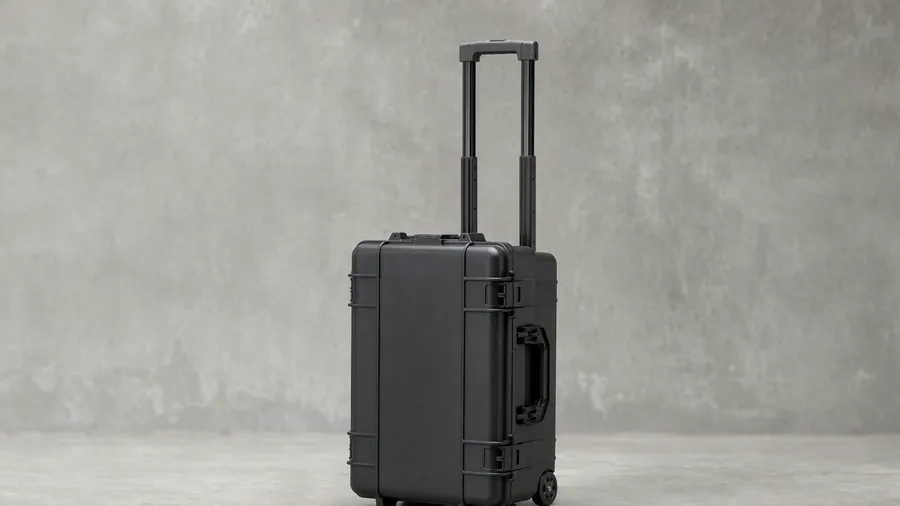
In our file a telescopic handle never appears on its own: all 19 listings that record one also record two wheels, and no listing records wheels without a telescopic handle or a telescopic handle without wheels. That is a system rather than a grade, and it explains the publishing gap. An extended height is stated on 11 of the 19 - 295 mm on five shells, 240 mm on two, 310 mm on two, 385 mm on KX-85726 and 485 mm on KX-97227, the tallest figure in the file - while eight rolling shells state none. KX-97227 also shows why the number matters independently of the shell: 485 mm of extended travel on a body that stands 270 mm tall puts the grip well above the lid line, which is what a tall operator wants on a long pull and what a low rack deck cannot accept.
An empty cell is not a zero. The eight rolling models without a published figure - KX-85021, KX-85022, KX-5126, KX-85424, KX-85427, KX-96027, KX-96127 and KX-66232 - all carry the same two-part hardware record, so the reach exists and only the number is missing from the datasheet. Put the raised envelope into every shelf pitch, vehicle floor and lift doorway before you accept a configuration, and at sample stage check that the stages latch cleanly at each height and that the folded side grip still seats flat.
Selection guidance: match the handle to the carry, not to the catalogue
Work the decision in this order. First, name the longest uninterrupted stretch of smooth ground the case will travel; if that stretch is short, the carrying method is a lift, and a folding grip plus a second pair of hands is the specification. Second, take the loaded mass - published empty weight plus your equipment and foam - and ask who lifts it and how often. At a median of 1,200 g our fixed-folding shells are a single-person carry, while at the 8,500 g median of the telescopic set the case is a two-person lift the moment the wheels stop helping. Third, decide whether the case has to stack, because in this catalogue the stacking answer and the telescopic answer are one number read backwards: 136 stackable shells with no wheels, 19 non-stackable shells with both.
Fourth, check the rim you will actually grip. Deep-lid shells need the cover arrested one-handed, so a lid-side grip and its boss position matter more than the base handle; long, narrow shells need grips placed so the case stays level instead of pivoting about its centre of mass, which is why a marked drawing is worth more than a specification adjective. Fifth, write down what nobody has published yet - handle count, grip geometry, handle material and any load figure - and require each of them as a stated value on the drawing you approve, from us as much as from anyone else.
Applications: what the carry pattern changes
Different programmes load the handle differently. Field and deployment kits move from person to person over ground that ends the wheels, so the folding grip and a second position on the far side carry the real load; the deep-body listings that publish 3,430 g on KX-5021 up to 6,420 g on KX-6621 are the ones worth interrogating about grip count, because none of them states how many grips the shell has. Electronics and instrument programmes are the heaviest per litre and the least forgiving of a case dragged by one corner, so a rehearsed two-hand lift at sample stage tells you more than any handle material claim - and no handle polymer is published on any listing here.
Customising handles: configuration work or new tooling
Custom hardware is recorded as available on all 155 listings, and hardware material is stated as metal or polymer by configuration rather than fixed per model. Within an existing tool, configuration work covers substituting an equivalent bought-in handle on the same fixing, changing grip or hardware colour, fitting bolt-on parts to moulded inserts, and specifying the grip and latch arrangement your own drawing shows. Those routes are quoted against OEM terms on an existing mould: about 45 days to first sample from a MOQ of 300 pieces, with custom colour and custom logo also at 300 pieces, and standard cases and custom foam at a MOQ of 1.
A new grip position, a telescopic channel in a shell tooled without one, or an anchor cut across the gasket line is a moulding change rather than an accessory: on our commercial frame that is about 125 days with a MOQ from 3,000 pieces per component. Converting a stackable folding-grip shell to the telescopic system would also forfeit the stacking rim that the same listing publishes as true, so we price it as tooling, freight and carrying decisions in one line. The frame itself is fixed: wholesale and OEM or ODM only, quoted EXW or FOB, no retail orders, no DDP terms and no overseas warehouse, with a 30 percent deposit and the balance after your inspection; third-party factory inspection is welcome.
Procurement notes: putting handles onto the order
A handle specification survives receiving inspection only if the purchase order carries it. Put on the order: the handle type string for the named model, which fields are stated and which are explicitly marked as unspecified, the extended and retracted figures for any telescopic unit, the marked drawing showing grip positions relative to the latch line and the hinge, and the stacking status you accepted. Ask for the spares position in the same exchange - grip assemblies, stanchions and fixings are serviceable items, and a small spares kit against a fleet order costs far less than a case taken out of service mid-deployment because a grip fixing could not be replaced.
Send us the equipment dimensions in its packed configuration, its mass, a written description of the route including every lift, stair and racking deck, and the mass a single operator is allowed to handle. The answer comes back with published figures for named models, the model page link beside each number, and an explicit statement of which values are measured and which our file records as blank. Fred Zhao, KeXin Sales Team, WhatsApp +86 135 3588 0002. Written by KeXin New Materials (Guangdong) Co., Ltd.
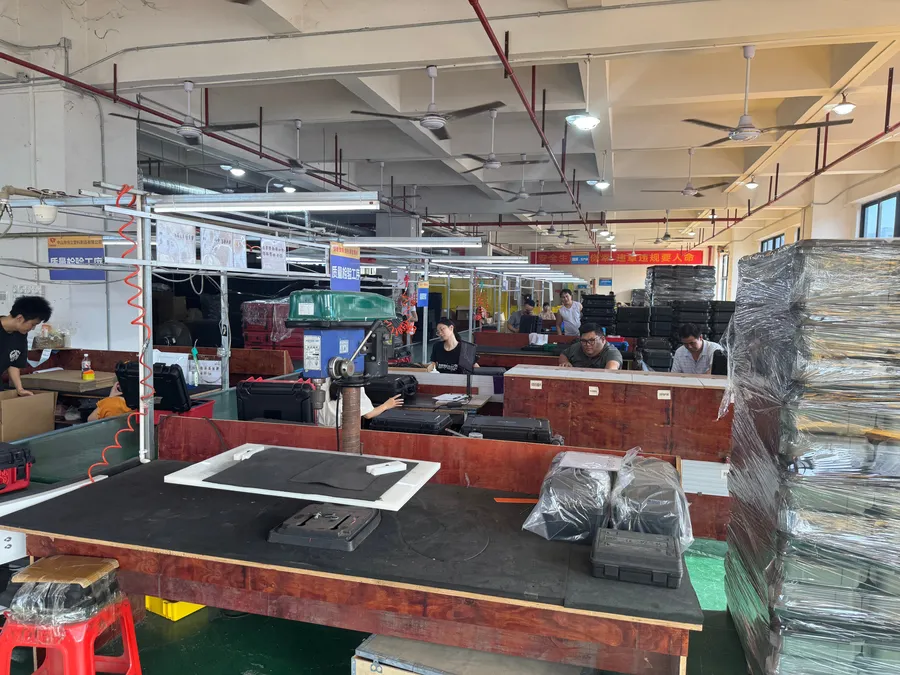
Customisation
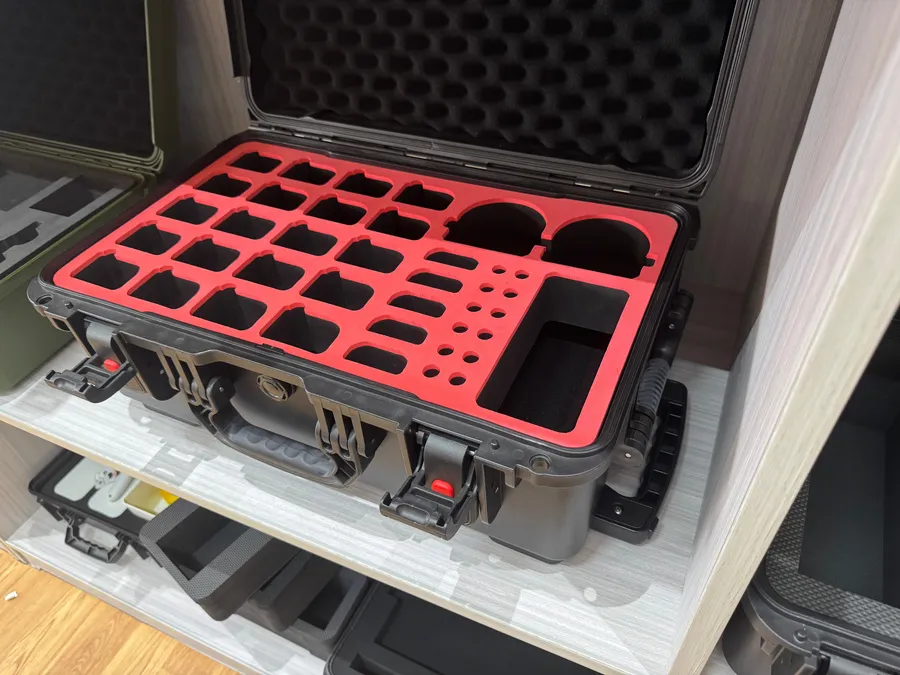
Everything described above is configurable on a standard shell: interior layout (pick-and-pluck, die-cut or CNC-cut), foam grade and thickness, colour, logo method, latch and lock count, pressure-equalisation valve, cable ports, document holder and identification plate. A bespoke exterior geometry requires a new mould — 125 days, from 3,000 units per moulded component.
Procurement considerations
| Question | What to send us |
|---|---|
| Which shell fits? | Equipment L × W × H as packed, plus required clearance per axis |
| What does it cost? | Order quantity and estimated annual quantity — the two drive different answers |
| Is tooling needed? | Whether an existing shell clears the envelope with usable foam depth |
| Lead time? | Your required delivery date, not just the order date |
| Certification? | The exact standard your tender names — we will say whether we can test to it |
| Freight? | Destination and preferred terms; carton and pallet data supplied with the quotation |
Comparison and selection guide
The tables on this page exist because a protective case is chosen by comparing three things: the envelope, the environment and the handling chain. Where no table applies, the rule below is.
| Situation | What To Do |
|---|---|
| Start from the equipment, not the case | Measure the tallest, widest and longest points of the packed equipment including antennas, handles and connectors. Add 20 mm minimum clearance per axis before selecting a shell. |
| Then choose the carrying method | Under 8 kg, a fixed handle is lighter and cheaper. Over 12 kg or any journey over 30 m, specify the T series with telescopic handle and wheels. |
| Then decide the interior | Pick-and-pluck for kits that change. Die-cut or CNC-cut for fixed layouts that must be auditable at a glance. |
- Size on internal dimensions plus clearance, never on a product name.
- Choose the carrying method before the shell: it changes the series, not just the price.
- Specify the interior last, and decide up front whether the end user will reconfigure it.
What affects case handles for a hard-shell equipment case? relates to Logistics & Packing Guide. Related families: Military Protective Cases / Equipment Transport Cases / Rolling Cases / Custom Protective Cases / Electronics Cases / Tool Cases / Field Equipment Cases / Tactical Equipment Cases. Related sectors: field and industrial equipment. Continue in the Logistics & Packing Guide cluster.
This page is written from our own production data. If your requirement differs, send the dimensions and we will tell you which of the 155 models fits, or whether a custom route is needed.