How do buyers compare case palletization across protective case suppliers?
Case palletization is compared on inputs, because the result is yours, not the supplier's. On our file of 155 active models the field you would expect to settle the question - a pallet quantity in pieces or cartons - is recorded as not measured on 155 of 155 listings, with the note that it is calculated from the carton footprint against your pallet size, and container loading for 20GP, 40GP and 40HQ is likewise not measured on 155 listings and supplied with the quotation instead. So the honest comparison is a two-number audit plus one piece of arithmetic. The two numbers: carton footprint, which we publish on 64 of 155 listings, and pieces per carton, published on 58 of 155 and running from 1 to 40 with a median of 10. The arithmetic is how many of those footprints tile across your deck and how many layers fit under your cube-out height. A supplier who gives you both numbers for the model you are buying, and will run the tiling against your actual pallet and container, is comparable. A supplier who prints a generic cases-per-pallet figure with no carton dimension and no pallet size attached is not, and neither are we, because that number carries your assumptions, not ours. Gross mass is published on 0 of 155 listings, so a freight model also has to ask which weight definition every number is built on.
Key points
- Ask for carton footprint and pieces per carton together by model: we publish footprint on 64 of 155 listings and pieces on 58, and a deck plan needs both or it is arithmetic nobody can check.
- Pallet quantity is recorded as not measured on all 155 listings because it is calculated from your pallet size - so compare suppliers on inputs and on running your deck.
- Six of our carton-publishing models carry no pieces figure, and nine shells ship one per carton, six of them wheeled - the two places a carton-based pallet plan and a case-based plan diverge.
- Container loading for 20GP, 40GP and 40HQ is not measured on 155 of 155 and supplied with the quotation, because a floor-loaded container and a palletised one are different numbers from the same shells.
- Carton height is the layer-count variable most buyers forget: our published carton heights run from 232 mm to 755 mm with a median of 540 mm, which sets how many tiers fit under a cube-out height.
- Mass underpins the freight model and has a hole in it: net shell mass is published on 93 of 155 listings (100 g to 15,320 g, median 1,480 g) but gross as shipped on 0, so pin the definition.
- If a tender names a pallet or container figure we do not hold, we say so in the quotation and compute it from your deck and container rather than inherit a series-wide number.
What case palletization actually asks a supplier to give you
Palletization is not one number, and treating it as one is where purchasing files go wrong. A buyer usually wants 'how many cases on a pallet', but that single figure is the product of at least five inputs: the carton footprint, the pallet deck you actually use, whether you allow overhang, how tall you can stack before the load is unstable or exceeds a shelf or container ceiling, and whether you are shipping cases loose, in cartons, or as a mixed pallet of several models. A supplier who hands you one printed number has silently chosen all five of those for you, and almost certainly not the way your warehouse or your forwarder works.
So the useful comparison is not whose pallet number looks better - it is whose inputs are complete and whose arithmetic is transparent. We publish the carton footprint and the pieces per carton for the models where we have them, and we decline to publish a pallet count, because the honest version of that figure has your pallet size inside it. This page shows you how to run the same comparison against any supplier: check the inputs, then make them do the tiling on your deck.
The five fields we ask every supplier to fill in
Send the same five lines to every quote and have the vendor complete them for the exact model you intend to buy. Some will come back empty from everybody, including us, and the point is to see the blanks line up across bids instead of letting the most confident-sounding catalogue fill them with a guess.
| Field On The Sheet | Our 155-Model File Publishes | Demand From Any Supplier |
|---|---|---|
| Carton footprint, length by width | 64 of 155 listings; footprints from 410 by 360 mm up to 730 by 630 mm | The packed carton outer, not the bare shell, and the units it is measured in |
| Pieces per carton | 58 of 155 listings; from 1 to 40, median 10, with 18 listings at 20 or more | The figure for the model and interior you are ordering, not a range average |
| Carton height | 64 listings, from 232 mm to 755 mm, median 540 mm | Height so you can compute layers under your cube-out or shelving limit |
| Pallet quantity, cases or cartons | Recorded as not measured on 155 of 155; the file says it is calculated from carton footprint against your pallet | Their worked tiling on your named pallet size and your overhang rule |
| Container loading, 20GP / 40GP / 40HQ | Not measured on 155 of 155; supplied with the quotation | Whether it assumes palletised stacks, a locked column set, or a floor-loaded container |
Carton footprint and pieces per carton: the two numbers a deck plan needs
Almost every pallet decision reduces to two fields, and both are easy to ask for. Footprint tells you how many cartons tile across a deck; pieces per carton converts cartons into the units you are buying. On our file the smallest published carton footprint is 410 by 360 mm on the compact KX-2005, which ships 40 cases per carton, and the largest footprints cluster around 730 by 630 mm on the KX-3607, KX-3608 and KX-3609 shells. Between those extremes sit workable mid-size decks such as KX-2305 at 480 by 370 mm with 40 per carton and KX-2507 at 505 by 430 mm with 20.
Read the two together and a deck plan appears: a small, high-count carton like KX-2005 gives you hundreds of units on one pallet and rewards tight tiling, while a large, low-count carton turns the pallet into a single-layer handling question. Pieces per carton on our 58 publishing listings run from 1 to 40 with a median of 10, and 18 of them sit at 20 or above. That spread is why a bare 'cases per pallet' headline is meaningless without the carton footprint and the count in front of it - two models with similar shell sizes can differ by an order of magnitude in units per deck simply because one ships nested twenty deep and the other one at a time.
Where the file has holes, and what to ask when it does
An honest palletization comparison has to survive the blank cells, and ours has two kinds. The first is footprint without a piece count: six listings that publish a carton - KX-3607, KX-3608 and KX-3609 among them - state no pieces-per-carton figure, so you can lay the boxes on a deck but you cannot convert them to units without asking. The second is the single-case carton: nine listings ship one case per carton, and six of those nine are from the wheeled T range, whose shells are too big and too awkward to nest. For that group a carton-based pallet plan and a case-based one are the same thing, and the pallet becomes a one-layer-tall handling problem rather than a tiling problem.
The correct move when you hit a hole is to make the supplier state the assumption, not to borrow a neighbouring model's number. Ask which configuration the blank would be filled for, and get the missing field in writing before the figure enters your freight model. A vendor who quietly copies a sibling model's count into your carton's empty cell has given you a plausible-looking number that is wrong for the thing you are buying.
The arithmetic we run against your pallet
Here is the calculation, worked on our own published carton numbers so you can see the shape of it - this is method, not a figure we ship as a specification. Take KX-2005 with a 410 by 360 by 495 mm carton at 40 pieces. On a 1200 by 1000 mm deck, tile the 360 mm edge across the 1200 mm side - three cartons, using 1080 mm - and the 410 mm edge along the 1000 mm side - two cartons, using 820 mm - which gives six cartons per layer, or 240 cases per layer. At a 495 mm carton height two layers stand just under a metre of load, so the deck fills long before it hits a container ceiling, and the constraint becomes carton count and your weight limit rather than height. Change the pallet to 1200 by 800 mm and the same cartons tile differently, which is exactly the point.
Now run the reverse case. KX-96127 ships one case per carton in a 640 by 625 by 280 mm box; on the same 1200 by 1000 deck only two of those footprints fit across, so the pallet holds two units a layer and the arithmetic collapses to a handling question, not a tiling question. Neither result is a published pallet figure; both are your deck multiplied by our carton inputs, and the reason we hand you the inputs instead of the answer is that a number printed without your pallet size, your overhang rule and your cube-out height would be wrong for most of the people who read it.
Bare-case loading versus carton loading
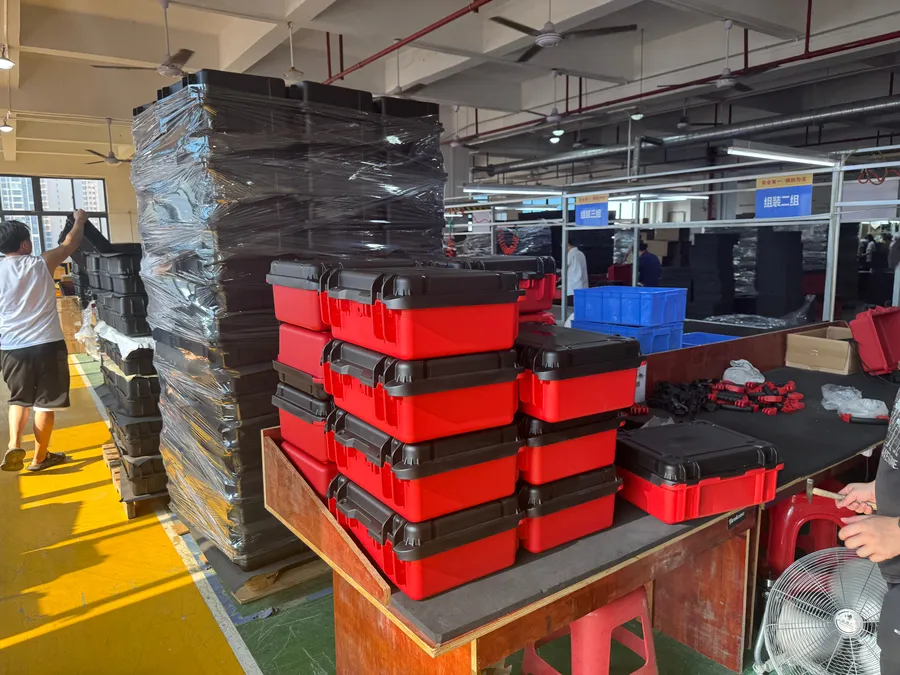
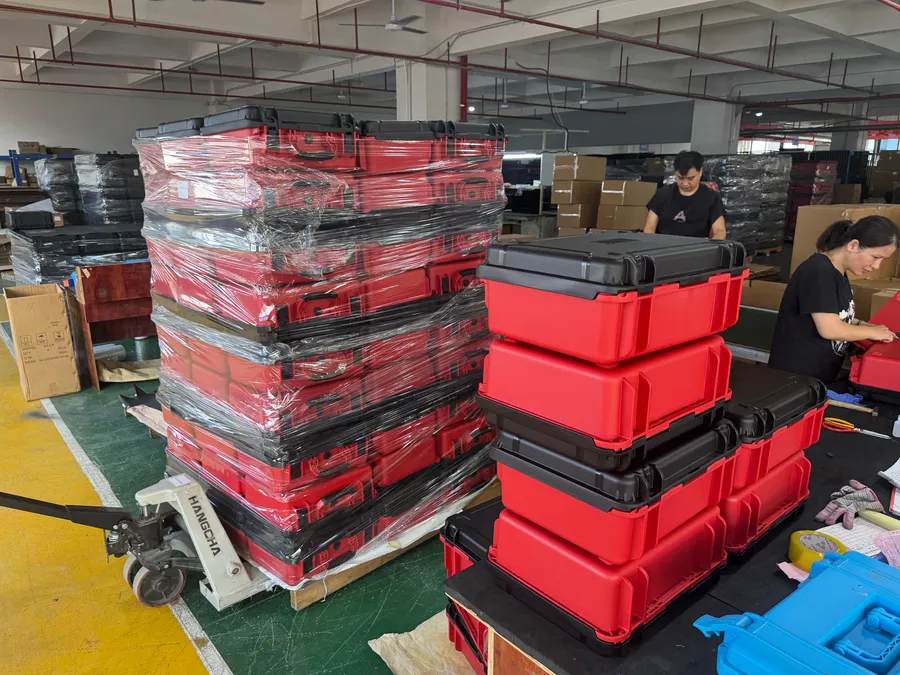
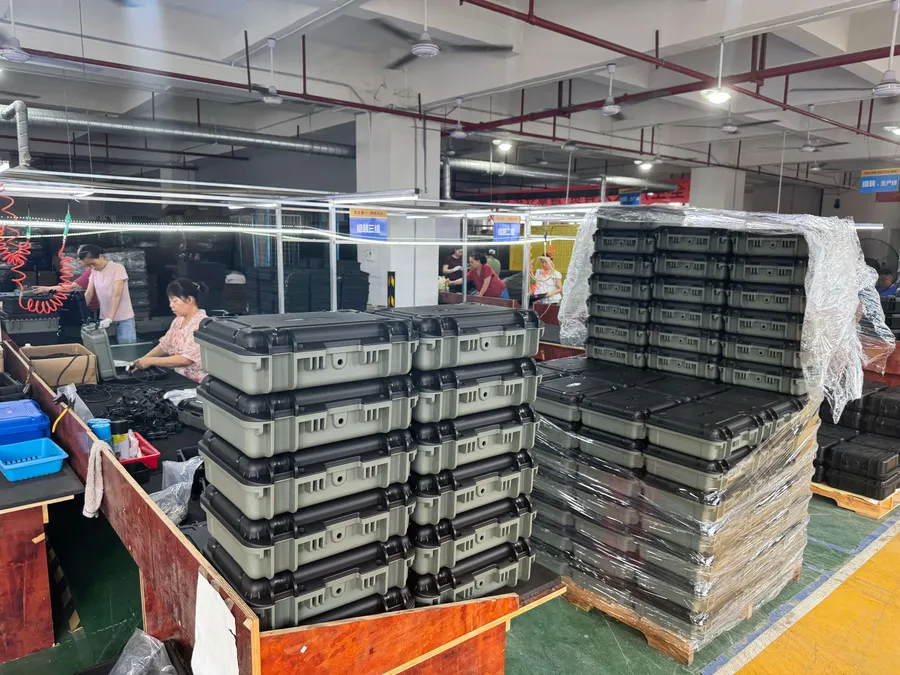
Some buyers palletise the shells loose, some palletise the cartons, and the two give different counts from the same product. Loose shell loading uses the external footprint of the case, which for our largest bases is 843 by 592 mm shared by three big 8-series field shells and 610 by 610 mm on the square KX-96127. Carton loading adds the box and the nesting, which is where the high piece counts come from - the 410 by 360 mm KX-2005 carton carries forty cases that would never tile forty-deep as loose shells. Decide which mode your forwarder is actually quoting you, because a per-pallet figure built on nested cartons and a warehouse that receives loose shells will disagree badly.
The 19 non-stackable wheeled shells matter again here. They are not in a vertical column by design, so on a deck they go one layer deep and are separated rather than stacked, which lowers per-pallet density and shifts the problem from height to footprint. If your plan assumes you can two-high anything, confirm the stackable flag first: we publish it for all 155 models, 136 true and 19 false, and the false ones set your pallet ceiling to a single layer.
Container loading, and why it is a quotation line and not a catalogue line
Container loading for a 20GP, 40GP or 40HQ box is the same arithmetic taken to a wall, and it is one of the fields we deliberately leave to the quotation. Our file records it as not measured on all 155 listings with the note that the figures are supplied with the quotation, because a container number depends on decisions the case maker cannot know at catalogue time: whether you ship palletised stacks or floor-load loose cartons to squeeze more units in, whether you mix models, which door height you tie to, and whether the destination accepts a taller column. Print a container count against a shell nobody has seen loaded, and you have produced a number with your freight assumptions missing from it.
This is also where palletisation and containerisation split into two different supplier questions. A palletised container is limited by deck times deck height times number of tiers, and it unloads fast. A floor-loaded container trades unload time for unit count and needs clean, uniform cartons and a stacking order the case can survive. Ask every supplier which mode their container figure assumes before you compare two bids, because a 20 percent gap between them is frequently a palletised-versus-floor-loaded difference wearing the disguise of better packing.
Mass fields a freight model needs and does not get
A pallet and a container are also limited by weight, and the mass data has a gap exactly where freight needs it. Net shell mass is published on 93 of our 155 listings, from 100 g to 15,320 g with a median of 1,480 g; the wheeled T range publishes all nineteen of its masses, from 4,912 g to 15,320 g, while the 74 non-wheeled listings that publish mass median 1,200 g. Gross as shipped is published on 0 of 155 listings, and that is a position rather than an oversight - a gross figure is only meaningful with a packing scope, and packing scope is agreed order by order.
The practical instruction for a comparison is to pin the definition before accepting any weight. Ask each supplier whether their number is bare shell, shell plus foam, or shipped carton, because a freight model built on shell mass and a vendor quote built on shipped-carton mass will differ by a wide margin without either party having misreported anything. Where your load planning needs the shipped figure, give us the interior you want and the packing you require and the gross becomes ours to state for that order.
Where palletization decides the choice, application by application
For high-volume electronics and instrument kits shipped in compact shells, palletisation is mostly a tiling-and-count exercise and rewards models with small cartons and high piece counts; here the 410 by 360 mm, forty-per-carton pattern is the one that fills a deck and a container efficiently. For field and equipment transport the shells are large, often one-per-carton or few-per-carton, and the binding constraints become footprint, layer height and the stackable flag rather than units per pallet. For ammunition and storage boxes destined for a shelf, carton footprint has to match the store's racking module as well as the deck.
Long equipment breaks the grid entirely. KX-89616 is a 956 by 408 mm shell and the 8-series KX-814641 runs 1,356 mm on its longest axis; neither tiles neatly on a standard deck, so those ship floor-loaded or on edge, and the palletisation conversation turns into a container-interior conversation. Match the plan to the shape class before you ask any supplier for a count, or the count will be for a load you cannot build.
Custom work, and what changes a pallet plan
The fields that move a pallet number most are the ones you can set on an order: the interior foam layout decides how many cases nest into a carton, and custom packaging is available across all 155 listings, so a carton is a design choice rather than a fixed attribute. Changing foam density or tray depth changes pieces per carton, which flows straight through to units per pallet; it does not change the shell's external footprint. Getting a supplier to state the carton for your chosen interior, rather than for their default, is the single most effective edit you can make to a deck plan.
The commercial frame is fixed and should be in the comparison so bids are like for like. OEM on an existing mould quotes at 45 days to first sample from a minimum order of 300 pieces; a new mould runs 125 days with a minimum from 3,000 pieces per component; custom colour and custom logo sit at 300 pieces. Payment is a 30 percent deposit with the balance after inspection, terms are EXW or FOB, we work wholesale and OEM or ODM only, we do not sell retail, we do not quote DDP and we hold no overseas warehouse - all of which decide who books the container and on whose deck the loading is planned.
Procurement notes on palletization comparisons
Put the five fields, your pallet size, your overhang rule and your container list into the RFQ as a table every vendor completes, and make the last page of each bid your worked tiling rather than their headline count. Before you commit a freight budget, ask two suppliers to produce the per-pallet and per-container numbers for your exact model and interior on your exact deck - the one who cannot is telling you their catalogue figure was never meant to be used the way you are using it.
At receiving, verify the carton against the sheet: measure the footprint, count the pieces, weigh a shipped carton, and check it against the numbers that built your freight quote. Keep every pallet and container calculation filed against the model and the production batch it came from, not against the series page. A palletisation comparison is only as trustworthy as the day the inputs were last measured on the thing you were actually shipped.
Customisation
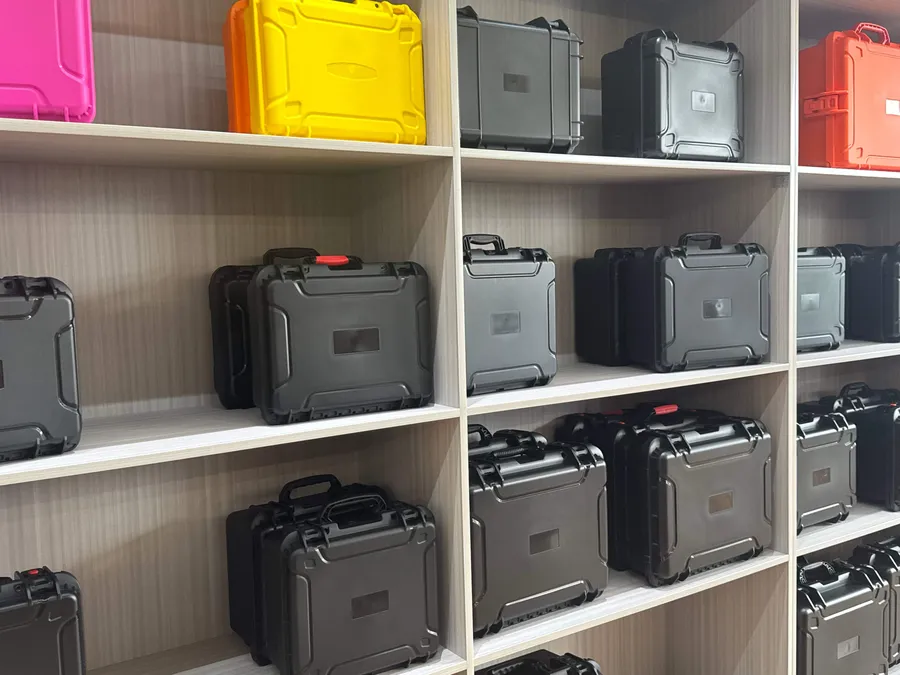
Everything described above is configurable on a standard shell: interior layout (pick-and-pluck, die-cut or CNC-cut), foam grade and thickness, colour, logo method, latch and lock count, pressure-equalisation valve, cable ports, document holder and identification plate. A bespoke exterior geometry requires a new mould — 125 days, from 3,000 units per moulded component.
Procurement considerations
| Question | What to send us |
|---|---|
| Which shell fits? | Equipment L × W × H as packed, plus required clearance per axis |
| What does it cost? | Order quantity and estimated annual quantity — the two drive different answers |
| Is tooling needed? | Whether an existing shell clears the envelope with usable foam depth |
| Lead time? | Your required delivery date, not just the order date |
| Certification? | The exact standard your tender names — we will say whether we can test to it |
| Freight? | Destination and preferred terms; carton and pallet data supplied with the quotation |
Comparison and selection guide
The tables on this page exist because a protective case is chosen by comparing three things: the envelope, the environment and the handling chain. Where no table applies, the rule below is.
| Situation | What To Do |
|---|---|
| Fastest | Standard shell plus CNC foam — typically 45 days from approved drawing. |
| Branded | Standard shell plus custom colour and logo — MOQ applies to the resin colour. |
| Bespoke geometry | New mould — 125 days, MOQ from 3,000 units per component. |
- Size on internal dimensions plus clearance, never on a product name.
- Choose the carrying method before the shell: it changes the series, not just the price.
- Specify the interior last, and decide up front whether the end user will reconfigure it.
How do buyers compare case palletization across protective case suppliers? relates to Logistics & Packing Guide. Related families: Custom Protective Cases / Equipment Transport Cases / Military Protective Cases / Military Transport Cases / Field Equipment Cases / Electronics Cases. Related sectors: field and industrial equipment. Continue in the Logistics & Packing Guide cluster.
This page is written from our own production data. If your requirement differs, send the dimensions and we will tell you which of the 155 models fits, or whether a custom route is needed.


