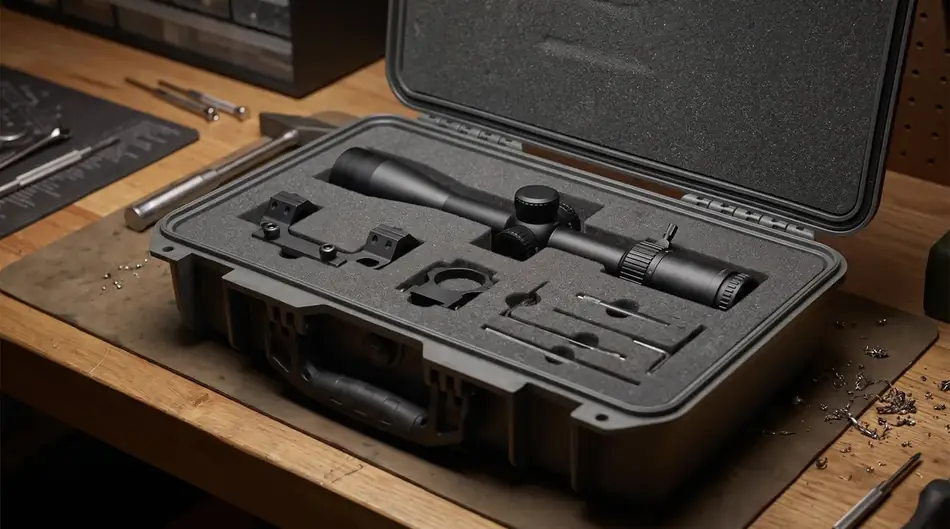
Industrial tool transport case: what an everyday working case has to survive
An industrial tool transport case is specified from four facts before any price is discussed: the tool list and its heaviest item, the way the case moves from van to bench, the interior layout that shows what is missing, and the environment it meets. Volume alone does not decide it, because a 27 litre case can be too short for a 480 mm torque wrench and a 24 litre case can be right. On our sheet, 120 of 155 models carry the tool-case tag, 115 of those record a wall thickness between 2.0 mm and 5.8 mm, 91 offer a seal as a compressible gasket in a continuous moulded channel, five are trolley cases with wheels and a telescopic handle, and the interiors accept pick and pluck, die-cut or CNC-cut foam in EVA, PE or EPE. Working load, stack load, dust, water and temperature are recorded as not measured, so the loaded case is assessed as a whole rather than from a rating. This article covers the published numbers, the layout choices, instrument and motor-part duty, and the OEM terms.
Key points
- The duty cycle, not the shell, defines an industrial case: two openings a day for years is a different brief from a one-way shipment.
- 120 of 155 models carry the tool-case tag, 91 of those are sealed and five are trolleys with wheels and a telescopic handle.
- Wall thickness is recorded per model up to 5.8 mm on this group, but working load and stack load are not measured.
- A cut foam layout gives the missing-tool check in one glance; a pick and pluck grid is the cheapest option and the first to loosen.
- Dense parts need a base foam or dividers to spread point loads, plus a carry method that matches the mass.
- Settle the packed kit, the route and the interior before colour or logo; those three decide the model and the price.
What defines an industrial tool transport case
The industrial part is not the shell; it is the duty cycle. A tool transport case leaves a workshop van, crosses a yard, gets stacked in a store, comes back with the tools still in their places, and repeats that twice a day for years. Four facts decide the specification: the tool list and its heaviest item, the way the case moves, the interior layout that shows what is missing, and the environment it meets. Price follows those four, and colour follows price.
Most enquiries start in the wrong place, with a litre figure or a photograph of a competitor case. A litre figure tells you volume and nothing about the longest tool, the point load of a torque wrench, or whether the lid will close on a socket set left in its tray. Start with a packed list and one photograph of the tools laid out as they will travel. That is enough to shortlist a shell and to price a foam layout, and we ask for it before quoting a custom interior.
What the sheet publishes for tool-class cases
Of 155 shell models, 120 carry the tool-case tag and 115 of those record a wall thickness, running from 2.0 mm to 5.8 mm. Ninety-one offer a seal as a compressible gasket in a continuous moulded channel and 29 are plain shells intended for dry storage and frequent access; five are trolley models with wheels and a telescopic handle; shell material splits into 68 polypropylene, 32 engineering polypropylene and 20 ABS. The instrument-case tag covers 115 models, 96 of them sealed and eight on trolleys. The protection block records water, dust, temperature, UV, stack load and working load as not measured on these models, and no ingress code is printed anywhere on the sheet.
| Property | What The Sheet Records | How To Use It |
|---|---|---|
| Property | What the sheet records | How to use it |
| Tool-case models | 120 of 155 carry the tag; 115 record a wall | Shortlist by internal size first, then read the wall per model. |
| Sealing | 91 sealed with a compressible gasket in a moulded channel; 29 plain | Sealed for dust, rain or a wet yard; plain for a dry store and daily opening. |
| Trolley versions | 5 with wheels and a telescopic handle | Choose by route and mass, not by empty weight. |
| Shell material | 68 PP, 32 engineering PP, 20 ABS | Material follows duty and finish, not prestige. |
| Foam | Pick and pluck, die-cut, CNC-cut in EVA, PE or EPE | A cut layout is the only version that gives a missing-tool check. |
| Load and temperature | Working load, stack load, temperature, UV: not measured | Assess the loaded case; ask for conditioning or load data as a quoted scope. |
Interior layout: shadow board, tray, or foam
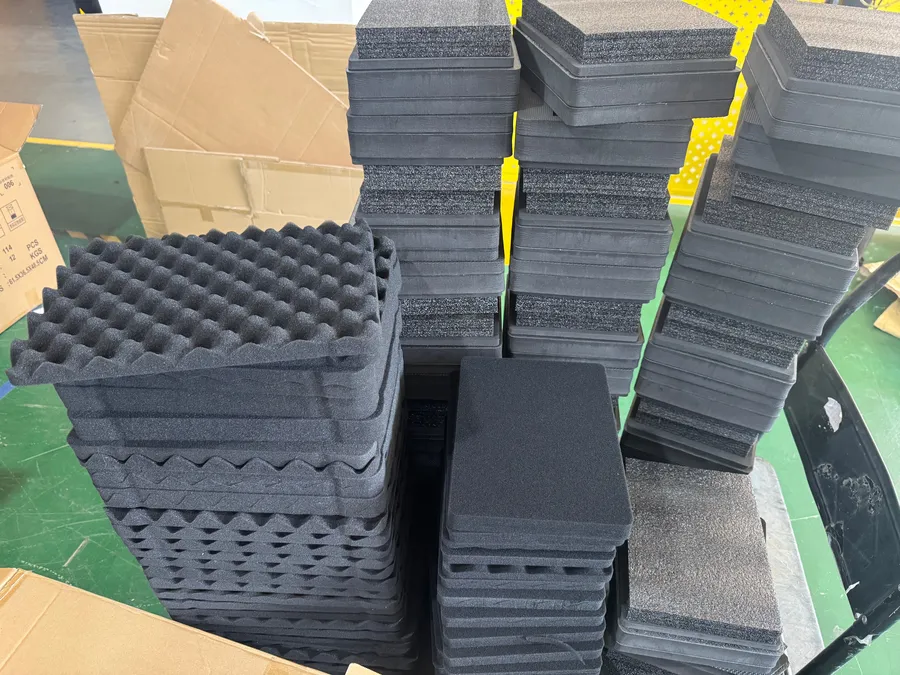
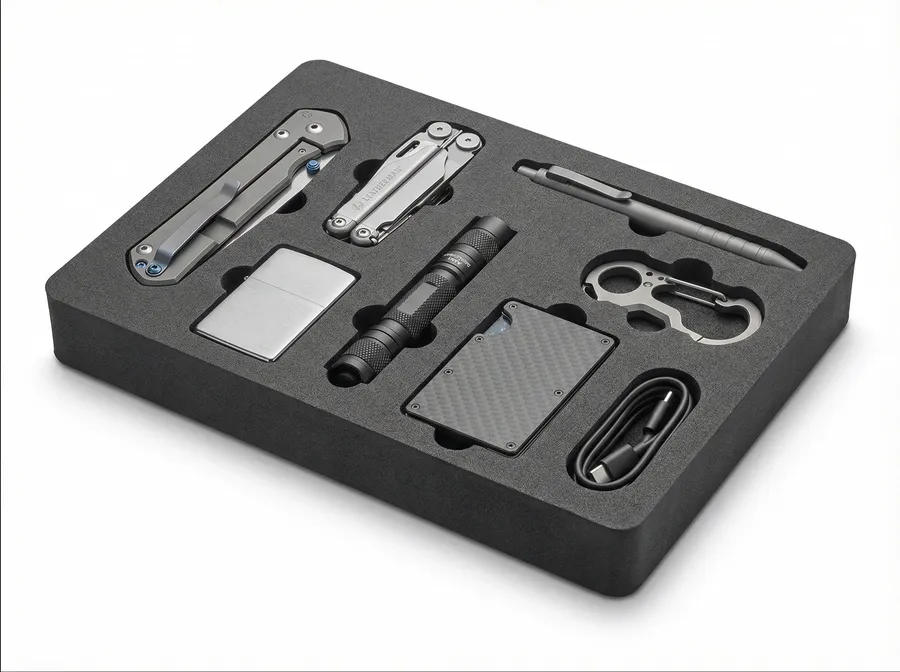
A tool case is judged at the moment a tool is missing. A cut foam layout gives that check in one glance and protects each tool from its neighbours; a tray or a shadow board gives it with faster access but less cushioning; a plain block with a pick and pluck grid is the cheapest compromise and the first to loosen after a year of daily use. Our foam options are pick and pluck, die-cut and CNC-cut, in EVA, PE and EPE grades, with structures that include top foam, base foam, an egg-crate lid layer, a layered set or a custom cut.
We need a drawing, a photograph of the packed kit or a physical sample to cut a layout, and that requirement is recorded on the sheet. Thickness is decided from the gap between the tool and the lid, not from a house rule: too thin and the tool loads the lid; too thick and the latches need force to close, which is the first thing an operator complains about. A layered set is usually better for a mixed kit, because one worn layer can be replaced without remaking the whole interior, and the guide to foam inserts explains how the layers are usually divided.
Mobility: trolley, fixed handle, or a two-person lift
Five of the 120 tool-tagged models are trolley cases: wheels, a telescopic handle and a sealed shell. That is a small group because a tool case lifted into a van ten times a day is often faster without wheels, while a case that travels through a depot or a hangar is miserable without them. The decision is the route, not the weight alone: stairs, gravel, a tailgate height and the number of people available at each end decide it.
Wheels and the telescopic handle are service parts and take load in a different way from the shell: a wheel struck on a kerb transfers a shock into the base moulding, so a trolley case with a dense load wants the base foam to carry the mass rather than the side wall. A fixed folding handle is standard on most non-trolley models, and a shoulder strap is a manufacturer option. If the loaded case exceeds what one person should lift, say so in the RFQ; the answer is usually a different model, not a stronger handle.
Industrial instrument storage inside a working case
An instrument is not a tool: it has a display, a calibration status and often a certificate that travels with it. The interior has to hold the instrument so that the display and any connector face are not loaded, and the document has to travel where it will be found. A document holder is a manufacturer option on our models, and a calibration record fits in a lid pocket or under a top foam layer. A deep model such as the WL4321, with 202 mm of internal height in a 411 x 208 mm cavity, suits a bench meter or a gauge; a shallow wide case suits a set of gauges laid flat.
Two limits are worth stating plainly. We publish no static-control rating for any interior, so if the instrument is sensitive to static, specify the foam grade and assess the assembled interior rather than assuming that a plastic case is safe. Desiccant is also a consumable the buyer adds: a sealed shell slows moisture exchange, but it does not dry the air inside, so a sachet, a humidity indicator and a re-drying routine belong in the packing instruction, not in the case specification.
Motor accessories: dense loads and point loads
Motor accessories, brushes, bearings, couplings and small castings are dense and awkward: the mass is concentrated, the shapes are hard, and a case that feels strong empty can deflect under a heavy load. The sheet records wall thickness per model, up to 5.8 mm on the tool-tagged group, and that is the number to read first, but it is not a load rating: working load and stack load are recorded as not measured, so the loaded case has to be assessed as a whole, with the base foam or a divider taking the point loads.
For dense parts, three details matter more than the shell: a base foam that spreads the load across the floor of the case, dividers or compartments that stop the parts colliding, and a carry method that matches the mass. A trolley case moves a dense load better than a handle; a two-person lift with a fixed folding handle is better than a single handle that takes the whole mass. If the parts are oily, a removable liner is easier to clean than foam, and a case that is opened wet should be dried before it is closed.
Published sizes for tool, instrument and motor-part duty
The table is read from the product sheet, per model, and it is not a family capability. External dimensions are the outside envelope; internal dimensions are the clear cavity; usable interior volume is smaller than the geometric volume because ribs, hinge mouldings and lid geometry take space; net weight is the empty case. All nine models are sealed, and the trolley models carry wheels and a telescopic handle.
| Model | External Mm | Internal Mm | Usable Interior L | Wall Mm | Net Weight Kg | Wheels |
|---|---|---|---|---|---|---|
| Model | External mm | Internal mm | Usable interior L | Wall mm | Net weight kg | Wheels |
| WL5321 | 525 x 434 x 214 | 481 x 373 x 192 | 27.5 | 5.8 | 4.81 | No |
| WL4822 | 483 x 381 x 224 | 460 x 330 x 210 | 27.4 | 3.3 | 2.71 | No |
| WL8-5424 Trolley | 540 x 430 x 240 | 483 x 363 x 190 | 26.6 | 4.5 | 6.00 | Yes |
| WL8-5726 Trolley | 576 x 363 x 257 | 520 x 296 x 210 | 25.8 | 4.2 | 5.60 | Yes |
| WL5021 | 495 x 374 x 206 | 465 x 315 x 196 | 24.7 | 3.7 | 3.43 | No |
| WL4821 | 475 x 363 x 210 | 447 x 312 x 194 | 21.7 | 4.5 | 3.67 | No |
| WL6-4621 | 456 x 340 x 210 | 430 x 288 x 186 | 18.4 | 4.7 | 3.00 | No |
| WL4321 | 433 x 263 x 209 | 411 x 208 x 202 | 14.9 | 3.0 | 2.33 | No |
| WL8-8442 Trolley | 843 x 592 x 415 | 740 x 518 x 364 | 111.6 | 5.0 | 15.32 | Yes |
Five decisions, in order
Work through the list in this order and the model list narrows by itself. Reverse the order and you end up trying to make a chosen case fit a kit it was never sized for, which is the most expensive way to buy a tool case.
Customisation, OEM and order terms
Customisation covers the foam layout, colour, logo, packaging, hardware and private label. Quotation thresholds follow the sheet: one unit for a stocked shell or a custom foam layout, around 300 units where a logo, a colour or an OEM marking needs a batch or a fixture, and around 3,000 per moulded component where a new shell geometry is required. Lead time is 45 days from approved drawing and deposit on an existing mould, and 125 days when a new mould has to be cut. A 30% deposit is the standard term, with the balance settled against the shipping documents.
We supply wholesale and OEM buyers only: distributors, workshops, rental fleets and equipment contractors, on EXW or FOB terms from Guangdong. We do not sell to consumers, do not quote DDP, and hold no overseas warehouse, so the freight plan is yours and the carton and pallet data are published so you can build it. Carton figures are per model, for example three WL5321 cases in a 530 x 440 x 635 mm carton, and container loading for 20GP, 40GP and 40HQ is supplied with the quotation because it depends on the mix.
Before you order: the checks that prevent a remake
Confirm the interior against a packed sample, not a drawing alone. A tool that measures 470 mm can still fail to sit in a 481 mm cavity once a connector, a chuck or a case for the tool itself is added, and the last 10 mm is what a drawing hides. Ask for the usable interior figures, then add the foam thickness on every face that carries foam.
Ask what is recorded as measured and what is recorded as not measured. On our sheet the hinge, the feet and a padlockable latch body are recorded as measured; the seal, the latches, the document holder and the shoulder strap are manufacturer options; and working load, stack load, dust, water and temperature are recorded as not measured. If your customer needs a test report, that is a quoted scope against your configuration, and it is better raised before the order than after the first article.
Customisation
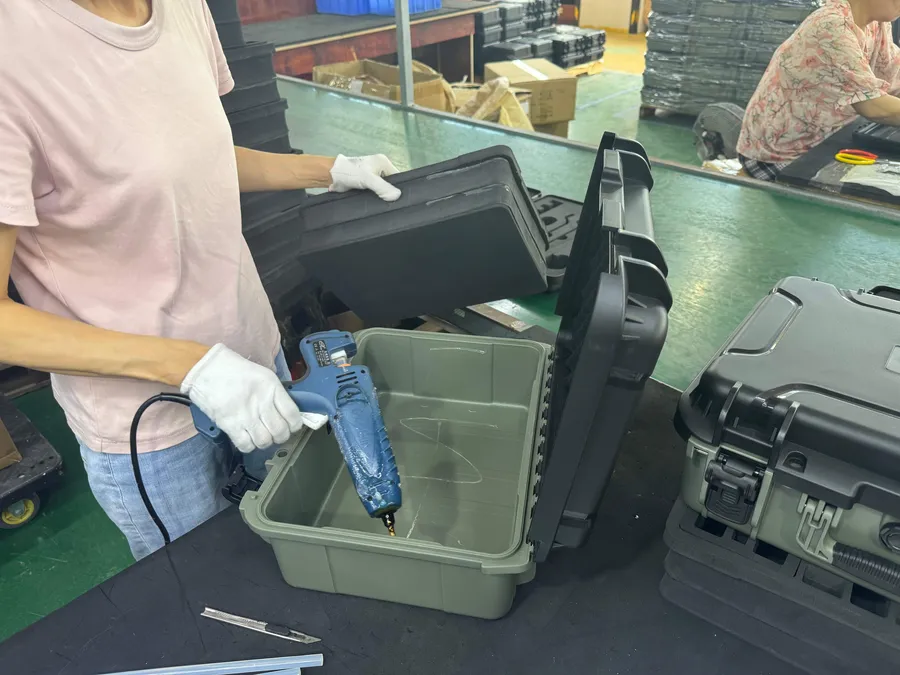
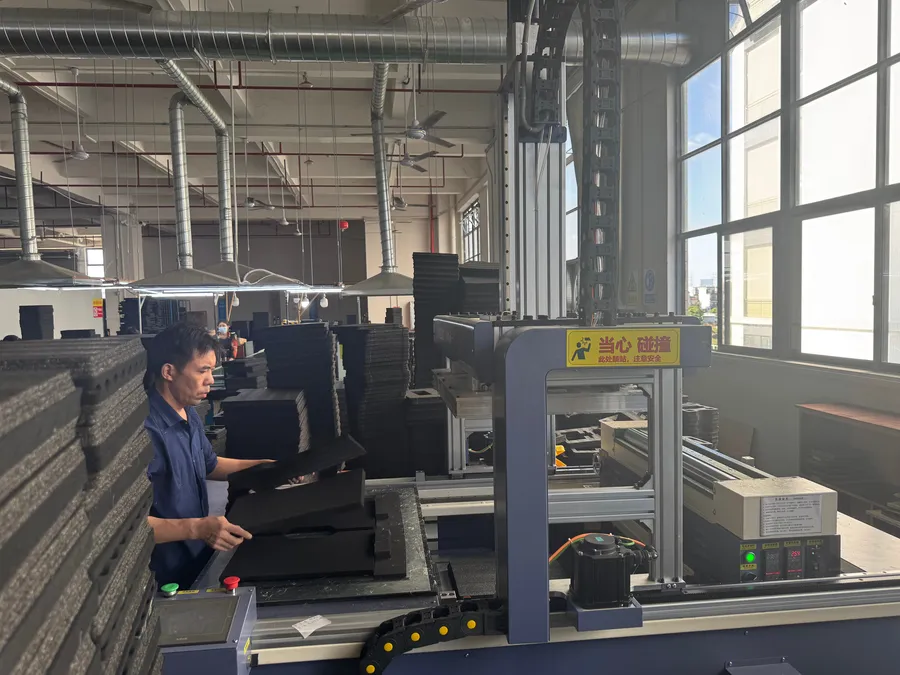
Everything described above is configurable on a standard shell: interior layout (pick-and-pluck, die-cut or CNC-cut), foam grade and thickness, colour, logo method, latch and lock count, pressure-equalisation valve, cable ports, document holder and identification plate. A bespoke exterior geometry requires a new mould — 125 days, from 3,000 units per moulded component.
Procurement considerations
| Question | What to send us |
|---|---|
| Which shell fits? | Equipment L × W × H as packed, plus required clearance per axis |
| What does it cost? | Order quantity and estimated annual quantity — the two drive different answers |
| Is tooling needed? | Whether an existing shell clears the envelope with usable foam depth |
| Lead time? | Your required delivery date, not just the order date |
| Certification? | The exact standard your tender names — we will say whether we can test to it |
| Freight? | Destination and preferred terms; carton and pallet data supplied with the quotation |
Comparison and selection guide
The tables on this page exist because a protective case is chosen by comparing three things: the envelope, the environment and the handling chain. Where no table applies, the rule below is.
| Situation | What To Do |
|---|---|
| Fixed inventory | CNC or die-cut silhouette with part numbers printed on the foam. |
| Variable kit | Pluck foam plus a loose tray. |
| Bench work | Removable trays that lift out square so the case doubles as a stand. |
- Size on internal dimensions plus clearance, never on a product name.
- Choose the carrying method before the shell: it changes the series, not just the price.
- Specify the interior last, and decide up front whether the end user will reconfigure it.
Industrial tool transport case: what an everyday working case has to survive relates to Logistics & Packing Guide. Related families: Tool Cases / Instrument & Equipment Cases / Equipment Transport Cases / Custom Protective Cases / Electronics Cases. Related sectors: field and industrial equipment. Continue in the Logistics & Packing Guide cluster.
This page is written from our own production data. If your requirement differs, send the dimensions and we will tell you which of the 155 models fits, or whether a custom route is needed.