How should field research equipment be transported?
Inventory and measure every item in its transport configuration, then give the kit cases whose internal envelopes exceed the largest items with clearance on each axis, foam that stops movement, and a seal channel where the route is dusty or wet. Field research equipment transported between sites is damaged in the last fifty metres far more often than on the freight leg, so the case has to survive being carried, stacked in a vehicle and reopened by someone who did not pack it. What the factory adds to that method is published data: internal dimensions, wall thickness, weight and seal availability stated per model, and protection fields stated exactly as measured or not measured.
Key points
- Measure the kit as it travels — antennas folded, cables coiled — then add clearance on each axis before selecting a shell.
- Accessories usually occupy more volume than the instruments; inventory them or the case gets sized for half the kit.
- Choose the carry method by mass and distance: trolley shells exist because a 10 kg case is not carried by hand.
- A gasket channel is a build feature you can inspect; an ingress rating is a test result — ask any supplier for the report and the method.
- Protection fields on our shells are recorded as measured or not measured per model; nothing is implied from a lookalike case.
- Carton quantities and pallet fit decide the freight cost; ask for the packing data with the quotation, not after it.
Where field research equipment actually gets damaged
Most of the damage to field research equipment transported between sites does not happen in the air or on the motorway; it happens in the last fifty metres — down a ramp, across a muddy compound, into the back of a vehicle, or onto a shelf where the case is stacked under something heavier. A transport method that only plans for the freight leg misses exactly where the losses are.
Field kits also fail in a quieter way: they arrive complete but unusable, because a cable, a battery charger or a mounting bracket stayed behind. The method below therefore starts with an inventory rather than with a case, and it treats the case as the unit of inventory — the thing that gets checked out at the depot and checked back in at the site.
Step 1 — inventory the kit and measure it in transport configuration
List everything that travels: instruments, sensors, spare batteries, chargers, cables, tools, mounts and documentation. Then measure each item as it will actually sit in the case — antennas folded, brackets mounted, cables coiled and bagged. Accessories normally occupy more volume than the instruments they belong to, and a case sized only for the instruments is the most common sizing error we see.
Convert the list into an internal envelope: the largest item plus clearance on each axis, then the total volume of everything else. The rule we publish in the measuring guide is to add roughly 20 mm on each axis before selecting a shell, and to check the narrow internal width as well, because some shells taper towards the corners.
Step 2 — match the case to who carries it, and how far
The table below is drawn from the published dimensions in our catalogue, one row per representative shell, from hand-carried kits to the trolley platform that moves itself.
| Model | Internal Envelope (Mm) | Wall | Net Weight | Usable Volume | Carry |
|---|---|---|---|---|---|
| WL6-2109 | 195 × 128 × 81 | 3.0 mm ABS | 470 g | 1.7 L | hand-carried sensor and logger kits |
| WL6-2205 | 200 × 98 × 41 | 3.5 mm ABS | 310 g | 0.7 L | flat instruments, mounts and documentation |
| WL8-3514 | 315 × 235 × 122 | 4.9 mm PP | not published for this model | 7.2 L | vehicle kits, seal channel on the shell |
| WL712# | 308 × 250 × 96 | 2.8 mm engineering PP | 710 g | 6.4 L | no seal offered on this shell — dry routes |
| WL9-7227 trolley | 590 × 435 × 210 | 6.0 mm engineering PP | 10.0 kg | 43.1 L | 485 mm telescopic handle, wheels, not stackable |
| WL8-6136 trolley | 530 × 360 × 304 | 5.0 mm PP | 8.5 kg | 46.4 L | 295 mm telescopic handle, wheels, not stackable |
Reading the table: mass, distance and stacking decide the shell
The split in the table is deliberate: under roughly 8 kg a fixed handle is the lighter and cheaper solution; past that, or past about 30 m of handling, wheels and a telescopic handle stop being a comfort and become the reason the equipment arrives. The two trolley shells are also the two that do not stack — put that in the loading plan rather than discovering it at the tailgate.
Where a shell is offered without a seal, the datasheet says so plainly, and the honest route is to keep that shell for dry routes and vehicle-internal duty. Wall thickness is the number behind stacking behaviour, and it is published per model, so a mixed load of cases can be planned shelf by shelf before the vehicle is loaded.
Outdoor field research equipment transported by vehicle, trailer or on foot
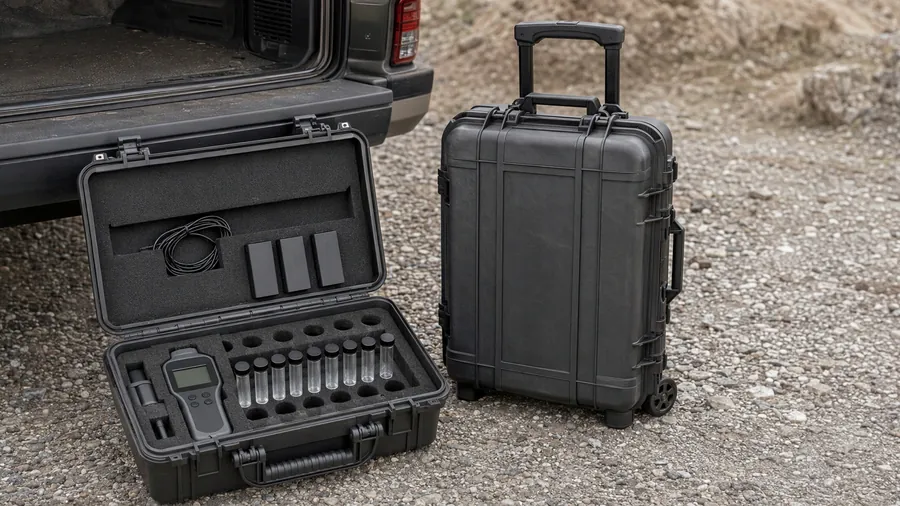
Outdoor field research equipment transported on roof racks, in open trailers or on foot sees dust, rain on the move and handling that no bench sees. The build features that matter are the seal channel — a compressible gasket in a continuous moulded channel, offered on most of the outdoor family — wall thickness for the racking and stacking loads, and hardware that can be serviced in the field rather than at a factory.
Two habits protect the kit more than any feature list. First, ask the valve question before the purchase: whether a case needs pressure equalisation depends on the closure design and the altitude profile of the route, and it is a question to settle before the case latches hard on a cold morning. Second, label the case externally with the kit inventory and keep a contents list inside the lid — the checklist costs nothing and is what actually gets the kit back complete.
Packing the interior so the road does not rearrange it
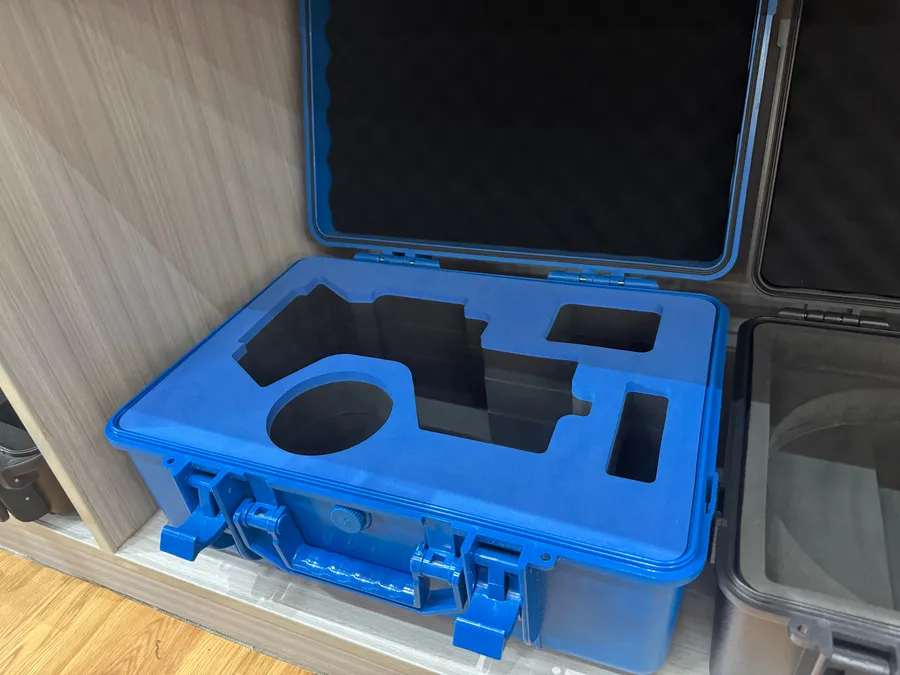
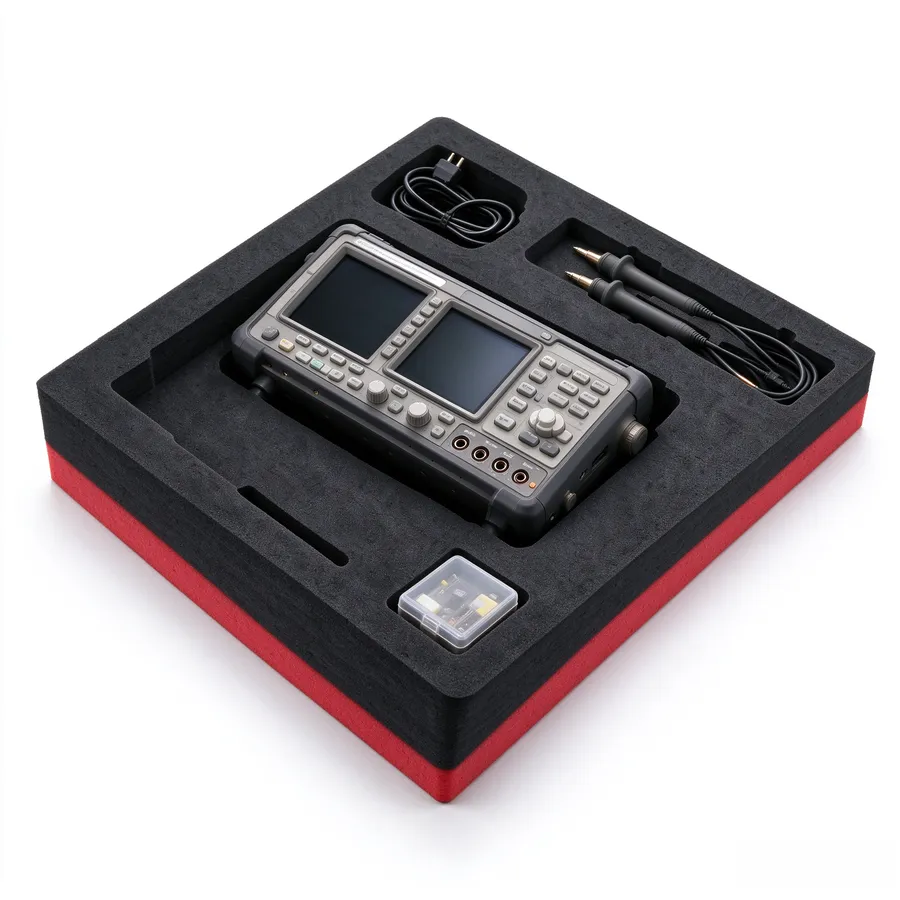
Inside the case, the foam is the product. A firm carrier layer under a soft contact layer protects instruments without abrading them; heavy items sit low and near the hinge edge; and anything that must not migrate — spare lenses, filters, memory cards — gets a cut pocket rather than a loose compartment. Pluck foam on the top layer keeps the layout adjustable between seasons, which is worth more in a research programme than a perfect one-off cut.
Cables and chargers are packed in their own sub-compartment, because the items most often lost between sites are the ones without a fixed address. If the kit changes between deployments, say so in the interior brief: a layout designed for change is a different drawing from a layout designed for one perfect fit, and the factory can draw either once the truth is on the table.
What we do not claim about field protection
Our catalogue records protection per model as measured or not measured. For the shells in this family the waterproof, dust, UV and temperature fields are recorded as not measured; impact behaviour depends on the foam layout you specify and is a manufacturer option rather than a shell property; and corrosion resistance is measured, because the thermoplastic shell has no ferrous corrosion path. We do not print an IP code on any datasheet, and no drop height is claimed without a test.
When a tender asks for a rating — ingress, drop or anything else — we answer with the fields that carry data and quote accredited third-party testing on the configured case against the method named in the tender. That is the standard to hold any supplier to: a report, a method, and the configuration that was actually tested, not a number copied from a lookalike case.
The shipping leg: cartons, pallets and trade terms
For the freight leg, the numbers that matter are carton data and pallet fit, and they are published per model: WL6-2205 packs 20 pieces per carton of 475 × 285 × 320 mm, WL712# packs 16 pieces per carton of 635 × 585 × 455 mm, and the WL9-7227 trolley packs one per carton of 715 × 515 × 280 mm. Pallet counts are calculated from the carton footprint against your pallet size rather than published as a fixed claim, so send the pallet specification with the enquiry.
Orders are wholesale and OEM/ODM only, on EXW or FOB terms — no retail, no DDP and no overseas warehouse. Payment is a 30% deposit with the balance after inspection, and third-party factory audits are welcome before commitment. Contact Fred Zhao or the KeXin sales team on WhatsApp +86 135 3588 0002, and KeXin New Materials (Guangdong) Co., Ltd. will come back with case sizes, carton data and a loading plan for the whole kit rather than a single model.

Customisation
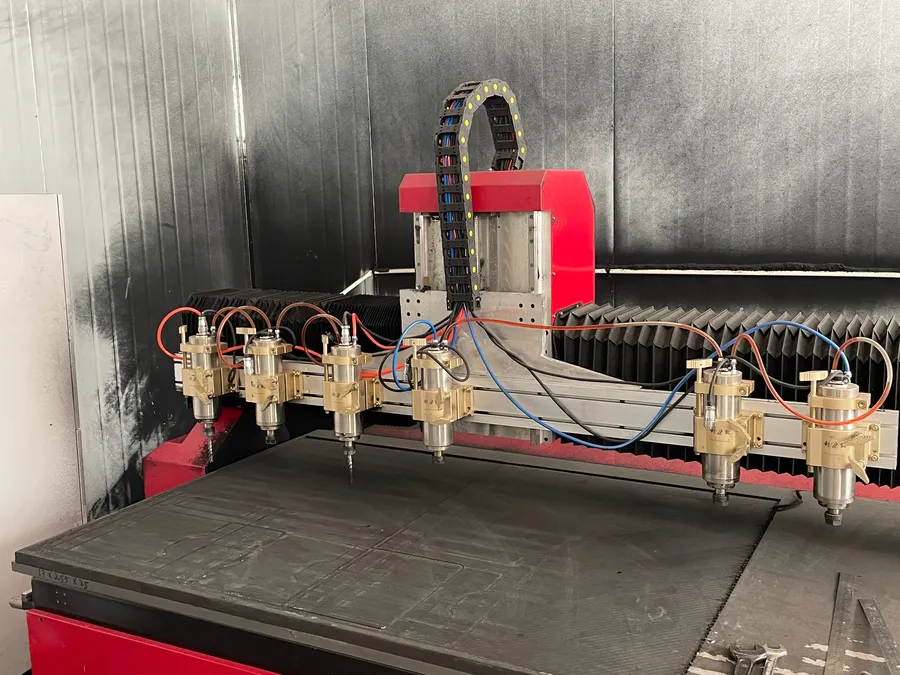
Everything described above is configurable on a standard shell: interior layout (pick-and-pluck, die-cut or CNC-cut), foam grade and thickness, colour, logo method, latch and lock count, pressure-equalisation valve, cable ports, document holder and identification plate. A bespoke exterior geometry requires a new mould — 125 days, from 3,000 units per moulded component.
Procurement considerations
| Question | What to send us |
|---|---|
| Which shell fits? | Equipment L × W × H as packed, plus required clearance per axis |
| What does it cost? | Order quantity and estimated annual quantity — the two drive different answers |
| Is tooling needed? | Whether an existing shell clears the envelope with usable foam depth |
| Lead time? | Your required delivery date, not just the order date |
| Certification? | The exact standard your tender names — we will say whether we can test to it |
| Freight? | Destination and preferred terms; carton and pallet data supplied with the quotation |
Comparison and selection guide
The tables on this page exist because a protective case is chosen by comparing three things: the envelope, the environment and the handling chain. Where no table applies, the rule below is.
| Situation | What To Do |
|---|---|
| Dust | Continuous rim plus enough latches to hold it closed over a temperature cycle. |
| Cold | PP shells retain toughness better than ABS at low temperature. |
| Service life | Ask for a spares kit of latches, hinges and gaskets with the first order. |
- Size on internal dimensions plus clearance, never on a product name.
- Choose the carrying method before the shell: it changes the series, not just the price.
- Specify the interior last, and decide up front whether the end user will reconfigure it.
How should field research equipment be transported? relates to Logistics & Packing Guide. Related families: Field Equipment Cases / Equipment Transport Cases / Instrument & Equipment Cases / Outdoor Protective Cases. Related sectors: field and industrial equipment. Continue in the Logistics & Packing Guide cluster.
This page is written from our own production data. If your requirement differs, send the dimensions and we will tell you which of the 155 models fits, or whether a custom route is needed.


