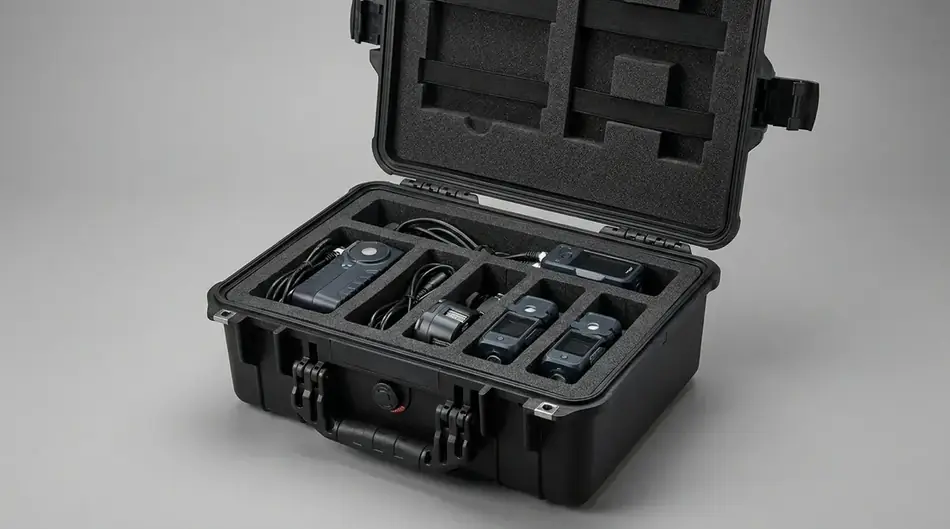
Military walkie-talkie radio protective briefcase?
A military walkie-talkie radio protective briefcase is a hand-carried hard case dimensioned around the transceiver, its antenna and the battery, charger, headset and cable kit that travel with it - and that is exactly how we build to it: from a published library of 155 moulded models whose internal and external dimensions, wall thickness (2.0 mm to 6.0 mm) and net weights are listed per model, so you size the interior against the longest item in the loadout rather than against a generic rating phrase. Sealing, foam layout, colour, logo and hardware are configuration choices quoted per order; we publish no water or dust ingress code for any model, because those fields are recorded as not measured. KeXin supplies wholesale and OEM buyers only, on EXW Zhongshan or FOB Shenzhen terms, with a first sample in 45 days on an existing mould.
Key points
- Dimension the interior to the antenna, not to the handset: an upright or fitted antenna is usually the tallest and longest item in a radio loadout.
- Briefcase-format and compact models in our library run from 0.8 L (WL6-2205, internal 200 x 98 x 41 mm) to 17.3 L (WL4321, internal 411 x 208 x 202 mm).
- Wall thickness is a model property, from 2.0 mm on flat series-0 shells to 5.0 mm on WL9-3221; never generalise one figure across the range.
- 124 of the 155 published models offer a compressible EPDM or equivalent gasket, and 31 shells do not, so confirm the model page before specifying sealing.
- No water or dust ingress code is published for any model in the catalogue; accredited laboratory testing is quoted as a separate work package per configuration.
- The latch body on all 155 published models accepts a standard padlock, which is the practical custody control for a shared or issued radio kit.
- Custom-cut foam starts at one piece while logo, colour and packaging start at 300 units, so a single evaluation case can validate the layout first.
Military walkie-talkie radio protective briefcase: what the format has to carry
A buyer searching for a military walkie-talkie radio protective briefcase is usually describing a single-handle hard case that carries a handheld transceiver plus everything that makes the radio usable in the field: spare battery packs, a charging cradle or charger lead, a headset or spare earpiece, a belt clip or chest harness, a short length of coax or an adapter, and often an antenna carried separately because it does not stay on the body of the radio. That contents list drives four decisions at once - internal length, internal width, the split between lid foam and base foam, and total carried weight - which is why we answer the request with per-model numbers instead of a slogan.
The word military is buyer language for a construction expectation, not a certificate we can hand over. What we can hand over is the specification sheet: external and internal dimensions, narrow internal width, wall thickness, lid and base depth, net weight and internal volume for each of 155 active moulded models across seven series. If your tender names a test method, we quote accredited third-party laboratory testing against that method for the ordered configuration, and the report travels with the shipment.
Published interior sizes that fit transceivers and their accessories
The models below are the ones buyers most often shortlist for handheld radio kits, and every figure in the table is the published value for that model, taken from our specification data rather than rounded up for a brochure. The narrow columns matter as much as length: a handheld lying flat with its battery fitted needs internal width and depth, while a radio carried with the antenna attached needs internal length or a lid depth that clears the antenna base. Where a field has no published value for a model we show a dash rather than invent one.
| Model | Best Fit | External Mm | Internal Mm | Wall Mm | Net Weight | Volume | Gasket Option |
|---|---|---|---|---|---|---|---|
| WL6-2205 | One handheld plus one spare battery | 222 x 128 x 50 | 200 x 98 x 41 | 3.5 | 310 g | 0.8 L | Yes |
| WL6-2209 | Handheld, battery and headset | 222 x 128 x 87 | 200 x 98 x 78 | 3.5 | 410 g | 1.5 L | Yes |
| WL2805 | Flat attaché layout, two handsets | 280 x 230 x 53 | 270 x 190 x 46 | 2.1 | 340 g | 2.4 L | No |
| WL3218 | Two radios, charger and cables | 315 x 260 x 180 | 308 x 230 x 172 | 3.0 | 900 g | 12.2 L | Yes |
| WL4318 | Briefcase proportions, radio plus handset kit | 432 x 240 x 186 | 407 x 187 x 178 | 3.0 | 1,970 g | 13.5 L | Yes |
| WL4321 | Squad kit with lid depth 164 mm | 433 x 263 x 209 | 411 x 208 x 202 | 3.0 | 2,330 g | 17.3 L | Yes |
| WL9-3221 | Thick-wall single-operator kit | 323 x 243 x 212 | 300 x 200 x 200 | 5.0 | 1,230 g | 12.0 L | Yes |
| WL6-4114 | Four-radio unit kit with chargers | 405 x 362 x 135 | 378 x 307 x 120 | 4.0 | 2,100 g | 13.9 L | Yes |
| WL8-5021 Trolley | Relay kit carried on wheels | 495 x 370 x 210 | 437 x 308 x 164 | 4.5 | 4,912 g | 22.1 L | Yes |
Three packing geometries, and how to pick one
The first geometry is one handset plus its battery and a headset, where a narrow shell such as WL6-2209 (internal 200 x 98 x 78 mm, 410 g) keeps the carried load low and the whole kit still sits flat in a vehicle footwell. The second is a two- or four-radio unit loadout, where the deciding figure becomes internal length and the lid depth: WL4318 gives 407 mm of internal length behind a 38 mm lid and a 140 mm base, which is how a true briefcase format behaves when antennas are carried detached in foam pockets, while WL4321 opens that base out to 202 mm internal depth for a charger and coiled cable.
The third is a relay or control loadout with several handsets, battery packs, a programming cable and a notebook of logs, where total volume and handling win over weight and a wheeled shell such as WL8-5021 Trolley (internal 437 x 308 x 164 mm, 4,912 g, telescopic handle) is the honest answer. Pick the geometry before you pick a colour or a logo, because the geometry is what the foam has to obey.
Foam layout for antennas, batteries, headsets and cables
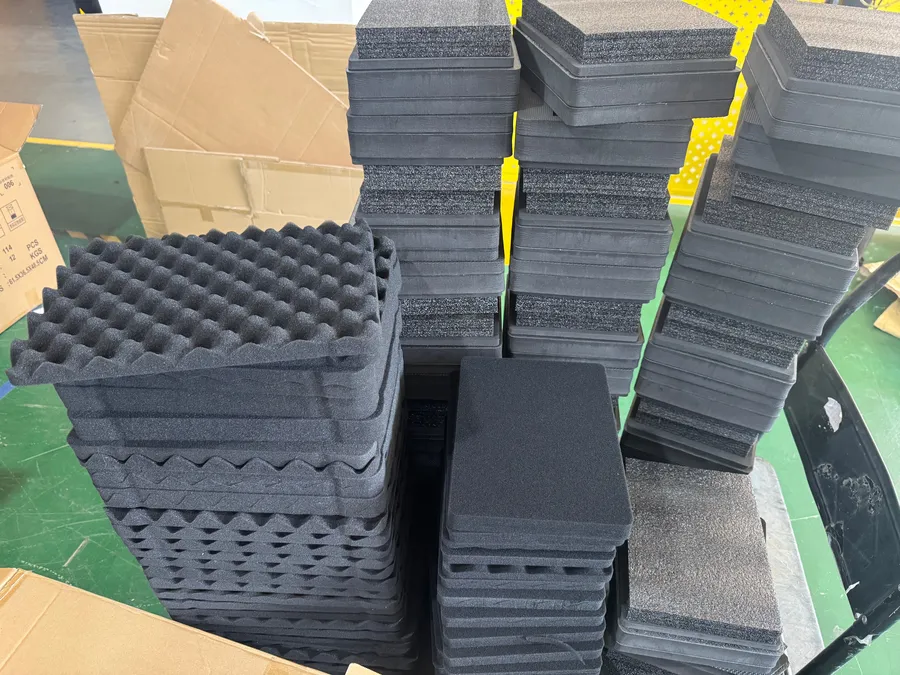
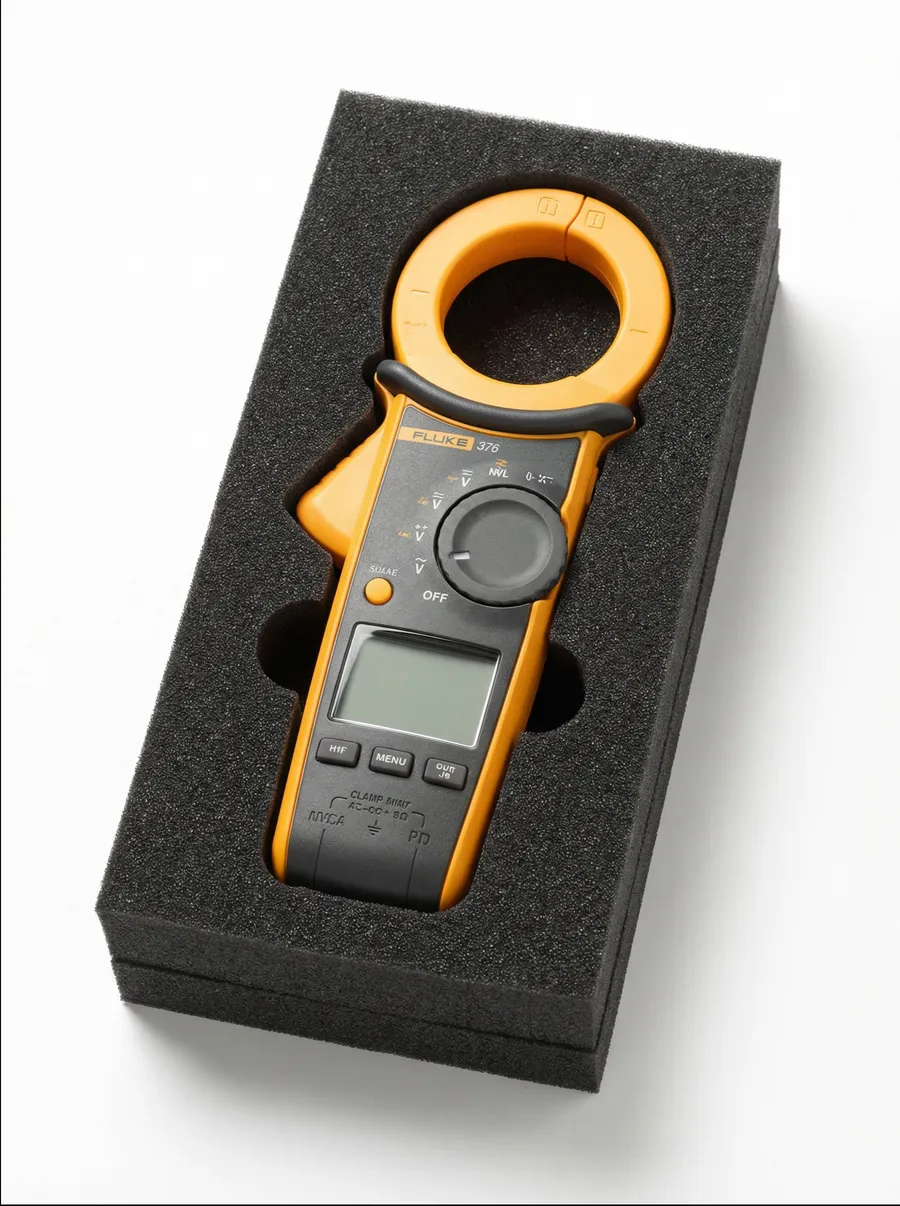
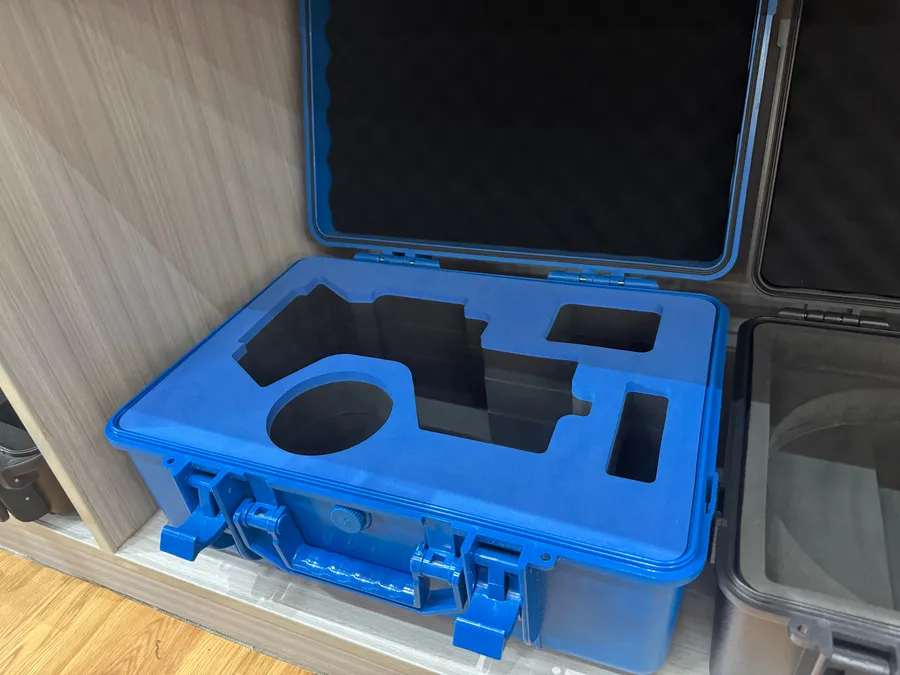
Interior work is where a radio case earns its keep. We cut foam per drawing, with cross-linked PE, EVA or EPS assigned by zone, and the standard constructions are pick-and-pluck for kits that change every deployment, die-cut or CNC-cut for a fixed loadout, layered foam where a rigid sub-plate carries the handsets, and an egg-crate lid face where loose accessories must stay under pressure when the case is opened upright. Antennas are the classic failure: a pocket that is deep enough for the base but too narrow for the whip will bend the thread, so we ask for the antenna carried in the position you actually store it, and we record the pocket depth on the drawing.
Battery pockets deserve their own zone rather than a shared cavity, because a loose lithium pack rattling against a chassis is both a cosmetic and a safety nuisance; a moulded recess with a finger lift keeps the operator's gloves working. Cable runs go in channels under the base foam so nothing presses on a connector. Custom foam carries no minimum beyond one piece, which means the layout can be iterated on a single evaluation case before you commit to a volume tier.
What we publish about water, dust and impact - and what we do not
Our data carries three claim labels, and you should read any supplier's numbers through the same lens. Measured means the value came from our own production or incoming-material records - dimensions, wall thickness and net weight are in this group. Manufacturer option means the construction is available but the figure depends on the configuration you order, which is how gaskets, foam layouts, hardware material and a pressure-equalisation accessory are listed. Not measured means no test record exists for that model and configuration, and for those fields we state no value at all. Ingress behaviour against water or dust sits in that third column for all 155 models, so no rating code appears on our pages, and impact or stack figures are likewise published only where a record exists.
That is a deliberate position rather than a gap in the paperwork: a rating printed on a brochure is not the same thing as a laboratory report on the case you received. If your programme needs those numbers, tell us the method your specification names and we will quote accredited third-party laboratory testing as a separate work package on the ordered configuration, with the report issued against that build. A gasket channel, a latch count and a lid depth are what make sealing behave; those are geometry we can publish, and the resulting rating is a test result we will not invent.
Hardware choices that matter on a carried radio case
Handles, latches and hinges decide whether a case survives years of being grabbed from a vehicle seat. In our published catalogue 136 models carry a fixed folding handle and 19 carry a telescopic handle alongside the folding carry handle, which is the trolley group. Every one of the 155 models has a hinge recorded in our production data and a latch body that accepts a standard padlock, so custody control does not require a special hasp; latch count is specified per configuration rather than fixed across a family. Feet are recorded on the models that carry them, and a pressure-equalisation accessory is listed as a configuration option rather than standard fitting, because a case that changes altitude or temperature can otherwise become hard to open or strain its seal.
OEM, MOQ and lead time for a radio case programme
The commercial ladder is uniform across the catalogue and published on every model page: one piece for a standard shell, one piece for a shell with custom-cut foam, 300 units where a printed logo, a custom colour or bespoke packaging enters the run, and 3,000 pieces per component when a dedicated new mould is cut to your dimensions. A first sample on an existing mould takes 45 days from an approved drawing and deposit; a new mould takes 125 days from the same starting point. A 30% deposit applies on order confirmation, with the balance against inspection. Colour and logo tiers are where a unit's identity is usually built - dark shells, laser-etched or printed marking, an interior foam colour that makes a missing accessory obvious at a glance.
Buying notes: terms, sampling and how to start
We are a manufacturer, not a reseller: business is wholesale and OEM or ODM for distributors, contractors and integrators. Quotations issue on EXW Zhongshan or FOB Shenzhen; we do not run retail, we do not quote DDP, and we hold no overseas warehouse, so freight is arranged by your side or your forwarder from the port terms on the invoice. Carton dimensions and pieces per carton are published where packing data exists - WL6-2205 ships 20 pieces in a 475 x 285 x 320 mm carton, WL3218 ships 12 pieces in 645 x 530 x 550 mm, WL4321 ships 12 pieces in 885 x 515 x 650 mm - and pallet counts are calculated against your pallet footprint, with 20GP, 40GP and 40HQ loading supplied with the quotation. Third-party factory inspection is welcome, before and during production.
A practical sequence works for almost every radio case enquiry: send the equipment list with the antenna carried as you store it, your target internal layout and your quantity band; we map it to a published model or flag that a new mould is the cheaper long-run answer; you receive a drawing of the foam and a specification sheet with claim labels; one evaluation case follows; then the 300-unit branding tier or the mould project. KeXin New Materials (Guangdong) Co., Ltd. - contact Fred Zhao or the KeXin Sales Team, WhatsApp +86 135 3588 0002.
Customisation
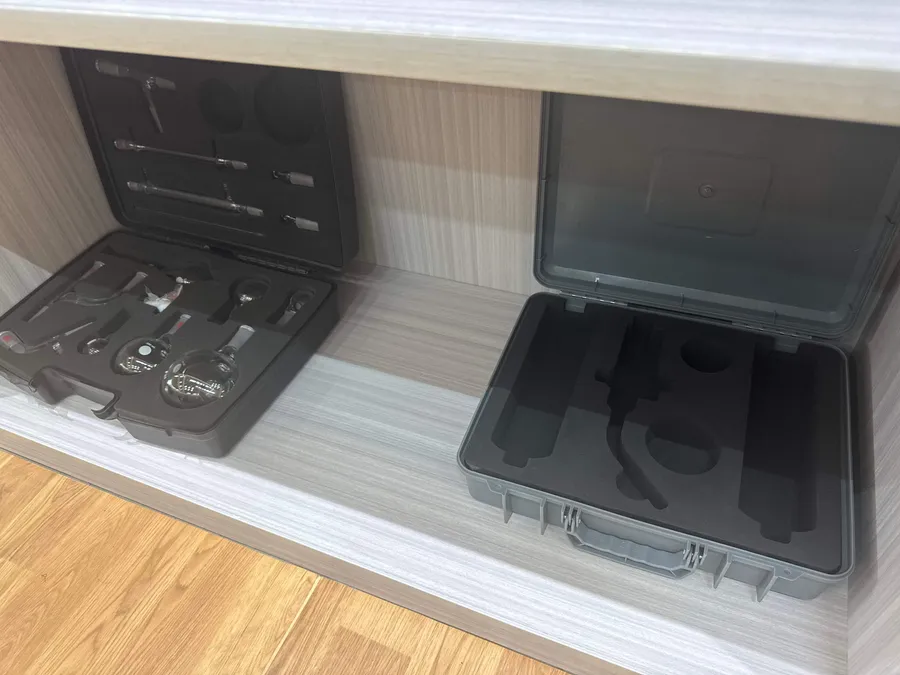
Everything described above is configurable on a standard shell: interior layout (pick-and-pluck, die-cut or CNC-cut), foam grade and thickness, colour, logo method, latch and lock count, pressure-equalisation valve, cable ports, document holder and identification plate. A bespoke exterior geometry requires a new mould — 125 days, from 3,000 units per moulded component.
Procurement considerations
| Question | What to send us |
|---|---|
| Which shell fits? | Equipment L × W × H as packed, plus required clearance per axis |
| What does it cost? | Order quantity and estimated annual quantity — the two drive different answers |
| Is tooling needed? | Whether an existing shell clears the envelope with usable foam depth |
| Lead time? | Your required delivery date, not just the order date |
| Certification? | The exact standard your tender names — we will say whether we can test to it |
| Freight? | Destination and preferred terms; carton and pallet data supplied with the quotation |
Comparison and selection guide
The tables on this page exist because a protective case is chosen by comparing three things: the envelope, the environment and the handling chain. Where no table applies, the rule below is.
| Situation | What To Do |
|---|---|
| Start from the equipment, not the case | Measure the tallest, widest and longest points of the packed equipment including antennas, handles and connectors. Add 20 mm minimum clearance per axis before selecting a shell. |
| Then choose the carrying method | Under 8 kg, a fixed handle is lighter and cheaper. Over 12 kg or any journey over 30 m, specify the T series with telescopic handle and wheels. |
| Then decide the interior | Pick-and-pluck for kits that change. Die-cut or CNC-cut for fixed layouts that must be auditable at a glance. |
- Size on internal dimensions plus clearance, never on a product name.
- Choose the carrying method before the shell: it changes the series, not just the price.
- Specify the interior last, and decide up front whether the end user will reconfigure it.
Military walkie-talkie radio protective briefcase? relates to Military Case Guide. Related families: Military Protective Cases / Communication Equipment Cases / Tactical Equipment Cases / Field Equipment Cases. Related sectors: field and industrial equipment. Continue in the Military Case Guide cluster.
This page is written from our own production data. If your requirement differs, send the dimensions and we will tell you which of the 155 models fits, or whether a custom route is needed.