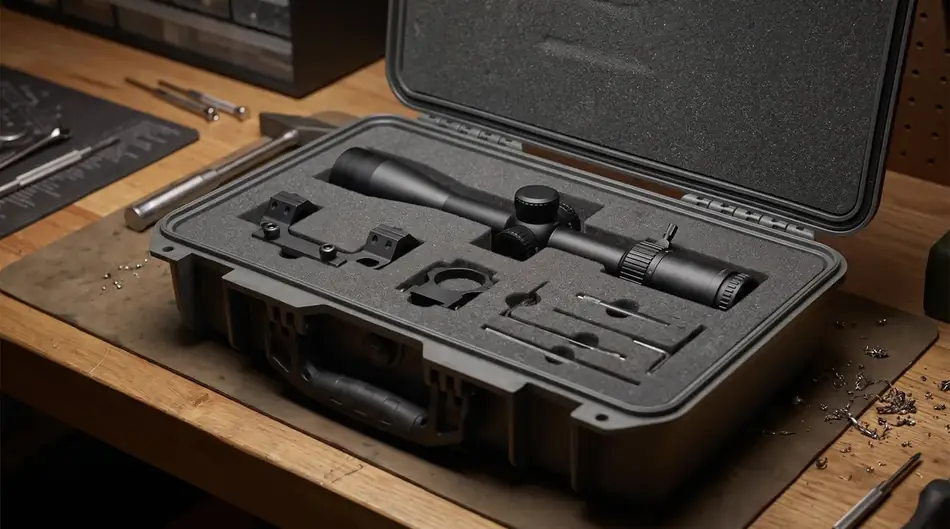
Industrial tester & tools hard briefcase?
An Industrial tester & tools hard briefcase is a hand-carried shell with a fixed handle, sized around the tester plus its leads, probes and a working set of hand tools. It is specified from four facts: the tester and the longest accessory, the depth needed for plugs and probes, the way the kit is checked at the end of a shift, and the environment between the van and the bench. On our sheet, 120 of 155 models carry the tool-case tag, 115 of those record a wall thickness between 2.0 mm and 5.8 mm, 91 offer a seal as a compressible gasket, and the briefcase-size models run from a 240 x 200 x 120 mm interior up to 355 x 280 x 60 mm, with net weights from 460 g to 1.68 kg. Water, dust, temperature, UV, stack load, working load and any ingress code are recorded as not measured, so the case is assessed as a loaded kit rather than from a rating. This page covers the published sizes, the interior layout, the rating words buyers ask about, what we do not claim, and the OEM terms.
Key points
- Specify the briefcase from the tester and its longest lead or probe, not from a litre figure, because depth and corner radius decide the fit.
- 120 of 155 models carry the tool-case tag; 115 record a wall from 2.0 mm to 5.8 mm and 91 offer a seal as a compressible gasket.
- Briefcase-size models here run from 240 x 200 x 120 mm to 355 x 280 x 60 mm internal, with net weights from 460 g to 1.68 kg.
- A fixed handle and a hand-carry route are a different brief from a trolley; check the loaded mass before choosing wheels or a shoulder strap.
- No ingress code, drop height, electrostatic rating or defence-standard test result is claimed; the seal is a mechanical gasket, not a rating.
- Terms are wholesale and OEM only, EXW or FOB, 45 days for OEM samples, 125 days for a new mould, 30 percent deposit before production.
Industrial tester & tools hard briefcase: which format suits which job
The format is simple and its job is narrow. An Industrial tester & tools hard briefcase is a rigid shell with a fixed carry handle, sized so that a technician can carry the tester, its leads, its probes and a small set of hand tools in one hand from a van to a bench or a plant room. It is not a trolley case and it is not a shipping crate; the design pressure comes from being opened and closed many times a day, carried up stairs, set down on wet concrete, and checked at the end of a shift to see that every item is back in its place.
That duty cycle decides the specification. A calibration technician carrying a bench meter and a set of leads has a different brief from an electrical contractor carrying a multimeter, a clamp and insulated screwdrivers, and both differ from a field service engineer carrying a portable pressure calibrator with a hand pump. The shell can be the same family; the interior, the depth and the handle are what change. Because the briefcase is carried rather than wheeled, loaded mass matters more than it does on a trolley case, and a kit that is comfortable at 4 kg becomes tiring at 8 kg over a long walk.
Published briefcase-size models and their real dimensions
The models below are published at briefcase scale, with a fixed handle and no trolley. Internal dimensions are given first because they decide whether the tester and its accessories fit; net weight is the empty case as published per model. The seal column states whether the model offers a seal as a compressible gasket in a continuous moulded channel, which is a mechanical feature rather than a rating. Carton data is printed only where the sheet records it, so an entry reading not published means the figure is not on the sheet for that model rather than zero.
| Model | Internal Size, Mm | Wall, Mm | Net Weight | Seal | Carton And Per-Carton |
|---|---|---|---|---|---|
| Model | Internal size, mm | Wall, mm | Net weight | Seal | Carton and per-carton |
| KX-3207 | 308 x 230 x 64 | 3.0 | 570 g | gasket offered | 645 x 530 x 430, 24 per carton |
| KX-3308 | 325 x 236 x 76 | 2.3 | 575 g | plain shell | 670 x 550 x 425, 20 per carton |
| KX-3508 | 344 x 268 x 72 | 3.0 | 995 g | gasket offered | 730 x 615 x 428, 20 per carton |
| KX-3113 | 296 x 258 x 121 | 2.9 | 1.06 kg | plain shell | 635 x 595 x 540, 16 per carton |
| KX-62810 | 253 x 182 x 86 | 4.0 | 900 g | gasket offered | 480 x 293 x 550, 10 per carton |
| KX-2811 | 253 x 180 x 98 | 5.0 | 890 g | gasket offered | not published |
| KX-712 | 308 x 250 x 96 | 2.8 | 710 g | plain shell | 635 x 585 x 455, 16 per carton |
| KX-63413 | 310 x 255 x 106 | 4.8 | 1.68 kg | gasket offered | 670 x 365 x 710, 10 per carton |
| KX-2614 | 240 x 200 x 120 | 2.2 | 460 g | plain shell | not published |
Fitting a tester, its leads, probes and hand tools
The first measurement is not the tester; it is the longest accessory. A pair of silicone test leads coiled loosely, a clamp with a jaw that does not fold flat, a set of insulated screwdrivers and a temperature probe will each set a minimum internal length and depth that the bare instrument does not. Measure the tester with its boot or holster on, lay the leads out as they will travel rather than coiled tight, and measure the deepest plug or adaptor because that is what decides whether the lid closes without pressing on the item.
The interior then has three common answers. Pick and pluck foam lets the buyer pull out pre-cut blocks to form a cavity, which is cheap and quick but loosens as the cube edges break down with repeated handling. Die-cut foam follows the exact outline of the tester and its accessories and is the usual choice for a service kit that is checked item by item. CNC-cut foam is the most repeatable for a kit with several small items, because each cavity is cut to a drawing rather than by hand. Foam is offered in EVA, PE and EPE, and the choice is driven by how much the item can move, how heavy it is and whether the cavity has to survive years of opening and closing. A lid pocket for paperwork and a divider set for the hand tools are often more useful than a larger cavity, because they keep the small items from migrating into the tester's space.
The rating words on a tester case datasheet, read carefully
Buyers often arrive with rating words copied from another datasheet: a two-digit ingress code, a drop height, an electrostatic-discharge claim, a defence-standard test method, an airdrop reference. Each of those words describes a result obtained under a stated configuration, on a stated sample, by a stated method. None of them is a property of the plastic itself, and a case that passed a drop height in one orientation with one load has not thereby passed it in another. The honest way to read such a word is to ask for the report behind it: which sample, which configuration, which load, which method, which date.
Our sheet takes the opposite route and marks the unknowns as unknown. Water, dust, temperature, UV, stack load and working load are recorded as not measured, no ingress code is printed for these models, and the seal on the sealed models is a compressible gasket in a continuous moulded channel rather than a rating. When a programme needs a measured result, we quote testing against an agreed method at a recognised laboratory as a separate scope, and the report belongs to that order. That is slower than printing a badge, but it means a buyer who needs a number gets a real one rather than a slogan.
What we do not claim
We do not claim an ingress code, a drop height, an electrostatic rating, a defence-standard test result or a third-party conformity result for these models unless a specific order has commissioned that test and the report is attached to it. We do not publish customer names, order volumes, field failure rates, rankings or expert endorsements, because none of those are ours to publish on a product page. The numbers in this article are the published case, wall, weight and carton figures from the model sheet; anything beyond them is a quotation line, not a claim.
For a tester briefcase this discipline matters more than for most products, because the buyer's own customers may rely on the kit. A calibration laboratory that tells its clients an instrument travelled in a rated case has made a statement it must be able to support, and a supplier who supplies the badge without the report has handed the laboratory a liability. Our position is to publish what is measured per model, mark the rest as not measured, and quote the test when a programme needs it, so that the statement the buyer makes is one the buyer can support.
OEM, MOQ, lead times and order terms
We supply wholesale and OEM or ODM only. We do not sell single units at retail, we do not ship DDP, and we hold no overseas warehouse; terms are EXW or FOB from our factory. For an OEM programme the sample lead time is 45 days from approved artwork and specification, and a new mould is 125 days. Payment is 30 percent deposit, with the balance settled after inspection and before shipment. Buyers who want a third-party factory audit before placing an order are welcome to arrange one.
For a branded service-team briefcase, the usual programme is a standard shell from the published range with a custom foam interior, a printed logo and a specified colour. MOQ is set per model and per customisation and is confirmed in the quotation, because it depends on whether the shell is standard or a new mould, and on how many foam layouts the order carries. The practical advice is to freeze the tester, the accessory list and the interior drawing before the sample is approved, because a change to the foam after approval is a re-cut and a change to the shell depth is a tooling change. Colour and logo come last, after the fit is settled.
How to specify a tester briefcase in one page
Write down the tester model with its boot, then the longest lead, the deepest plug and the largest hand tool, and give each a measured length. Add a 5 to 10 mm margin for foam and decide whether the leads travel coiled loose or on a reel, because that changes the cavity. Decide whether the case is carried by hand all day or only from a van to a door, because that sets the loaded mass limit and whether a fixed handle is enough. Choose the interior by how the kit is checked: a shadow layout for item-by-item checks, a simpler cavity for a one-way shipment.
Then decide the seal: a gasket model for a wet yard or a dusty plant room, a plain shell for a dry bench where the case is opened constantly. Finally, list the measurements the programme needs and treat any test as a quoted scope, and send the pallet standard if the cases will be shipped in bulk, because the carton and the unit load are built around the case. A brief written in that order can be quoted once and built once, which is the difference between buying a case and buying a working kit.
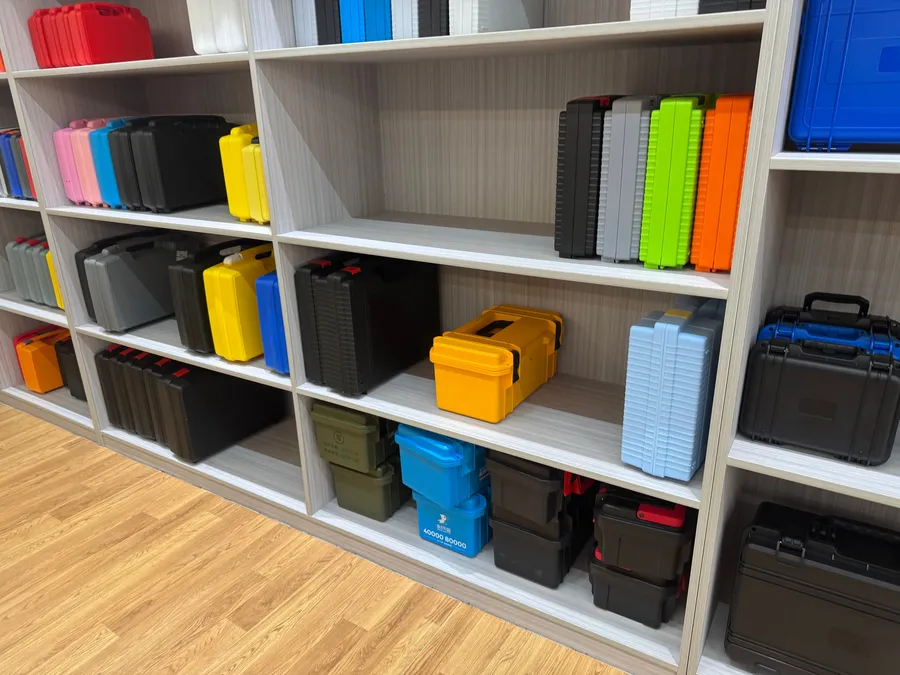
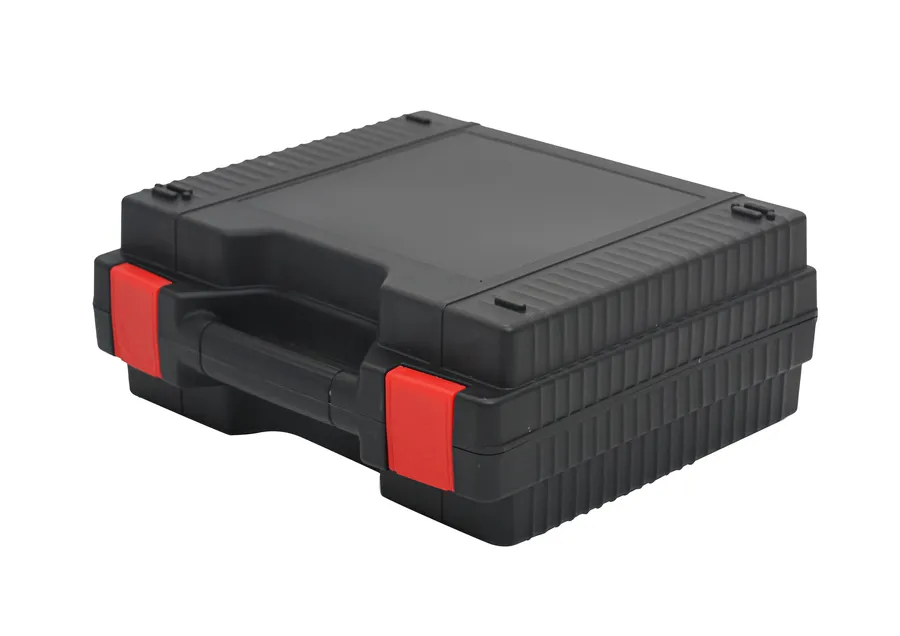
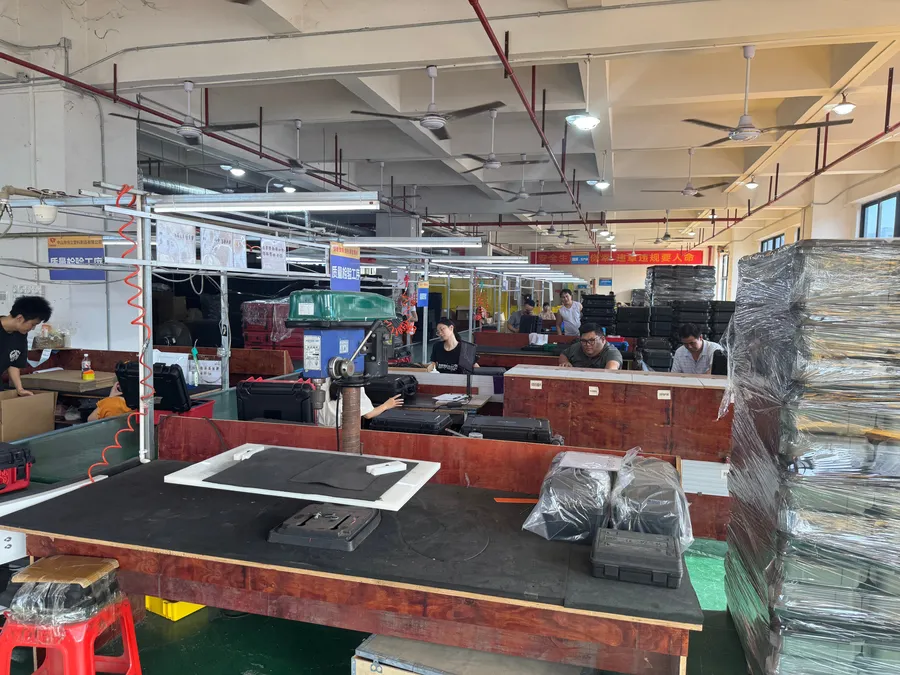
Customisation
Everything described above is configurable on a standard shell: interior layout (pick-and-pluck, die-cut or CNC-cut), foam grade and thickness, colour, logo method, latch and lock count, pressure-equalisation valve, cable ports, document holder and identification plate. A bespoke exterior geometry requires a new mould — 125 days, from 3,000 units per moulded component.
Procurement considerations
| Question | What to send us |
|---|---|
| Which shell fits? | Equipment L × W × H as packed, plus required clearance per axis |
| What does it cost? | Order quantity and estimated annual quantity — the two drive different answers |
| Is tooling needed? | Whether an existing shell clears the envelope with usable foam depth |
| Lead time? | Your required delivery date, not just the order date |
| Certification? | The exact standard your tender names — we will say whether we can test to it |
| Freight? | Destination and preferred terms; carton and pallet data supplied with the quotation |
Comparison and selection guide
The tables on this page exist because a protective case is chosen by comparing three things: the envelope, the environment and the handling chain. Where no table applies, the rule below is.
| Situation | What To Do |
|---|---|
| Fixed inventory | CNC or die-cut silhouette with part numbers printed on the foam. |
| Variable kit | Pluck foam plus a loose tray. |
| Bench work | Removable trays that lift out square so the case doubles as a stand. |
- Size on internal dimensions plus clearance, never on a product name.
- Choose the carrying method before the shell: it changes the series, not just the price.
- Specify the interior last, and decide up front whether the end user will reconfigure it.
Industrial tester & tools hard briefcase? relates to Protective Case Basics. Related families: Tool Cases / Instrument & Equipment Cases / Custom Protective Cases. Related sectors: field and industrial equipment. Continue in the Protective Case Basics cluster.
This page is written from our own production data. If your requirement differs, send the dimensions and we will tell you which of the 155 models fits, or whether a custom route is needed.