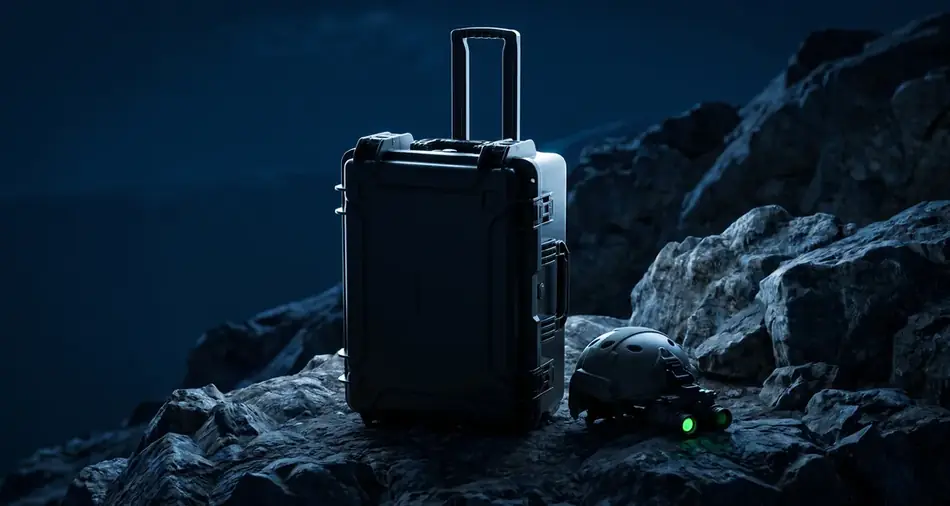
Outdoor Equipment Transport Packaging?
Outdoor Equipment Transport Packaging works when it is specified at three levels: the unit shell that carries the kit, the sub-shells that keep batteries, optics and fuel away from fragile gear, and the export carton and pallet plan that moves the whole load from our factory floor to your warehouse. The shell decision is a published-numbers decision, not a brochure decision: our library holds 155 moulded shells and 145 of them sit in the outdoor protective cases category, with internal volumes from 0.3 to 58.7 litres and a median of 17.2 litres across that set, internal dimensions published in millimetres for every model, and a compressible gasket recorded as available on 124 of the 155 shells. Carry method is the second decision: 19 T-series shells add wheels and a telescopic handle, deep-body shells such as the KX 5321 put 149 mm of base depth under a 43 mm lid, and the narrow internal width column published for 36 models tells you whether a tapered item actually passes through the mouth of the box. Carton data is the commercial level: 64 models publish carton dimensions and 58 publish pieces per carton, with counts from 1 to 40. What we do not publish is any unmeasured performance figure - no ingress-protection code, no free-fall height, no stack-load number; protection fields in our database read not measured, so put per-configuration test reports in the RFQ instead of trusting a label.
Key points
- Size the shell on the largest packed item plus about 20 mm of clearance per axis, then read the narrow internal width column, because a taper of 15 to 30 mm is normal on small outdoor shells.
- 145 of our 155 moulded shells sit in the outdoor protective cases category, with published internal volumes from 0.3 to 58.7 litres and a median of 17.2 litres.
- The lid-to-base split decides what actually fits: the KX 2813 publishes 92 mm of lid over a 25 mm base, while the KX 5321 gives 149 mm of base under a 43 mm lid.
- Carry method is a series decision: all 19 T-series shells add wheels and a telescopic handle, and none of them stack, while the 0 to 9 series are hand-carried and most are stackable.
- Carton data is published per model, not promised: 64 models list carton dimensions and 58 list pieces per carton, with counts from 1 to 40.
- Protection performance is not a published figure: the waterproof, dust, temperature and stack-load fields read not measured, so require a per-configuration test report in the RFQ.
- Wholesale terms are fixed: MOQ is 1 for a stock shell and custom foam, 300 for logo or colour work, with OEM lead time of 45 days on an existing mould and 125 days for a new one.
Outdoor Equipment Transport Packaging: The Three Levels That Decide The Freight Bill
Outdoor Equipment Transport Packaging covers more than the box the gear arrives in. A working outdoor load is usually three levels of packaging stacked on top of each other. Level one is the unit shell: the moulded case that carries one kit, sized to the largest item in its packed configuration. Level two is the sub-kit split: batteries, fuel canisters, optics and wet gear separated into their own pockets or their own shells so that the heaviest and messiest items never travel against the most fragile ones. Level three is the export layer: the carton each shell ships in, the pallet those cartons build, and the container figure a forwarder prices. Buyers who skip level three discover the cost at the quotation stage, because two shells of identical internal size can carry completely different freight bills once carton and pallet geometry enter the math.
Outdoor use adds conditions that an office-to-site load never sees: rain at the trailhead, dust on a gravel track, a shell strapped in the sun on a roof rack, a cold night in a vehicle. Those conditions are exactly why the specification should stay grounded in numbers you can verify. What a shell publishes - internal dimensions, wall thickness, gasket availability, closure hardware, foam options - can be checked line by line. What it does not publish is a measured performance figure, and our own database is explicit about that: the protection fields on every model read not measured, which we treat as the honest baseline for an outdoor specification rather than a gap to be filled with adjectives.
The library behind this page holds 155 moulded shells, every one with published internal dimensions in millimetres. 145 of them are catalogued under the outdoor protective cases category and 148 carry the outdoor application tag. Across that outdoor-designated set, published internal volumes run from 0.3 to 58.7 litres with a median of 17.2 litres, and 72 shells sit in the 3-to-20-litre band that most camp and travel load plans land in. On materials, 84 of the outdoor-designated shells are moulded in PP, 38 in engineering PP, 22 in ABS and one pairs PP with ABS, so the material choice is a real decision with published options rather than a single default.
Published Size Envelopes For Outdoor Shells, From 0.3 To 34.4 Litres
The table below lists ten shells that span the outdoor range from a 100-gram pocket box to a 34.4-litre deep-body case, using the figures exactly as they appear in our product database. Empty mass is published for 93 of the 155 shells overall, so the mass column is a per-model fact and not a family average. The lid and base depth split is recorded on 100 shells, and on every one of those the two halves add up to the internal depth, which is what makes the closure line readable from a datasheet before you order. A narrow internal width is published for 36 models across the library, running from 70 mm to 308 mm, and where it is recorded it is the figure your item has to pass, because moulded shells carry a draft angle and the widest point of your kit must clear the narrowest point of the mouth.
| Model | External Mm | Internal Mm | Narrow Mm | Wall Mm | Lid Base Mm | Mass G | Material | Gasket |
|---|---|---|---|---|---|---|---|---|
| KX 1204 | 120 x 90 x 40 | 115 x 78 x 32 | 70 | 2.6 | 16 + 16 | 100 | PP | none recorded |
| KX 1905 | 190 x 190 x 45 | 180 x 160 x 40 | 130 | 3.0 | 25 + 15 | 250 | PP | compressible gasket |
| KX 2406 | 240 x 200 x 55 | 230 x 155 x 50 | 140 | 2.0 | 25 + 25 | 330 | PP | none recorded |
| KX 2805 | 280 x 230 x 53 | 270 x 190 x 46 | 175 | 2.1 | 23 + 23 | 340 | PP | none recorded |
| KX 2808 | 275 x 230 x 82 | 265 x 190 x 76 | 170 | 2.2 | 38 + 38 | 430 | PP | none recorded |
| KX 3207 | 315 x 260 x 70 | 308 x 230 x 64 | 205 | 3.0 | 32 + 32 | 570 | PP | compressible gasket |
| KX 3508 | 350 x 300 x 79 | 344 x 268 x 72 | 240 | 3.0 | 36 + 36 | 995 | Engineering PP | compressible gasket |
| KX 6-2109 | 211 x 165 x 93 | 195 x 128 x 81 | not published | 3.0 | not published | 470 | ABS | compressible gasket |
| KX 5321 | 525 x 434 x 214 | 481 x 373 x 192 | not published | 5.8 | 43 + 149 | 4810 | Engineering PP | compressible gasket |
| KX 8-5021 | 495 x 370 x 210 | 437 x 308 x 164 | not published | 4.5 | not published | 4912 | Engineering PP | compressible gasket |
Carry Method Compared: One Hand, Two Hands, Or Wheels And A Telescopic Handle
Carry method is the spec line buyers forget until the first field trip. A shell that is liftable on the workshop bench is not liftable on a steep boat ramp, and the difference is decided by series-level design, not by a colour option. The comparison below groups the library by series with one verified example per row. The 19 T-series shells are the only ones with wheels and a telescopic handle; recorded handle heights on the models that publish one run from 240 mm to 485 mm. The T series is also the only group that does not stack: 0 of 19 are stackable, while 136 of the 155 shells overall are, which matters the moment the cases go onto a shelf or a pallet between trips. Seal availability is likewise a per-series fact: a compressible gasket is recorded as available on 124 of the 155 shells overall, but on 12 of 23 in the 0 series and 58 of 62 in the heavy-duty 8 series, so the gasket line has to be checked model by model rather than assumed.
| Series | Shells | Example | Carry | Gasket Available | Stackable |
|---|---|---|---|---|---|
| 0 Series - mini / compact | 23 | KX 2808 (3.8 L) | one hand | 12 of 23 | 23 of 23 |
| 6 Series - mid-size | 20 | KX 6-2109 (2.0 L, ABS) | one to two hands | 20 of 20 | 20 of 20 |
| 8 Series - heavy-duty | 62 | KX 8-14641 (1280 mm internal) | two hands or pallet | 58 of 62 | 62 of 62 |
| 9 Series - deep-body | 18 | KX 5321 (34.4 L) | two hands | 14 of 18 | 18 of 18 |
| T Series - rolling | 19 | KX 8-5021 (22.1 L) | wheels + telescopic handle | 18 of 19 | 0 of 19 |
How To Size The Shell Before You Ask For A Quote
Measure every item as it travels, not as it sits on a shelf: stove with its legs folded, tripod with its head on, lantern with the handle down, camera body with the lens mounted. Take the largest single packed envelope, add about 20 mm of clearance on every axis, and only then shortlist shells by internal dimensions - a figure we publish in millimetres for all 155 models. Clearance is not generosity; it is the foam that has to exist between the item and the wall, and a pocket cut to the exact size of an object is a pocket you will fight every time you pack in the dark or with gloved hands.
Check the mouth before the volume. Where a shell tapers we publish a narrow internal width - recorded on 36 models from 70 mm to 308 mm - and that figure, not the nominal width, decides whether the item passes. The KX 2808, for example, publishes 190 mm of internal width with 170 mm at the narrow point; the KX 1204 publishes 78 mm nominal against a 70 mm narrow passage. Two boxes of near-identical litre figures can hold or fail to hold the same stove depending entirely on this column, which is why our guide on internal versus external dimensions treats the mouth as a separate number.
Split the depth budget the same way. On the 100 shells where the split is published, lid and base depths always add to the internal depth, and the two extremes tell you what the split is for: the KX 2813 gives 92 mm of lid over a 25 mm base for gear that wants to be pressed down from above, while the KX 5321 gives 149 mm of base under a 43 mm lid so the load sits low and heavy items ride under the closure line. Weight is the last check: published empty shells run from 100 g on the KX 1204 to 15.3 kg on the rolling KX 8-8442, and the median usable interior volume across the outdoor-designated set is 0.59 of the external envelope once corner radius, seal channel and hardware are subtracted. If the arithmetic lands between two sizes, take the smaller liftable shell and split the kit - our field notes on how outdoor equipment should be organized inside a case start from exactly that rule.
Export Packing: Carton Counts, Pallet Plans And Container Figures
Carton data is the part of outdoor equipment transport packaging that decides the freight invoice, and it is published rather than promised: 64 of the 155 models list carton dimensions and 58 list pieces per carton, with counts running from 1 to 40. The examples below are read directly from the database. Small shells ship in high-count cartons - the KX 2805 packs 32 pieces into a 570 x 470 x 435 mm carton - while deep-body and rolling shells ship one per carton because the carton barely exceeds the shell. That spread is why a pallet plan built on shell dimensions alone is a guess; the carton footprint is the unit that actually stacks.
Pallet and container quantities are a different class of number, and our database is deliberate about how it records them. Every model carries a pallet-quantity field marked not measured, with the note that a pallet load is calculated from the carton footprint against your pallet size - because a 1100 x 1100 mm pallet, a 1200 x 1000 mm euro-pallet and a 48 x 40 inch North American pallet produce different answers from the same carton. Container figures are recorded the same way: the 20GP, 40GP and 40HQ numbers are supplied with the quotation once your pallet and destination are known. The practical consequence for a buyer is simple: send the pallet spec with the RFQ, and the packing plan comes back as arithmetic on published cartons rather than as a rough percentage. Our pages on container loading and on stacking and palletising protective cases walk through that method in detail.
| Model | Carton Mm | Pieces Per Carton |
|---|---|---|
| KX 2406 | 490 x 410 x 290 | 20 |
| KX 2805 | 570 x 470 x 435 | 32 |
| KX 2808 | 560 x 445 x 415 | 20 |
| KX 3207 | 645 x 530 x 430 | 24 |
| KX 3508 | 730 x 615 x 428 | 20 |
| KX 6-2109 | 470 x 365 x 560 | 20 |
| KX 5321 | 530 x 440 x 635 | 3 |
| KX 8-5022 | 495 x 375 x 245 | 1 |
| KX 9-6127 | 640 x 625 x 280 | 1 |
Where Outdoor Equipment Transport Packaging Gets Used
The same three-level logic repeats across the outdoor sectors we ship to, with the mix of levels shifting. Camp and overlanding loads lean on the 3-to-20-litre band: a cook kit in one shell, recovery and repair gear in another, first aid where it can be reached one-handed. Hunting loads add long items - a tripod, an axe, a tree-stand arm - and long items break the volume logic entirely, which is why the library keeps narrow long shells such as the KX 8-14641 with 1280 x 350 x 140 mm of internal length for masts, booms and legs. Photography and video loads invert the depth rule: optics want a lid-heavy split and a soft interior, and battery-powered gear travels in its own pocket away from anything that presses on it.
Field science and survey teams are the closest to an industrial buyer: they reorder the same shell with the same cut foam for years, and their packaging decision is really a procurement decision about consistency and documentation. What changes between sectors is rarely the shell; it is the interior and the packing plan. A camping retailer wants a shell that stacks cleanly on a shop shelf and ships 20 to 32 per carton, while an expedition operator wants deep-body shells that ride low in a vehicle drawer. Both start from the same published numbers, and both are better served by two or three right-sized shells than by one big box - the sizing method in our camping-size guide works out that split in about ten minutes.
Customization: Foam Zones, Colour, Logo, Hardware And Moulds
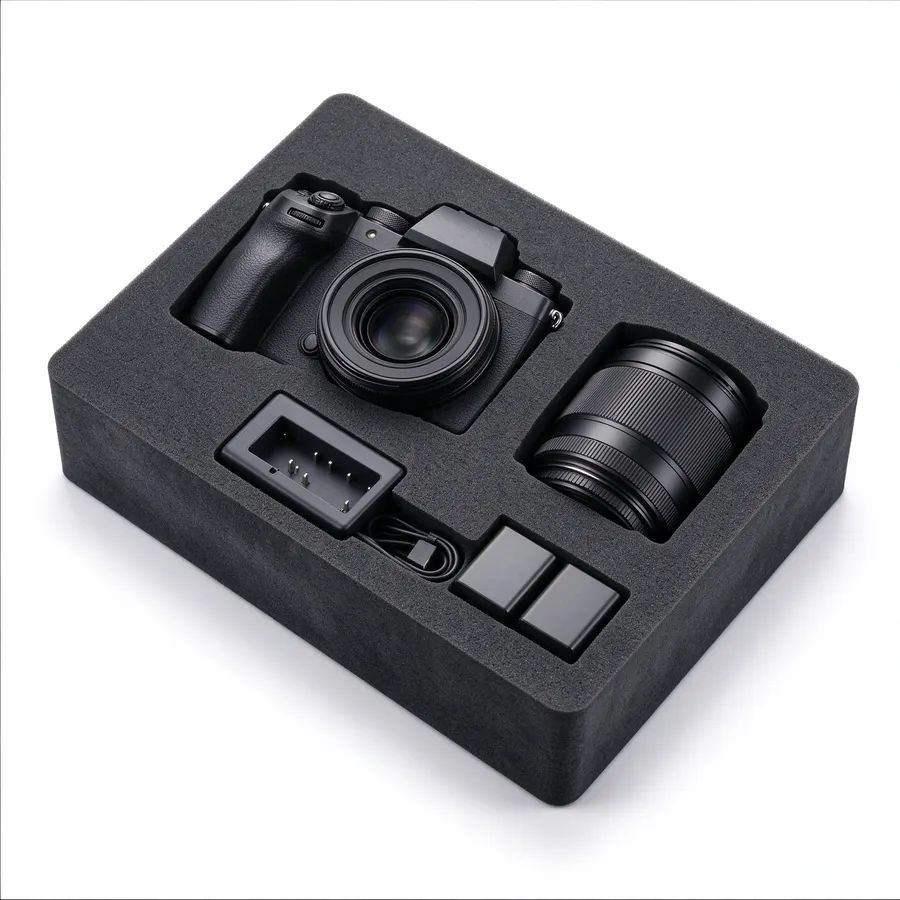
The interior is where an outdoor spec is won or lost, and custom foam is open at every level of our range: MOQ 1 on custom foam, cut against a drawing, a photograph of the packed kit, or a physical sample - all three input formats are recorded in the database as accepted. Foam grades cover pick-and-pluck, die-cut, CNC-cut, EVA, PE and EPE, in structures from a plain top layer to egg-crate and multi-layer builds, so a mixed camp kit can get rigid zones for hard items and a soft press layer over everything else. Shell-level customization follows the wholesale MOQ ladder: logo and colour start at 300 pieces, private label and OEM work at 300, and a new mould at 3,000 per component with a 125-day tooling window.
Lead times are recorded per model in the database rather than promised as a general figure: 45 days for OEM work on an existing mould and 125 days for a new mould. A 30 percent deposit is the standard term that starts either clock. What we will not customize is the performance story: we will add a gasket, change hardware, thicken a wall or design a foam layout, but we will not convert any of that into an unmeasured rating on the datasheet. If a program needs measured protection figures, the route is a per-configuration test with a report - the same position our guides on foam inserts and on hardware take, because an interior cut to drawing is the one part of the specification a buyer can fully verify from a file.
Procurement Notes: Terms, Honest Claims And The Questions To Send
The commercial frame first: we are a manufacturer selling wholesale and OEM, quoting EXW or FOB, and we do not do retail, DDP or overseas warehousing. MOQ is 1 on a stock shell, which exists so a buyer can order a trial piece, cut foam against it and validate the fit before committing to a program; logo, colour and OEM work start at 300 pieces. Quotations are built from the published specification sheet of the chosen model plus your foam drawing, carton requirement and pallet spec - which is why the three-level framing of this page maps one-to-one onto how a quote is actually assembled.
On claims, our position is written into the data itself. The protection fields for waterproofing, dust, UV, temperature, stack load and load capacity read not measured for the models in the database; shock and impact protection are recorded as manufacturer options that require a specified foam layout, with the note that the shell alone is not a shock rating and no drop height is claimed. A compressible gasket is a construction fact recorded on 124 shells, not a performance figure; the latch body accepting a standard padlock, the hinge type and the feet are recorded as measured hardware facts. Read that distinction as a buyer: construction facts are published, performance figures must come from a per-configuration test report, and our guide on what an ingress-protection rating does not tell you explains how to ask for one.
Three questions make any outdoor packaging RFQ sharper. First, which figure governs the fit - nominal internal width or the narrow internal width where the shell tapers - and is it published for the model you chose. Second, what does the export plan look like: carton dimensions and pieces per carton for the model, then a pallet layout against your actual pallet, then container figures for the destination. Third, what exactly is being claimed about sealing and impact, and which parts of it will be evidenced by a test report rather than by a datasheet adjective. Buyers who send those three answers get a quotation that can be compared line by line with any other supplier's, and our procurement checklist lists the rest of the documents to attach.
Customisation
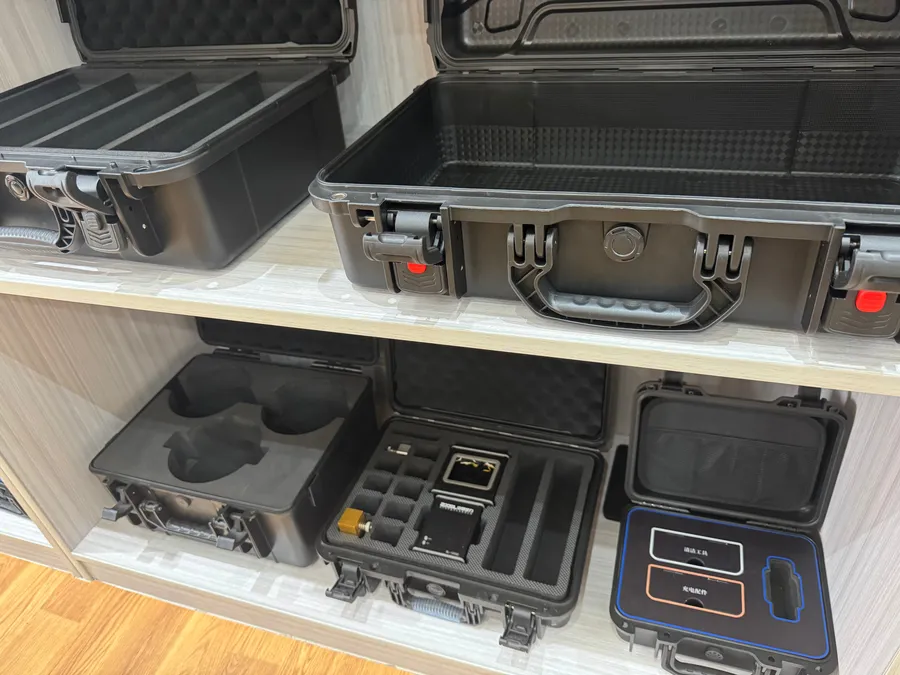
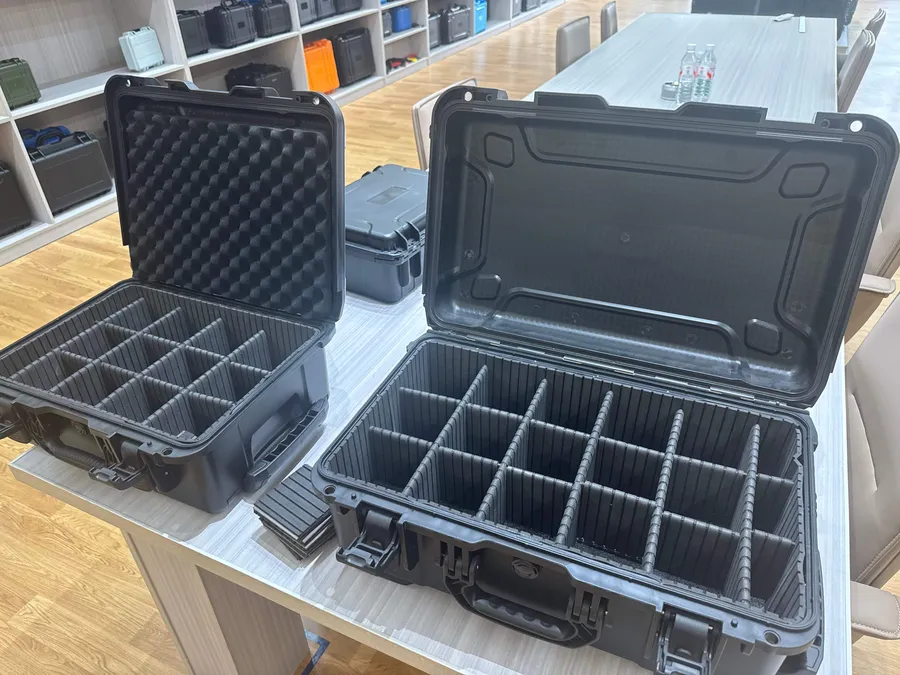
Everything described above is configurable on a standard shell: interior layout (pick-and-pluck, die-cut or CNC-cut), foam grade and thickness, colour, logo method, latch and lock count, pressure-equalisation valve, cable ports, document holder and identification plate. A bespoke exterior geometry requires a new mould — 125 days, from 3,000 units per moulded component.
Procurement considerations
| Question | What to send us |
|---|---|
| Which shell fits? | Equipment L × W × H as packed, plus required clearance per axis |
| What does it cost? | Order quantity and estimated annual quantity — the two drive different answers |
| Is tooling needed? | Whether an existing shell clears the envelope with usable foam depth |
| Lead time? | Your required delivery date, not just the order date |
| Certification? | The exact standard your tender names — we will say whether we can test to it |
| Freight? | Destination and preferred terms; carton and pallet data supplied with the quotation |
Comparison and selection guide
The tables on this page exist because a protective case is chosen by comparing three things: the envelope, the environment and the handling chain. Where no table applies, the rule below is.
| Situation | What To Do |
|---|---|
| Marine or wet | Sealed configuration with a drain-friendly interior and stainless hardware. |
| Dry and dusty | A close-fitting rim and a lid that can be opened one-handed without spilling contents. |
| Carried far | Under 10 kg packed, with a padded handle or shoulder webbing. |
- Size on internal dimensions plus clearance, never on a product name.
- Choose the carrying method before the shell: it changes the series, not just the price.
- Specify the interior last, and decide up front whether the end user will reconfigure it.
Outdoor Equipment Transport Packaging? relates to Protective Case Basics. Related families: Outdoor Protective Cases / Waterproof Cases / Rolling Cases / Equipment Transport Cases. Related sectors: field and industrial equipment. Continue in the Protective Case Basics cluster.
This page is written from our own production data. If your requirement differs, send the dimensions and we will tell you which of the 155 models fits, or whether a custom route is needed.