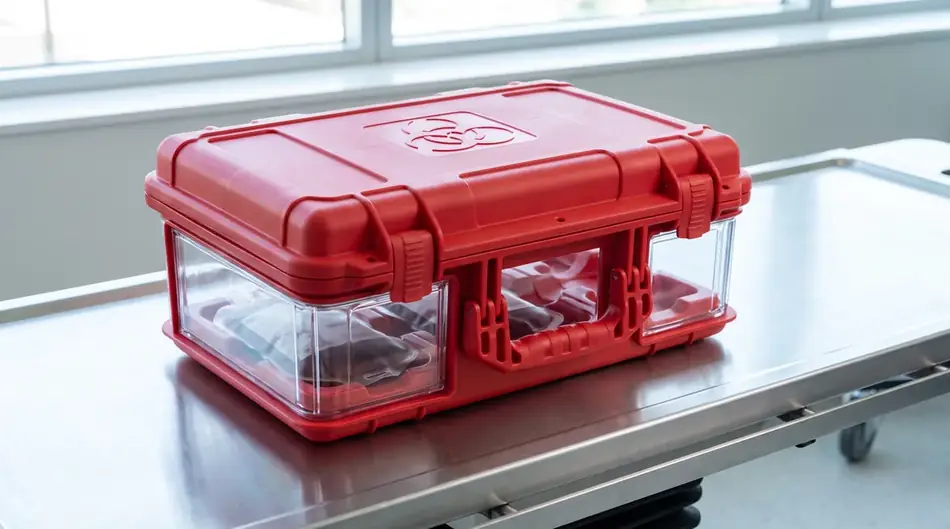
Pre-hospital emergency medication classified box?
It is a lockable hard shell whose interior is cut into separated pockets, so each medication group sits in its own physical location instead of sharing one loose tray. Choose it in that order: first the layout your service actually uses, then the pocket depth your ampoules and vials need standing or lying, then the external size and weight a crew will carry. On our published records, a shallow wide floor suits a side-by-side class layout, with KX-3607 giving 355 x 280 x 60 mm at 800 g and KX-4610 giving 455 x 338 x 84 mm at 1,115 g, while standing vials want the 253 x 180 x 152 mm of KX-92817 or the 300 x 200 x 200 mm of KX-93221. Every one of those shells lists a latch body that accepts a standard padlock. The box is a custody and impact envelope: it does not hold a temperature, it is not primary packaging, and drug storage rules, schedule separation and record-keeping remain with your pharmacist and your jurisdiction, not with a case.
Key points
- Pick the classification layout first, then the shell: pocket count and separation drive internal size more than drug volume does.
- Ampoules stored lying down need 60 to 84 mm of depth; vials or syringes standing need 110 to 200 mm, and lid plus base split decides which.
- Every shell cited here records a padlock-compatible latch and a latch count specified per configuration, which is the physical half of custody.
- Temperature range is recorded as not measured on our shells, so a classified box never substitutes for a validated cold-chain system.
- Look-alike, sound-alike pairs need distance or a divider, not a label: the foam has to create the gap.
- Custom foam is cut from one unit, so a layout can be proven before a fleet order; logo and colour start from 300 per SKU.
- Ask any supplier for measured interior figures and a written list of what is not measured, rather than a compliance adjective.
Pre-hospital emergency medication classified box: what the term describes
A Pre-hospital emergency medication classified box is a rigid carrying case whose interior is divided so that medication groups cannot end up in each other's space. In practice the classification is one of several schemes a service already uses: separation by controlled schedule under your jurisdiction's rules, by route of administration, by high-alert status, by adult versus paediatric concentration, or by the look-alike and sound-alike pairs that cause the most documented administration errors. The case does not invent that scheme. It makes the scheme physical, so a crew reaches for a group by location and a count at end of shift can be done against pockets rather than against a jumbled tray.
The second job is protection. An ambulance box spends its life on a moving floor, being lifted over equipment, opened with one hand in a doorway and set down on surfaces that are not clean. A soft bag protects a vial from nothing at all and lets two ampoules knock against each other. A moulded shell with a cut foam interior spreads that energy across the wall and keeps each item in its own pocket, which is why the classified boxes that last in service are hard-shelled and the ones that get replaced are not.
What the box is responsible for, and what it is not
Be precise about the boundary, because it is where specifications go wrong. The case supplies a mechanical envelope, a locked closure, separated pockets and a surface that can be wiped. It does not supply a sterile field, it is not the primary packaging for any drug, and it does not create an environment. Nothing in our published data records a temperature range for these shells, and the protection fields on each model are tagged measured, option or not measured, with ingress, drop height, stack load and temperature sitting in the not measured column. That honesty is the point: a box that a buyer believes is controlling a temperature is more dangerous than a box nobody trusted.
Clinical and legal responsibilities sit elsewhere. Which drugs a crew may carry, how schedules must be segregated, who holds the key, how a discrepancy is logged and how often a cold-chain item may be out of refrigerated storage are governed by your national and local rules and by your service's pharmacist or medical director. We can build the physical separation you specify and record it on the job card. We cannot tell you that a case satisfies a pharmacy or medicines-storage regulation, and no supplier should; ask instead what the shell does in a crash cabinet, on a trolley or in a boat, and let the clinical policy decide the layout.
Classification layouts that hold up in a moving vehicle
Each scheme places different demands on the interior. The table below is the one we work from when a service sends us its drug list, because it converts a policy into pocket geometry and then into a shortlist of shells.
| Layout | How It Works | What The Case Must Provide |
|---|---|---|
| Separation by control category | Restricted items are isolated in their own locked section; the rest is open to the crew | A distinct pocket or a second shell, plus a padlock point on that lid rather than on the whole case |
| Separation by route | Injection, intranasal, inhaled and oral items each have a home location | A wide floor with several shallow pockets; depth matters less than length and width |
| High-alert isolation | Concentrated agents are physically away from the dilute versions used for routine dosing | A divider of real thickness in the foam, not a printed line, and no shared pocket wall |
| Adult and paediatric split | Two concentrations of the same drug are never adjacent | Two separated zones, often two boxes on one trolley, each with its own latch count |
| Look-alike and sound-alike distance | Pairs with similar labelling are placed where a glance cannot confuse them | Gap distance created by the cut, so the arrangement cannot be defeated by someone repacking it |
| Quantity and expiry control | End-of-shift count is done pocket by pocket; oldest stock is at the front | Fixed, repeatable pocket sizes and a document area on the lid interior |
Published interior sizes for classified medication boxes
Figures below are read directly from each model's published record, which is why some columns differ between shells of similar footprint. Where a field is absent it has not been measured on that shell, and we leave it blank instead of borrowing a neighbouring model's number and presenting it as a capability.
| Case | Internal | Lid Plus Base | Wall | Net Weight | Volume | Closure | Suits |
|---|---|---|---|---|---|---|---|
| KX-3607 | 355 x 280 x 60 mm | 30 + 30 mm | 3.0 mm | 800 g | 5.2 L | Padlock-compatible latch, gasket in moulded channel | Wide flat class layout, ampoules lying down |
| KX-3609 | 355 x 280 x 80 mm | 40 + 40 mm | 3.0 mm | 900 g | 6.9 L | Padlock-compatible latch, gasket in moulded channel | Same floor with room for prefilled syringes |
| KX-4610 | 455 x 338 x 84 mm | 42 + 42 mm | 3.0 mm | 1,115 g | 11.1 L | Padlock-compatible latch, gasket in moulded channel | Full adult box with several separated zones |
| KX-4613 | 455 x 338 x 116 mm | 74 + 42 mm | 3.0 mm | 1,370 g | 15.3 L | Padlock-compatible latch, gasket in moulded channel | Drugs plus airway adjuncts in one carry |
| KX-4616 | 455 x 338 x 148 mm | 74 + 74 mm | 3.0 mm | 1,395 g | 19.6 L | Padlock-compatible latch, gasket in moulded channel | Deep lid for standing bottles and a dosing card |
| KX-92817 | 253 x 180 x 152 mm | 125 + 27 mm | 5.0 mm | 940 g | 5.5 L | Padlock-compatible latch, gasket in moulded channel | Compact restricted-items box, thick wall |
| KX-93221 | 300 x 200 x 200 mm | 165 + 35 mm | 5.0 mm | 1,230 g | 9.6 L | Padlock-compatible latch, gasket in moulded channel | Standing vials and infusion bags on edge |
| KX-63612 | 333 x 217 x 114 mm | not published for this shell | 3.5 mm | 1,300 g | 7.1 L | ABS shell, padlock-compatible latch, gasket | Rigid small box for a single class group |
| KX-63619 | 333 x 217 x 175 mm | not published for this shell | 3.5 mm | 1,660 g | 10.8 L | ABS shell, padlock-compatible latch, gasket | Same footprint, deeper contents, flat printing face |
| KX-83815 | 350 x 300 x 130 mm | 95 + 35 mm | 4.2 mm | not published for this shell | 11.0 L | Padlock-compatible latch, gasket in moulded channel | Paediatric box with a small footprint on a trolley |
| KX-84816 | 410 x 360 x 140 mm | 100 + 40 mm | 4.2 mm | not published for this shell | 16.6 L | Padlock-compatible latch, gasket in moulded channel | Large floor for a six-zone class layout |
| KX-5723 | 500 x 340 x 211 mm | 169 + 42 mm | 5.0 mm | 4,680 g | 28.7 L | Padlock-compatible latch, gasket in moulded channel | Station or rapid-response cache rather than a carry |
Depth decides whether the classification survives the layout
Most classified boxes are chosen on footprint and then fail on depth. A drug ampoule lying on its side needs about 20 mm of clearance, so a 60 mm interior such as KX-3607 comfortably takes a foam floor, the item and a lid liner. A 5 mL vial standing in a pocket needs the base depth to exceed the vial height, which is why KX-93221 splits 200 mm as 165 mm lid over 35 mm base and KX-92817 splits 152 mm as 125 mm over 27 mm: the tall lid is doing the work, and the shallow base keeps the vial seated. If you take the same contents and put them in a shell with 40 mm of base and a flat lid, the vials tip into each other and the separation you specified in the policy exists only on paper.
Two shells in one order is usually the better answer for custody, too. Services that must keep restricted items apart frequently run a main box, say the 455 x 338 x 84 mm floor of KX-4610, with a small separate lockable box for the controlled group, such as the 253 x 180 x 152 mm of KX-92817 nested inside it or clipped beside it. That gives one key holder for the restricted group without hiding the rest of the kit, and it keeps the end-of-shift count to two predictable locations.
Locking, latch count and what custody means physically
The hardware record for every shell in the table above lists a padlock-compatible latch body, and the latch count itself is specified per configuration rather than fixed by the mould. That flexibility matters for a classified box: a crew that opens the case forty times a shift wants two quick latches on the main compartments and a separately lockable section for restricted items, which is a latch layout decision rather than a different mould. Hinges, feet and the latch bodies are published as measured on production units, so the closure you specify is the closure that ships.
What we do not publish is a tamper-evident performance figure or a custody system. A plastic seal strip, a numbered tag and a signature log are part of your protocol and are cheap to add inside a case we build to your layout; the case provides the hasps, the pocket and the rigidity that make that protocol possible. If a specification asks you for a documented tamper-evidence result, treat it the same way you would an ingress claim: ask which article was tested, by whom, and whether the tested sample is the shell being delivered with your machining in it.
Temperature and light: the limits of a hard shell
The temperature field on our product records is not measured for these models, and we state it plainly because refrigeration is the single most common misunderstanding in medication box enquiries. A moulded polypropylene or ABS shell with foam slows a temperature change the way any insulating mass does; it holds no set point, it carries no validated hold time, and it will not turn a box into a cold chain. Items that must stay inside a stated range need the validated system their manufacturer specifies, plus a monitoring device, and the case's only real job is to keep that system upright and its connectors undamaged.
Light is a more modest but genuine benefit. These shells are opaque, closed by a gasketed lid where one is offered, and stay shut in a sunlit vehicle, so contents are not sitting in direct window light the way they do in a transparent bag. That is a property of the enclosure, not a measured photostability claim. Keep storage conditions with the drug's own labelling and your service's policy, and choose the box for impact, separation and custody.
Interior materials and the cleaning conversation
The published foam options for these shells are pick and pluck, die-cut and CNC-routed, in cross-linked polyethylene, EVA or EPE by zone, with layered and custom-cut builds available. For a medication box, services usually choose a CNC-routed base for the fixed groups and a pluck layer for anything that changes between shifts, because a routed pocket cannot be quietly repacked by whoever got there first. Loose padding is the worst option: it hides items, it absorbs a spill, and it makes a count unreliable.
We do not publish an antimicrobial rating or a cleanability result for foam, and we would rather say so than invent one. Closed-cell polyethylene tolerates a wipe-down better than open-cell material, and a spill into a routed pocket is still easier to manage than a spill into a soft bag's seams. Most services handle the risk structurally: the drugs stay in their own sealed packaging or in removable trays, the foam only positions them, and the tray is what gets cleaned or replaced. Specify it that way with us and we will cut around it.
What we do not claim on this page
Listed once so nobody has to hunt for it. We publish measured interior and exterior dimensions, wall thickness, lid and base depth, net weight, usable interior volume, shell material, gasket presence and carton data. We record ingress protection, drop height, impact energy, stack load, UV exposure, temperature range and hold time as not measured for these models, and we print no protective code on a gasket's behalf. We hold no medicines, pharmacy or device regulatory approval for a case, we make no conformity statement about drug storage rules in any country, and we do not publish an antimicrobial or tamper-evidence test result. Where a programme needs a documented figure, we quote accredited third-party testing against the exact configuration and tell you its cost and lead time up front.
Fleet quantities, OEM work and lead time
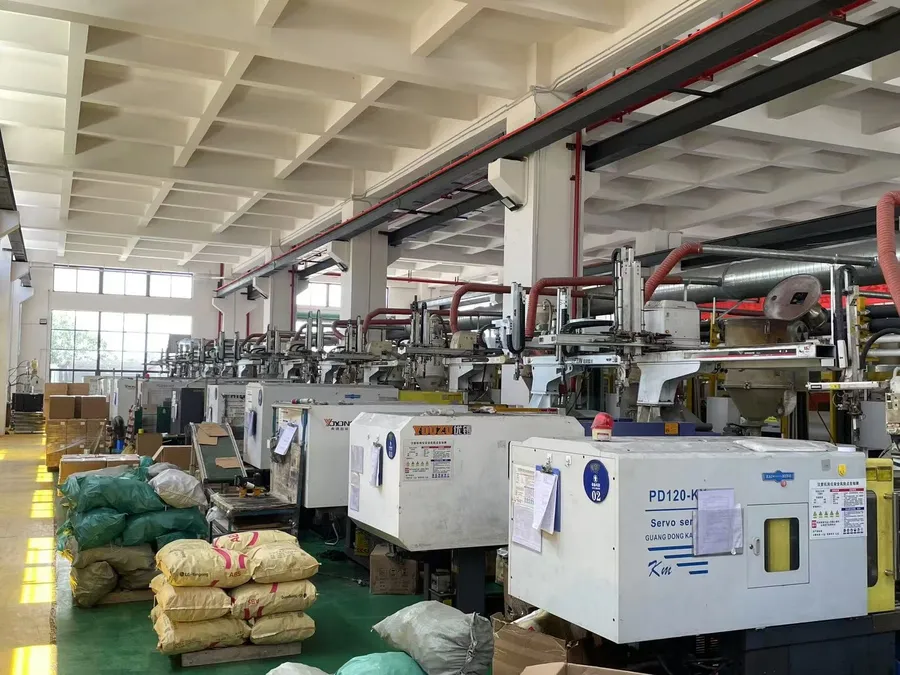
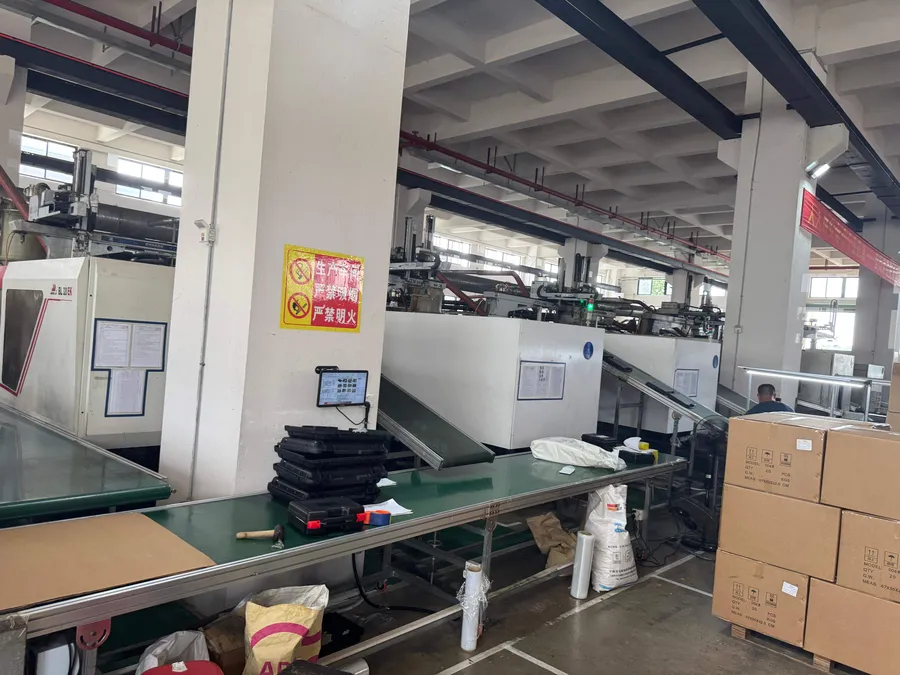
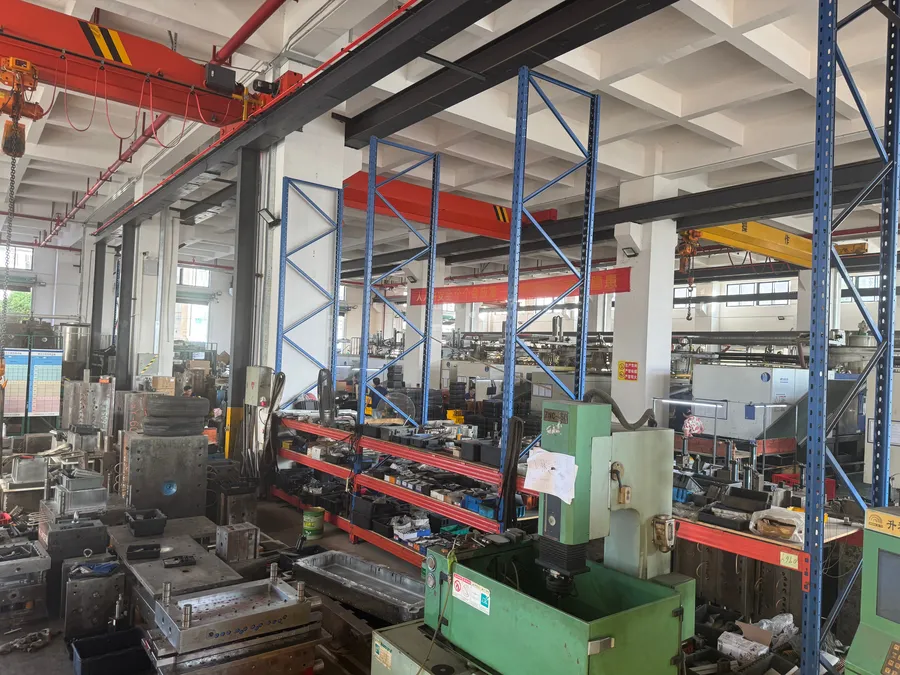
This is wholesale and OEM business. Standard shells start from one unit, and custom foam is also cut from one unit, so a single proof box can be built to a service's layout before anything is committed. Logo, colour and OEM quantities start from 300 per SKU, which is where a fleet order with a service name and a colour code on the lid usually lands. A first sample on existing tooling runs 45 days. A new mould, needed only when the exterior geometry itself has to change, starts from 3,000 units per moulded component and runs 125 days. Payment is a 30% deposit with the balance released after your inspection passes, and third-party factory audits are scheduled on request.
Quotations are EXW or FOB from Zhongshan. We do not sell retail, we do not quote DDP and we keep no overseas warehouse, so your own forwarder handles the landed cost. Carton data is published per model, 20 pieces of KX-3508 in a 730 x 615 x 428 mm carton, 12 of KX-3218 in 645 x 530 x 550 mm, 10 of KX-4012 in 725 x 420 x 580 mm and 8 of KX-63612 in 585 x 385 x 560 mm, and pallet builds are calculated against your order rather than quoted as a standing figure.
What to send us with an enquiry
Six items, and the answer comes back as a model number with a cutting drawing attached rather than as a brochure. The layout drives the shell, so the drug list and the policy wording are the two inputs we cannot substitute with a guess; the carrying position then removes half the candidates on weight before size is even compared.
| Item | Detail |
|---|---|
| Drug list as carried | Presentations and quantities per item, and whether each lies down or stands |
| Classification scheme | The policy wording your service follows, including which group must be separately locked |
| Required pockets | Zone count and minimum pocket size, plus any removable tray you already use |
| Carrying position | Crew compartment shelf, wall bracket, trolley or hand carry, which sets size and weight |
| Quantities | Trial units and estimated annual units, since they take different routes to price |
| Marking and tender wording | Logo, colour, label plate, and any standard or grade quoted word for word |
Who is answering
KeXin New Materials (Guangdong) Co., Ltd. moulds and assembles these shells in Zhongshan for wholesale, OEM, ODM and private-label programmes. Send the six items above to Fred Zhao or the KeXin Sales Team on WhatsApp +86 135 3588 0002, and you will receive a shortlist keyed to the published model records used here, a proposed pocket layout, and a written note on which figures are measured and which would need separate accredited testing.
Customisation
Everything described above is configurable on a standard shell: interior layout (pick-and-pluck, die-cut or CNC-cut), foam grade and thickness, colour, logo method, latch and lock count, pressure-equalisation valve, cable ports, document holder and identification plate. A bespoke exterior geometry requires a new mould — 125 days, from 3,000 units per moulded component.
Procurement considerations
| Question | What to send us |
|---|---|
| Which shell fits? | Equipment L × W × H as packed, plus required clearance per axis |
| What does it cost? | Order quantity and estimated annual quantity — the two drive different answers |
| Is tooling needed? | Whether an existing shell clears the envelope with usable foam depth |
| Lead time? | Your required delivery date, not just the order date |
| Certification? | The exact standard your tender names — we will say whether we can test to it |
| Freight? | Destination and preferred terms; carton and pallet data supplied with the quotation |
Comparison and selection guide
The tables on this page exist because a protective case is chosen by comparing three things: the envelope, the environment and the handling chain. Where no table applies, the rule below is.
| Situation | What To Do |
|---|---|
| Clinical environment | Closed-cell foam or a wipeable tray; no open-cell pluck foam. |
| Emergency use | Latches that open with one hand and a lid that stays up unaided. |
| High-value device | Deeper base foam, a separate transducer zone, and a documented drop test if required. |
- Size on internal dimensions plus clearance, never on a product name.
- Choose the carrying method before the shell: it changes the series, not just the price.
- Specify the interior last, and decide up front whether the end user will reconfigure it.
Pre-hospital emergency medication classified box? relates to Protective Case Basics. Related families: Medical Equipment Cases / Field Equipment Cases / Instrument & Equipment Cases / Military Protective Cases. Related sectors: field and industrial equipment. Continue in the Protective Case Basics cluster.
This page is written from our own production data. If your requirement differs, send the dimensions and we will tell you which of the 155 models fits, or whether a custom route is needed.