Musical instrument pedal & audio briefcase?
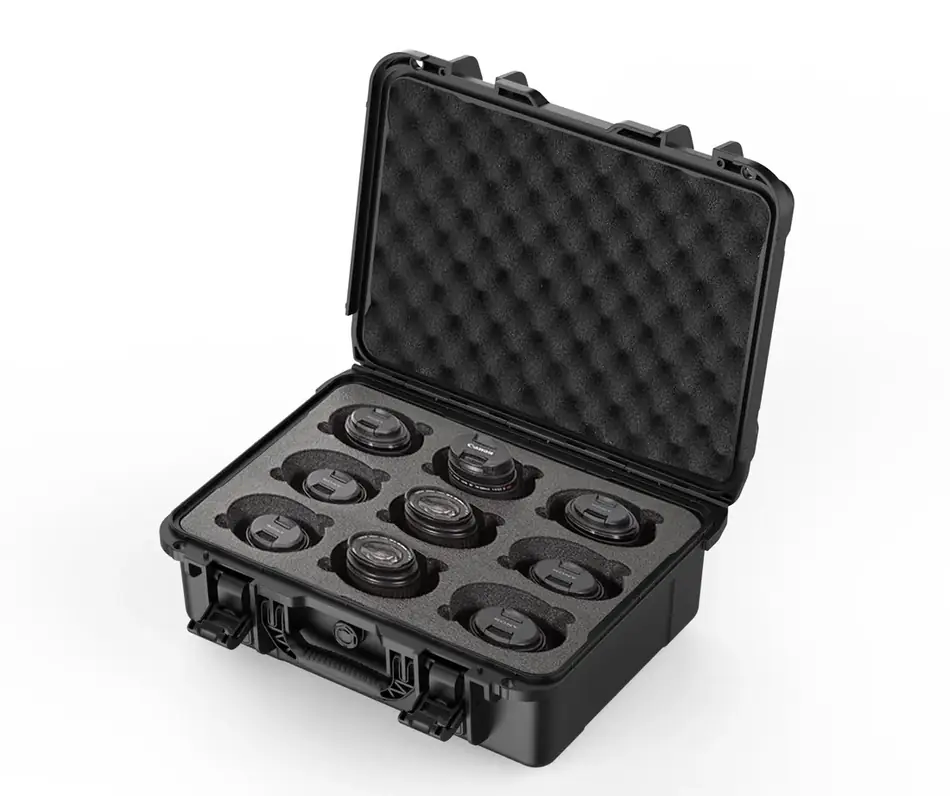
A musical instrument pedal & audio briefcase is a hand-carried hard case whose interior is cut around a small effects board or an audio kit - a few stompboxes, a power brick, cables, a recorder, an interface, microphones and headphones - rather than around a generic box, and that is how we build it: from 155 published moulded models with real internal dimensions, wall thickness from 2.0 mm to 6.0 mm and per-model weights, combined with foam cut to your drawing from one piece. The deciding numbers are internal length and width for the board footprint, then lid plus base depth for knobs, jacks and power supplies. We publish no water or dust rating for any model - those fields are recorded as not measured - and we supply wholesale and OEM buyers only, EXW Zhongshan or FOB Shenzhen, first sample in 45 days on an existing mould.
Key points
- Board footprint first: our published interiors span 270 x 190 mm (WL2805) to 880 x 350 mm (KX-89616), with the longest published interior length at 1,280 mm.
- Depth is the second decision, not a detail: lid plus base depth is what clears tall knobs, jack plates and a switching power supply sitting on the board.
- Wall thickness ranges from 2.0 mm on flat shells to 5.0 mm on thick-wall models, and it drives both weight and how the foam can be anchored.
- Net weight is published per model where measured, from 293 g (WL2405) to 4,912 g (WL8-5021 Trolley); several large 8-series shells publish no weight figure.
- Custom-cut foam starts at one piece, so an effects layout can be proven on a single case before any volume commitment; logo, colour and packaging start at 300 units.
- 124 of the 155 published models offer a compressible EPDM or equivalent gasket, which is the relevant question for dusty venues and outdoor stages.
- A musical instrument pedal & audio briefcase ships economically: WL2805 packs 32 pieces per carton, WL3508 packs 20, WL3213 packs 16.
Musical instrument pedal & audio briefcase: what the format is really for
The search phrase describes a small, hand-carried hard case for the kit a player or a field audio engineer moves between a rehearsal room, a venue and a studio: a short effects board with four to eight pedals and a power supply, or a recorder with a pair of microphones, a handheld interface, headphones, a DI box and the cables that make all of it work. Unlike a gig bag, the shell is moulded thermoplastic with latches, and unlike a flight case, it is sized so one person can carry it with an instrument in the other hand. That is a real engineering brief, and it is answered with four numbers: internal length, internal width, the lid-and-base depth split, and net weight.
We do not sell a single purpose-built pedal board case. Instead the catalogue offers 155 active moulded models in seven series, and the interior is cut per drawing, so a distributor can carry one shell family across several product SKUs by changing the foam - a four-pedal tray, a six-pedal tray with a power brick recess, or an audio-kit layout with microphone pockets. The same shells serve instrument technicians, broadcast crews, rental houses and schools, which is why the packing data below is published rather than approximate.
Published sizes for boards, recorders and audio kits
Every figure in this table is the published value for that model in our specification data, not a rounded marketing number. Internal plan area tells you whether a board fits; internal depth tells you whether it fits with the power supply on top of it; the narrow internal width matters where a shell tapers at the corners; and the gasket column shows whether a sealing option exists for that model at all. Where our data holds no figure - weight on several large 8-series shells, for example - the cell reads not published rather than an estimate.
| Model | Internal Mm | External Mm | Wall Mm | Net Weight | Volume | Gasket Option | Typical Audio Use |
|---|---|---|---|---|---|---|---|
| WL2805 | 270 x 190 x 46 | 280 x 230 x 53 | 2.1 | 340 g | 2.4 L | No | Four-pedal flat board, cables |
| WL3213 | 308 x 230 x 118 | 315 x 260 x 128 | 3.0 | 860 g | 8.4 L | Yes | Board plus power brick in the lid zone |
| WL3308 | 325 x 236 x 76 | 330 x 272 x 82 | 2.3 | 575 g | 5.8 L | No | Six-pedal board, low profile |
| WL3508 | 344 x 268 x 72 | 350 x 300 x 79 | 3.0 | 995 g | 6.6 L | Yes | Interface plus headphones and adapters |
| WL3609 | 355 x 280 x 80 | 360 x 310 x 90 | 3.0 | 900 g | 8.0 L | Yes | Field recorder with microphones |
| WL704# | 350 x 220 x 80 | 355 x 265 x 90 | 2.1 | 630 g | 6.2 L | No | DI boxes, small mixer, cable pool |
| WL712# | 308 x 250 x 96 | 315 x 290 x 110 | 2.8 | 710 g | 7.4 L | No | Two-row pedal tray with lid clearance |
| KX-83813 | 350 x 170 x 115 | 384 x 230 x 128 | 3.3 | Not published | 6.8 L | Yes | Narrow single-row board, briefcase proportions |
| KX-86216 | 582 x 300 x 130 | 620 x 360 x 155 | 3.3 | Not published | 22.7 L | Yes | Full pedalboard with power distribution |
| KX-89616 | 880 x 350 x 140 | 956 x 408 x 154 | 5.0 | Not published | 43.1 L | Yes | Large board or controller keyboard |
| KX-814641 | 1,280 x 350 x 140 | Published per model page | 5.0 | Not published | 62.7 L | Yes | Longest published interior in the catalogue |
| WL8-5021 Trolley | 437 x 308 x 164 | 495 x 370 x 210 | 4.5 | 4,912 g | 22.1 L | Yes | Wheeled carry for heavy audio kits |
Pedalboards, audio interfaces and microphones need three different interiors
A stompbox board is a width-and-depth problem. Pedals are low but their jacks stick out at the ends, knobs stand proud on the top face, and a daisy-chain or isolated power brick is often the tallest object in the box. The layout that works is a base foam plate with the board recessed so the pedals sit below the shell's parting line, plus lid foam that touches the board and not the switches - otherwise every closure pushes the top row. On WL3213 the published split is an 86 mm lid and a 32 mm base, which is the opposite bias and suits a case where accessories stack above the board; WL712# splits 54 mm and 42 mm for a shallower tray.
An audio interface, recorder or mixer is a connector problem. Knobs, XLR bodies and jack sockets want pockets with finger relief, and a cable pool under a removable sub-plate keeps the lid from pressing a connector into a chassis. Microphones want either moulded cradles or a pluck field with a retaining strap, and their clips and windscreens need their own zone so nothing rubs a capsule. A musical instrument pedal & audio briefcase built for a player and one built for a location sound kit therefore share a shell and never share a drawing, which is why we ask which one you are packing.
Foam choices: pick-and-pluck, die-cut or CNC-cut
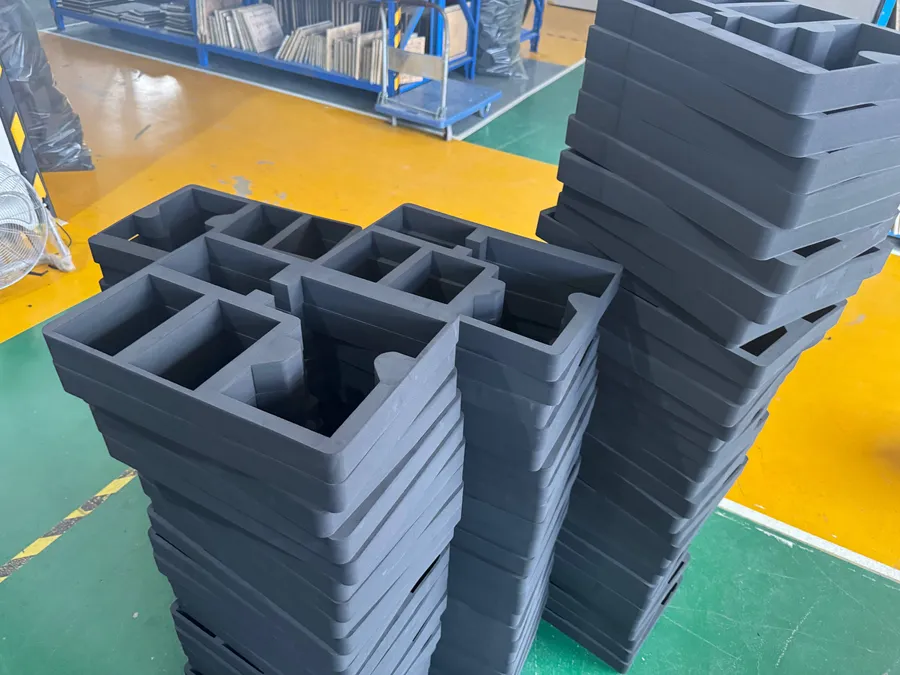
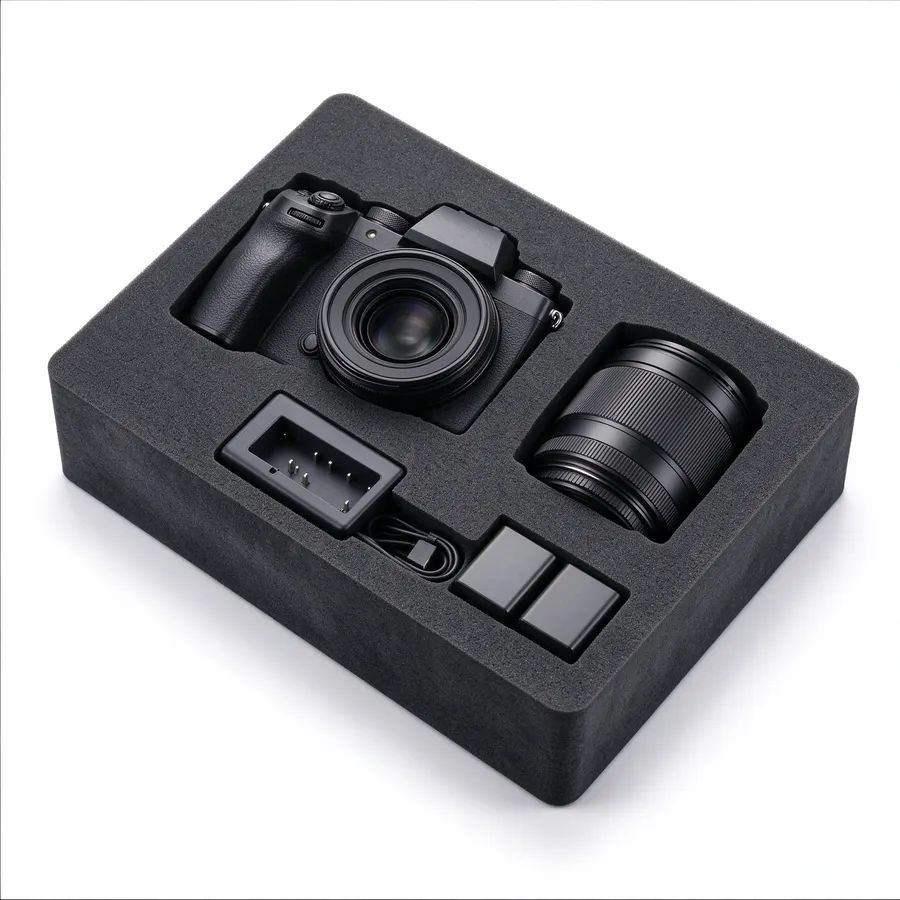
Our published foam options are pick-and-pluck, die-cut, CNC-cut, EVA, PE and EPE, with top foam, base foam, egg-crate faces, layered builds and custom shapes, and all of it is cut per drawing, photograph of the packed kit, or a physical sample supplied by you. Pick-and-pluck is the right answer when a product line sells one shell against many kit contents, because the end customer finishes the layout; CNC-cut pockets are the answer for a rental or OEM programme where every unit must pack identically and a missing accessory should be visible in one second. A dense cross-linked PE zone under a heavy power brick and a softer layer under a connector face is the usual combination, and it is a decision we make against your measured heights, not a default.
What we do not claim about protection
Two disciplines apply to this page as to every page on the site. First, the numbers: dimensions, wall thickness and net weight come from our own production records, gasket availability and foam construction are configuration options we can supply, and any field where no record exists is shown as not measured with no figure printed. Second, the consequence: we publish no ingress rating for water or dust on any of the 155 models, and no drop height, stack load or temperature range for these shells, so a specification that needs those values is met by commissioning accredited third-party laboratory testing against the method your document names, quoted as a separate work package on the ordered build. A venue-tested claim copied from another supplier's brochure is worth nothing in an acceptance inspection, and we would rather hand you a report.
What we can state about construction is concrete and checkable on delivered goods. Shells are moulded in PP on 94 models, engineering PP on 38, ABS on 22 and one PP/ABS hybrid, all with hinges recorded in our production data and latch bodies that accept a standard padlock; 124 of the 155 offer a compressible EPDM or equivalent gasket; 136 carry a fixed folding handle and 19 a telescopic handle with the folding carry handle. Those are the properties that decide whether a case survives a year of loading into a van, and none of them requires an adjective.
Choosing the right shell: a short selection guide
Start by drawing the kit as it travels, not as it sits on a desk. Measure the board or bag with pedals mounted, including jack overhang, then measure the tallest accessory - usually the power supply - and decide whether it lives beside the board or above it. Add the cable run and the spares you actually replace. That gives three numbers: plan area, base depth and lid depth. Take them to our published per-model tables and shortlist the two or three shells whose internal dimensions clear the loadout, then compare net weight against how the case is carried and how far. A flat, light shell such as WL2405 at 293 g with 220 x 162 x 49 mm of internal space suits a four-pedal travel board; WL3609 at 900 g with 355 x 280 x 80 mm suits a recorder and microphone kit; KX-86216 with 582 x 300 x 130 mm suits a full board with power distribution.
Then decide the family economics. If you are a distributor listing several products against one shell, choose a model with published carton data and a gasket option so the same tooling serves two price points: WL3508 ships 20 pieces in a 730 x 615 x 428 mm carton, WL3213 ships 16 in 645 x 530 x 520 mm, WL2805 ships 32 in 570 x 470 x 435 mm, and WL712# ships 16 in 635 x 585 x 455 mm. Pallet quantities are calculated against your pallet footprint rather than quoted as a fixed figure, and 20GP, 40GP and 40HQ loading comes with the quotation.
OEM and private label for music and audio brands
Music and audio buyers usually want three things beyond the shell: their colour, their mark, and an interior that makes the product look engineered rather than packaged. All three sit on the published ladder - custom-cut foam from one piece, then printed logo, custom colour and custom packaging from 300 units, and a dedicated new mould from 3,000 pieces per component when a distinct external size is worth the tooling. A first sample on an existing mould takes 45 days from an approved drawing and deposit; a new mould takes 125 days from the same point. A 30% deposit applies on confirmation with the balance after inspection, and third-party factory inspection is welcome at any stage.
Commercial terms and how an order starts
KeXin New Materials (Guangdong) Co., Ltd. is a manufacturer working with wholesale, OEM and ODM buyers - distributors, brands, rental operators and institutions. We do not sell retail, we quote EXW Zhongshan or FOB Shenzhen only, we do not offer DDP, and we operate no overseas warehouse, so international freight sits with your forwarder from the stated port terms. To open an enquiry, send the equipment list with measured heights, the quantity band, your target market and whether you need a sealing option; you will receive a model shortlist with the published specification table, a foam sketch with claim labels, and a sample plan. Contact Fred Zhao or the KeXin Sales Team, WhatsApp +86 135 3588 0002.
Customisation
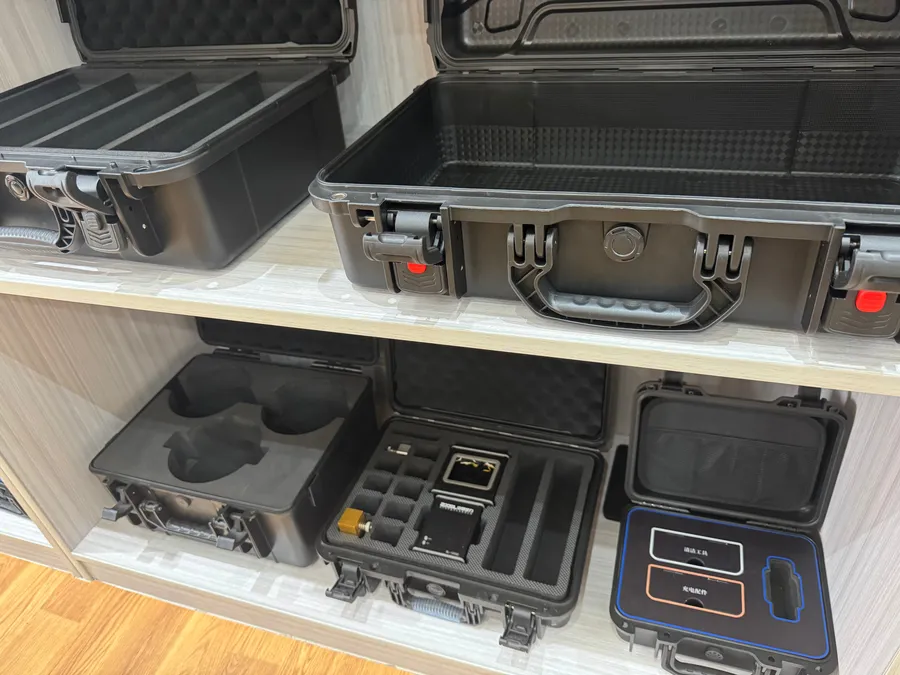
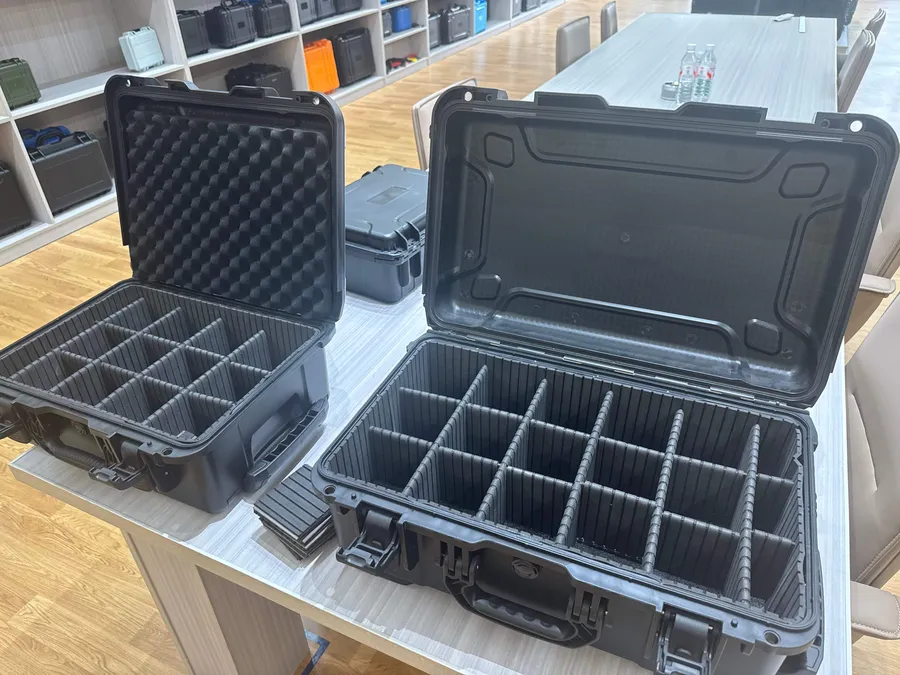
Everything described above is configurable on a standard shell: interior layout (pick-and-pluck, die-cut or CNC-cut), foam grade and thickness, colour, logo method, latch and lock count, pressure-equalisation valve, cable ports, document holder and identification plate. A bespoke exterior geometry requires a new mould — 125 days, from 3,000 units per moulded component.
Procurement considerations
| Question | What to send us |
|---|---|
| Which shell fits? | Equipment L × W × H as packed, plus required clearance per axis |
| What does it cost? | Order quantity and estimated annual quantity — the two drive different answers |
| Is tooling needed? | Whether an existing shell clears the envelope with usable foam depth |
| Lead time? | Your required delivery date, not just the order date |
| Certification? | The exact standard your tender names — we will say whether we can test to it |
| Freight? | Destination and preferred terms; carton and pallet data supplied with the quotation |
Comparison and selection guide
The tables on this page exist because a protective case is chosen by comparing three things: the envelope, the environment and the handling chain. Where no table applies, the rule below is.
| Situation | What To Do |
|---|---|
| Benchtop mass | Firm base carrier, 50 mm minimum, with a soft contact layer. |
| Optical head | Suspend the body and clear the lenses entirely; never let foam touch a coated surface under load. |
| Field kit | CNC base for the instrument, pluck-foam top for probes and consumables. |
- Size on internal dimensions plus clearance, never on a product name.
- Choose the carrying method before the shell: it changes the series, not just the price.
- Specify the interior last, and decide up front whether the end user will reconfigure it.
Musical instrument pedal & audio briefcase? relates to Protective Case Basics. Related families: Instrument & Equipment Cases / Camera & Photography Cases / Electronics Cases / Custom Protective Cases. Related sectors: field and industrial equipment. Continue in the Protective Case Basics cluster.
This page is written from our own production data. If your requirement differs, send the dimensions and we will tell you which of the 155 models fits, or whether a custom route is needed.