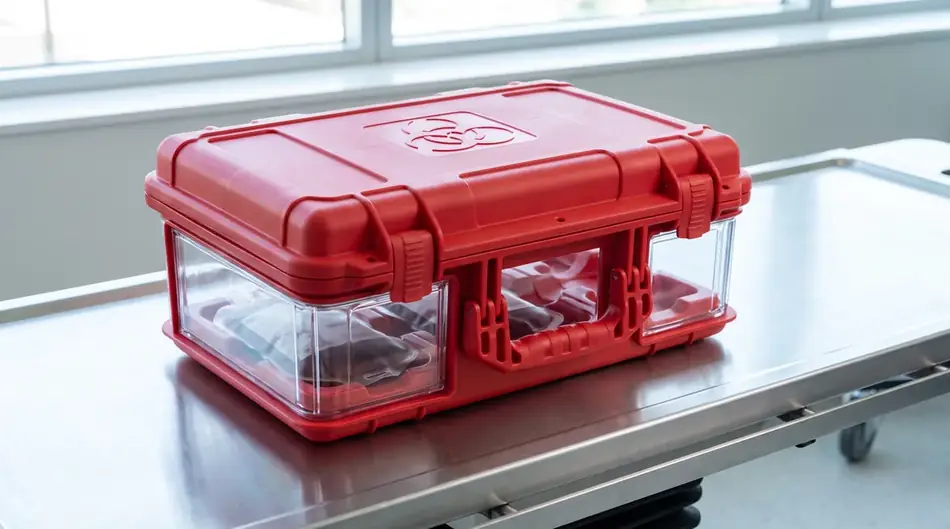
Laboratory Glassware Safety Transit Container
A laboratory glassware safety transit container is a sizing and interior-layout problem before it is a material problem: the vessel must be held so that no two pieces of glass contact each other, the foam must not be the only thing between a bottle shoulder and a hard wall, and the whole assembly must be findable inside a larger case or on a pallet. KeXin publishes external and internal dimensions, lid and base depth, wall thickness and net weight per model, with 71 models listed under medical equipment cases and internal volumes across the catalogue running from 0.3 to 139.5 litres. We do not publish an ingress or impact rating for these shells, because none is recorded in our product data; accredited laboratory testing is quoted per configuration on request.
Key points
- Size the interior on the tallest vessel plus its top foam, not on the tray that holds it: lid depth and base depth are published as separate numbers per model.
- Compare wall thickness before assuming stiffness. Published values in our catalogue run from 2 mm to 6 mm, and 74 models sit at 4.0 mm or above.
- Ask for the gasket by model number. Seal availability is a per-model field, so a shell listed without one is not a sealing assembly and should not be quoted as one.
- Send a drawing, a photograph of the packed kit, or a physical sample. That is the only way a cut layout can be quoted without guessing where the vessels actually sit.
- Separate containment from protection: an absorbent liner and a liquid-tight inner tray are configuration choices, not properties of the shell.
- Plan the return leg by carton footprint against your own pallet size. Pallet quantities are calculated per order in our data rather than pre-published per model.
What the container has to survive on a real journey
Glassware moves through a sequence of small impacts rather than one large one: a container is loaded in a laboratory, carried to a vehicle, stacked beside other freight, braked into a restraint, and lifted by a handle that is not always the one nearest the centre of mass. Each of those events loads the bottle at a different point, so the interior layout matters more than the plastic grade. A rim clamp that grips a volumetric flask below the neck keeps the load in compression, where glass behaves well, instead of bending the body, where it does not. That is a cut-design decision, and it is the reason we ask for the packed kit rather than a list of part numbers.
The second load path is the one people forget: the contents become the hazard. A broken bottle of reagent inside a sealed shell produces a wet interior, a smell on opening, and a contaminated foam block that cannot be dried in the field. Where a spill is plausible, the sensible design is a sealed primary container inside a locatable secondary container, with absorbent material between them. The outer shell then handles abrasion and stacking, and the inner tray handles the liquid. Neither part is doing the other's job, and a purchase specification that asks for one component to do both tends to get neither.
The third path is environmental but ordinary. A case that leaves an air-conditioned store and sits in a vehicle bay will move through a temperature swing, and any enclosed air volume will change pressure with it. Some of our shells offer a pressure valve as a configuration option; where the field is blank in our data, we treat the valve as a change to be quoted rather than a feature already fitted. A lid that is hard to open after a climb in altitude is usually a venting question, not a latch quality question.
Read the size table as three numbers, not one
Buyers normally quote one figure, the internal length by width, and then discover the vessel will not stand up. Our tables publish the internal box, the lid depth and the base depth separately, because the usable height of a case is the sum of the two depths minus whatever the foam costs you. A model with 152 mm internal height split as 125 mm lid and 27 mm base behaves very differently from one with an even split, if your tallest item is a 140 mm cylinder: the first lets you put the deep cut in the base and keep the lid flat, the second forces the tall item to protrude into the lid and press against the gasket line.
Wall thickness belongs in the same reading. It is the difference between the external and internal figures divided across two sides, and it explains why two shells with almost the same footprint hold different volumes. A thin-wall shell saves mass on a carried leg; a thick-wall shell resists point loading when it is stacked under other cases. Both are legitimate, and the choice depends on whether the case is carried by a person or buried in a stack.
Comparison across published models
The rows below are read directly from the model data we publish. Where a field is blank in our record we have written it as not published rather than inferring a value, because a transit container bought on an assumed number is the expensive kind of surprise. Use the table to shortlist two or three candidates, then send the packed-kit photograph so the cut can be laid out against a real interior rather than a nominal one.
| Model Size | Depth Budget | Wall And Mass | Gasket And Carry |
|---|---|---|---|
| KX-2406: 240x200x55 external, 230x155x50 internal | 25 lid + 25 base | 2 mm wall, 330 g net, 1.8 litres internal volume, PP | No gasket on this shell; stackable; fixed handle |
| KX-3207: 315x260x70 external, 308x230x64 internal | 32 lid + 32 base | 3 mm wall, 570 g net, 4.5 litres internal volume, PP | Gasket recorded; stackable; fixed handle |
| KX-3609: 360x310x90 external, 355x280x80 internal | 40 lid + 40 base | 3 mm wall, 900 g net, 8 litres internal volume, PP | Gasket recorded; stackable; fixed handle |
| KX-4010: 400x360x100 external, 390x315x88 internal | 44 lid + 44 base | 3 mm wall, 1015 g net, 10.8 litres internal volume, PP | Gasket recorded; stackable; fixed handle |
| KX-4312: 430x300x115 external, 420x260x104 internal | 52 lid + 52 base | 3.5 mm wall, 1170 g net, 11.4 litres internal volume, PP | Gasket recorded; stackable; fixed handle |
| KX-92817: 280x225x165 external, 253x180x152 internal | 125 lid + 27 base | 5 mm wall, 940 g net, 6.9 litres internal volume, Engineering PP | Gasket recorded; stackable; fixed handle |
| KX-63317: 328x232x167 external, 300x178x152 internal | not published lid + not published base | 4 mm wall, 1370 g net, 8.1 litres internal volume, ABS | Gasket recorded; stackable; fixed handle |
| KX-3315: 334x287x150 external, 303x224x135 internal | 100 lid + 35 base | 4.1 mm wall, 1670 g net, 9.2 litres internal volume, Engineering PP | Gasket recorded; stackable; fixed handle |
Interior layout: foam is a structure, not a thickness
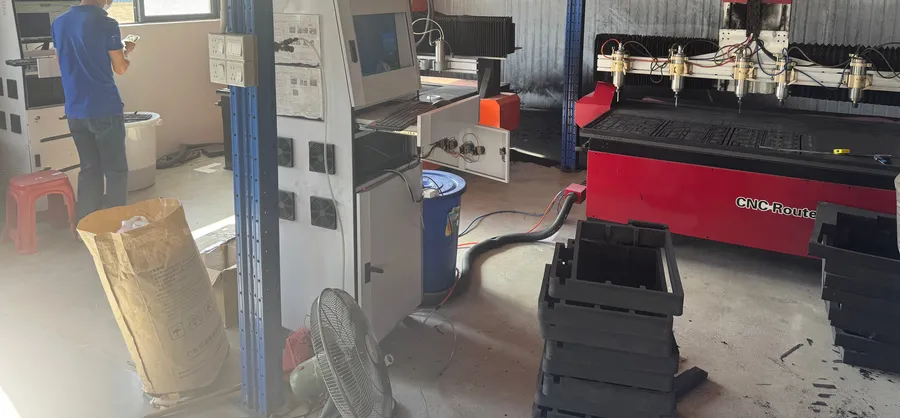
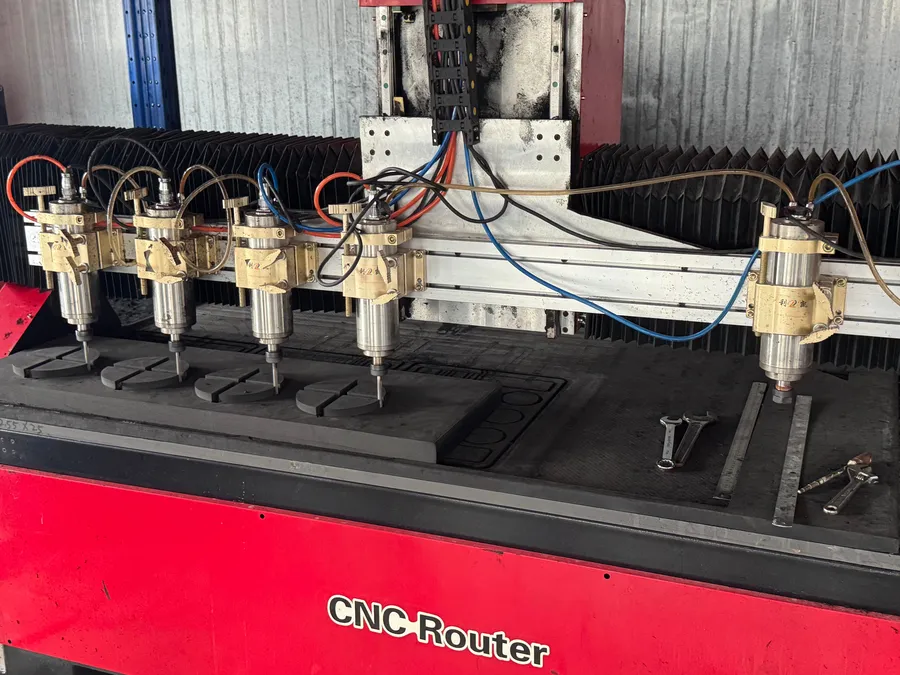
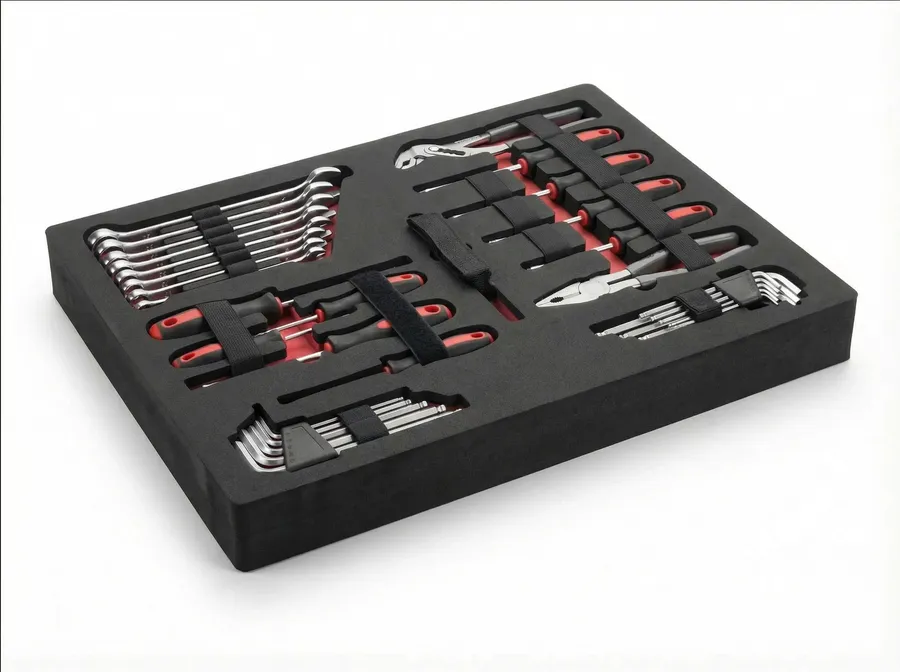
We work in cross-linked PE, EVA, EPS and EPE, in pick-and-pluck, die-cut, CNC-cut, egg-crate and layered forms. For glassware the useful distinction is not which material is softest but where the density changes. A vessel neck wants support over a short length; a body wants cradling along its whole height; a stopper wants to be held so it cannot chip against a neighbour. Layering a firmer base under a softer top face does that in two operations, and it is cheaper than a single block of the softest material, which tends to let items lean into each other once the case is warm.
Spacing is the other half. The rule we work to is that no two rigid objects touch through the foam when the case is fully loaded, which means the wall between two cut walls has to survive the deflection of both items at once. That is why a layout drawn from the packed kit beats one drawn from a datasheet: the datasheet gives you the widest dimension of each item, and the kit shows how they actually nest, which way the necks face, and whether the caps come off for travel.
For reagent sets that travel as a group, a removable inner tray is worth more than extra foam thickness, because the tray lets the whole set be lifted out of a larger case without disturbing the layout, and it can be washed or replaced when a bottle fails. Trays are cut to the shell, so they are quoted with the shell rather than added later.
Choosing the model, in the order we would ask you to
Start with the tallest single item and add the foam you need under it; that fixes the internal height budget and eliminates half the catalogue at once. Second, lay out the footprint on paper at true scale and count how many positions you actually need, because a case sized for eight flasks that will usually travel with three is a case that rattles. Third, decide whether the shell itself has to be a barrier or whether an inner tray is the barrier; if the answer is the tray, you are free to use a lighter shell. Fourth, check the handle and carry style: KX-3609 is a fixed-handle model at 900 g, while a larger shell with wheels and a telescopic handle is a different carrying decision entirely. Fifth, only then look at wall thickness, as the tie-breaker between two candidates that already fit.
If your laboratory also ships samples outward and returns empty containers, size the return layout at the same time. Empty protective packaging travelling back is freight paid to move air, and a nesting arrangement or a stackable shell changes the cost per cycle more than a material upgrade does. Our stackable field is published per model, and it is the cheapest lever available when the outbound and inbound loads are the same shape.
Where these containers are used
The common pattern is not a single long haul but repeated short ones: sampling rounds, field stations, mobile testing units, teaching collections moved between rooms, and QC samples sent from a production line to a laboratory. Each of those legs is short, which is exactly why the container is loaded so often, and why latches, hinges and handle fixings fail before the shell does. In our hardware data, latch count is set per configuration, hinge presence is published per model, and the lock field notes where a latch body accepts a standard padlock.
A second group of users needs the case to be readable rather than tough: a shared sampling kit that several people pack has to show, at a glance, which position is empty. That is an argument for a cut layout with named positions, or for pick-and-pluck where the user fills the shape, rather than a precision die-cut that hides an omitted item inside a generic cavity.
Custom cuts, liners and OEM marking
Custom foam has a minimum order of 1 unit, logo marking 300 units, colour 300 units and general OEM 300 units; a new mould is 3000 units per component with a 125-day tooling lead, against 45 days for OEM work on an existing mould. Those figures are our standing business parameters, and they are the reason a one-off laboratory purchase is usually a stock shell plus a cut insert rather than a bespoke mould.
Marking is worth planning in the first order rather than the second. Position numbering, a reagent-set name, or a customer logo are all applied to the shell or the insert, and on an existing mould the change is a tooling-free one. If the kit will be audited, leave a document pocket in the layout; it is a published option field on some models and blank on others, so it has to be asked for by name.
Commercial terms worth stating in the specification
We sell wholesale and OEM, on EXW or FOB, with a 30 percent deposit. We do not sell retail, we do not quote DDP, and we hold no overseas stock. If your purchasing process needs a delivered duty paid price, that figure has to come from your own forwarder, and it is better to discover that during RFQ than after a shipment has been booked. Container loading for 20GP, 40GP and 40HQ is supplied with the quotation, calculated from the carton footprint rather than assumed, and pallet quantities follow your pallet size.
For a glassware programme, the practical specification line is short: model number, internal dimensions as published, lid and base depth, wall thickness, net weight, whether a gasket is fitted, the cut layout reference, and the marking. Everything else is a claim you should expect a laboratory report for, and a supplier who volunteers one without naming the procedure deserves the question.
What we leave blank, and why that is the useful answer
Our product record carries the waterproof and dust fields as not measured for these shells, and the protection rating field as not measured with a note that accredited testing is quoted per configuration. That is deliberate. A gasket is a manufactured feature that can be inspected, and we publish it model by model; a rating is the output of a specific procedure on a specific assembly, and printing one against a catalogue line that may or may not carry that assembly is how buyers end up with a paper number and a wet sample. Shock and impact are recorded the same way: the shell contributes wall thickness, and the protection comes from the foam layout you specify.
So the honest form of this specification is a shortlist of two or three models with real published numbers, a cut layout drawn from your packed kit, and a named testing scope if your quality system needs one. Send us the kit photograph and the volumes you need to carry, and we will return the model, the insert drawing and the commercial terms against it.
Customisation
Everything described above is configurable on a standard shell: interior layout (pick-and-pluck, die-cut or CNC-cut), foam grade and thickness, colour, logo method, latch and lock count, pressure-equalisation valve, cable ports, document holder and identification plate. A bespoke exterior geometry requires a new mould — 125 days, from 3,000 units per moulded component.
Procurement considerations
| Question | What to send us |
|---|---|
| Which shell fits? | Equipment L × W × H as packed, plus required clearance per axis |
| What does it cost? | Order quantity and estimated annual quantity — the two drive different answers |
| Is tooling needed? | Whether an existing shell clears the envelope with usable foam depth |
| Lead time? | Your required delivery date, not just the order date |
| Certification? | The exact standard your tender names — we will say whether we can test to it |
| Freight? | Destination and preferred terms; carton and pallet data supplied with the quotation |
Comparison and selection guide
The tables on this page exist because a protective case is chosen by comparing three things: the envelope, the environment and the handling chain. Where no table applies, the rule below is.
| Situation | What To Do |
|---|---|
| Clinical environment | Closed-cell foam or a wipeable tray; no open-cell pluck foam. |
| Emergency use | Latches that open with one hand and a lid that stays up unaided. |
| High-value device | Deeper base foam, a separate transducer zone, and a documented drop test if required. |
- Size on internal dimensions plus clearance, never on a product name.
- Choose the carrying method before the shell: it changes the series, not just the price.
- Specify the interior last, and decide up front whether the end user will reconfigure it.
Laboratory Glassware Safety Transit Container relates to Protective Case Basics. Related families: Medical Equipment Cases / Instrument & Equipment Cases / Custom Protective Cases / Equipment Transport Cases. Related sectors: field and industrial equipment. Continue in the Protective Case Basics cluster.
This page is written from our own production data. If your requirement differs, send the dimensions and we will tell you which of the 155 models fits, or whether a custom route is needed.