Portable Case for Field Electrical Testing Equipment?
Choose it from the inside out: measure the tester with its leads coiled and probes clipped on, then pick the shell whose published internal length, width and base depth clear that envelope with room for foam. On our published data a clamp meter and short lead set fits a KX-2508 interior of 245 x 175 x 68 mm at 338 g, an insulation tester with a proper lead set fits KX-3113 at 296 x 258 x 121 mm and 1,060 g, and a full field kit with charger and spares fits KX-4613 at 455 x 338 x 116 mm and 1,370 g. Lid and base depth matter as much as footprint, and the narrow internal width at the rails is the real limit. Ingress, impact and environmental ratings are recorded as not measured on these shells; we publish dimensions and quote accredited testing per configuration.
Key points
- Measure the tester with leads coiled and probes attached, then allow roughly 10 mm per side before you pick an internal size.
- Compare lid depth and base depth separately: a probe handle standing in its holster needs base depth, not a shallow lid.
- Wall thickness is published per model, from 2.0 mm on KX-2508 to 5.0 mm on KX-5723, and it sets racking and foam budget.
- Empty shell weight decides portability: 338 g carries on a strap, 2,330 g wants a real handle, 4,912 g is a wheeled trolley.
- Treat the published narrow internal width, not the nominal interior width, as the limit where the rails squeeze the kit.
- For any supplier, ask which article was tested, by whom and to which revision before accepting an ingress or impact claim.
- Custom foam is cut from one unit; we need a drawing, a photo of the packed kit, or a physical sample to lay it out.
Portable Case for Field Electrical Testing Equipment: what the phrase has to cover
A Portable Case for Field Electrical Testing Equipment is one shell that carries an instrument together with everything that makes that instrument usable on site: test leads, probes, crocodile clips, a current clamp, a charger, spare fuses and the paper manual. Sizing from the instrument's own carton is where most enquiries go wrong, because a set of 4 mm leads coiled to a safe radius adds 120 to 160 mm along the diagonal of the bundle, and probe handles stand upright rather than lying flat. Size the case around the kit you actually close and carry, then read the published internal length, width and depth against that envelope.
Field electrical work also loads a case in ways an instrument datasheet never mentions. Lids are opened with gloves on, one hand holds the shell while the other probes a panel, and the case is set down on concrete, gravel or a ladder shelf instead of a bench. That pushes the decision towards a moulded handle a gloved hand can close around, latches that work one-handed, a base stiff enough not to flex while a probe is pressed home, and an interior where nothing has to be dug out from under the lead bundle to reach the meter.
Where a portable case for field electrical testing equipment differs from an instrument box
An instrument box is sized to the instrument. A field test kit is sized to a workflow: the technician opens the case on a ladder, takes the meter out with the leads still coiled, closes it one-handed while climbing down, and stows it in a van alongside a drill and a cable reel. Those four actions choose the case more strongly than any rating. They argue for a lid that stays open without a stay that snags a sleeve, for latches that do not need two thumbs, for a handle offset so the case hangs upright against a hip, and for a footprint that lies flat on a shelf rather than rocking on a moulded rib.
It also means the case is bought as a system with the interior. Two technicians with the same insulation tester often need different shells: one carries 5 m leads and a laptop charger, the other carries 30 m leads on a spool that stands 200 mm tall. The second needs the 411 x 208 x 202 mm interior of KX-4321 with its 164 mm of lid depth; the first is comfortable in the 355 x 280 x 80 mm floor of KX-3609. Nobody can pick from the instrument name alone, which is why every number in this page is tied to a specific model record.
Size the shell from the packed kit, not from the catalogue page
Measure your kit in three states rather than one. First the instrument alone, in its boot and holster if it wears one. Second the instrument with leads coiled and probes clipped to the bundle, which is the configuration that actually has to close. Third the full field set with charger, spare fuses, a temperature probe and documentation. Published internal dimensions are the ruler for all three: a clamp meter with a short lead set clears a KX-2508 interior of 245 x 175 x 68 mm at a net shell weight of 338 g, while an insulation tester with a real lead set needs the 296 x 258 x 121 mm of KX-3113 at 1,060 g. Allow roughly 10 mm per side once the foam is compressed, and treat the narrow internal width published for several shells, 160 mm on KX-2508, 217 mm on KX-3308 and 302 mm on KX-4613, as the true limit at the racking rails rather than the nominal interior width.
Empty shell weight is a portability figure, not a courtesy line in a table. A 338 g case carried up a ladder all day is a different tool from a 2,330 g KX-4321, and the 4,912 g KX-85021 with wheels and a telescopic handle is a trolley solution rather than something a technician will lift into a ceiling void. Decide first how far the case travels by hand: below about 1.5 kg a shoulder strap is enough, between 1.5 and 3 kg the handle geometry and its position start to matter more than the size, and above 3 kg wheels stop being an accessory.
Published interior sizes for common field test kits
Every figure below is read from the published record for that model. Where a field is not published it has not been measured on that shell, and we say so rather than rounding a neighbouring model's number upwards.
| Case | Internal | Lid Plus Base | Wall | Net Weight | Shell And Gasket | Typical Kit |
|---|---|---|---|---|---|---|
| KX-2508 | 245 x 175 x 68 mm | 34 + 34 mm | 2.0 mm | 338 g | PP, no gasket offered on this shell | Clamp meter, short lead set, probes in one tray |
| KX-3308 | 325 x 236 x 76 mm | 38 + 38 mm | 2.3 mm | 575 g | PP, no gasket offered on this shell | Multimeter plus an accessory pouch flat in the lid |
| KX-2614 | 240 x 200 x 120 mm | 60 + 60 mm | 2.2 mm | 460 g | PP, no gasket offered on this shell | Small handheld tester standing with probes above it |
| KX-3609 | 355 x 280 x 80 mm | 40 + 40 mm | 3.0 mm | 900 g | PP, compressible gasket in a moulded channel | Insulation tester with a 4 mm lead set laid flat |
| KX-3113 | 296 x 258 x 121 mm | 83 + 38 mm | 2.9 mm | 1,060 g | Engineering PP, no gasket offered on this shell | Deep lid for a holster-mounted tester and loose clips |
| KX-4012 | 380 x 305 x 110 mm | 85 + 25 mm | 3.5 mm | 1,480 g | Engineering PP, gasket in a moulded channel | Two instruments with charger and documentation |
| KX-4321 | 411 x 208 x 202 mm | 164 + 38 mm | 3.0 mm | 2,330 g | Engineering PP, gasket in a moulded channel | Narrow footprint, tall interior: lead spool standing upright |
| KX-4613 | 455 x 338 x 116 mm | 74 + 42 mm | 3.0 mm | 1,370 g | PP, gasket in a moulded channel | Complete field electrical kit, one carry |
| KX-4616 | 455 x 338 x 148 mm | 74 + 74 mm | 3.0 mm | 1,395 g | PP, gasket in a moulded channel | Same footprint, deeper: kit plus calibration accessories |
| KX-63416 | 310 x 255 x 138 mm | not published for this shell | 4.8 mm | 1,800 g | ABS, gasket in a moulded channel | Rigid small footprint with a heavier wall |
| KX-64114 | 378 x 307 x 120 mm | not published for this shell | 4.0 mm | 2,100 g | ABS, gasket in a moulded channel | Bench-style test set carried to site |
| KX-5723 | 500 x 340 x 211 mm | 169 + 42 mm | 5.0 mm | 4,680 g | Engineering PP, gasket in a moulded channel | Large instrument plus manuals and calibration papers |
| KX-85021 | 437 x 308 x 164 mm | not published for this shell | 4.5 mm | 4,912 g | Engineering PP, gasket, wheels and telescopic handle | Protection relay or primary injection test set |
Lid depth, base depth and narrow width: the numbers that decide whether it closes
Depth split is the figure buyers notice too late. Shells with a similar footprint differ mainly in how interior depth is divided between lid and base. KX-4012 gives 380 x 305 mm of floor but splits its 110 mm as 85 mm of lid over 25 mm of base, while KX-4613 splits a comparable 116 mm as 74 mm lid over 42 mm base. If a tester stands in its holster, or a 10 m lead bundle sits on its edge, the base depth is what carries it and the lid depth is what swallows the accessory tray. Choosing on external height alone produces a shell that closes on a latch and bulges on an instrument.
Stackability and packing change the economics again. KX-85021 and KX-85424 are published as wheeled shells that do not stack, so they travel as single units; KX-2508, KX-3113, KX-3609, KX-4012 and KX-4613 are all published as stackable, which is what makes a mixed fleet of test-kit cases economic to ship in one container. Carton data is published per model, 20 pieces of KX-2508 in a 515 x 440 x 385 mm carton, 16 pieces of KX-3113 in 635 x 595 x 540 mm, 10 pieces of KX-4012 in 725 x 420 x 580 mm, 8 pieces of KX-63416 in 675 x 365 x 360 mm and 12 pieces of KX-4321 in 885 x 515 x 650 mm. Pallet builds and container loading are calculated against your pallet size and your order, and issued with the quotation rather than printed as a generic capacity claim.
Shell material: polypropylene or ABS for a test instrument
Both materials are in the catalogue and neither is universally better for an electrical kit. The polypropylene shells in the table above are the tougher choice per unit of volume and the lighter one, and a dimpled PP wall on a van floor is still a wall; the ABS shells give a flatter, more rigid face that takes labels, screen windows and machined ports cleanly, at a mass penalty. KX-63416 carries 8.7 litres behind a 4.8 mm wall and weighs 1,800 g, where the similar-footprint KX-3609 gives 6.9 litres at 3.0 mm and 900 g. Choose ABS when the wall itself has to be machined or printed; choose PP when the case is carried and thrown.
| Material | What It Does | Watch Out | Models |
|---|---|---|---|
| Polypropylene (PP) | Light per litre, flexes and dimples rather than splitting | Flat lid faces need thicker mouldings, so wall is published per model | KX-2508, KX-3308, KX-2614, KX-3609, KX-4613, KX-4616 |
| Engineering PP | Same chemistry with heavier sections, published up to 5.0 mm wall | A measured thickness, not an environmental rating of any kind | KX-3113, KX-4012, KX-4321, KX-92817, KX-5723, KX-85021 |
| ABS | Rigid, flat, easy to machine and to print a panel or label onto | Heavier per litre and less tolerant of a cold impact | KX-62209, KX-63416, KX-64114, KX-5021 |
The interior layout is the actual protection
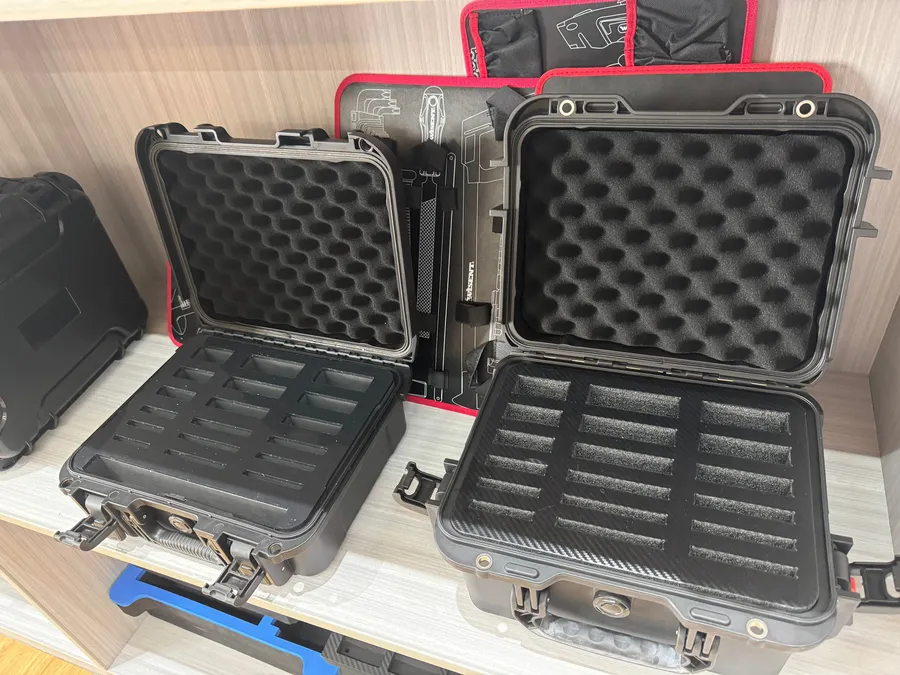
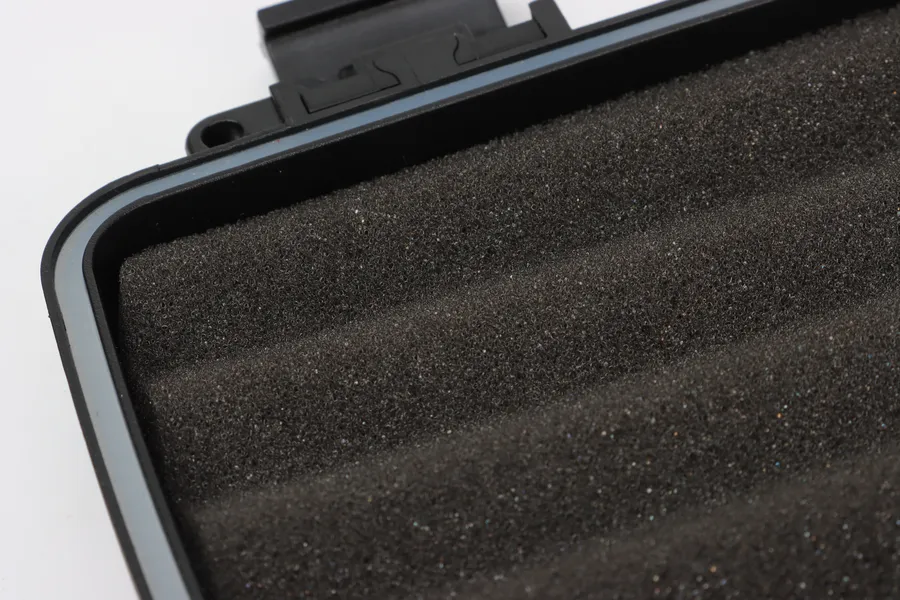
A hard shell with loose contents transmits the shock into whichever corner of the instrument lands first, so what protects a tester is a foam layout that holds the body, isolates the display face and stops lead ends from pressing into the probe tips. Our published foam options run from pick and pluck, which an end user can reconfigure between deployments, through die-cut layers for repeatable production quantities, to CNC-routed pockets that follow an instrument exactly and give a charger its own recess. Layered bases let a thin lid carry the instrument while a denser bottom takes the mass, which is how a 116 mm deep shell protects a 900 g tester without adding 40 mm to the outside.
To cut a layout we need one of three things: a drawing with pocket dimensions, a photograph of the packed kit as you actually carry it, or a physical sample of the instrument and its accessories. That is not bureaucracy. The difference between a 120 mm and a 140 mm pocket for the same tester changes which shells are candidates at all, and a sample removes the guessing entirely. Custom foam is cut from one unit, so proving an interior costs nothing beyond the shell, and re-cutting after a tester changes is a normal repeat order rather than a new project.
What we do not state about ingress, impact or environmental performance
We publish dimensions, wall thickness, lid and base depth, net weight, interior volume and packing data, because those are values we measure on production units. Ingress protection, drop height, stack load, UV exposure and temperature range are recorded as not measured in our product data for these shells, and no rating is implied by the shape of a case or by the presence of a gasket. A compressible gasket seated in a continuous moulded channel, which is what KX-3609, KX-4012, KX-4613 and the ABS models carry, resists dust and splash in the way its design intends; it is a construction detail, and we do not print a test result on its behalf.
Apply the same discipline to every supplier you are comparing, including us. An ingress protection code, a military environmental method, an explosive-atmosphere rating or an electrostatic discharge claim is a statement about one test, run on one article, with a stated specimen count, at a named laboratory, on a date. Ask for the report behind the mark: which standard and revision, which shell and which interior were tested, who witnessed it, and whether the tested sample already had cable ports, a hatch or a modified latch. A cut opening in a lid voids most of the reasoning behind an original result, and a rating copied from a catalogue line is not the same as a rating carried by the unit being delivered to you.
How a tender that names a protection grade is handled
When a specification names a grade, we answer in three steps. First we say plainly whether an accredited report exists for that grade on that shell; usually it does not, because we have not run one, and an honest no protects your bid better than a borrowed yes. Second, if the requirement is real, we quote accredited third-party testing against the exact configuration: shell, gasket, latch count, foam and any port machining, because those are the variables the outcome depends on. Third, we place the cost and lead time of that test alongside the cases, so the compliance line is priced before an order rather than discovered at delivery.
Buyers who have been told a grade comes with the mould are often surprised by the second step. It is the correct sequence. An untested claim written into a tender document is a liability for the bidder, not for the case supplier, and a shell that has been machined for a cable gland after a laboratory saw it is no longer the article the report describes. If your programme needs a documented result, budget for the test; we will help you scope it and we welcome a third-party factory audit at any point in the process.
Quantities, OEM terms and lead time for test equipment cases
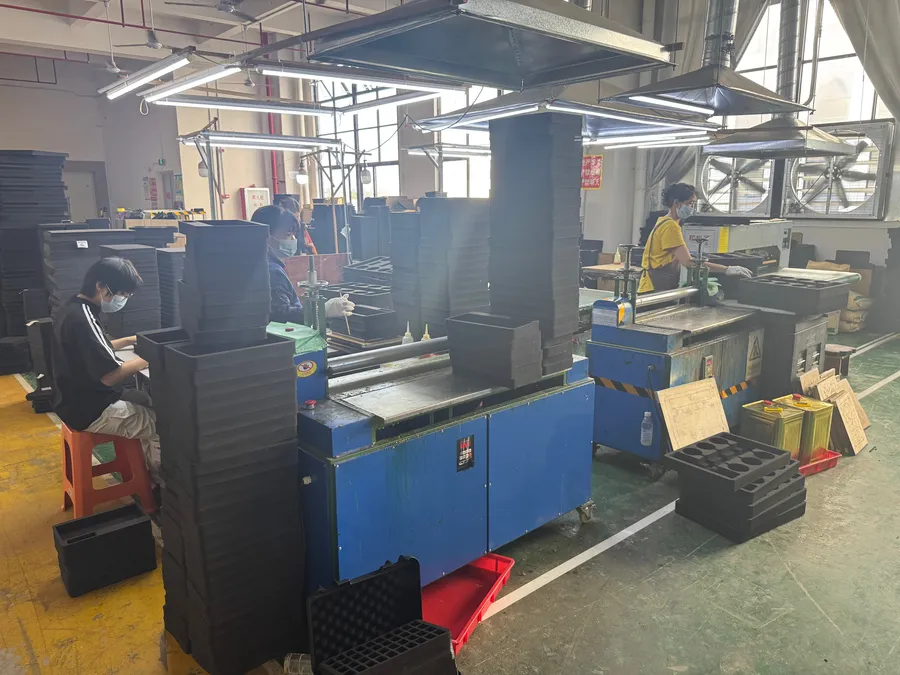
Business is wholesale, OEM, ODM and private label. Standard shells start from one unit so a technician can prove the fit before a fleet is committed. Logo, colour and OEM quantities start from 300 per SKU. A new mould, which is what a genuinely different exterior geometry needs, starts from 3,000 units per moulded component and runs 125 days. A first sample on existing tooling, carrying your interior, colour and marking, runs 45 days. Payment is a 30% deposit with the balance after your inspection passes, and third-party inspection is treated as normal practice rather than an exception.
Quotations are issued EXW or FOB from Zhongshan. We do not sell retail, we do not quote DDP and we hold no overseas warehouse, so landed-cost arithmetic stays yours with your own forwarder. Published carton dimensions and pieces per carton let you build the pallet plan early, and a distributor of a maintenance-instrument line can mix shells in one shipment because the standard minimum stays at one unit per model.
What to send when you specify one
Send these seven items and the shortlist comes back with figures attached to model numbers rather than adjectives.
| Field | What To Send |
|---|---|
| Equipment as packed | Photograph or drawing of the tester with coiled leads, probes, charger and spares |
| Interior you must clear | Length, width and depth, plus base depth separately if anything stands upright |
| Carrying method | Hand, shoulder strap, van boot or trolley; this decides wheels and handle before size |
| Quantities | Trial quantity and estimated annual quantity, which price along different routes |
| Marking | Logo, colour, label plate or asset tag, or explicitly nothing |
| Tender language | The standard and grade named, quoted word for word, with the revision |
| Destination and terms | Port or city plus preferred terms, so EXW or FOB can be costed without a guess |
Who is answering the enquiry
KeXin New Materials (Guangdong) Co., Ltd. moulds these shells in Zhongshan and ships them on wholesale and OEM terms. Send the seven items above to Fred Zhao or the KeXin Sales Team, on WhatsApp +86 135 3588 0002, and you will get a shortlist keyed to the published records used in this page, a foam proposal for the instrument you actually carry, and a written note on which environmental claims exist and which would need an accredited test quoted separately.
Customisation
Everything described above is configurable on a standard shell: interior layout (pick-and-pluck, die-cut or CNC-cut), foam grade and thickness, colour, logo method, latch and lock count, pressure-equalisation valve, cable ports, document holder and identification plate. A bespoke exterior geometry requires a new mould — 125 days, from 3,000 units per moulded component.
Procurement considerations
| Question | What to send us |
|---|---|
| Which shell fits? | Equipment L × W × H as packed, plus required clearance per axis |
| What does it cost? | Order quantity and estimated annual quantity — the two drive different answers |
| Is tooling needed? | Whether an existing shell clears the envelope with usable foam depth |
| Lead time? | Your required delivery date, not just the order date |
| Certification? | The exact standard your tender names — we will say whether we can test to it |
| Freight? | Destination and preferred terms; carton and pallet data supplied with the quotation |
Comparison and selection guide
The tables on this page exist because a protective case is chosen by comparing three things: the envelope, the environment and the handling chain. Where no table applies, the rule below is.
| Situation | What To Do |
|---|---|
| Shock | Base layer thickness and grade sized to the packed mass. |
| ESD | Anti-static PE, specified by surface resistivity range. |
| Dust | Sealed configuration with a continuous rim. |
- Size on internal dimensions plus clearance, never on a product name.
- Choose the carrying method before the shell: it changes the series, not just the price.
- Specify the interior last, and decide up front whether the end user will reconfigure it.
Portable Case for Field Electrical Testing Equipment? relates to Protective Case Basics. Related families: Electronics Cases / Instrument & Equipment Cases / Field Equipment Cases / Communication Equipment Cases. Related sectors: field and industrial equipment. Continue in the Protective Case Basics cluster.
This page is written from our own production data. If your requirement differs, send the dimensions and we will tell you which of the 155 models fits, or whether a custom route is needed.


