Outdoor two-way radio protective hard box?
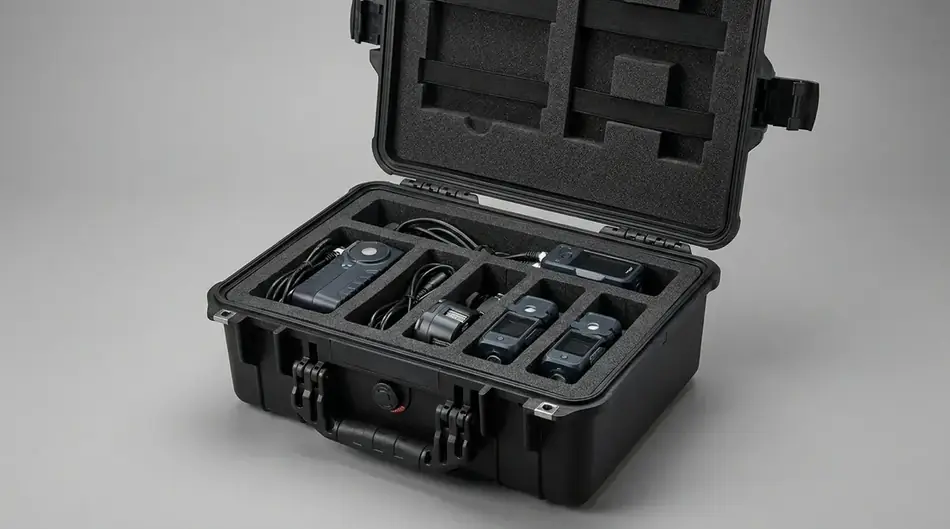
Outdoor two-way radio protective hard box is a procurement phrase that means a moulded shell sized to the radio in its travel configuration - antenna on, belt clip fitted, spare battery pack loaded - lined with a cut foam layout that fixes each unit in its own pocket and keeps spare batteries away from metal kit. The shell choice is a published-numbers decision: our library holds 155 moulded shells, 145 of them in the outdoor protective cases category, every one with internal dimensions in millimetres, and the compact formats that radio kits actually land in start at 115 x 78 x 32 mm inside on the KX 1204 and run through 4.5-litre sealed formats such as the KX 3207 (308 x 230 x 64 mm inside, a compressible gasket recorded as available). Three columns do most of the work: the narrow internal width published for 36 models, because the widest point of the radio must clear the narrowest point of the mouth; the lid-to-base depth split, which decides whether radios lie flat or stand; and the gasket line, which is a construction fact on 124 of the 155 shells and not a performance rating - the waterproof field in our database reads not measured on every model, so a per-configuration test report is the only honest way to buy a sealing figure. Everything else - cut pockets per radio, logo, colour - is customization at wholesale MOQ, quoted EXW or FOB.
Key points
- Measure the radio as it travels: antenna fitted, belt clip on, battery pack loaded - the antenna usually sets the length and the clip sets the depth budget.
- Read the narrow internal width column before the nominal one: 36 models publish it, from 70 mm to 308 mm, and the widest point of the radio must clear it.
- The lid-to-base split decides the layout: the KX 2813 publishes 92 mm of lid over a 25 mm base for flat-laid radios, while the KX 9-3221 gives 165 mm of lid for stand-up pockets.
- A compressible gasket is recorded as available on 124 of the 155 shells, but the waterproof field reads not measured on every model - buy sealing as a test report, not as a label.
- The latch body accepts a standard padlock on every shell we list, a measured hardware fact that matters for rental and event fleets.
- Custom foam starts at MOQ 1 and is cut from a drawing, a photo of the packed kit or a physical sample; logo and colour work start at 300 pieces.
- Fleet logistics run on published carton data: the KX 2805 packs 32 shells per carton, so a 160-unit pool ships as five cartons and the pallet plan follows the carton footprint.
Outdoor Two-Way Radio Protective Hard Box: The Definition And The Three Checks
Outdoor Two-Way Radio Protective Hard Box is a procurement phrase that collapses three decisions into one product. The first decision is the shell: a moulded, hard-faced box whose published internal envelope has to beat the radio in travel configuration. The second is the interior: a foam layout with one pocket per radio, a slot for each antenna, and a separate zone for spare battery packs, chargers and headsets, cut against a drawing or a sample. The third is the logistics layer: the carton the shells ship in, the pieces-per-carton count, and the pallet plan that moves a fleet order from the factory to your depot. Buyers who treat the phrase as a single catalogue item end up comparing litre figures; buyers who split it into three get a spec they can hold each supplier to.
What the shell has to survive outdoors is a condition list, not a rating list: rain on the trail in, dust on a gravel track, a box dropped on rock from tailgate height, UV on a roof rack, a cold morning that makes a lid harder to open. Our published data stays deliberately inside what we can prove. Internal dimensions, wall thickness, gasket availability, closure hardware and foam options are published per model; performance figures are not, because the protection fields in the database - waterproofing, dust, temperature, stack load - read not measured across the range. That stance is not a disclaimer bolted on at the end; it is the reason the three checks below are all geometric.
The library behind the phrase: 155 moulded shells, every one with published internal dimensions in millimetres. 145 sit in the outdoor protective cases category and 148 carry the outdoor application tag; published internal volumes across that outdoor-designated set run from 0.3 to 58.7 litres with a median of 17.2 litres, and 72 shells sit in the 3-to-20-litre band where most radio kit loads land. On materials, 84 of the outdoor-designated shells are PP, 38 are engineering PP, 22 are ABS and one pairs PP with ABS - three published material routes with different stiffness, mass and cost behaviour, which our PP-versus-ABS guide compares line by line.
Published Internal Envelopes For Radio Loads
The table lists ten shells that span the radio-kit range, from a 100-gram single-unit pocket box to a 6.6-litre sealed case, with figures read directly from the product database. Empty mass is published for 93 of the 155 shells, so the mass column is a per-model fact rather than a family average. The lid and base depth split is recorded on 100 shells, and on every one of those the halves add up to the internal depth, which makes the closure line readable before you order. Narrow internal width is published for 36 models from 70 mm to 308 mm; where it is recorded, it is the passage the radio actually has to pass, because the moulding carries a draft angle.
| Model | Internal Mm | Narrow Mm | Wall Mm | Lid Base Mm | Mass G | Material | Gasket |
|---|---|---|---|---|---|---|---|
| KX 1204 | 115 x 78 x 32 | 70 | 2.6 | 16 + 16 | 100 | PP | none recorded |
| KX 1905 | 180 x 160 x 40 | 130 | 3.0 | 25 + 15 | 250 | PP | compressible gasket |
| KX 6-2109 | 195 x 128 x 81 | not published | 3.0 | not published | 470 | ABS | compressible gasket |
| KX 2406 | 230 x 155 x 50 | 140 | 2.0 | 25 + 25 | 330 | PP | none recorded |
| KX 2805 | 270 x 190 x 46 | 175 | 2.1 | 23 + 23 | 340 | PP | none recorded |
| KX 2808 | 265 x 190 x 76 | 170 | 2.2 | 38 + 38 | 430 | PP | none recorded |
| KX 3207 | 308 x 230 x 64 | 205 | 3.0 | 32 + 32 | 570 | PP | compressible gasket |
| KX 3508 | 344 x 268 x 72 | 240 | 3.0 | 36 + 36 | 995 | Engineering PP | compressible gasket |
| KX 2813 | 260 x 200 x 117 | not published | not published | 92 + 25 | 800 | PP | none recorded |
| KX 9-3221 | 300 x 200 x 200 | not published | not published | 165 + 35 | 1230 | PP | compressible gasket |
Fit Method: Measure The Radio Three Ways, Then Check The Mouth
Radio dimensions are a moving target inside one product: the same handheld is a different object with the antenna fitted, the belt clip on and a high-capacity battery pack loaded. Measure it three ways - standing without the antenna, lying flat with the antenna along the body, and with clip and battery in place - and take the worst case of each axis as the envelope you specify against. Antennas deserve their own decision: a flexible stub antenna can lie in a shallow slot cut across the foam, while a fixed whip usually forces the radio to stand, and that flips the layout from flat-lay to vertical in one line of the spec.
Then check the mouth, not the volume. Where a shell tapers we publish a narrow internal width - 36 models from 70 mm to 308 mm - and the widest point of the radio has to clear that figure, not the nominal width. The KX 2808 publishes 190 mm of internal width with 170 mm at the narrow point; the KX 1204 publishes 78 mm nominal against a 70 mm narrow passage. A radio kit that fits the average but not the mouth is the most common sizing error in this category, and it is fully avoidable with the two columns in the table above. Our guide on internal versus external dimensions works the same arithmetic for larger equipment.
Depth splits decide the layout style. On the 100 shells where the split is published, the two halves always add to the internal depth: the KX 2813 gives 92 mm of lid over a 25 mm base, which suits radios lying flat under a soft press layer with antennas in shallow slots; the KX 9-3221 gives 165 mm of lid over a 35 mm base, which suits radios standing in vertical pockets with a foam wall between neighbors. Neither is better in the abstract - the radio's travel envelope picks the split, and the foam drawing does the rest. Leave about 20 mm of clearance per axis for the pocket walls; a pocket cut to the exact size of the unit is a pocket you will fight every time you pack with gloves on.
Sealing, Latches And Carry: Published Facts Versus Manufacturer Options
Sealing is where honest specification matters most outdoors, so here is exactly what our data says. A compressible gasket is recorded as available on 124 of the 155 shells, and by series the figure varies from 12 of 23 in the compact 0 series to 20 of 20 in the mid-size 6 series and 58 of 62 in the heavy-duty 8 series. That is a construction fact - a gasket channel exists and a gasket can be fitted. It is not a performance figure: the waterproof field reads not measured on every model in the database, and we publish no ingress-protection code for the same reason. If the program needs a sealing number, the route is a per-configuration test with a report; our guide on what an ingress-protection rating does not tell you explains what to ask a laboratory for, and the seal-maintenance guide covers the checks that keep the gasket working season after season.
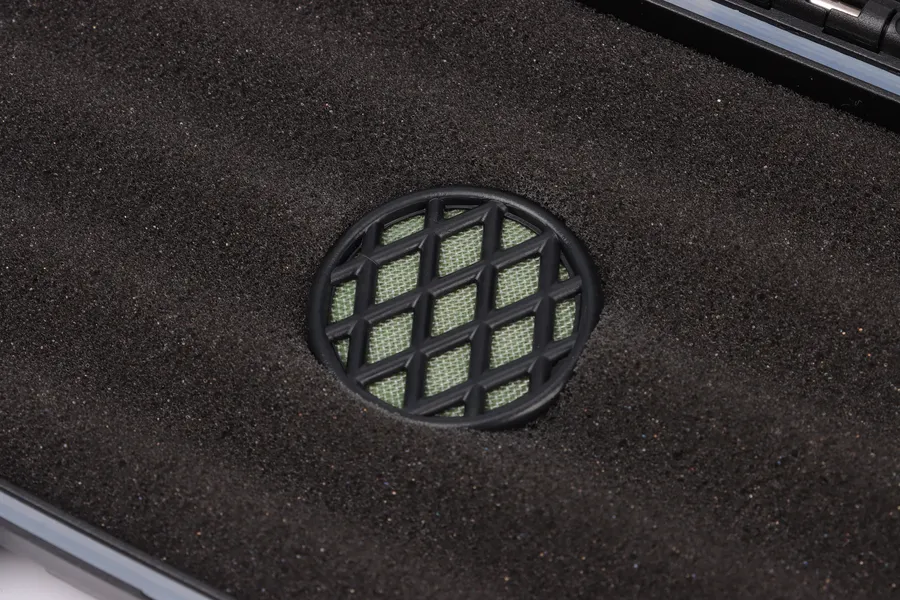
Closure and carry hardware is published as measured facts or as options, and the difference is worth reading carefully. The latch body accepting a standard padlock is recorded as a measured fact on every shell we list - the padlock itself is not included, but the locking geometry is. Hinges and feet are recorded as measured. A shoulder strap and a pressure-equalisation valve are recorded as manufacturer options, and both earn their place outdoors: the strap turns a two-hand case into a single-shoulder carry on a long approach, and the valve matters at altitude, where a temperature drop can pull the lid down hard against the gasket and make opening a two-person argument. Wheels and telescopic handles belong to the 19 T-series shells and are listed per model.
Wall thickness is the quiet variable in this category: the compact shells in the table publish walls from 2.0 to 3.0 mm, the mid-size ABS shell publishes 3.0 mm, and the deep-body formats go to 4.5 mm and beyond. Thicker walls add stiffness and mass in roughly equal measure, which is why the mass column is published next to the wall column - a sealed 570-gram shell such as the KX 3207 carries its gasket and 3.0 mm walls to a 4.5-litre interior, and the same arithmetic on the 995-gram KX 3508 buys a 6.6-litre interior in engineering PP. For a radio kit that rides in a vehicle most of the day, the lighter compact shells are usually the right call; for a kit that gets checked into airline baggage, the mass buys margin, and the honest trade-off is published rather than asserted.
Radio Fleet Packaging: Foam Layouts And Export Cartons
A fleet order is where the packaging levels meet, and the arithmetic is published end to end. On the interior side, the foam layout is cut to your radio geometry: one pocket per unit, an antenna slot per pocket, a charger zone and a battery zone, with custom foam starting at MOQ 1 and cut from a drawing, a photograph of the packed kit or a physical sample - all three input formats are recorded in the database as accepted. The internal envelope sets the ceiling on pocket count, and the count itself is an output of the foam drawing, not a factory promise; a 344 mm internal length such as the KX 3508's is the number the pockets divide, not a number we advertise as a radio capacity.
On the export side, carton data is published per model: 64 of the 155 shells list carton dimensions and 58 list pieces per carton, with counts from 1 to 40. The examples below are read directly from the database, and they show why fleet planning starts from the carton rather than the shell: compact formats ship in high-count cartons, while larger sealed shells ship one or a few per carton. As a worked example, a model whose published carton takes 32 shells per carton - the KX 2805 in the table - turns a 160-unit pool into exactly five cartons; the pallet load is then calculated from the carton footprint against your pallet size, and 20GP, 40GP and 40HQ container figures are supplied with the quotation. None of those packing numbers is invented at quote time; they are arithmetic on published cartons.
| Model | Carton Mm | Pieces Per Carton |
|---|---|---|
| KX 2406 | 490 x 410 x 290 | 20 |
| KX 2805 | 570 x 470 x 435 | 32 |
| KX 2808 | 560 x 445 x 415 | 20 |
| KX 3207 | 645 x 530 x 430 | 24 |
| KX 3508 | 730 x 615 x 428 | 20 |
| KX 6-2109 | 470 x 365 x 560 | 20 |
Where Outdoor Two-Way Radio Protective Hard Boxes Get Used
The buyer profiles repeat across sectors, and the difference between them is mostly the interior and the packing plan, not the shell. Event and rental operators run the largest fleets: dozens to hundreds of identical handhelds checked out and recovered every week, which pushes the spec toward padlockable latches, a foam layout that a temporary crew can repack correctly, and carton-friendly shells that stack on a shelf between events. Hunting and guiding parties run small kits - four to eight radios plus batteries - where a single sealed 3-to-7-litre shell covers the load and the mouth dimensions do the deciding.
Trail, survey and utility crews behave like industrial buyers: the same shell with the same cut foam is reordered for years, and the documentation trail matters as much as the box. Mountain and cold-weather operations add the pressure-valve consideration from the hardware section, because a case that lives through a 20-degree swing overnight is a case that gets argued open in the morning. For teams that also carry longer kit, the same radio shell often travels alongside a narrow long case - our library keeps narrow-format shells with internal lengths to 1280 mm for masts and antenna poles - and for teams whose radios ride with drones or cameras, the packing logic continues in our drone and photography packaging guides. In every profile the three-level framing holds: shell by published envelope, interior by foam drawing, export by published carton.
Customization: CNC-Cut Pockets, Logo, Colour And OEM Terms
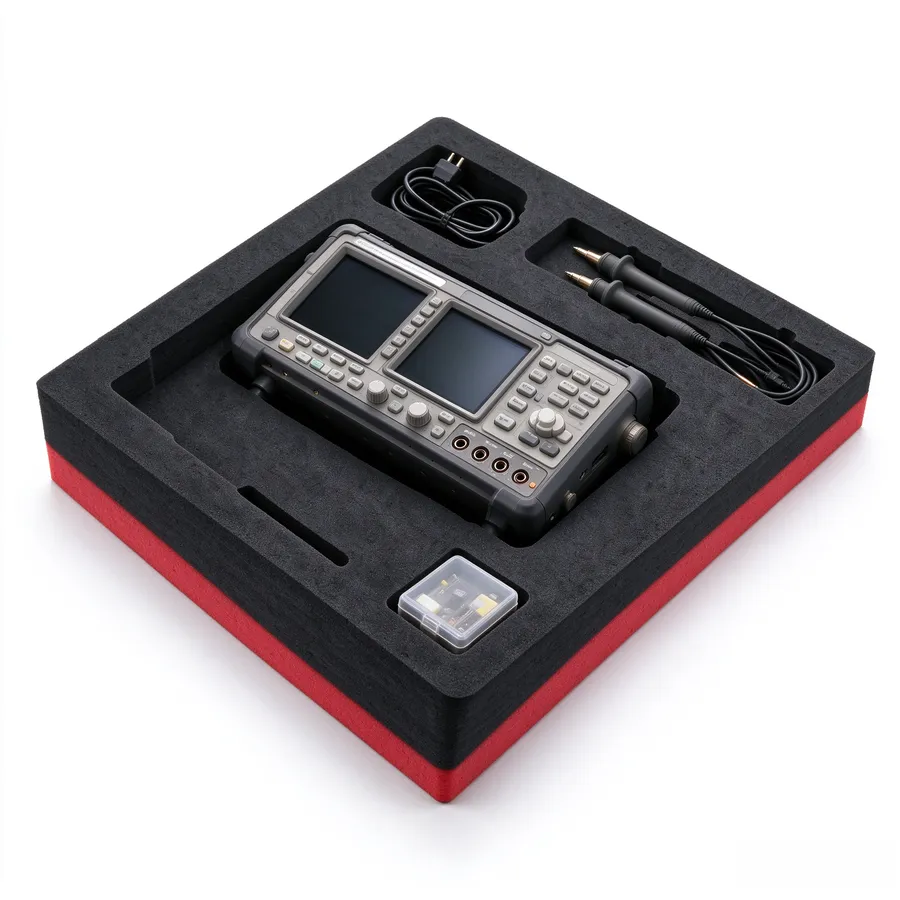
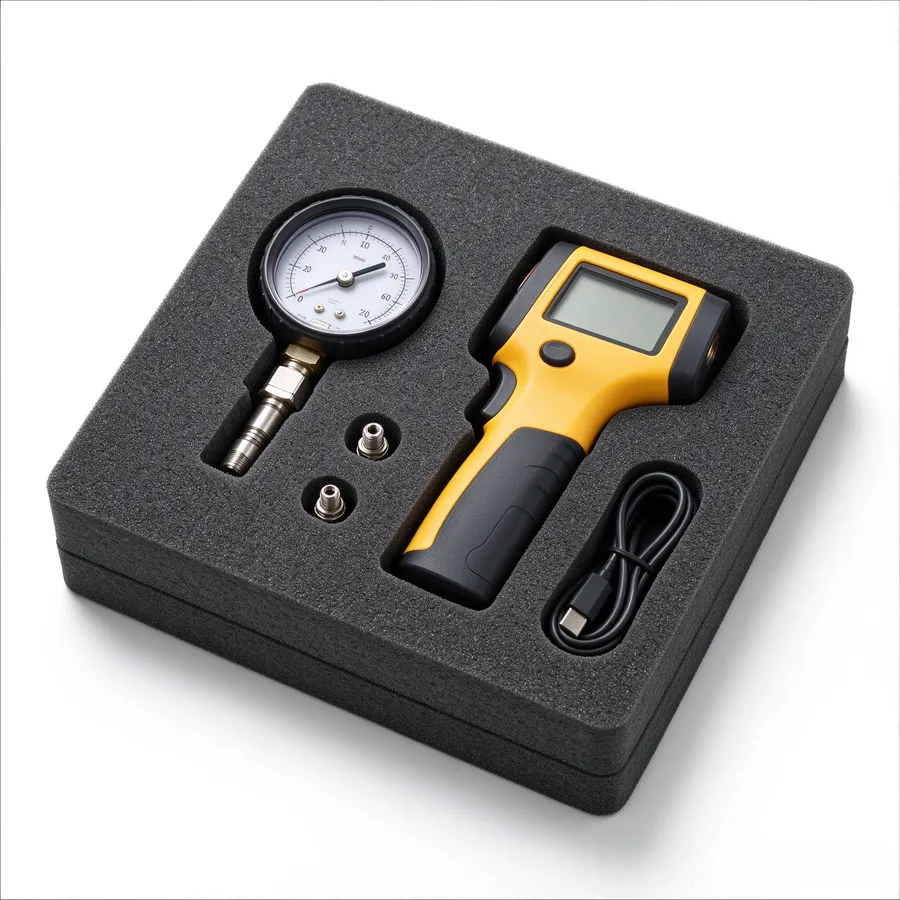
The interior is the product in this category, and it is fully open to customization. Foam grades cover pick-and-pluck, die-cut, CNC-cut, EVA, PE and EPE, in structures from a plain top layer to egg-crate and multi-layer builds; CNC-cut is the route for a radio fleet because each pocket is machined to the unit's travel envelope with an antenna slot and a finger notch. Custom foam starts at MOQ 1, and the accepted inputs are recorded in the database: a drawing, a photograph of the packed kit, or a physical sample. For a fleet program the photograph-plus-sample route is the fastest to a correct first article, because the cutter works from the objects rather than from an idealized sketch.
Shell-level customization follows the wholesale MOQ ladder and the recorded lead times. Logo and colour work start at 300 pieces; private label and OEM start at 300; a new mould is quoted from 3,000 pieces per component with a 125-day tooling window, while OEM work on an existing mould runs on a 45-day lead time, both started by a 30 percent deposit. Colour is worth a note for fleet operators: a distinctive shell colour is the cheapest loss-control measure a rental pool can buy, and it is a 300-piece decision rather than a tooling decision. What we do not customize into the datasheet is a performance claim - a gasket, thicker walls or a denser foam layout change the construction facts, and any protection figure attached to them has to come from a per-configuration test report.
Procurement Notes: Terms, Honest Claims And The RFQ Questions That Matter
The commercial frame: we are a manufacturer selling wholesale and OEM, quoting EXW or FOB, with no retail channel, no DDP and no overseas warehousing. MOQ is 1 on a stock shell and on custom foam, which exists so a buyer can order one box, cut the radio layout against it and validate the fit before committing; logo, colour and OEM start at 300. A quotation is assembled from the chosen model's published specification sheet plus your foam input, carton requirement and pallet spec - the same three levels this page is organized around - and our MOQ-and-cost guide explains how those numbers interact.
On claims, read the database the way it is written. Construction facts are published and checkable: internal dimensions on every shell, wall thickness where recorded, gasket availability on 124 of 155, padlock-accepting latch geometry as a measured fact, hinges and feet as measured, shoulder strap and pressure valve as manufacturer options. Performance figures are not published: the waterproof, dust, temperature, shock and load fields read not measured or manufacturer-option on the models, with the shock note stating that the shell alone is not a shock rating and that a specified foam layout is required. Treat any supplier's outdoor radio case the same way - ask which lines are construction and which lines are performance, and require a test report for the second kind before it enters your specification.
Four questions sharpen the RFQ. First, the radio's travel envelope: send the three measurements - antenna on, clip on, battery loaded - plus the foam input format you can provide. Second, the layout: flat-lay or stand-up, which decides the depth split you need from the shell. Third, the export plan: pieces per carton for the model, a pallet layout against your actual pallet size, and container figures for the destination. Fourth, the evidence line: which claims in the quote are construction facts and which will be evidenced by a per-configuration test report. Our procurement checklist collects the full document list, and buyers who send the four answers get quotations that can be compared line by line across suppliers.
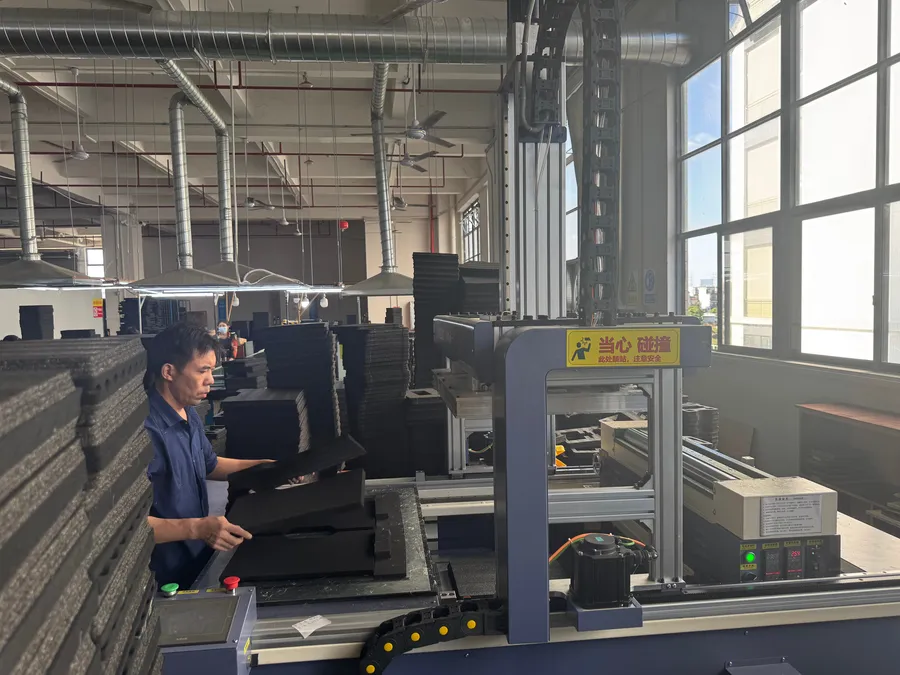
Customisation
Everything described above is configurable on a standard shell: interior layout (pick-and-pluck, die-cut or CNC-cut), foam grade and thickness, colour, logo method, latch and lock count, pressure-equalisation valve, cable ports, document holder and identification plate. A bespoke exterior geometry requires a new mould — 125 days, from 3,000 units per moulded component.
Procurement considerations
| Question | What to send us |
|---|---|
| Which shell fits? | Equipment L × W × H as packed, plus required clearance per axis |
| What does it cost? | Order quantity and estimated annual quantity — the two drive different answers |
| Is tooling needed? | Whether an existing shell clears the envelope with usable foam depth |
| Lead time? | Your required delivery date, not just the order date |
| Certification? | The exact standard your tender names — we will say whether we can test to it |
| Freight? | Destination and preferred terms; carton and pallet data supplied with the quotation |
Comparison and selection guide
The tables on this page exist because a protective case is chosen by comparing three things: the envelope, the environment and the handling chain. Where no table applies, the rule below is.
| Situation | What To Do |
|---|---|
| Marine or wet | Sealed configuration with a drain-friendly interior and stainless hardware. |
| Dry and dusty | A close-fitting rim and a lid that can be opened one-handed without spilling contents. |
| Carried far | Under 10 kg packed, with a padded handle or shoulder webbing. |
- Size on internal dimensions plus clearance, never on a product name.
- Choose the carrying method before the shell: it changes the series, not just the price.
- Specify the interior last, and decide up front whether the end user will reconfigure it.
Outdoor two-way radio protective hard box? relates to Protective Case Basics. Related families: Outdoor Protective Cases / Communication Equipment Cases / Waterproof Cases / Custom Protective Cases. Related sectors: field and industrial equipment. Continue in the Protective Case Basics cluster.
This page is written from our own production data. If your requirement differs, send the dimensions and we will tell you which of the 155 models fits, or whether a custom route is needed.