Can case latches be customised for a specific piece of equipment?
Yes, within the closure hardware, and the equipment sets the plan rather than the catalogue. On our published file of 155 models, 155 of 155 record the number of case latches as specified per configuration instead of printing a fixed count, while 155 of 155 state that the latch body accepts a standard padlock and give hardware material as metal or polymer by configuration. So customising case latches for a specific piece of equipment means deciding five things on a drawing: how many closure points, where they sit along the rim, how deep the latch is recessed, which way the hasp faces, and whether a worn unit can be swapped in service. We ask for a drawing, a photograph of the packed kit, or a physical sample. Changes on an existing tool run 45 days to first sample at 300 pieces; a new mould for altered latch geometry runs 125 days from 3,000 pieces per component.
Key points
- Latch count is not a catalogue field: 155 of 155 listings record it as specified per configuration, so write the number into your order text instead of assuming one from a series.
- Set the closure plan from published depth. 100 of 155 listings publish a lid and base depth split, with lid depth from 16 mm to 320 mm and base depth from 15 mm to 168 mm.
- The padlock provision needs no new tooling: 155 of 155 listings state the latch body accepts a standard padlock, so only the orientation of that loop is a decision.
- On 124 of 155 shells the latches compress a gasket in a continuous moulded channel; on the other 31 the file records no seal offered, so the same latch count does a different job.
- Choose a recessed latch design on a moulded case when units stack or ride in vehicles, and check it against published wall thickness, which runs from 2.0 mm to 6.0 mm across the file.
- Two clocks decide the programme: 45 days and 300 pieces on an existing tool, 125 days and 3,000 pieces per component when new steel is cut for a changed latch boss.
What customising case latches actually changes on a moulded shell
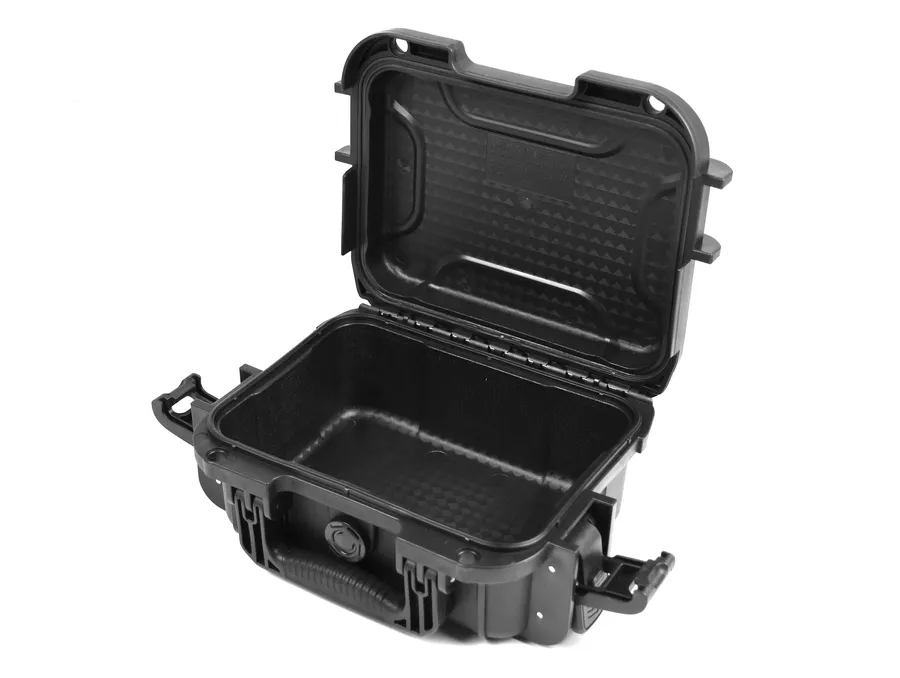
A buyer who asks about customising case latches for a specific piece of equipment is usually mixing four separate questions in one sentence: how many closure points the lid will carry, where they sit along the rim, whether the latch body sits flush with the shell or stands proud of it, and whether a worn latch can be replaced without scrapping the case. On a thermoplastic moulded case these four have four different answers, because two of them are drawing decisions taken before a tool is ever cut and two are hardware selections made at assembly. Getting that separation straight is the difference between a quotation that holds and one that changes quietly after the first sample arrives.
Our published file is deliberately narrow on this subject, and that is worth reading as a feature rather than a gap. Every one of the 155 listings records the latch field as specified per configuration and gives hardware material as metal or polymer by configuration. Nothing in the file generalises one shell's latch count to a whole series, because a 190 mm compact case and an 843 mm trolley case do not want the same number of closure points even when they come from the same mould family. When a supplier hands you a fixed latch count for every size in a range, ask what the lid depth is on the largest item in it.
The five latch decisions your equipment drawing drives
| Decision | What Our File Records | What Your Equipment Changes | Where It Is Settled |
|---|---|---|---|
| How many latches a protective case needs | 155 of 155 listings record the count as specified per configuration; no number is generalised across a series | Lid depth and the length of sealing rim to hold. A 25 mm lid on WL1905 and a 320 mm lid on WL8-8442 Trolley are not the same problem | On the closure drawing, before the first sample is made |
| Latch position and spacing along the rim | Not published as a field for any model; positions follow the shell geometry rather than a catalogue line | Where the lid deflects when the case is carried one-handed, and whether the rim is straight, stepped or broken by a label field | Drawing plus a photograph of the packed kit, or a physical sample |
| Recessed latch design on a moulded case | Wall thickness is published per model and ranges from 2.0 mm to 6.0 mm across the file, median 3.9 mm | Whether a flush latch can be seated without cutting through a load-bearing wall section or a stacking rim | Mould insert change on an existing tool; new steel only if the cavity cannot hold the recess |
| Padlock hasp orientation on a custom case | 155 of 155 listings state that the latch body accepts a standard padlock | Which side the shackle faces and whether it clears a hinge, a stacking rim or a printed identification panel | Confirmed at drawing stage; the moulded loop itself needs no separate tool work |
| Replaceable case latch hardware | Hardware material published as metal or polymer by configuration on 155 of 155 listings | Whether a service team swaps a latch in the field, or whether the whole unit comes back for refurbishment | Fastener pattern and boss design, quoted against the order and the service model you choose |
Latch geometry follows published depth, not a series name
The single most useful published number for a closure plan is the depth split. Of our 155 models, 100 list both a lid depth and a base depth. Among the 124 shells where a seal is offered, lid depth runs from 25 mm to 320 mm with a median of 127.5 mm, and base depth from 15 mm to 168 mm with a median of 45 mm. Among the 31 shells the file lists without a seal, lid depth reaches only 92 mm and the median is 39 mm. That difference is the whole reason a latch count cannot be inherited from a catalogue: a shallow lid spanning 190 mm can be held evenly by one or two points, while a 320 mm lid on a 740 mm long case needs enough closure points that the middle of the long edge never lifts. The table below shows five real listings from the file so you can see how the geometry changes the question.
| Model | External Mm | Internal Mm | Lid / Base Depth Mm | Wall Mm | Seal Per File |
|---|---|---|---|---|---|
| WL1204 (KX-1204) | 120 x 90 x 40 | 115 x 78 x 32 | 16 / 16 | 2.6 | None offered on this shell |
| WL1905 (KX-1905) | 190 x 190 x 45 | 180 x 160 x 40 | 25 / 15 | 3.0 | Compressible gasket in continuous moulded channel |
| WL6-2205 (KX-62205) | 222 x 128 x 50 | 200 x 98 x 41 | Not published for this listing | 3.5 | Compressible gasket in continuous moulded channel |
| WL8-4816 (KX-84816) | 482 x 420 x 160 | 410 x 360 x 140 | 100 / 40 | 4.2 | Compressible gasket in continuous moulded channel |
| WL8-8442 Trolley (KX-88442) | 843 x 592 x 415 | 740 x 518 x 364 | 320 / 44 | 5.0 | Compressible gasket in continuous moulded channel |
Where case latches meet the gasket: compression is a shared job
On 124 of our 155 shells the file records a compressible gasket sitting in a continuous moulded channel; on the remaining 31 it records that no seal is offered on that shell. Where a gasket is present, latches and seal share one variable, which is how evenly the rim is pulled down along its full length. A closure count chosen for a flat lid will still gap in the middle of a long edge if the spacing ignores the span, and the published lid depth is the figure that tells you what that span is. Where no seal is offered, the latch only has to hold the lid against the shell face, which is a simpler job and usually allows a lighter plan.
We record waterproof and dust resistance as not measured on all 155 listings, and we print no IP-style ingress code anywhere in the file. That has a direct consequence for latch discussions: a closure plan is written against the geometry we publish, not against a rating. If your programme needs an ingress figure, tell us the equipment and the exposure and we will quote accredited third-party testing against the standard your customer names, on the configuration as built rather than on a datasheet claim. The gasket material we publish across the file is an EPDM or equivalent compressible gasket, offered as a configuration item.
Two tooling routes, and what each one costs in time
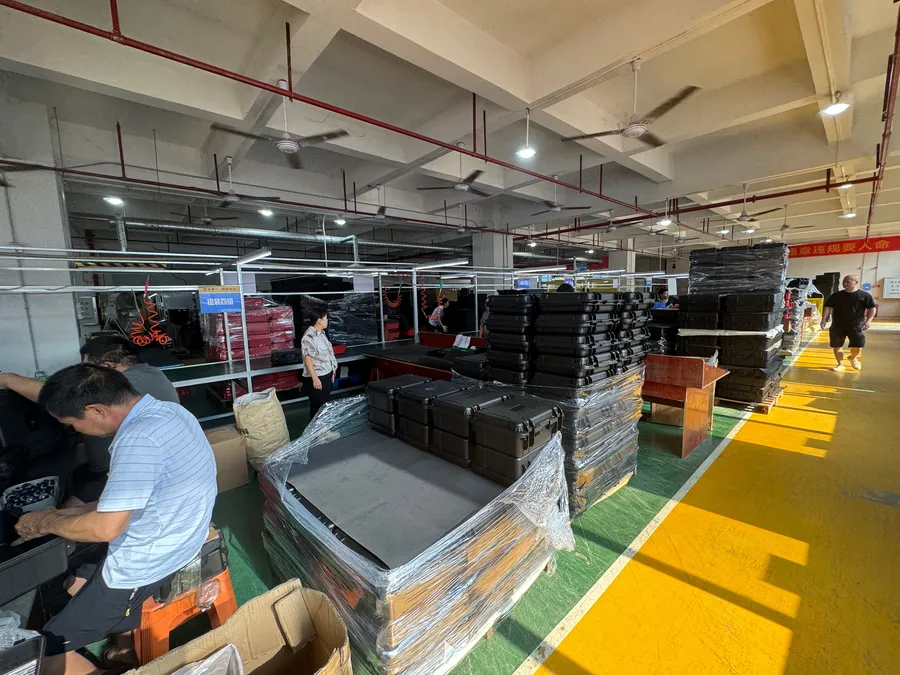
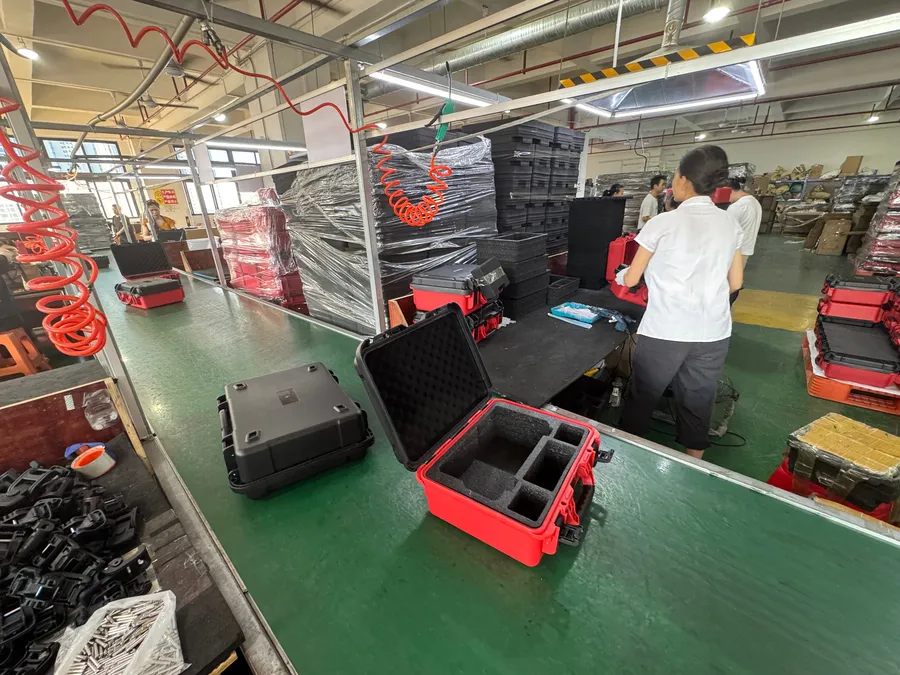
Commercially the terms are fixed and simple: we work wholesale and on OEM or ODM orders only, ship EXW or FOB, and do not sell retail, do not quote DDP and hold no overseas warehouse. Payment is a 30 percent deposit with the balance settled after inspection, and third-party factory audits are welcome at any point in the programme. On a latch question specifically, the practical point is that most of what buyers want to change lives on the existing-tool side of that table, which means a 45-day sample loop instead of a 125-day tooling loop.
| Route | What It Can Cover | Minimum Quantity | Lead Time | Best Fit |
|---|---|---|---|---|
| Existing tool | Latch count and position, hasp orientation, hardware grade, colour, logo and packaging | 300 pieces for OEM, logo and colour items; standard and custom foam items from 1 piece | 45 days to first sample | Programmes that need the closure behaviour changed without cutting new steel |
| New mould | A changed latch boss, a new recess depth, or a shell geometry that does not exist in the current cavity set | 3,000 pieces per component | 125 days | Reserved for geometry an existing cavity genuinely cannot hold, such as a flush recess in a thin wall |
| Service spares | Replaceable case latch hardware for units already in the field, supplied against the original configuration | Agreed with the spare part list rather than the shell MOQ | Quoted with the spare schedule | Fleets with a maintenance model, where a latch is a wear item rather than a shell defect |
Applications where the closure plan usually has to be redrawn
Three patterns come up repeatedly. First, instrument and electronics kits carried by hand: 136 of our 155 listings publish a fixed folding handle and 19 publish a telescopic handle together with a fixed folding one, and in both cases the person lifting the case is the same person who has to open it one-handed, so a latch position that looks fine on a drawing forces the lid crooked in practice. Second, stacked field loads: shells that ride in a vehicle get their latches struck by the stacking rim of whatever sits on top, and this is where a recessed latch design on a moulded case earns its tooling change. Third, service fleets, where lids are opened dozens of times a week and the sensible question is whether you want replaceable case latch hardware as a spare line rather than a shell return.
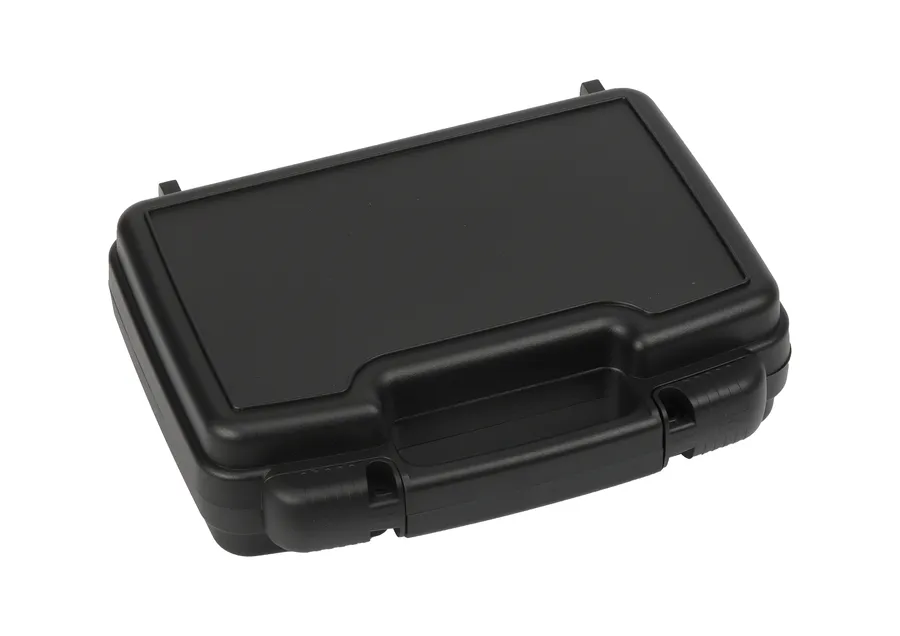
Ammunition and outdoor boxes are the fourth case, and it is the opposite problem: the lids are shallow, the walls on the unsealed group run from 2.0 mm to 2.9 mm in our file, and a deep recess for a flush latch can remove more material than the wall can give up. On those shells we normally solve it with latch count and position rather than with a new cavity, which keeps the programme on the 45-day path.
What we do not publish about case latches
This section exists because the honest answer is shorter than most buyers expect. Across the 155 listings we publish no latch count per model, no latch open-close cycle figure, no closure force figure, no drop height, and no ingress protection rating; waterproof, dust resistance, ultraviolet resistance, temperature range, stack load and load capacity are all recorded as not measured in the file. What we do publish as measured is narrower and worth knowing: the hinge is present on 155 of 155 listings, moulded feet on 155 of 155, corrosion resistance on 155 of 155 for the thermoplastic shell with no ferrous corrosion path, and the padlock statement in the latch body on 155 of 155.
A buyer who needs any of the unpublished figures should treat them as a test scope to be arranged and quoted, not as something inherited from a similar shell. That is also why we ask for the equipment before we answer the hardware question. If a supplier answers how many latches a protective case needs with a single number for every size in the range, ask them what lid depth their largest case has; the two figures travel together or not at all.
Buying notes: what to send before anyone quotes a latch plan
Send four things and you will get a real answer instead of a brochure. One, the internal envelope you need, or the equipment dimensions so we can size against the published internal range of 115 mm to 1,280 mm in length. Two, a drawing, a photograph of the packed kit, or a physical sample, which is exactly what our foam and hardware notes ask for. Three, the carry and stacking context, because that decides padlock hasp orientation on a custom case and whether you want the latch flush or proud. Four, the quantity band and the destination, so the route can be quoted as EXW or FOB against the 300-piece or 3,000-piece path rather than in the abstract.
Send those to Fred Zhao or the KeXin Sales Team, on WhatsApp +86 135 3588 0002, and you will get the closure drawing back with the tooling route marked on it. This page is published by KeXin New Materials (Guangdong) Co., Ltd., and every figure in it is taken from our own 155-model product file rather than from a marketing sheet. Where the file records something as not measured, we leave it as not measured and quote the test instead.
Customisation
Everything described above is configurable on a standard shell: interior layout (pick-and-pluck, die-cut or CNC-cut), foam grade and thickness, colour, logo method, latch and lock count, pressure-equalisation valve, cable ports, document holder and identification plate. A bespoke exterior geometry requires a new mould — 125 days, from 3,000 units per moulded component.
Procurement considerations
| Question | What to send us |
|---|---|
| Which shell fits? | Equipment L × W × H as packed, plus required clearance per axis |
| What does it cost? | Order quantity and estimated annual quantity — the two drive different answers |
| Is tooling needed? | Whether an existing shell clears the envelope with usable foam depth |
| Lead time? | Your required delivery date, not just the order date |
| Certification? | The exact standard your tender names — we will say whether we can test to it |
| Freight? | Destination and preferred terms; carton and pallet data supplied with the quotation |
Comparison and selection guide
The tables on this page exist because a protective case is chosen by comparing three things: the envelope, the environment and the handling chain. Where no table applies, the rule below is.
| Situation | What To Do |
|---|---|
| Fastest | Standard shell plus CNC foam — typically 45 days from approved drawing. |
| Branded | Standard shell plus custom colour and logo — MOQ applies to the resin colour. |
| Bespoke geometry | New mould — 125 days, MOQ from 3,000 units per component. |
- Size on internal dimensions plus clearance, never on a product name.
- Choose the carrying method before the shell: it changes the series, not just the price.
- Specify the interior last, and decide up front whether the end user will reconfigure it.
Can case latches be customised for a specific piece of equipment? relates to Logistics & Packing Guide. Related families: Custom Protective Cases / Equipment Transport Cases / Military Protective Cases / Electronics Cases. Related sectors: field and industrial equipment. Continue in the Logistics & Packing Guide cluster.
This page is written from our own production data. If your requirement differs, send the dimensions and we will tell you which of the 155 models fits, or whether a custom route is needed.


