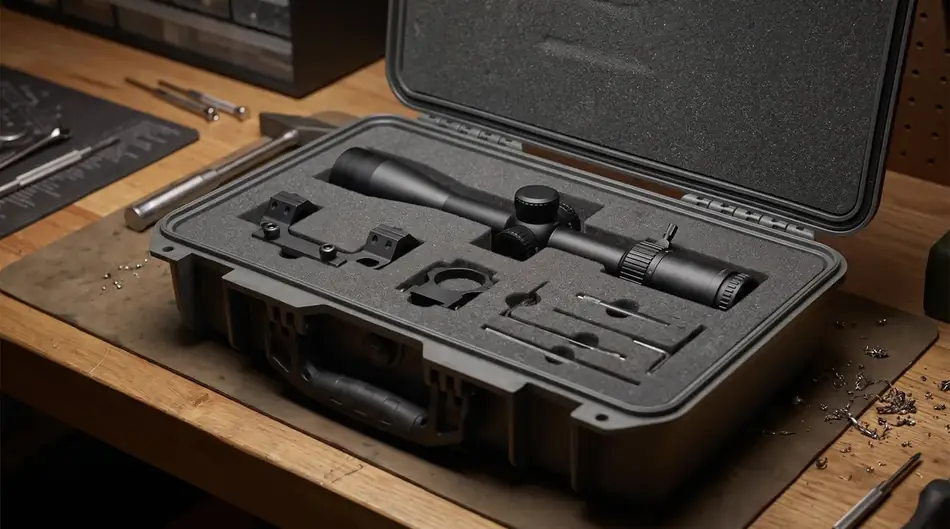
Can case locks be customised for a specific piece of equipment?
Yes - but only within the closure hardware, and the equipment decides the rest. On our file of 155 models the lock is a configuration decision rather than a fixed catalogue attribute: 155 of 155 listings state that the latch body accepts a standard padlock, while 155 of 155 record the number of latches as specified per configuration and give hardware material as metal or polymer by configuration. So what a specific piece of equipment changes is count, position, hasp geometry, key or tamper-evidence management, and whether the latches share their work with a gasket - all settled on a drawing, not by picking a series. Moulded changes run 45 days at 300 pieces on an existing tool, or 125 days from 3,000 pieces per component when a new mould is cut.
Key points
- Case locks customise at four levels - padlock loop, latch count and position, hasp geometry, and key or tamper-evidence management - and only the padlock loop is fixed across our range.
- 155 of 155 listings state that the latch body accepts a standard padlock, so a shackle passes without a bolted-on hasp on any shell in the file.
- No latch count is published for any of the 155 models; every listing records the count as specified per configuration, so the number goes in the order text.
- Closure count is really a lid-depth question: 100 of 155 listings publish a lid and base depth split, with lid depth running from 16 mm to 320 mm.
- On 124 of 155 shells the latches compress a gasket in a continuous moulded channel; on the other 31 they only hold the lid down, which changes what a lock must deliver.
- Moulded lock changes cost time in two bands: 45 days and 300 pieces on an existing tool, 125 days and 3,000 pieces per component for a new mould.
What customising case locks really means on a moulded case
A buyer who asks whether case locks can be customised for a specific piece of equipment is usually asking four different questions at once: can a padlock be fitted, how many closure points will there be, can the hasp or loop be shaped for a particular fitting, and can the closure be made tamper-evident or key-managed. Those four have four different answers on a thermoplastic moulded case. The first is already settled by the moulding on our whole range; the second is a drawing decision that depends on the shell geometry rather than the lock supplier; the third is an insert change in the tool; the fourth is almost always an added component rather than a moulded one.
The distinction matters because the failure mode is different for each. A missing padlock loop is a lost requirement. Too few closure points is a lid that seals at the corners and gaps in the middle of the long edge. A hasp that clashes with the case label or a stacking rim is a batch that cannot be assembled. And a key program that nobody agreed at quotation stage becomes rework across every unit already shipped, which is why we treat lock questions as part of the equipment conversation, not as an accessory list.
The four lock decisions and what each one changes in the tool
Read the table as a cost map rather than a feature list. Two of the four decisions - latch count and moulded hasp geometry - touch the tool, which is where the 45-day and 125-day bands come from. The other two are component choices that can be made after the shell exists, which is why they are the cheapest safety net when a lock requirement arrives late in a project.
| Decision | What It Is On Our Shells | What Customising Changes | Typical Route And Timing |
|---|---|---|---|
| Padlock loop | Moulded into the latch body; 155 of 155 listings state a standard padlock is accepted | Nothing to change on this field; what changes is which latches are positioned to take a shackle | Confirmed at drawing stage; no separate tool work for the loop itself |
| Latch count and position | 0 of 155 listings publish a count; all 155 record it as specified per configuration | Compression along the long edge, lid deflection under carry load, and whether a gasket is squeezed evenly | Mould insert or cavity change where bosses are involved; quoted against the shell drawing |
| Hasp, shroud or lock plate geometry | Hardware material published as metal or polymer by configuration on 155 of 155 listings | Whether a padlock sits flush, whether it fouls a stacking rim, and whether the lid can be opened one-handed | Add-on hardware at 300-piece OEM quantities; moulded boss needs the 125-day new-mould path |
| Key management and tamper evidence | Not published as a datasheet field on any listing; handled as a configuration item | Whether a closure can be re-sealed invisibly, keyed alike across a fleet, or numbered per unit | Supplied components chosen with the order; sealing tags or hasps add assembly steps, not tooling |
How the equipment changes the answer: three published examples
Latch decisions track the geometry of the lid far more than the type of equipment. KX 1204 is a 120 x 90 x 40 mm shell with a published internal size of 115 x 78 x 32 mm, 2.6 mm wall thickness and a 16 mm plus 16 mm lid-and-base split; at 100 g it is carried in a pocket, and its closure only has to hold a lid down. KX 4010 is 400 x 360 x 100 mm external with an internal 390 x 315 x 88 mm, 3.0 mm walls, a 44 mm plus 44 mm split and a published 9.3 litres of usable volume; the parting line sits halfway up a much larger frame, so the latches are now controlling deflection across an edge 400 mm long.
KX 88442 is the other end of the file: 843 x 592 x 415 mm external, 740 x 518 x 364 mm internal, 5.0 mm wall, 15,320 g of empty shell, a 320 mm lid over a 44 mm base, and wheels with a telescopic handle. There the lid is the majority of the enclosure, the latches grip mostly lid material, and gravity is doing more work on the closure than any carrying strap is. A lock requirement written for KX 1204 would be a serious under-specification on KX 88442, and the reverse would add cost and pinch points to a shell that needs neither.
Published lid and base depth is the number that decides a lock plan
Across the file, 100 of 155 listings publish both a lid depth and a base depth, and on all 100 those two figures add back to the published internal height within one millimetre - so the parting line is knowable before anyone quotes a closure. The split is not uniform: the lid is the deeper half on 65 listings, the base is deeper on 6, and 29 are split evenly. Median lid depth is 97.5 mm against a median base depth of 44 mm, lid depth runs from 16 mm to 320 mm, and base depth from 15 mm to 168 mm. On 29 listings the lid alone is 150 mm or deeper, and those are the shells where a lock has to be engineered against lid walls rather than a deep base.
That is also why we will not answer a latch-count question from a series name. A shell whose lid is 16 mm deep and one whose lid is 320 mm deep cannot share a sensible closure pattern, and the 55 listings with no published split are exactly the ones where a supplier quoting from memory is guessing. Send the external and internal size you need, or a photograph of the packed kit, and the closure layout comes back on the drawing.
Gaskets, valves and the compression a lock has to deliver
Locks do sealing work whether the buyer planned for it or not. On 124 of 155 listings a compressible gasket in a continuous moulded channel is published as a measured feature of the shell; on the remaining 31 listings the shell states that no seal is offered. On the sealed half of the range, the closure points are what squeeze the gasket, which means adding a latch changes seal compression and removing one can open a gap in the middle of the longest edge. On the unsealed half, the lock only holds the lid down, and the conversation shifts to dust ingress at the rim and to how much lid deflection the equipment can tolerate.
Pressure equalisation belongs in the same conversation, because a sealed lid with latches across it is a closed volume. Our file publishes no valve value on any listing and records the valve as a manufacturer option on all 155, which is the honest position: the decision is made per configuration, and where a valve is fitted near the seal line it competes with the gasket that the latches compress. If your kit moves between conditioned stores and cold fields, or travels by air, put the valve in the same order line as the closure count so one drawing resolves both.
Tooling routes, minimum quantities and lead times
For hardware that bolts, rivets or clips on, customisation is possible at the OEM minimum of 300 pieces, sampled in 45 days on an existing tool. Anything that has to be moulded as part of the shell - a lock boss, a shroud, a relocated latch platform - is a new-mould decision: 125 days and a minimum of 3,000 pieces per component. Foam, by contrast, is available from a single piece, which is why a delayed lock requirement is so often solved by re-laying the foam and adding external hardware rather than reopening a tool. Custom logo, colour and packaging all sit in the 300-piece band; the 3,000 band exists only for tool steel.
We work wholesale and OEM or ODM only, on EXW or FOB terms, and we do not sell retail, do not quote delivered-duty-paid prices and hold no overseas warehouse stock, so a lock change is always a production change with a stated date rather than a swap of shelf stock. A 30% deposit opens the order and the balance is settled after inspection, and third-party inspection or a factory visit is welcome at any point in the 45-day or 125-day window.
What we do not claim about locks
Three things are commonly assumed from photographs and are not supported by our published file. First, no attack-resistance or pry-resistance figure: the padlock-ready note on 155 of 155 listings says a shackle passes, nothing about how long the closure would survive an attempt to defeat it. Second, no ingress-protection code for any of the 155 models - our listings record the protection rating as not measured and offer accredited third-party testing against the shipping configuration as a quoted work package, so a specification that names a code we have not measured is met with a plain statement of that, not an improvised answer. Third, no published latch count, hasp dimension, hinge type or hardware grade, because those are configuration outputs.
Where a buyer needs a rating for a procedure, the workable route is to name the test and the configuration and let an accredited laboratory do it; we quote that separately rather than claim it by description. Wall thickness is the one structural number that is published and useful as context: 148 of 155 listings give it, from 2.0 mm to 6.0 mm with a median of 3.9 mm, and 56 models are 4.5 mm or thicker. That is a moulding measurement, not a security claim.
A buyer checklist before you commit to customised locks
Put six items in writing and the lock question closes without surprises. One: the shell size you need, external and internal, or a drawing or photograph of the packed equipment - because the parting line decides the closure layout. Two: the number of closure points and their positions, stated on the drawing rather than inherited from a series. Three: whether a padlock is fitted at every latch or only at selected ones, since a loop that fouls a stacking rim or a label panel is a scrap risk. Four: whether the shell carries a gasket, because on 124 of our 155 listings it does and on 31 it does not, and the answer changes what the latch must deliver. Five: keying, numbering or tamper-evidence requirements across a fleet. Six: whether a pressure valve is in or out of the seal line.
If you are comparing suppliers on this topic, compare stated fields rather than photographs, and read our method page on how buyers compare case locks across protective case suppliers before you benchmark anyone - it sets out the five statements we count on our own file, including the two that are uniform and the three that are configuration answers. For the ordering paperwork, how case locks should be specified in a protective case RFQ is the companion page, and the common failure list is on what are the common mistakes in case locks for equipment transport cases.
Where the lock fits in the rest of the hardware set
A lock is one of five hardware items on these shells, and the published record differs sharply between them. Feet are stated as present on 155 of 155 listings and a fixed folding handle on all 155; 19 models - all trolley shells - add wheels and a telescopic handle, and those same 19 are the only models in the file that are not stackable, which directly limits where a padlock can hang when cases are shipped two high. Shoulder straps and document holders are recorded as manufacturer options on all 155 with no published value, so both are order-line decisions. The wider hardware picture, including how latches, hinges and wheels interact under load, is on case hardware latches hinges wheels.
Customisation is available on hardware for every model in the file: the OEM block on 155 of 155 listings records custom hardware as available alongside custom foam, logo, colour, packaging and private labelling. If the equipment inside is what drives the requirement - a fragile instrument, an optics set, a hand-tool kit - the foam layout is usually the faster half of the answer, and foam insert guide for protective cases covers that side of the same drawing.
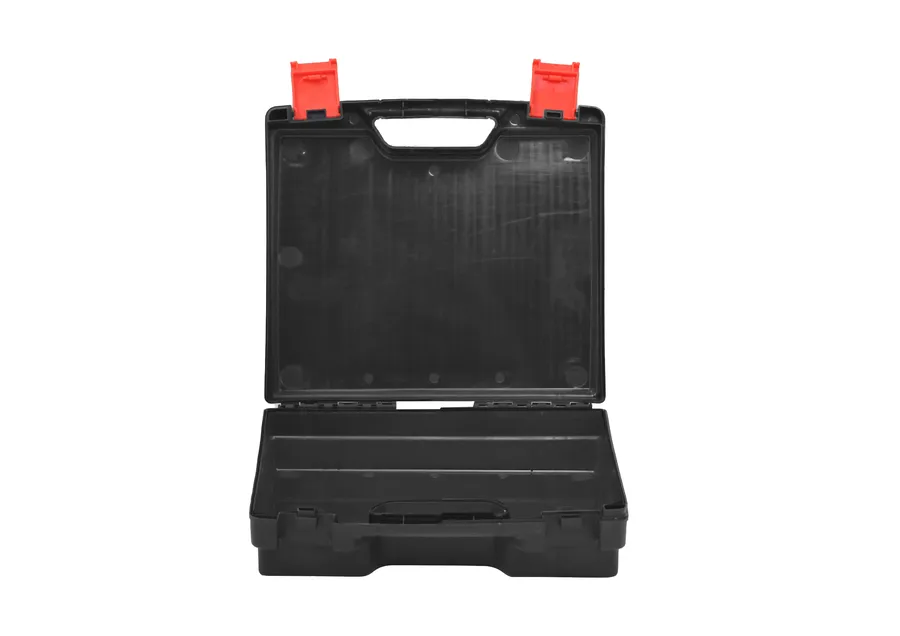
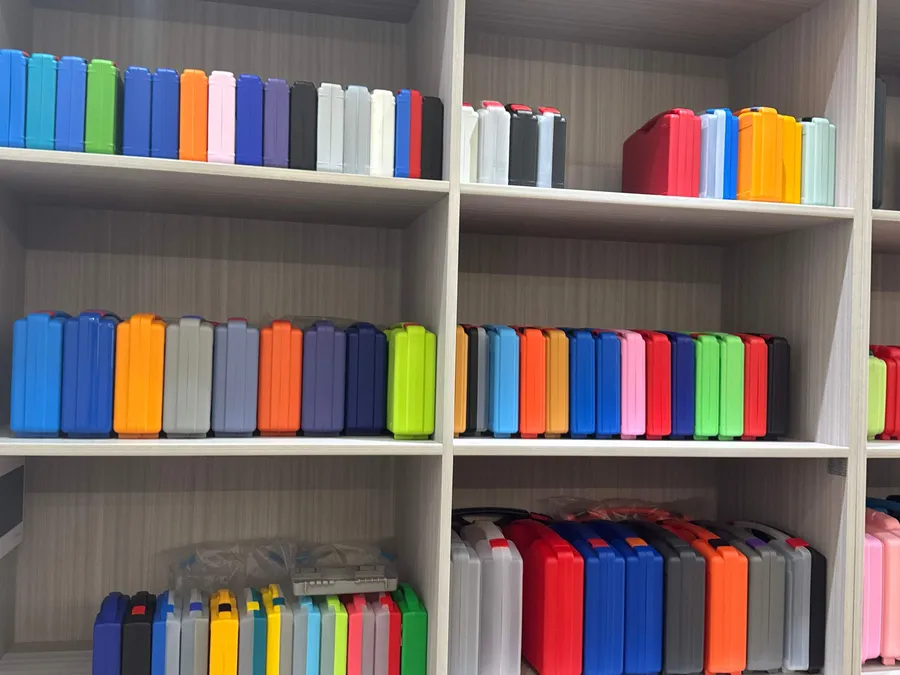
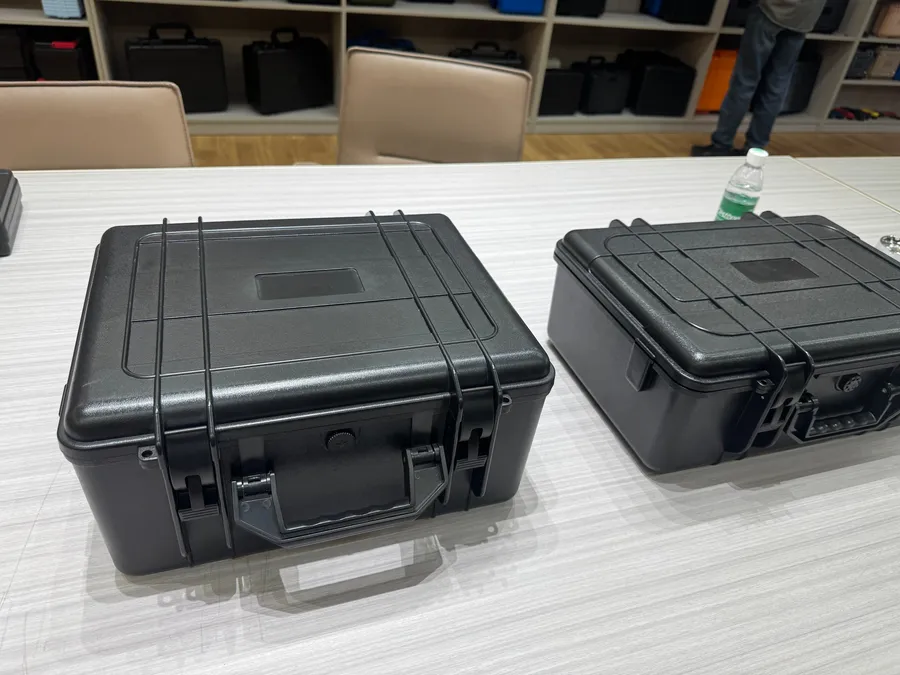
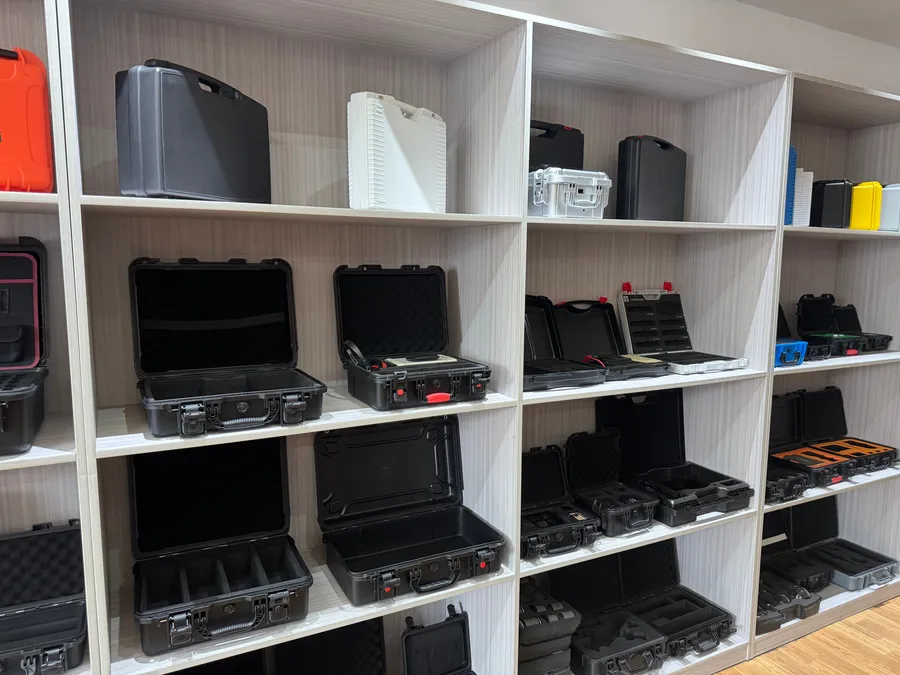
Customisation
Everything described above is configurable on a standard shell: interior layout (pick-and-pluck, die-cut or CNC-cut), foam grade and thickness, colour, logo method, latch and lock count, pressure-equalisation valve, cable ports, document holder and identification plate. A bespoke exterior geometry requires a new mould — 125 days, from 3,000 units per moulded component.
Procurement considerations
| Question | What to send us |
|---|---|
| Which shell fits? | Equipment L × W × H as packed, plus required clearance per axis |
| What does it cost? | Order quantity and estimated annual quantity — the two drive different answers |
| Is tooling needed? | Whether an existing shell clears the envelope with usable foam depth |
| Lead time? | Your required delivery date, not just the order date |
| Certification? | The exact standard your tender names — we will say whether we can test to it |
| Freight? | Destination and preferred terms; carton and pallet data supplied with the quotation |
Comparison and selection guide
The tables on this page exist because a protective case is chosen by comparing three things: the envelope, the environment and the handling chain. Where no table applies, the rule below is.
| Situation | What To Do |
|---|---|
| Fastest | Standard shell plus CNC foam — typically 45 days from approved drawing. |
| Branded | Standard shell plus custom colour and logo — MOQ applies to the resin colour. |
| Bespoke geometry | New mould — 125 days, MOQ from 3,000 units per component. |
- Size on internal dimensions plus clearance, never on a product name.
- Choose the carrying method before the shell: it changes the series, not just the price.
- Specify the interior last, and decide up front whether the end user will reconfigure it.
Can case locks be customised for a specific piece of equipment? relates to Logistics & Packing Guide. Related families: Custom Protective Cases / Tool Cases / Military Protective Cases / Electronics Cases. Related sectors: field and industrial equipment. Continue in the Logistics & Packing Guide cluster.
This page is written from our own production data. If your requirement differs, send the dimensions and we will tell you which of the 155 models fits, or whether a custom route is needed.