What is case seals and why does it matter when buying a protective case?
A case seal is the compressible gasket loaded into the rim of a hard shell so that the closure hardware squeezes it against the opposite face; it matters at buying time because whether a shell has one changes the geometry, the tooling route and the spare-parts plan, not just a line on a datasheet. In our own file of 155 models, 124 listings publish a compressible gasket in a continuous moulded channel and 31 publish none offered on that shell, while 155 of 155 describe the gasket material as an EPDM or equivalent compressible gasket offered as a configuration item. The honest part of the answer is what we do not state: waterproof and dust resistance are recorded as not measured on all 155 listings and no IP-style ingress code is printed anywhere in the file, so a seal is bought as a construction feature and any rating your customer needs is arranged as accredited third-party testing quoted against the configuration.
Key points
- Case seals are verifiable construction: of our 155 listings, 124 publish a channel-held gasket and 31 publish none, so ask which of the two you are being quoted.
- Does every hard case have a seal? Not in our range. Seal availability tracks the shell: 20 of 20 in the 6 Series and 58 of 62 in the 8 Series, but 0 of 6 in the 7 Series and only 2 of 7 in the 1 Series.
- A gasket only works if the rim is held evenly: published lid depth runs 25 mm to 320 mm on sealed shells against 16 mm to 92 mm on unsealed ones, so latch spacing and seal are quoted together.
- Wall thickness is the safety margin for a seal groove. Sealed shells publish 3.0 mm to 6.0 mm walls, median 4.2 mm; unsealed shells publish 2.0 mm to 2.9 mm, median 2.2 mm.
- Keep the seal and the foam separate in your specification. Case seals sit in the moulded channel of the shell; foam sits inside the cavity, and one does not substitute for the other.
- Seal work mostly lives on the cheap side of tooling: 300 pieces and 45 days on an existing tool, versus 3,000 pieces per component and 125 days when a channel geometry needs new steel.
What a case seal actually is on a moulded hard shell
Start with the part itself, because the word is used loosely. On a thermoplastic injection-moulded case, a seal is a compressible gasket that runs continuously around the rim of one half of the shell, usually the base, sitting inside a channel that was moulded as part of the shell rather than glued on afterwards. When the lid closes and the latches or clasps are fastened, the hardware loads that gasket against the mating face of the other half. The seal does not clamp anything by itself and it does not stiffen the case; it is a deformation feature whose entire job depends on how evenly something else presses it along its full length.
That definition explains why we treat this as a buying question rather than a footnote. The three things a seal genuinely changes on a purchase order are the shell design (a channel has to be built into the cavity), the closure plan (there must be enough load points, spaced for the span), and the service model (a gasket is a compressible item that can be damaged, dried out or pinched, and it is cheaper to replace than a shell). None of those is visible in a photograph of a closed case, which is exactly why buyers who ask what case seals are and why they matter when buying a protective case usually get a marketing answer instead of a construction answer.
The two answers our product file publishes, in real counts
Our 155-model file records the seal field for every listing, and it publishes exactly two kinds of answer. If you are comparing suppliers, this is the table you want them to fill in for their own range, because a range that shows one architecture for every size is either a very narrow range or an unrevised datasheet.
| Construction Recorded In The File | How Many Listings | What It Means When You Buy | Published Gasket Material |
|---|---|---|---|
| Compressible gasket in a continuous moulded channel | 124 of 155, recorded as measured | The rim geometry and the closure count have to be quoted together, and spare gaskets can be ordered against the same configuration record | EPDM or equivalent compressible gasket, listed as a configuration item on 155 of 155 |
| None offered on this shell | 31 of 155 | The latches only hold the lid against the shell face, so the closure plan is simpler and the shell wall can be thinner | No channel exists in the cavity, so a seal cannot be added without tool work |
| Pressure equalisation valve | 0 of 155 fitted; the field is published as a configuration item on 155 of 155 | Altitude and cabin-pressure questions are a valve decision, not a gasket decision, and neither is included by default | Not applicable to the gasket itself |
Case seal availability across the model file
Seal availability is not spread evenly across sizes or families, and the pattern is useful when you are shortlisting. Ask a supplier how to maintain a case seal on a moulded shell and the first answer should be: check whether the shell you bought was published with one. In our file the 6 Series carries a channel-held gasket on all 20 listings and the 8 Series on 58 of 62, while the 7 Series carries none on all 6 listings and the 1 Series on only 2 of 7. The shallow 0 Series, which includes the smallest shells in the range, offers a seal on 12 of 23.
The practical reading is that seal presence correlates with what the shell was designed to carry, not with how expensive it is. A 222 mm instrument box in the 6 Series ships with a gasket channel, while a 313 mm outdoor box in the 9 Series and a 466 mm case in the 1 Series are published without one. That is also the answer to does every hard case have a seal: in a real published range, a meaningful minority of shells are designed as closed-but-unsealed boxes, and a buyer who assumes otherwise will specify a requirement the tool cannot meet.
| Series In The File | Listings | With Published Seal | Without |
|---|---|---|---|
| 6 Series | 20 | 20 | 0 |
| 8 Series | 62 | 58 | 4 |
| T Series trolleys | 19 | 18 | 1 |
| 9 Series | 18 | 14 | 4 |
| 0 Series | 23 | 12 | 11 |
| 1 Series | 7 | 2 | 5 |
| 7 Series | 6 | 0 | 6 |
Why the seal matters at buying time: four things it changes
First, it changes the tool. A channel is a feature of the cavity, so a shell published without one cannot take a gasket later without new steel; on our file that route is 125 days and 3,000 pieces per component, while everything that stays inside the existing cavity is a 45-day, 300-piece OEM change. Second, it changes the closure plan. On the 124 sealed shells the latches are what load the gasket, and among those listings with published depth data, lid depth runs from 25 mm to 320 mm with a median of 127.5 mm. A long lid with too few load points seals at the corners and lifts in the middle.
Third, it changes what you should ask for in a quotation. The four numbers that make a seal discussion real are wall thickness, lid depth, base depth and internal volume, and our file publishes wall thickness from 2.0 mm to 6.0 mm across 148 listings, lid and base depth on 100 listings, and internal volume from 0.3 to 139.5 litres. Fourth, it changes the service plan. A gasket is a compressible item in a channel, so a fleet that opens cases daily should carry spare seals against the configuration record rather than returning whole shells, which is the same logic as ordering replaceable hardware for a wear item.
Case seal vs foam gasket in a protective case
This confusion costs buyers real money, so it is worth separating the two. The case seal sits in the rim of the shell and is compressed between lid and base; the foam sits inside the cavity and is compressed between the equipment and the shell wall. In our file the foam fields are entirely separate from the seal fields: foam types published are Pick and Pluck, Die-Cut, CNC-Cut, EVA, PE and EPE, with structures listed as top foam, base foam, egg-crate or convoluted, custom cut and layered, and the material published as cross-linked PE, EVA or EPS by zone. A full cavity of pick and pluck foam will not hold a lid onto a gasket, and a gasket in the rim will do nothing for an instrument that shifts inside the box.
The one place they interact is volume. A seal consumes rim geometry, and the usable interior is what remains after shell walls and any lid foam. Across the file the published internal dimensions run from 115 by 78 by 32 mm on the smallest listing to 1,280 mm in length on the largest, and usable interior volume is published separately from internal volume on many listings. If your equipment only just fits, send the packed dimensions rather than the bare equipment dimensions, which is also what our drawing note asks for: a drawing, a photograph of the packed kit, or a physical sample.
What the geometry has to give a seal to work
Two published numbers decide whether a gasket does anything. The first is wall thickness, because a channel and a latch recess both take material out of the shell. Among the 124 listings published with a seal, wall thickness runs 3.0 mm to 6.0 mm with a median of 4.2 mm. Among the 31 without a seal it runs only 2.0 mm to 2.9 mm with a median of 2.2 mm. Those two groups are not the same shell with an extra rubber line; they are different mouldings, and that difference is why a seal is specified before a tool is cut rather than added afterwards.
The second is depth and mass, because both determine how much the lid flexes. Sealed shells with published depth data show base depth from 15 mm to 168 mm, median 45 mm, and net weight from 250 g to 15,320 g, median 2,035 g. Unsealed shells in the same file average far less: net weight 100 g to 6,140 g, median 630 g. A 5.0 mm wall, a 320 mm lid and a 139.5-litre interior on WL8-8442 Trolley is a closure-and-seal problem solved with multiple load points; a 2.6 mm wall and a 16 mm lid on WL1204 is a box that keeps dust out the way any closed lid does, and our file says so plainly by publishing no seal on it.
What we do not claim about case seals
Every protection figure that a seal is often used to imply is recorded as not measured in our file. Waterproof, dust resistance, ultraviolet resistance, temperature range, stack load and load capacity are all published as not measured on 155 of 155 listings, and no IP-style ingress code is printed anywhere in the range. The measured statements we do publish are narrower and mechanical: the hinge is present on 155 of 155 listings, moulded feet on 155 of 155, corrosion resistance of the thermoplastic shell on 155 of 155 with no ferrous corrosion path, and a latch body that accepts a standard padlock on 155 of 155.
So a seal is described in this range as construction, and the gasket is offered as an EPDM or equivalent compressible gasket under the configuration heading. If your programme needs a number, the correct sequence is to name the exposure and the standard, then let us quote accredited third-party testing against the configuration as built, on the shell with its channel, its latch spacing and its gasket lot. A figure taken from a similar case in a brochure is not a test result, and we would rather lose the order than print one.
Buying notes, quantities and who to send the envelope to
For wholesale and OEM or ODM programmes the seal decision is settled at the same moment as the shell decision, because it belongs to the cavity. Minimums and clocks from our own terms: standard and custom foam items from 1 piece, logo, colour and OEM items from 300 pieces with 45 days to first sample on an existing tool, and 3,000 pieces per component with 125 days when new mould is required. Shell materials published across the file are PP on 94 listings, engineering PP on 38, ABS on 22 and one PP and ABS combination, which matters because the gasket channel and the shell are moulded from the same family of thermoplastics.
Terms are fixed: we ship EXW or FOB, we do not sell retail, we do not quote DDP and we hold no overseas warehouse, with a 30 percent deposit and the balance paid after inspection. Third-party factory audits are welcome at any stage. Send the internal envelope you need, the equipment drawing or photograph, the exposure you are worried about and the quantity band to Fred Zhao or the KeXin Sales Team on WhatsApp +86 135 3588 0002, and the seal question comes back answered per model rather than per brochure. Published by KeXin New Materials (Guangdong) Co., Ltd.
Customisation
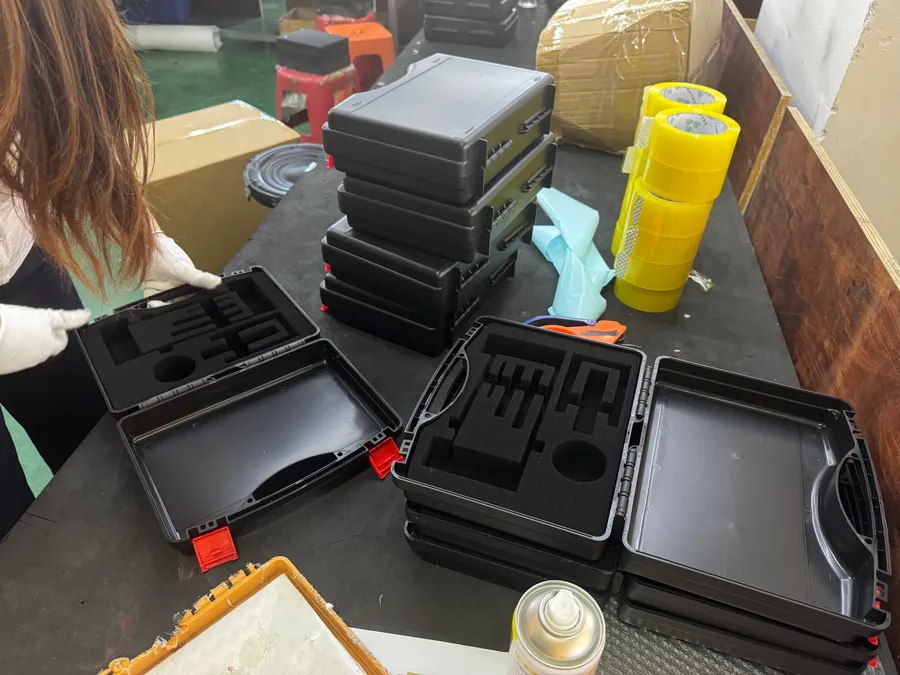
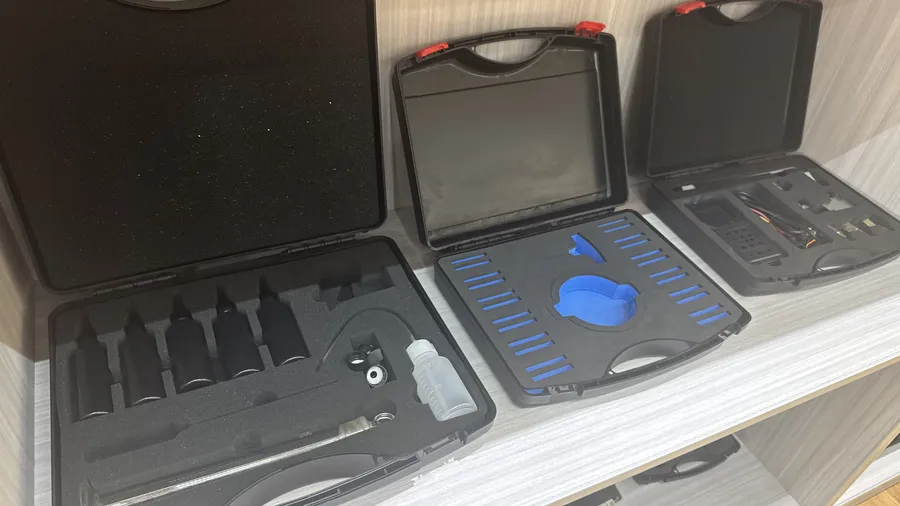
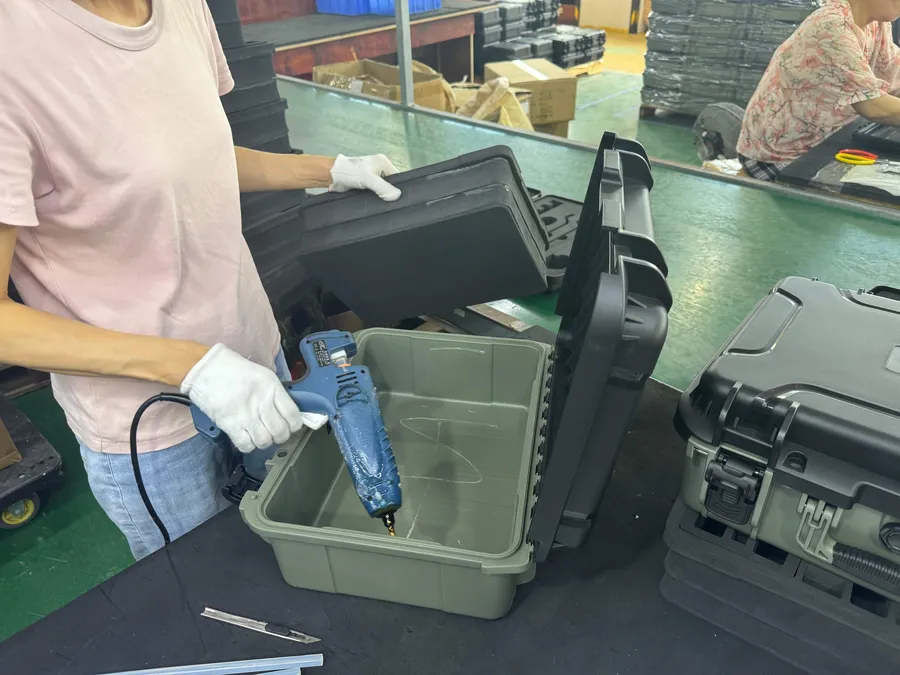
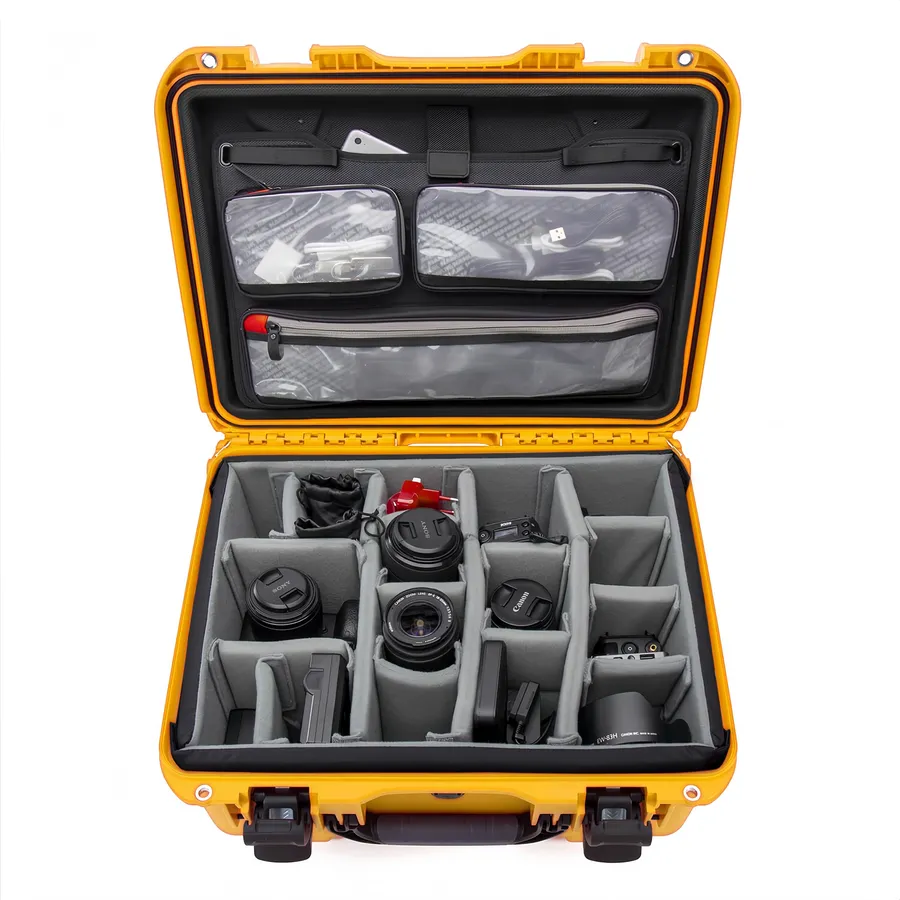
Everything described above is configurable on a standard shell: interior layout (pick-and-pluck, die-cut or CNC-cut), foam grade and thickness, colour, logo method, latch and lock count, pressure-equalisation valve, cable ports, document holder and identification plate. A bespoke exterior geometry requires a new mould — 125 days, from 3,000 units per moulded component.
Procurement considerations
| Question | What to send us |
|---|---|
| Which shell fits? | Equipment L × W × H as packed, plus required clearance per axis |
| What does it cost? | Order quantity and estimated annual quantity — the two drive different answers |
| Is tooling needed? | Whether an existing shell clears the envelope with usable foam depth |
| Lead time? | Your required delivery date, not just the order date |
| Certification? | The exact standard your tender names — we will say whether we can test to it |
| Freight? | Destination and preferred terms; carton and pallet data supplied with the quotation |
Comparison and selection guide
The tables on this page exist because a protective case is chosen by comparing three things: the envelope, the environment and the handling chain. Where no table applies, the rule below is.
| Situation | What To Do |
|---|---|
| Fastest | Standard shell plus CNC foam — typically 45 days from approved drawing. |
| Branded | Standard shell plus custom colour and logo — MOQ applies to the resin colour. |
| Bespoke geometry | New mould — 125 days, MOQ from 3,000 units per component. |
- Size on internal dimensions plus clearance, never on a product name.
- Choose the carrying method before the shell: it changes the series, not just the price.
- Specify the interior last, and decide up front whether the end user will reconfigure it.
What is case seals and why does it matter when buying a protective case? relates to Logistics & Packing Guide. Related families: Custom Protective Cases / Waterproof Cases / Equipment Transport Cases / Electronics Cases. Related sectors: field and industrial equipment. Continue in the Logistics & Packing Guide cluster.
This page is written from our own production data. If your requirement differs, send the dimensions and we will tell you which of the 155 models fits, or whether a custom route is needed.


