Can case seals be customised for a specific piece of equipment?
Yes, inside a clear boundary: the gasket is a component you can specify, while the channel it sits in is a feature of the tool. In our own file of 155 models, 124 listings record a compressible gasket in a continuous moulded channel and 31 record none offered on that shell, and the gasket material line reads EPDM or equivalent compressible gasket as a configuration item on 155 of 155. That single split decides which half of your request is an ordinary engineering change and which half is moulding work. Compound, hardness, cut length, splice method, closure count and whether a pressure-equalisation valve is fitted all sit on an existing tool, at an OEM minimum of 300 pieces with first samples in 45 days. Moving a channel, redrawing the rim, or adding a channel to one of the 31 shells that has none is new steel, quoted at 125 days from 3,000 pieces per component.
Key points
- Separate the two objects: the gasket is a configurable part on 155 of 155 listings, but only 124 shells publish a channel to put it in, and 31 publish none.
- Seal availability tracks published wall exactly in our file: every sealed listing is 3.0 mm or thicker, and all 24 unsealed listings that state a wall sit at 2.9 mm or below.
- Compound, cut length and the corner splice are your decisions; the channel position is the tool's, so write the seal brief against a model code, not against a series name.
- A gasket cannot compress itself: latch count is published as specified per configuration on 155 of 155 listings, so the closure plan and the seal plan are one document.
- Adding a seal to an unsealed shell is new mould work at 125 days and 3,000 pieces per component; every change inside the existing cavity runs 45 days from 300 pieces.
- No ingress figure is measured on any listing, so a customised seal is bought as a described build and a goods-in check rather than as a rating.
What customising a case seal actually means on a moulded shell
Buyers use one word for two objects that have different owners. The gasket is a part: it has a material, a length, a joint where the two ends meet, and a service life. The channel is geometry: a continuous recess moulded into the rim of one shell half, formed by the cavity steel long before any rubber is cut. In our published file those two objects are recorded differently. A compressible gasket in a continuous moulded channel is stated as the seal construction on 124 of 155 models, and 31 models state that none is offered on that shell. The gasket material itself, EPDM or equivalent compressible gasket, appears as a configuration item on all 155 listings, which is another way of saying the compound is a selection rather than a fixed property of the catalogue.
Once the two objects are separated, customising case seals for a specific piece of equipment stops being a yes or no question and becomes a short list of decisions. You can choose the compound and its hardness, the cut length and the splice, the closure count that loads the perimeter, whether a valve boss is used, and where a pass-through sits. What you cannot choose is whether the rim of a given shell has a channel at all; that was decided when the mould was cut. A seal brief therefore starts by naming a model code and only then names a material, because the first question is answered by the tooling and the second by the order.
Where the boundary runs: seal availability across the model file
The table below is a straight count of our 155 published listings by series, with no sampling and no averaging. Read it as the answer to which case shells have a moulded gasket channel, because that is decided by the family a shell was designed in and not by the size you happen to need. It is worth putting in front of any supplier, because a range that shows the same seal answer for every size is usually a range that has not been revised since the first datasheet was written, and a buyer who shortlists on internal volume alone will keep landing on shells that cannot take a gasket.
| Series In Our File | Listings | Publish A Moulded Gasket Channel | Publish None Offered |
|---|---|---|---|
| 6 Series, mid-size equipment case | 20 | 20 | 0 |
| 8 Series, heavy-duty large case | 62 | 58 | 4 |
| T Series, telescopic rolling case | 19 | 18 | 1 |
| 9 Series, deep-body heavy case | 18 | 14 | 4 |
| 0 Series, mini and compact utility case | 23 | 12 | 11 |
| 1 Series, small protective case | 7 | 2 | 5 |
| 7 Series, large equipment case | 6 | 0 | 6 |
| All listings | 155 | 124 | 31 |
Why a thin shell cannot simply be given a seal
Sort the same 155 listings by published wall thickness and the reason for that series pattern becomes obvious. A channel is a recess, a gasket needs section to be squeezed, and a latch boss has to be anchored somewhere, so all three compete for material in the same few millimetres of rim. In our file the boundary is clean: 3.0 mm is the thinnest wall on any listing that publishes a channel, and 2.9 mm is the thickest on any listing that publishes none. Seven listings state no wall figure at all, and none of the seven is sealed, which is why we treat a missing wall line as a question for a sample rather than as a small gap in a datasheet.
Shell material sorts the same boundary from a second direction. All 22 ABS listings record a channel; of the 94 polypropylene listings 75 do, and of the 38 engineering polypropylene listings 27 do, while the single listing stated as polypropylene or ABS records none. None of that means a thinner shell is a worse shell. It means a 2.0 mm utility lid is a closed box rather than a gasketed one, and that a buyer who wants a perimeter must buy the rim that carries it. By the longest external edge the same climb is visible: 4 of the 9 listings under 250 mm are sealed, 32 of 45 between 250 and 399 mm, 63 of 75 between 400 and 599 mm, 23 of 24 between 600 and 899 mm, and both listings at 900 mm and above.
| Published Wall Thickness | Listings | With A Moulded Gasket Channel |
|---|---|---|
| 2.0 mm to 2.4 mm | 16 | 0 |
| 2.5 mm to 2.9 mm | 8 | 0 |
| 3.0 mm to 3.9 mm | 50 | 50 |
| 4.0 mm to 4.9 mm | 44 | 44 |
| 5.0 mm and above | 30 | 30 |
| No wall figure published | 7 | 0 |
| All 155 listings | 155 | 124 |
Six features of your equipment that redraw the seal brief
The equipment, not the catalogue, writes the brief. The searches we get are literal in exactly this way: a seal around a cable pass-through on a hard case, a gasket that survives a daily bench cycle, a lid that carries payload instead of lying empty. What follows is the set of device characteristics that change a seal specification most often, with the tooling route each one takes. Note how few of them need new steel, because most are answered by choosing a shell that already publishes a channel and then specifying the part that goes in it.
| Feature Of Your Equipment | What It Asks Of The Seal | Where It Is Decided |
|---|---|---|
| A cable, probe or antenna that must stay connected inside the closed case | A pass-through that keeps the perimeter line unbroken, or a deliberately split gasket with a described joint | Existing tool, provided the shell publishes a channel and the boss position already exists |
| A lid that carries payload rather than lying empty | More load points, spaced for the span, because a loaded lid pulls the perimeter open at the middle | Existing tool, by configuration of latch count and position within supported bosses |
| An irregular housing, flange or heat sink that sits near the rim | Clearance checked against published internal depth and, on 36 listings, against a narrowest internal width | Existing tool, as a foam and cavity decision, before any seal change |
| A bench instrument opened and closed many times a day | A gasket treated as a wear item, with a spare ratio per hundred cases against the same configuration record | Existing tool, as a spares and service line on the order |
| Altitude or a wide ambient swing between store and use | A pressure-equalisation valve, which is a separate decision from the gasket | Recorded as a configuration item with no value stated on 155 of 155 listings, so it must be named |
| A shell you already own that was published without a channel | New cavity geometry, because a channel cannot be added to a rim that was moulded without one | New mould: 125 days and 3,000 pieces per component |
Five published shells, five different seal conversations
Every figure in this table comes from the published listing for that model, quoted as printed. Read it as a set of starting points for an enquiry rather than as a shortlist. The point is how much of what looks like one question, whether a case has a seal, is really a consequence of the shell that was chosen in the first place.
| Model | External Mm | Internal Mm | Wall Mm | Lid / Base Mm | Published Mass | Gasket Channel | Typical Seal Brief |
|---|---|---|---|---|---|---|---|
| KX-1905 | 190 x 190 x 45 | 180 x 160 x 40 | 3.0 | 25 / 15 | 250 g | yes | Small bench shell opened daily, so the line to write is gasket service life and spares, not geometry |
| KX-93221 | 323 x 243 x 212 | 300 x 200 x 200 | 5.0 | 165 / 35 | 1,230 g | yes | A deep lid on a small footprint, so closure count and position carry the perimeter rather than wall alone |
| KX-88442 | 843 x 592 x 415 | 740 x 518 x 364 | 5.0 | 320 / 44 | 15,320 g | yes | The largest published lid in the file at 139.5 litres, where an unbroken line at the corners is a real design item |
| KX-4710 | 466 x 387 x 102 | 458 x 345 x 90 | 2.5 | 45 / 45 | 1,370 g | none offered | A large shell with a shallow wall: a seal here is a new moulding, not a fitting change |
| KX-1204 | 120 x 90 x 40 | 115 x 78 x 32 | 2.6 | 16 / 16 | 100 g | none offered | The smallest published shell; a closed lid, no channel, and no gasket to maintain |
| KX-95419 | 540 x 445 x 190 | 525 x 400 x 170 | not published | not published | 3,600 g | none offered | One of seven listings with no wall figure, so a seal request needs a sample before it needs a price |
Two tooling routes, and which seal changes belong to each
This is the section that saves the most time in an OEM programme, because the two clocks are a long way apart. Everything that stays inside the existing cavity, the compound, the hardness, the cut length, the splice, the closure count within positions the tooling already supports, the colour, the logo, the foam layout, is an ordinary configuration change on our 45-day, 300-piece OEM terms. Anything that redraws the rim is moulding work and should be quoted as moulding work, because the minimum is ten times higher and the clock is nearly three times longer.
| Seal Change | Route | Minimum | First Sample |
|---|---|---|---|
| Gasket compound, hardness and cross-section on a shell that already publishes a channel | Existing tool | 300 pieces | 45 days |
| Cut length, corner splice method and spare gasket ratio | Existing tool | 300 pieces | 45 days |
| Closure count and position within the bosses the moulding already supports | Existing tool | 300 pieces | 45 days |
| Shell colour, logo, custom foam and custom packaging around the chosen seal | Existing tool | 300 pieces, and 1 piece for standard models and custom foam | 45 days |
| Adding a channel to one of the 31 shells published without one | New mould | 3,000 pieces per component | 125 days |
| Relocating the channel line or redrawing the rim geometry | New mould | 3,000 pieces per component | 125 days |
Where a custom seal meets the lid, the foam and the valve
A seal is only as good as the flatness of what presses it, and that is a geometry question you can check in the file before you ask anything. Lid depth is published on 100 of the 155 listings, running from 16 mm to 320 mm with a median of 97.5 mm, and on 65 of those 100 the lid is deeper than the base. Among the 124 sealed shells, lid and base are both published on 76, with lid depth from 25 mm to 320 mm and a median of 127.5 mm. Eleven sealed listings carry a lid of 200 mm or more, topped by KX-88442 at 320 mm over a 44 mm base. On shells that deep the closures are holding a box rather than a flap, so a seal brief that omits the closure plan is a brief that will be settled by whoever assembles the first sample.
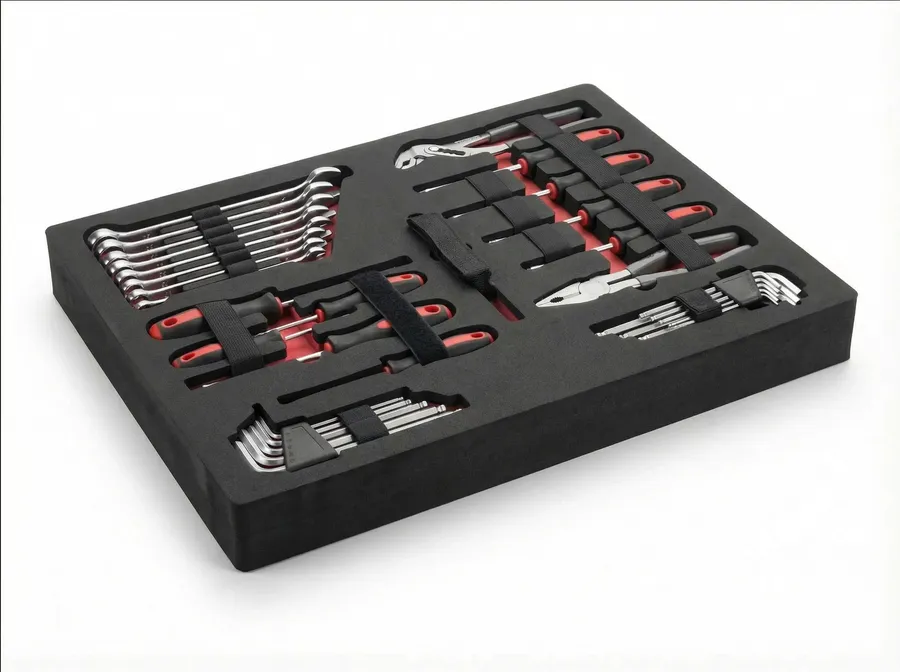
Keep the seal and the foam in separate columns, because they answer to different geometry. The seal sits in the rim and is compressed between lid and base; foam sits inside the cavity and is compressed between the equipment and the wall. Our file publishes custom foam shape, CNC cutting and die cutting as available on 155 of 155 listings, and asks for a drawing, a photograph of the packed kit, or a physical sample. The one place the two interact is volume: internal volume runs from 0.3 to 139.5 litres across the file, and 36 listings additionally publish a narrowest internal width, which is where a full-width instrument discovers that it fits the box but not the lid. The valve is the third separate decision. A pressure-equalisation valve is recorded as a configuration item with no value stated on 155 of 155 listings, which means silence in an enquiry reads as no valve rather than as fitted.
What we do not publish about a customised seal
State this before anyone quotes, because it is where a seal conversation most often drifts into an assertion. Water resistance is recorded as not measured on all 155 listings and dust resistance is recorded as not measured on all 155, and no ingress-protection figure, drop height, stack load, payload or temperature range is published for any model. Ultraviolet resistance is likewise not measured. What is recorded as measured on every listing is narrower and mechanical: a hinge present, moulded feet, a thermoplastic shell with no ferrous corrosion path, and a latch body that accepts a standard padlock. A customised seal therefore changes the construction line of your order, not the environmental line.
The same discipline applies to the gasket itself. No cross-section dimension is published per model, no compound datasheet is attached to a specific gasket lot, and no hardness figure is stated in the file, so a buyer whose procedure names a Shore value has to put that value in the order text rather than expect it back from the catalogue. Where your purchasing procedure requires a measured result instead of a described build, accredited third-party testing against the configuration as built, with its channel, its latch spacing and its gasket lot, is commissioned as a separate work package and quoted on request, and the laboratory report is then the claim rather than anything printed here.
Buying notes: what to send, how the sample is checked
A seal enquiry returns a faster and more accurate answer with four things attached: the model code or the size block including wall thickness, the internal contents with their widest and deepest dimension, the closure count you expect, and the check you intend to run at receiving. Send the drawing, a photograph of the packed kit, or the physical sample, because that is what our cavity and foam review works from. Commercial terms are fixed and they are the same whether the change is large or small: wholesale and OEM or ODM only, EXW or FOB, no retail, no delivered-duty-paid terms and no overseas warehouse, with a 30 percent deposit and the balance paid after inspection. Third-party factory audits are welcome at any stage. Packing is the usual blank: carton dimensions are published on 64 listings and pieces per carton on 58, pallet quantity is calculated from the carton footprint against your pallet, and container loading figures are supplied with the quotation once you state the pallet.
At goods-in the seal check is short and it belongs in the order text. With every closure done up, the lid should sit square with no visible gap at any corner; the gasket should be continuous and seated along the whole perimeter, with no adhesive bead standing in for a moulded joint and no twisted section; and the closure feel should be recorded on one retained case, because a perimeter that drifts later almost always drifts after a maintenance change nobody logged. For a quotation review or a sample sign-off, contact Fred Zhao or the KeXin Sales Team on WhatsApp +86 135 3588 0002. Published by KeXin New Materials (Guangdong) Co., Ltd.
Customisation
Everything described above is configurable on a standard shell: interior layout (pick-and-pluck, die-cut or CNC-cut), foam grade and thickness, colour, logo method, latch and lock count, pressure-equalisation valve, cable ports, document holder and identification plate. A bespoke exterior geometry requires a new mould — 125 days, from 3,000 units per moulded component.
Procurement considerations
| Question | What to send us |
|---|---|
| Which shell fits? | Equipment L × W × H as packed, plus required clearance per axis |
| What does it cost? | Order quantity and estimated annual quantity — the two drive different answers |
| Is tooling needed? | Whether an existing shell clears the envelope with usable foam depth |
| Lead time? | Your required delivery date, not just the order date |
| Certification? | The exact standard your tender names — we will say whether we can test to it |
| Freight? | Destination and preferred terms; carton and pallet data supplied with the quotation |
Comparison and selection guide
The tables on this page exist because a protective case is chosen by comparing three things: the envelope, the environment and the handling chain. Where no table applies, the rule below is.
| Situation | What To Do |
|---|---|
| Fastest | Standard shell plus CNC foam — typically 45 days from approved drawing. |
| Branded | Standard shell plus custom colour and logo — MOQ applies to the resin colour. |
| Bespoke geometry | New mould — 125 days, MOQ from 3,000 units per component. |
- Size on internal dimensions plus clearance, never on a product name.
- Choose the carrying method before the shell: it changes the series, not just the price.
- Specify the interior last, and decide up front whether the end user will reconfigure it.
Can case seals be customised for a specific piece of equipment? relates to Logistics & Packing Guide. Related families: Custom Protective Cases / Waterproof Cases / Electronics Cases / Instrument & Equipment Cases / Equipment Transport Cases / Military Protective Cases. Related sectors: field and industrial equipment. Continue in the Logistics & Packing Guide cluster.
This page is written from our own production data. If your requirement differs, send the dimensions and we will tell you which of the 155 models fits, or whether a custom route is needed.


