Can case palletization be customised for a specific piece of equipment?
Yes, with one clear caveat: a pallet pattern is a packing decision, not a property moulded into the shell, so almost everything about it can be set around a specific item. KeXin publishes a carton plan - outer carton dimensions and pieces per carton - for 64 of its 155 catalogue models, carton footprints run from 410 x 250 mm to 885 x 630 mm with 1 to 40 pieces inside, and the number of cases that reaches a pallet is calculated from that footprint against the deck you actually use. For one piece of equipment you can therefore choose the model whose plan tiles your deck, set the carton quantity and orientation, mix depths that share a footprint into one pattern, and take packaging, logo or private-label changes at 300 pieces on an existing mould with a forty-five day first article. Redrawing the external footprint is the one thing that is not an order line: a new mould runs 125 days from 3,000 pieces per component. The caveat is that the pallet quantity field is recorded as not measured for every model, so what you get is geometry you can verify, not a rated load.
Key points
- Palletization is decided by the carton plan and the deck you name, not by a rating printed on the case, which is why one item can be planned around.
- KeXin publishes carton dimensions and pieces per carton for 64 of 155 models; for the other 91 the pattern is agreed when the quotation is prepared.
- Published carton footprints run 410 to 885 mm long and 250 to 630 mm wide, holding from 1 to 40 pieces, so the same deck yields very different layer counts.
- Selection is the cheapest lever: 96 distinct external plans exist, and shared plans such as 315 x 260 mm let three case heights ride one pattern.
- Pack-side changes - carton quantity, orientation, carton print, private label - start at 300 pieces on an existing mould with a forty-five day first article.
- Pallet quantity and container loading are recorded as not measured for all 155 models: the figure is calculated geometry, never a stated load capacity.
What customising palletization for one item actually means
Buyers ask this question in three different ways, and the answers sit in three different places. The first version is selection: can a case be found for this instrument so that twenty, sixty or two hundred of them stand squarely on one deck? Usually yes, because the catalogue is built from moulded shells whose plans repeat, and because 64 models already carry a published carton plan you can do the arithmetic with. The second version is configuration: can the way your units are packed be changed so the deck fills better - fewer pieces per carton, a taller carton, a different orientation, carton print that identifies a layer? That is an order decision, and custom packaging is published as an option on every model in the range. The third version is redesign: can the shell footprint itself be redrawn to land on your deck? That is a tooling programme, with a different lead time and a different minimum.
The distinction is commercial, not academic. Selection and configuration are handled inside a normal wholesale or OEM order at no tooling cost. Redesign is a mould programme measured in thousands of pieces and months of lead time. Almost every pallet pattern that works in the field comes out of the first two routes, and the honest way to read this page is as a guide to which lever you are pulling.
The three layers that decide a pallet pattern
The carton plan comes first. A carton is the unit a warehouse actually stacks, and we publish its three dimensions and its piece count for 64 of 155 models. Those plans span 410 mm to 885 mm in length, 250 mm to 630 mm in width and 232 mm to 755 mm in height, and they carry from 1 to 40 cases each. The consequence is that case size alone tells you very little about a shipment: the KX 2005 shell measures only 195 x 170 x 46 mm, but it ships forty to a 410 x 360 x 495 mm carton, while the KX 5321 shell at 525 x 434 x 214 mm ships three to a 530 x 440 x 635 mm carton. Same deck, completely different layer economics.
The deck comes second, and it is yours, not ours. The product record states plainly that the pallet figure is calculated from the carton footprint against your pallet size, because a 1200 x 1000 mm, a 1200 x 800 mm and an 1100 x 1100 mm deck give three different answers to the same carton. Nothing in the catalogue assumes one standard deck, and a pattern quoted without naming the deck is guesswork.
The case geometry comes third, because it constrains what a carton can ever look like. The 155 models sit on 96 distinct external footprints, and the plans that repeat are repeating for a logistical reason: 405 x 325 mm appears on seven models, 463 x 370 mm on seven, 410 x 370 mm and 517 x 430 mm on four each, and 315 x 260 mm, 360 x 310 mm, 460 x 367 mm and 466 x 387 mm on three each. Where a plan repeats, its cartons tend to share a plan too, which is how a kit of mixed depths can still present one flat, square surface to a deck.
What can be customised for your equipment, and what needs a new mould
| Change | What It Sets | Published Basis | Order Position |
|---|---|---|---|
| Model selection from the published plans | Which carton footprint lands on your deck | 64 of 155 models publish carton dimensions and pieces per carton | Standard minimum of one unit, no tooling and no surcharge |
| Pieces per carton and carton orientation | Cases per layer and the height of each layer | Carton plans from 410 x 250 mm to 885 x 630 mm, holding 1 to 40 pieces | Custom packaging is published as an option on every model |
| Mixing depths that share one footprint | Whether a mixed kit ships on one pattern | KX 3207, KX 3213 and KX 3218 share a 315 x 260 mm plan and a 645 x 530 mm carton plan | Decided in the packing list; no tooling involved |
| Carton print, layer labelling, private label | Whether a deck can be read without opening it | Custom logo, custom colour and private label published across the range | Three hundred pieces minimum on an existing mould, forty-five days to first article |
| Foam layout and interior fit | Mass per layer and how that mass sits | Custom foam published from one unit; net weight recorded on 93 models, 100 g to 15,320 g | Fits inside the existing-mould programme |
| A new external plan sized to your deck | The footprint itself | 96 distinct plans already published, so a new plan must be justified against them | New mould: one hundred twenty-five days, from 3,000 pieces per component |
| Wheels and telescopic handle | Mobility, at the cost of a stackable shell | Nineteen T Series shells are published with wheels and without stackability | Plan them as a deck position, not as a column |
Worked patterns on a 1200 x 1000 mm deck
The table below is arithmetic on published carton plans, using one orientation per layer with no pinwheeling, and counting whole cartons that fit inside the deck lines. It is what you can verify yourself from the numbers on a model page. Cartons that overhang a deck are not shown as a fit, because an overhang is where a wrapped load starts to lean.
Read it as a comparison of strategies rather than a promise: the small 410 x 360 mm and 475 x 285 mm plans turn one layer into a couple of hundred units, the 645 x 530 mm plan trades layer count for a deeper case, and the single-carton shells at the bottom are the ones a pattern cannot help - they travel one or two to a layer whatever you do, which is why their cost per delivered unit belongs in the selection decision.
| Model | Carton Mm | Pieces Per Carton | Cartons Per Layer 1200X1000 | Cases Per Layer | Note |
|---|---|---|---|---|---|
| KX 2005 | 410 x 360 x 495 | 40 | 6 | 240 | Rotated to run 360 mm across the 1200 mm edge; two layers reach 990 mm above the deck |
| KX 2305 | 480 x 370 x 470 | 40 | 6 | 240 | Same strategy as KX 2005 on a 230 x 180 mm shell |
| KX 62205 | 475 x 285 x 320 | 20 | 8 | 160 | Narrow 285 mm width is what buys the extra cartons per layer |
| KX 2805 | 570 x 470 x 435 | 32 | 4 | 128 | Fits 4 per layer, but only 2 on a 1200 x 800 mm deck |
| KX 3207 | 645 x 530 x 430 | 24 | 2 | 48 | One of three models sharing this carton plan on a 315 x 260 mm shell |
| KX 3213 | 645 x 530 x 520 | 16 | 2 | 32 | Same deck pattern as KX 3207 at a 128 mm case height |
| KX 3218 | 645 x 530 x 550 | 12 | 2 | 24 | Deepest of the three; layer count unchanged, unit count down by half |
| KX 5321 | 530 x 440 x 635 | 3 | 4 | 12 | Tall carton: a second layer takes the load past 1,200 mm |
| KX 704 | 740 x 550 x 480 | 20 | 2 | 40 | Two cartons per layer on a 1200 x 1000 mm deck and two on a 1200 x 800 mm one, so this plan barely moves with deck choice |
| KX 96127 | 640 x 625 x 280 | 1 | 1 | 1 | Wheeled shell, published not stackable: 610 x 610 x 270 mm of deck for one unit |
How to specify a pallet pattern around one piece of equipment
Start from the item, not from the case. Write down the equipment's mass and its three dimensions, add the clearance and foam depth you expect, and that gives the internal requirement; the model follows from the published internal dimensions, and only then does the pallet question get answered. Working in the other order - picking a case you like and then asking how many fit on a pallet - is how a pattern gets quoted that cannot be built, because the carton that would tile the deck was never available for that shell.
Then name the deck and the destination handling path, because those two facts change the arithmetic more than any other input. A pattern built for a 1200 x 1000 mm rack deck is not a pattern for a 1200 x 800 mm EUR deck, and a load that will be broken down at a distributor cross-dock has to be layerable by hand, not only by forklift. Five numbers are enough for us to shortlist models and show you the geometry behind each option rather than a single recommended figure.
Where a customised pallet pattern earns its keep
In electronics and instrumentation programmes the units are small and the order lines are long, so the pattern is worth engineering: forty pieces to a 410 x 360 mm carton is 240 cases in a single layer of a 1200 x 1000 mm deck, and the difference between that and a careless plan is measured in whole decks per shipment. Here the useful customisation is carton quantity and print, not the shell.
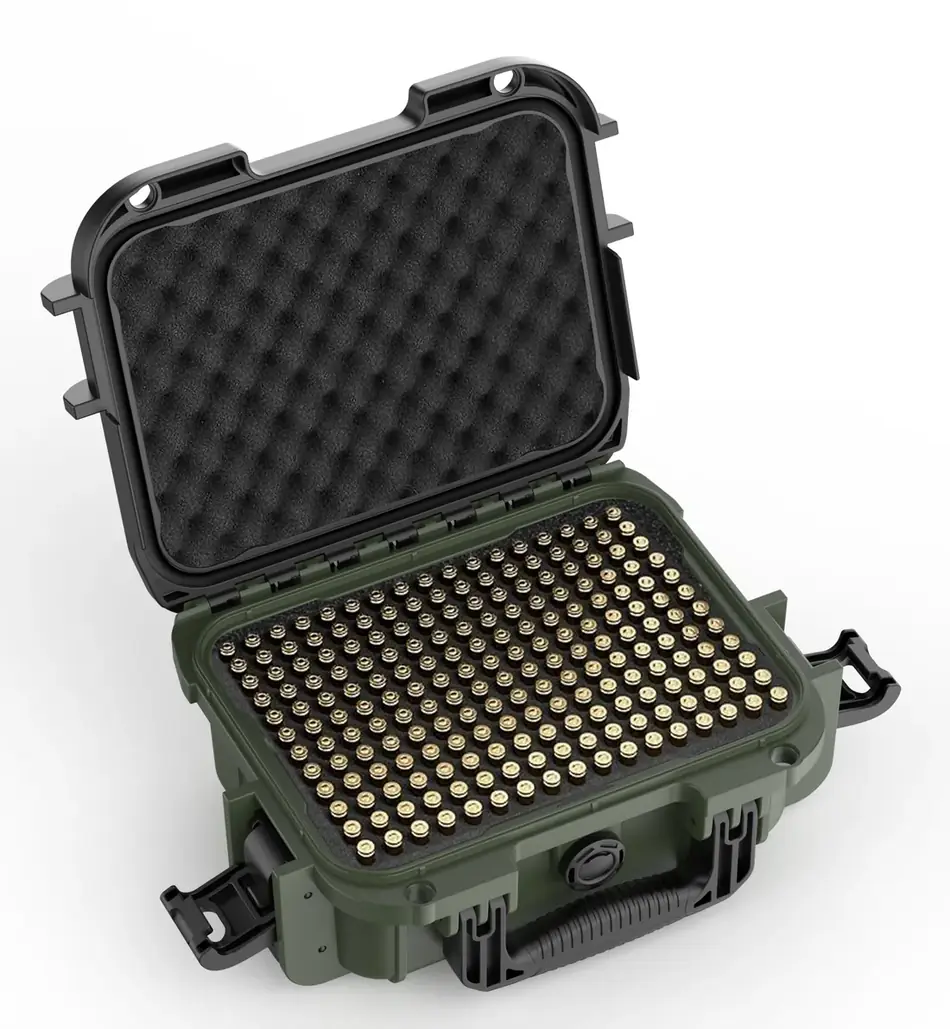
In ammunition, inventory and field-kit transport the constraint is different. Three case heights sharing the 315 x 260 mm plan - KX 3207 at 70 mm, KX 3213 at 128 mm and KX 3218 at 180 mm - go onto one 645 x 530 mm carton plan, so a single pallet pattern can carry a whole kit range and a warehouse can mix depths in one layer without inventing a new stow.
For maintenance and military transport kits the deep single units behave like furniture rather than like cartons. A KX 5321 ships three to a carton and takes four cartons per layer; a wheeled KX 96127 with a 610 x 610 x 270 mm shell is published not stackable and gives one unit to a layer whatever the carton does. Those items get planned as their own deck position, and the honest question to ask is not how many fit but what the shipment costs per delivered unit.
Outdoor, telecommunications and industrial buyers most often ask for identification rather than geometry: carton print, layer labels and colour coding so that a wrapped deck can be read at the dock without cutting straps. That is a 300-piece change on an existing mould and it solves more mis-shipments than any reshaping of a shell.
The customisations that touch the pack rather than the tool
Custom packaging, custom logo, custom colour, private label and OEM marking are published as available across the catalogue, and they are where a pallet programme normally lives. Changing pieces per carton changes the number of cartons per layer; rotating the carton ninety degrees changes the same number again, which is why KX 2005 gives six cartons to a 1200 x 1000 mm layer and only four to a 1200 x 800 mm one. Foam layout is published from a one-unit minimum, so interior work can be trialled on a single case before a pack programme is committed. Shell materials are published as PP, engineering PP and ABS, and net weight is recorded on 93 models from 100 g to 15,320 g, which is the figure that decides whether a layer can be lifted by hand once loaded.
What none of these levers touch is the moulded geometry. Wall thickness, recorded on 148 models from 2.0 mm to 6.0 mm, lid depth published from 16 mm to 320 mm and base depth from 15 mm to 168 mm are properties of the tool, and the shell's external plan follows from it. So when a pattern genuinely will not tile, the choice is between accepting a different deck, accepting a mixed layer, or opening a new mould at 125 days and 3,000 pieces per component - and that decision is worth pricing against the freight it saves before anyone draws steel.
What we do not publish about pallet quantities
Every model in the catalogue carries a pallet quantity field, and for all 155 that field is recorded as not measured, with the note that it is calculated from the carton footprint against your pallet size. The same applies to container loading, where the 20GP, 40GP and 40HQ figures are supplied with the quotation rather than printed per model, and to stack load, which is likewise not measured. What we can therefore show you is geometry - which carton, how many pieces, how many whole cartons land inside which deck lines - and not a rated load. Anyone who quotes you a pallet quantity without naming the deck, the orientation and the mass per layer is quoting an assumption.
Ninety-one models have no published carton plan at all, and for those the pattern is built when the order is prepared, not read off a page. If your programme needs a stated number rather than a calculation - for a rack, an automated store, or a contract with a freight operator - tell us the deck, the layer count, the mass above and the duration, and we will quote accredited third-party testing against that specification and record the result against the model instead of inventing a figure in a catalogue line.
Commercial terms for a palletization programme
KeXin New Materials (Guangdong) Co., Ltd. works on a wholesale and OEM basis only, quoted EXW or FOB from the factory, with a thirty percent deposit and the balance before shipment. We do not sell retail, we do not deliver DDP, and we hold no overseas warehouse, which means the pallet pattern is built here, at the factory, against the deck you name - a pattern that depends on stock being rebuilt at a regional hub is not something we can offer. Model selection and custom foam start at one unit; colour, logo, carton print and hardware configuration run from 300 pieces on an existing mould with forty-five days to first article; a new mould that changes an external plan runs 125 days from 3,000 pieces per component. Say which deck you use at the request-for-quotation stage and the geometry comes back with the price.
Customisation
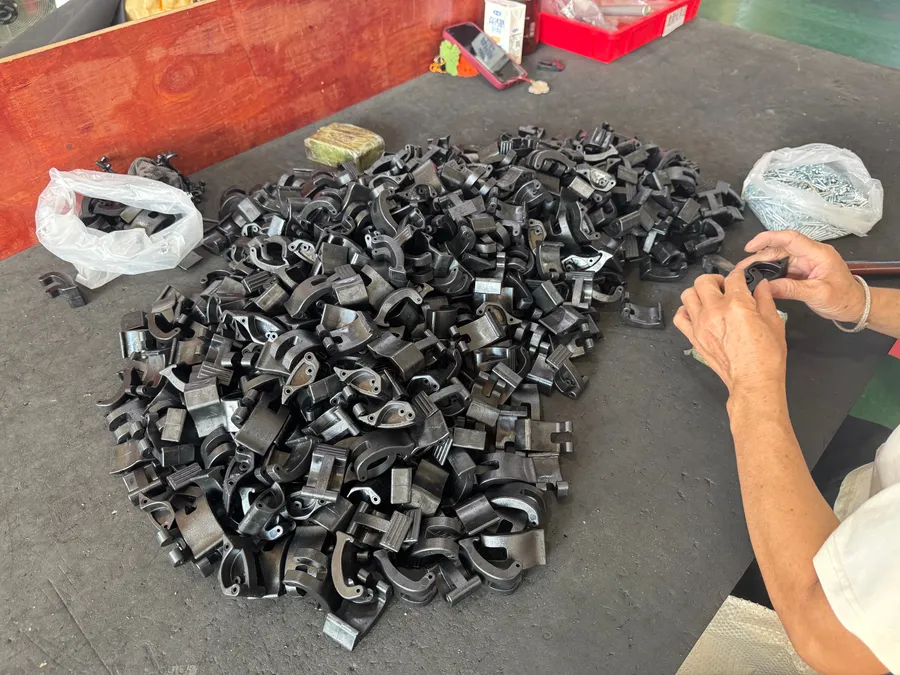
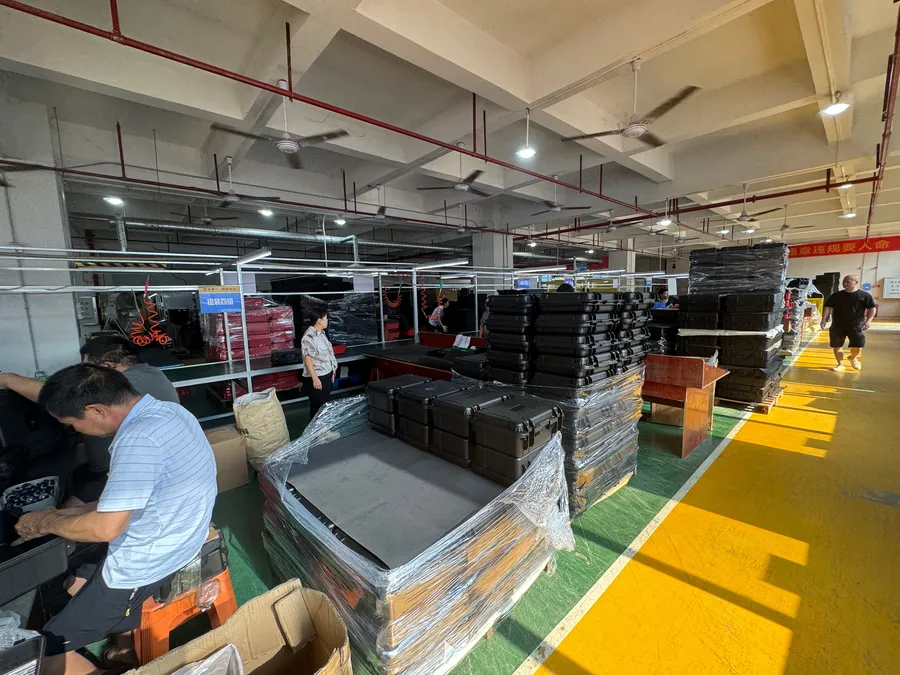
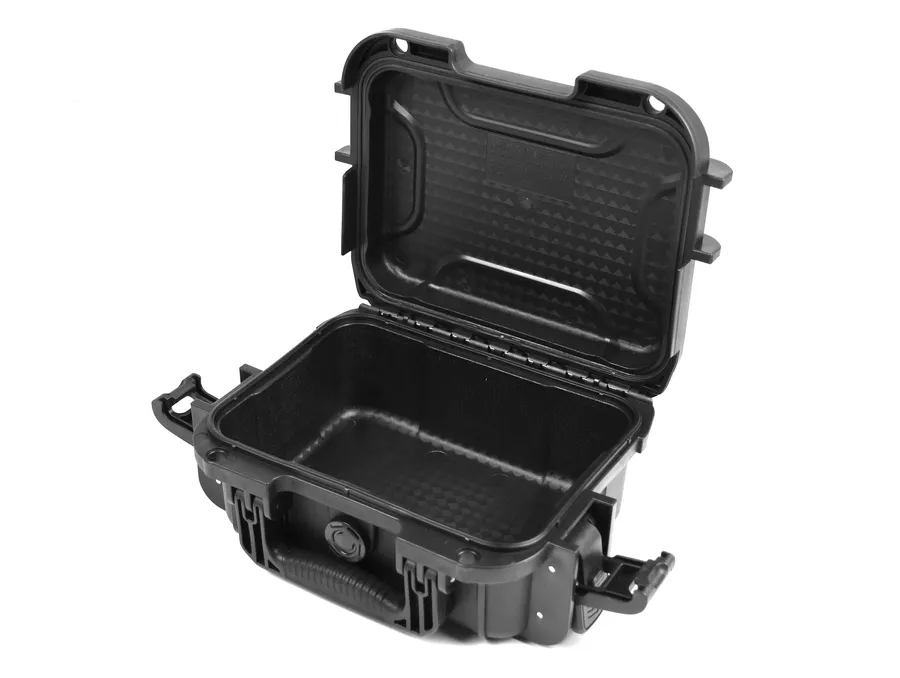
Everything described above is configurable on a standard shell: interior layout (pick-and-pluck, die-cut or CNC-cut), foam grade and thickness, colour, logo method, latch and lock count, pressure-equalisation valve, cable ports, document holder and identification plate. A bespoke exterior geometry requires a new mould — 125 days, from 3,000 units per moulded component.
Procurement considerations
| Question | What to send us |
|---|---|
| Which shell fits? | Equipment L × W × H as packed, plus required clearance per axis |
| What does it cost? | Order quantity and estimated annual quantity — the two drive different answers |
| Is tooling needed? | Whether an existing shell clears the envelope with usable foam depth |
| Lead time? | Your required delivery date, not just the order date |
| Certification? | The exact standard your tender names — we will say whether we can test to it |
| Freight? | Destination and preferred terms; carton and pallet data supplied with the quotation |
Comparison and selection guide
The tables on this page exist because a protective case is chosen by comparing three things: the envelope, the environment and the handling chain. Where no table applies, the rule below is.
| Situation | What To Do |
|---|---|
| Fastest | Standard shell plus CNC foam — typically 45 days from approved drawing. |
| Branded | Standard shell plus custom colour and logo — MOQ applies to the resin colour. |
| Bespoke geometry | New mould — 125 days, MOQ from 3,000 units per component. |
- Size on internal dimensions plus clearance, never on a product name.
- Choose the carrying method before the shell: it changes the series, not just the price.
- Specify the interior last, and decide up front whether the end user will reconfigure it.
Can case palletization be customised for a specific piece of equipment? relates to Logistics & Packing Guide. Related families: Custom Protective Cases / Ammunition Storage & Transport Boxes / Military Protective Cases / Tactical Equipment Cases / Outdoor Protective Cases / Equipment Transport Cases. Related sectors: field and industrial equipment. Continue in the Logistics & Packing Guide cluster.
This page is written from our own production data. If your requirement differs, send the dimensions and we will tell you which of the 155 models fits, or whether a custom route is needed.