Can protective case dimensions be customised for a specific piece of equipment?
Yes, and the honest answer is that protective case dimensions can be customised for a specific piece of equipment in three different ways, only one of which involves tooling. Route one is selection: choose a shell from our published model sheets whose internal dimensions already clear the device plus its foam allowance, of the 155 models we publish. Route two is interior customisation: keep the shell we already mould and cut a die-cut or CNC-cut foam layout to your equipment, where our published MOQ for custom foam is 1. Route three is a bespoke shell size, which means a new mould, quoted at 125 days with MOQ from 3,000 per component, while OEM work on an existing mould is quoted at 45 days. Most enquiries we receive are solved by route two, and the fit question can usually be answered from published millimetre data before any tooling conversation starts.
Key points
- Internal dimensions are the fit test and external dimensions are the freight test; never use one set to answer the other question.
- Custom foam is a sampling decision, not a tooling decision: our published MOQ for custom foam on existing shells is 1.
- OEM work on an existing mould is quoted at 45 days; a new mould that changes shell dimensions is quoted at 125 days.
- New-mould work carries MOQ from 3,000 per component, so we validate the interior with a foam sample before proposing tooling.
- Wall thickness is published per model, from 2.0 mm on KX-2005 to 6.0 mm on KX-6621, and it explains most of the size delta.
- Send a drawing, a photograph of the packed kit, or a physical sample; any single one of the three is enough to open a fit review.
Three ways to customise protective case dimensions for one device
The phrase custom work covers three separate commercial decisions, and separating them before you ask for a price saves weeks. The first is selection: choosing an existing shell whose published internal dimensions already exceed the equipment envelope once a foam allowance is added. The second is interior customisation: the shell stays exactly as moulded, and we cut a top foam and base foam layout, die-cut or CNC-cut, to the outline of your device. The third is dimensional customisation of the shell itself, which means a mould modification or an entirely new mould, and that is the only route with tooling time and a component-level MOQ attached to it. Our product sheets publish external dimensions, internal dimensions, wall thickness, lid depth, base depth, narrow internal width and net weight for 155 models, so the first two routes can be settled from data alone. The practical consequence is that a buyer with one unusual instrument does not automatically need a new case size; they usually need a new foam drawing against a size that already exists in the catalogue.
What our published sheets state, axis by axis
Every model sheet in our product data carries the same dimensional fields, so fit comparisons are done line by line rather than by eyeballing a photograph. The table below reproduces real published figures from that data set, chosen to span the size range a buyer normally asks about: a small utility shell, a mid-range instrument shell, a deeper kit box, a thick-walled communication case and the largest wheeled transporter in the range. Nothing in the table is rounded up or generalised to the rest of the range; each line is the number that model publishes.
| Model | External Mm | Internal Mm | Narrow Internal Width Mm | Wall Thickness Mm | Lid Plus Base Mm | Net Weight G |
|---|---|---|---|---|---|---|
| KX-1204 (0 Series, PP) | 120 x 90 x 40 | 115 x 78 x 32 | 70 | 2.6 | 16 + 16 | 100 |
| KX-2005 (0 Series, PP) | 195 x 170 x 46 | 190 x 135 x 40 | 127 | 2.0 | 20 + 20 | 175 |
| KX-3113 (9 Series, engineering PP) | 313 x 282 x 129 | 296 x 258 x 121 | not published | 2.9 | 83 + 38 | 1060 |
| KX-83612 (8 Series, PP) | 364 x 320 x 118 | 330 x 260 x 103 | not published | 3.3 | 75 + 28 | not published |
| KX-6621 (9 Series, engineering PP) | 662 x 495 x 210 | 587 x 434 x 192 | not published | 6.0 | 43 + 149 | 6420 |
| KX-88442 (T Series, PP, 2 wheels) | 843 x 592 x 415 | 740 x 518 x 364 | not published | 5.0 | 320 + 44 | 15320 |
Where the difference between the two sets of dimensions actually goes
Subtracting internal from external tells you where the plastic and the hardware live, and that is the most useful arithmetic in a fit review. On KX-1204 the length drops by 5 mm, the width by 12 mm and the height by 8 mm, which is what a 2.6 mm wall plus a moulded rim and latch recess costs at that scale. On KX-88442 the same subtraction gives 103 mm on length, 74 mm on width and 51 mm on height, because a wheeled transporter carries wheel housings, a telescopic handle channel standing 295 mm when extended, and deeper corner hardware. Lid depth plus base depth equals the published internal height on these sheets, so 320 + 44 mm equals the 364 mm interior of KX-88442 and 16 + 16 mm equals the 32 mm interior of KX-1204. That single relationship is worth checking before you ask us for a new height: if your device is 300 mm tall and the base foam is 40 mm, you need a lid depth above 260 mm, not necessarily a new shell. Several small models also publish a narrow internal width, for example 70 mm against a 78 mm internal width on KX-1204 and 127 mm against 135 mm on KX-2005, which is the tapered corner and the rib line: the widest cross-section is not the usable cross-section at every height.
Custom foam: the fastest route from a device outline to a working interior
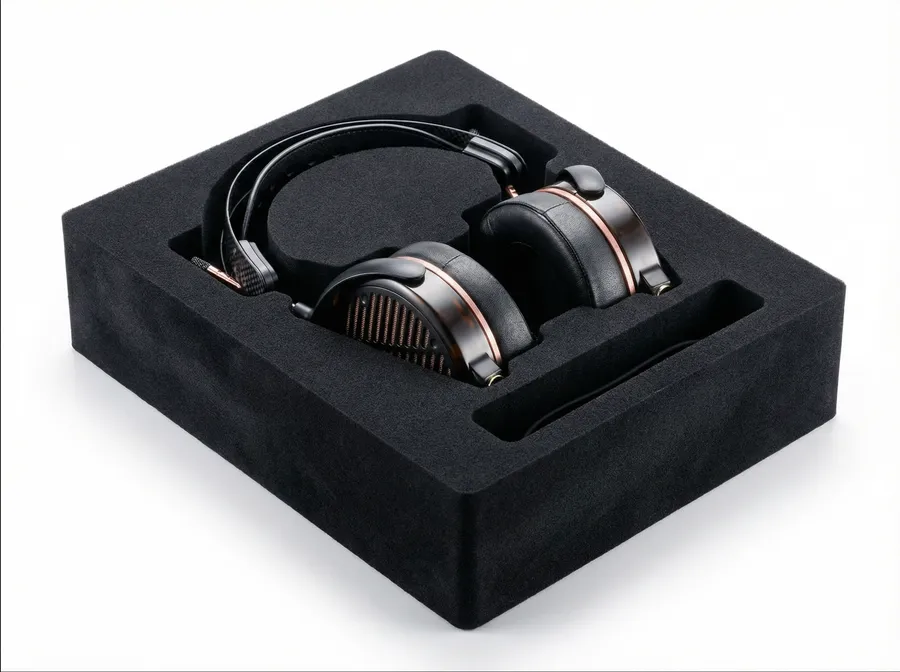
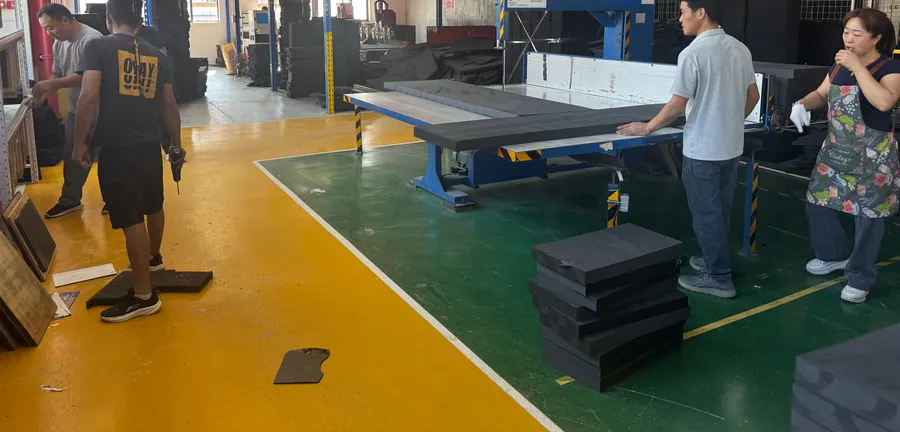
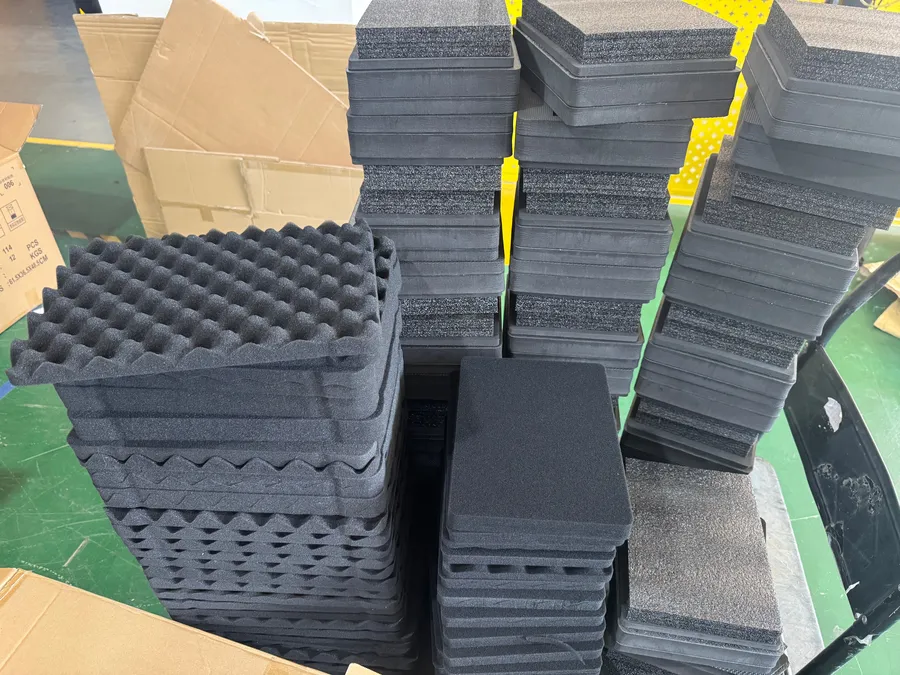
When the shell size is already right and only the cavity is wrong, we change the interior instead of the tooling. Our published foam options cover pick and pluck, die-cut and CNC-cut layouts in EVA, PE and EPE, assembled as top foam, base foam, egg-crate or convoluted layers, layered builds, or a fully custom cut. The published MOQ for custom foam is 1, and the published lead time for OEM work on an existing mould is 45 days, which means a first article with your instrument nested correctly is a sample cycle rather than a capital project. To start it we ask for one of three inputs, all of which we treat equally: a dimensioned drawing, a photograph of the packed kit laid out on a table, or the physical sample itself. For buyers comparing this against a shell change, the honest trade-off is that foam consumes internal volume. KX-88442 publishes 139.5 litres of internal volume against 111.6 litres of usable interior volume, and KX-3113 publishes 9.2 litres against 7.9 litres; the gap is the foam, and it is the number a buyer should compare with the actual kit, not with the bare device.
When a new mould is the correct answer for a bespoke size
A new mould is worth its cost when three conditions hold at once: no published shell clears the equipment envelope, the annual volume supports a component MOQ of 3,000 pieces or more, and the external size has to be constrained for a fixed rack, pallet bay or vehicle mount rather than merely convenient. Our published figures are 125 days for a new mould and 45 days for OEM work on an existing one, with the 30 percent deposit against the order and the balance settled after inspection before shipment. Where a buyer only needs a slightly different height, we say so plainly and offer the foam route first, because a tooling programme started to save 20 mm of interior is a poor use of their budget. Custom hardware, custom colour, custom logo, custom packaging and private labelling are all available on existing shells, so a distinctive product does not require distinctive dimensions.
Comparing the three routes side by side
| Route | What Changes | Published Moq | Timing | Best When |
|---|---|---|---|---|
| Select an existing shell | Nothing; the model is moulded and published today | 1 for standard units | Sample from existing stock configuration | Published internal dimensions already clear device plus foam |
| Existing shell with custom die-cut or CNC-cut foam | Interior only; shell dimensions stay as published | 1 for custom foam | OEM on existing mould quoted at 45 days | Size fits but the cavity is wrong for the kit |
| New mould for a bespoke shell size | External and internal protective case dimensions, wall and hardware positions | From 3,000 per component | New mould quoted at 125 days | Volume supports tooling and a rack or bay constrains the outside size |
Putting customised dimensions into an RFQ so it can be quoted once
A dimension enquiry that arrives as a single number always comes back for more detail, so we recommend a short fixed set of fields. Send the device envelope as length, width and height at its widest points, including antennas, handles, connectors and anything that stays attached. Send the packed-kit list, because a charger and a cable set change the interior more than the instrument does. Say which face is up in transit, whether the item may be inverted, and how many units sit in one carton. State the freight constraint as an external limit if one exists, for example a shelf depth or a trolley deck, and label it clearly as an external maximum rather than an interior target. Add your quantity, your label and colour requirements, and whether you want us to supply the foam or receive the shells empty. Our commercial scope is wholesale and OEM or ODM on EXW or FOB terms: we do not sell retail, we do not offer DDP, and we do not hold overseas warehouse stock, so the RFQ should assume a port or works collection.
Freight numbers: the external side of the same decision
Changing interior dimensions inevitably changes the carton, and the carton is what your freight is calculated on. Our published pack data shows the relationship directly: KX-6621 measures 662 x 495 x 210 mm externally, ships three pieces in a 665 x 500 x 650 mm carton, KX-63912 ships ten pieces of a 389 x 295 x 120 mm shell in a 625 x 405 x 635 mm carton, and KX-3508 ships twenty pieces of a 350 x 300 x 79 mm shell in a 730 x 615 x 428 mm carton. KX-2805 nests thirty-two pieces of a 280 x 230 x 53 mm shell into a 570 x 470 x 435 mm carton, which is two shells long, two wide and eight high with packing allowance. Small utility shells behave differently again: KX-2005 ships forty pieces of a 195 x 170 x 46 mm case in a 410 x 360 x 495 mm carton. We publish pallet quantities as calculated from the carton footprint against your pallet size rather than as a fixed number, and 20GP, 40GP and 40HQ loading figures are supplied with the quotation, because both depend on the configuration ordered rather than on the shell alone. If you are weighing a dimensional change, ask us for the carton and loading impact in the same enquiry; the freight consequence is usually larger than the material saving.
What we do not state about customised dimensions
A customised size does not create a performance claim, and we keep those two files apart. Our model sheets publish no IP code; protection fields are recorded as not measured, and accredited third-party testing is quoted per configuration when a buyer needs a report. Impact notes on the sheets state the wall thickness for that model and add that no drop height is claimed without a test, so changing a wall from 2.6 mm to 6.0 mm changes the published thickness figure and nothing else until a test exists. Stack load and load capacity are recorded as not measured on these sheets as well. What we do change when you customise is the dimensional set: external, internal, narrow width where published, lid and base depth, wall thickness, net weight, carton and pack quantity. That distinction matters in a tender, because a buyer sometimes asks us to attest to a standard in the same sentence as a size; the size we can state, the attestation belongs to a laboratory report and not to our drawing office.
Who this question usually comes from, and how to reach us
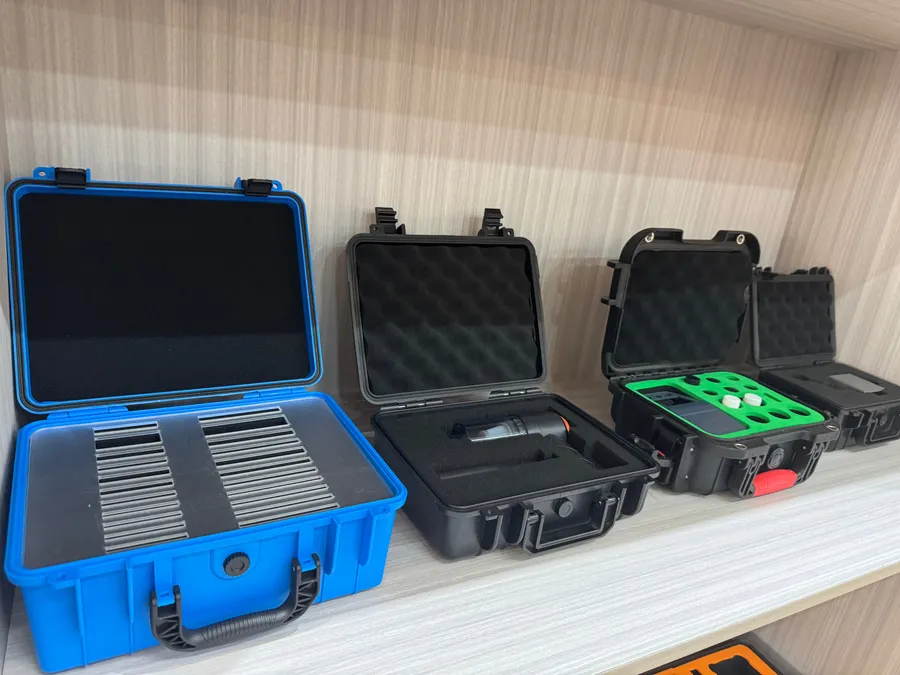
The enquiries that start with this question come mostly from buyers integrating electronics and test instruments into a fleet or a kit list: a handheld analyser with a dock, a fibre patch panel that will not lie flat, a camera body with a lens attached, a medical device with a charger and a manual, or an instrument that has to sit in a fixed shelf. For those applications, our published range for electronics and instrument shells is the place to start, and the interior route resolves most of them. KeXin New Materials (Guangdong) Co., Ltd. works with wholesale buyers and OEM or ODM programmes only, on EXW or FOB terms, with 30 percent deposit and the balance after inspection, and third-party factory audits are welcome. Send the drawing, the photograph of the packed kit, or the sample, and ask Fred Zhao or the KeXin Sales Team for a fit review first, before anyone spends money on tooling. WhatsApp +86 135 3588 0002.
Customisation
Everything described above is configurable on a standard shell: interior layout (pick-and-pluck, die-cut or CNC-cut), foam grade and thickness, colour, logo method, latch and lock count, pressure-equalisation valve, cable ports, document holder and identification plate. A bespoke exterior geometry requires a new mould — 125 days, from 3,000 units per moulded component.
Procurement considerations
| Question | What to send us |
|---|---|
| Which shell fits? | Equipment L × W × H as packed, plus required clearance per axis |
| What does it cost? | Order quantity and estimated annual quantity — the two drive different answers |
| Is tooling needed? | Whether an existing shell clears the envelope with usable foam depth |
| Lead time? | Your required delivery date, not just the order date |
| Certification? | The exact standard your tender names — we will say whether we can test to it |
| Freight? | Destination and preferred terms; carton and pallet data supplied with the quotation |
Comparison and selection guide
The tables on this page exist because a protective case is chosen by comparing three things: the envelope, the environment and the handling chain. Where no table applies, the rule below is.
| Situation | What To Do |
|---|---|
| Fastest | Standard shell plus CNC foam — typically 45 days from approved drawing. |
| Branded | Standard shell plus custom colour and logo — MOQ applies to the resin colour. |
| Bespoke geometry | New mould — 125 days, MOQ from 3,000 units per component. |
- Size on internal dimensions plus clearance, never on a product name.
- Choose the carrying method before the shell: it changes the series, not just the price.
- Specify the interior last, and decide up front whether the end user will reconfigure it.
Can protective case dimensions be customised for a specific piece of equipment? relates to Logistics & Packing Guide. Related families: Custom Protective Cases / Equipment Transport Cases / Instrument & Equipment Cases / Electronics Cases. Related sectors: field and industrial equipment. Continue in the Logistics & Packing Guide cluster.
This page is written from our own production data. If your requirement differs, send the dimensions and we will tell you which of the 155 models fits, or whether a custom route is needed.


