What is protective case dimensions and why does it matter when buying a protective case?
Protective case dimensions are the measured size sets that define a hard-shell case: the external dimensions of the shell, the internal cavity your equipment actually occupies, and the split of that cavity between base and lid, published model by model together with wall thickness and volume figures. They matter when buying because every downstream decision hangs on them - whether the equipment fits with its foam layout, whether the cavity narrows at the hinge line, which carton and pallet the case ships in, and whether two suppliers' quotation sheets are even comparable. Our product table publishes external and internal dimensions for all 155 models, and records anything unmeasured, such as protection grades, as not measured.
Key points
- Read protective case dimensions as three sets: external shell, internal cavity, and the base-to-lid depth split.
- Internal dimensions are what your equipment sees; external dimensions are what the freight invoice sees.
- Wall thickness explains most of the gap between outer and inner size; our published shells run 2.0 to 6.0 mm.
- Check the narrow internal width on 36 published models before assuming a wide panel slides past the hinge line.
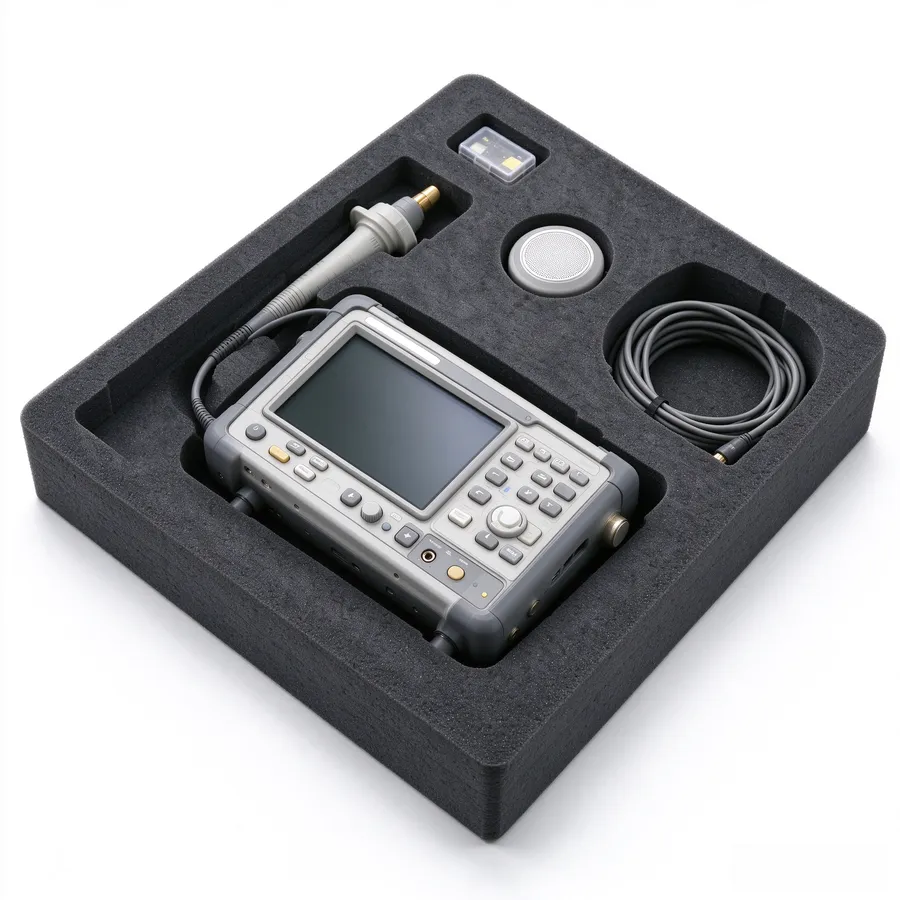
- Fit is dimension plus foam layout; send equipment outline and mass so the cavity is engineered, not guessed.
- Compare suppliers on published, per-model numbers - not on datasheet claims without measurement behind them.
What are protective case dimensions? A working definition
Protective case dimensions are not one number but three sets that answer different questions. The external dimensions describe the closed shell - what a shelf, a carton or a pallet position sees. The internal dimensions describe the cavity - what your instrument, weapon or radio assembly actually has to occupy. The base and lid depth split describes how that cavity divides across the parting line, which decides where thick foam can sit and which face of the equipment faces up.
Around those three sets sit the derived fields a datasheet should also carry: wall thickness, internal and external volume, and on some models a narrow internal width where hinges or liners intrude. When buyers ask what are protective case dimensions, the honest answer is this whole family of fields, because a case that fits on paper can still fail on the hinge line or under the lid if only one set was checked.
External dimensions versus internal dimensions, with published numbers
The fastest way to understand the relationship is to read it from real models. The table below lists five published cases from our 155-model range with their shell size, cavity size, wall thickness, net weight and internal volume, exactly as they appear in the product table. Notice that the difference between outer and inner size is not a constant - it scales with the wall section, and taller cases lose proportionally less than shallow ones.
A shallow 46 mm shell such as the KX 2005 gives up proportionally more cavity depth to its walls and lid than a deep 415 mm shell such as the KX 8-8442. That is why comparing external sizes across brands, without internal figures, can rank two cases in exactly the wrong order for your equipment.
| Model | External Mm | Internal Mm | Wall Mm | Net Weight G | Internal Volume L |
|---|---|---|---|---|---|
| KX 1204 | 120 x 90 x 40 | 115 x 78 x 32 | 2.6 | 100 | 0.3 |
| KX 6-3619 | 356 x 267 x 190 | 333 x 217 x 175 | 3.5 | 1660 | 12.6 |
| KX 8-4120 | 410 x 370 x 198 | 385 x 313 x 180 | 3.7 | not published | 21.7 |
| KX 8-9616 | 956 x 408 x 154 | 880 x 350 x 140 | 5.0 | not published | 43.1 |
| KX 8-8442 | 843 x 592 x 415 | 740 x 518 x 364 | 5.0 | 15320 | 139.5 |
Why protective case dimensions matter when buying
Dimensions decide fit, and fit decides everything else. A cavity that holds the equipment bare may still fail once foam walls, connector overhangs and a lid-organizer are added; the published internal figure is the envelope, and the usable space inside it depends on the foam layout you specify. This is why our product table carries both internal_volume_l and usable_interior_volume_l for every model - the second number reflects the cavity a specified layout actually leaves.
Dimensions also decide logistics. The shell size determines which carton the case ships in, the carton footprint determines pieces per pallet, and the pallet plan determines your landed cost per unit. And dimensions decide comparability: two quotation sheets that list external sizes only cannot be compared at all, because one manufacturer may publish generous internals behind a bulky shell and the other the reverse.
How we publish dimensions, field by field
Every one of the 155 models in our published table carries external dimensions, internal dimensions, internal volume, external volume and usable interior volume. One hundred models add the base and lid depth split, ninety-three publish net weight, and thirty-six publish the narrow internal width where a hinge line, rib or liner reduces the usable cavity. Wall thickness is published on 148 models and ranges from 2.0 mm on small shells to 6.0 mm on the largest.
Fields we have not measured are recorded as not measured rather than filled with attractive numbers. That includes every protection grade. A dimension is a measurement we take; a grade is a test result, and where no test exists the field says so. If your procurement standard requires a measured figure for a field we have not tested, the honest reading is in the datasheet - and laboratory work can be arranged per configuration at an accredited third-party laboratory.
The numbers buyers measure wrong
The most common error is measuring the equipment and assuming it equals the cavity. Equipment outlines are usually quoted at the body; rear connectors, antenna bases, latches on the instrument itself, and cable bends all eat internal depth and width. The second error is treating lid depth as fully usable depth - once a foam block or an organizer tray occupies the lid, the depth available to the equipment shrinks by exactly that amount.
The third error is comparing external dimensions between brands and concluding the larger shell is the roomier case. Wall sections differ; the published internal figure, not the outer envelope, is the fair comparison. Our guides on measuring usable interior dimensions and on internal versus external dimensions walk through each of these with worked examples, and the same logic underlies how we answer RFQ questions about cavity fit.
Dimensions in an RFQ: what to send the manufacturer
A dimension-driven RFQ is short and effective. Send the equipment outline in length, width and depth, the mass, and any protrusions beyond that outline - connectors, handles, antennas, mounting flanges. Add the foam preference, whether you want cut-outs, a cushion layout or an empty shell, and the orientation the equipment should sit in. With that, the manufacturer can match a cavity from the published range or quote a custom shell.
If no published cavity fits, the conversation moves to OEM work. Standard OEM first samples take 45 days; a new mould takes about 125 days. Both timelines start from the same dimensional brief, which is one more reason to measure carefully before the RFQ rather than after the first sample arrives.
What we do not claim alongside dimensions
Our product data separates what is measured from what is asserted. Dimensional fields are measurements taken on production shells, published per model. Protection fields - water, dust, shock, temperature, stacking load - are recorded as not measured unless a documented result exists, and no rating code is printed on our datasheets or marketing pages as though it were a shell property. Where a buyer's tender requires a grade, we say plainly whether a measurement exists for that configuration and arrange accredited third-party laboratory work on the specified build.
We recommend buyers apply the same standard to every supplier's datasheet, including ours. Ask which fields are measurements and which are claims, ask for the test method behind any quoted grade, and weight your comparison toward the fields a manufacturer can actually demonstrate.
Wholesale and OEM terms for dimension-driven projects
KeXin New Materials (Guangdong) Co., Ltd. supplies wholesale and OEM/ODM programs only - no retail, no DDP, no overseas warehouses - quoting EXW or FOB. OEM first samples take 45 days, a new mould about 125 days, terms are 30% deposit with the balance paid after inspection, and third-party inspection or a buyer-side factory audit is welcome. Send your equipment outline and foam preference, and KeXin Sales Team will match a cavity from the published range or quote a custom shell. Contact Fred Zhao on WhatsApp at +86 135 3588 0002 to start the dimensional review.
Customisation
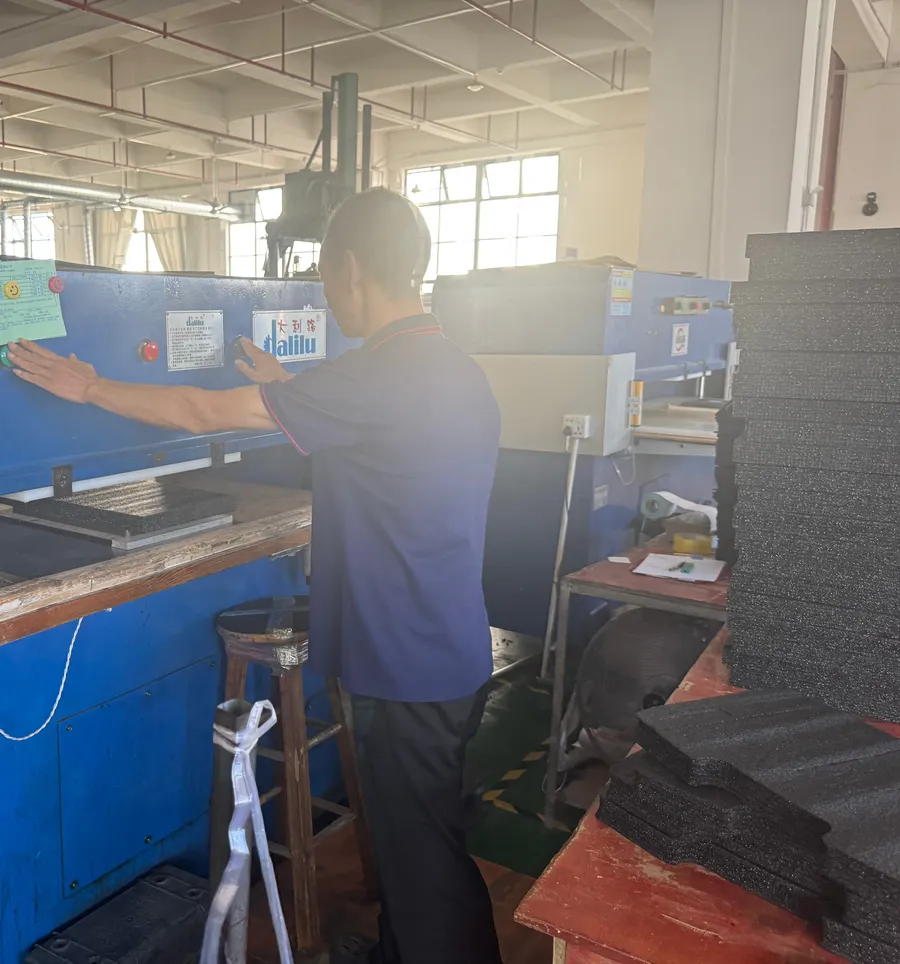
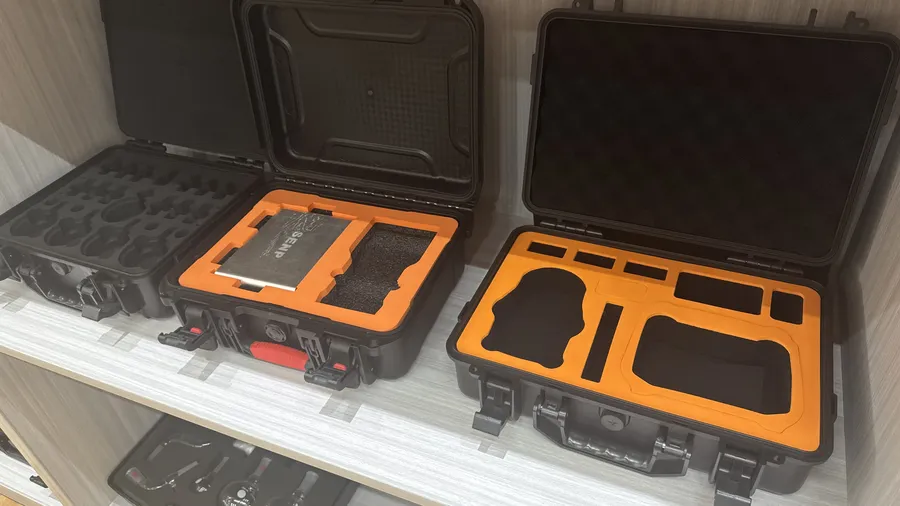
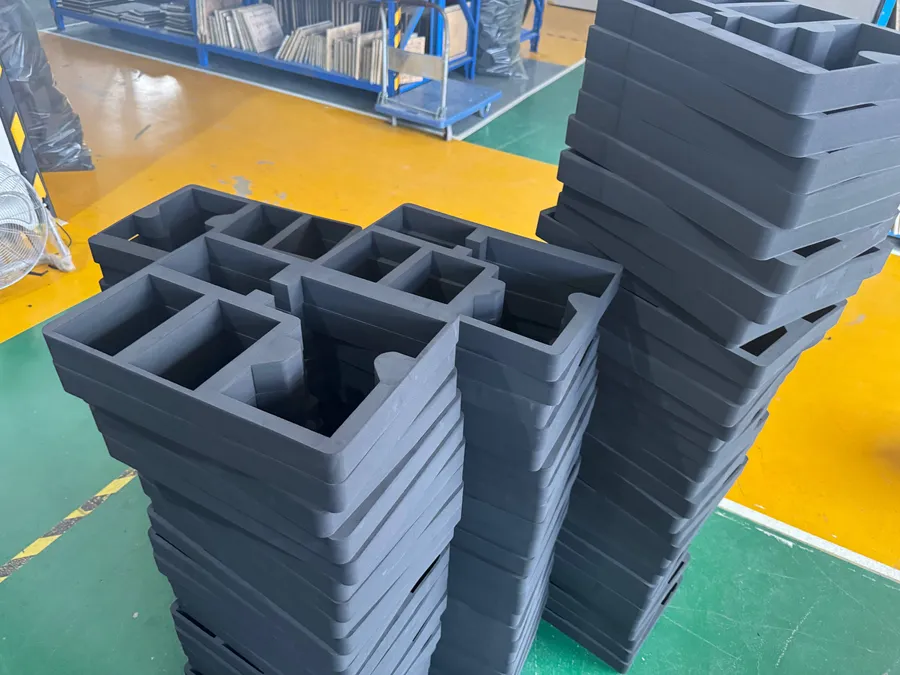
Everything described above is configurable on a standard shell: interior layout (pick-and-pluck, die-cut or CNC-cut), foam grade and thickness, colour, logo method, latch and lock count, pressure-equalisation valve, cable ports, document holder and identification plate. A bespoke exterior geometry requires a new mould — 125 days, from 3,000 units per moulded component.
Procurement considerations
| Question | What to send us |
|---|---|
| Which shell fits? | Equipment L × W × H as packed, plus required clearance per axis |
| What does it cost? | Order quantity and estimated annual quantity — the two drive different answers |
| Is tooling needed? | Whether an existing shell clears the envelope with usable foam depth |
| Lead time? | Your required delivery date, not just the order date |
| Certification? | The exact standard your tender names — we will say whether we can test to it |
| Freight? | Destination and preferred terms; carton and pallet data supplied with the quotation |
Comparison and selection guide
The tables on this page exist because a protective case is chosen by comparing three things: the envelope, the environment and the handling chain. Where no table applies, the rule below is.
| Situation | What To Do |
|---|---|
| Fastest | Standard shell plus CNC foam — typically 45 days from approved drawing. |
| Branded | Standard shell plus custom colour and logo — MOQ applies to the resin colour. |
| Bespoke geometry | New mould — 125 days, MOQ from 3,000 units per component. |
- Size on internal dimensions plus clearance, never on a product name.
- Choose the carrying method before the shell: it changes the series, not just the price.
- Specify the interior last, and decide up front whether the end user will reconfigure it.
What is protective case dimensions and why does it matter when buying a protective case? relates to Logistics & Packing Guide. Related families: Custom Protective Cases / Electronics Cases / Instrument & Equipment Cases / Equipment Transport Cases. Related sectors: field and industrial equipment. Continue in the Logistics & Packing Guide cluster.
This page is written from our own production data. If your requirement differs, send the dimensions and we will tell you which of the 155 models fits, or whether a custom route is needed.


