What information should be provided about case stackability before a quotation?
Give us six things and the stackability part of your quotation comes back with figures instead of caveats: whether units stack case-on-case, carton-on-carton, or both; the clear stacking height you are working to; your pallet deck size; the mass each stacked unit carries; whether any wheeled trolley models are in the mix; and whether your end customer requires a third-party load report. Across our 155 active models, 136 are published as stackable and the 19 wheeled trolley models are published as not stackable. The stack-load field, however, is recorded as not measured on all 155, so a load figure is a separate accredited testing package and never a datasheet line we hand over without a test record behind it.
Key points
- Name the stacking mode in the enquiry: case-on-case, carton-on-carton, or both. Those three answers are priced differently.
- 136 of our 155 active models are published as stackable; the 19 exceptions are the wheeled trolley models that carry telescopic handles.
- Stack load is recorded as not measured on every model, so treat it as a separate accredited test you commission, not a value to expect on a sheet.
- State your pallet deck size in the enquiry. Pallet quantity is calculated from the published carton footprint against your deck, not fixed by us.
- Published carton heights run from 232 to 755 mm across 64 models, so give the clear stacking height before anyone discusses units per pallet.
- If an upper unit sits on a lower lid, ask for the lid and base depth split per model; published splits run from 16 plus 16 mm to 320 plus 44 mm.
What a stackability line on a quotation is actually priced from
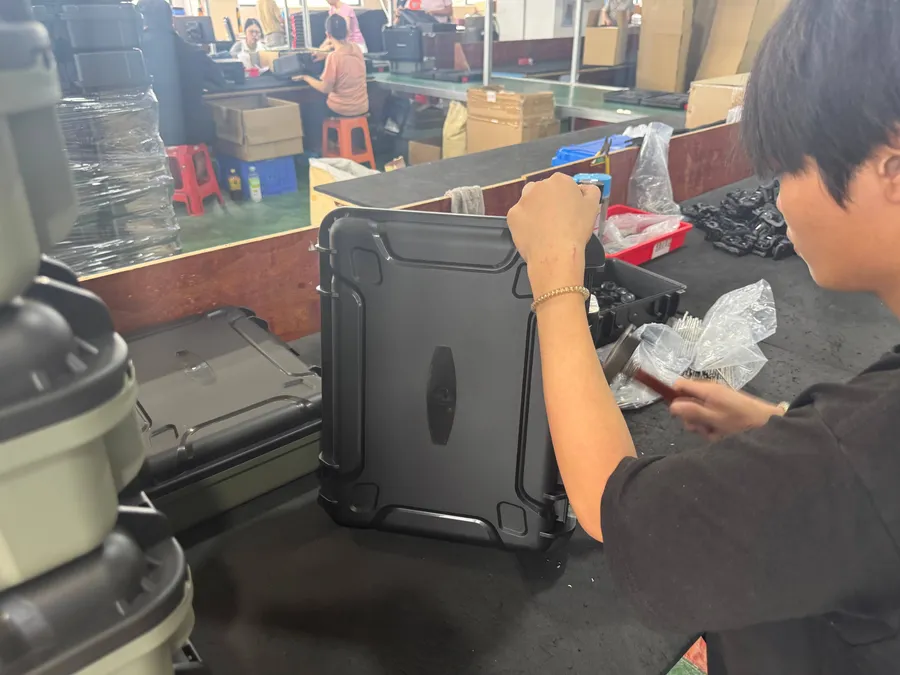
Stackability is not a feature we switch on at packing. It is a moulding outcome: the rim, the foot ring and the lid profile of a shell are formed in the tool, so a stacking interface that works case-on-case has to be read off the tool the model was made on, not promised in a catalogue sentence. When we price the stacking part of an order, we therefore work from four published numbers per model - external footprint, height, wall thickness and the lid and base depth split - and add three things only you can give us: the stacking mode, the clear height in your warehouse or container, and the mass the lower unit has to carry. KeXin New Materials (Guangdong) Co., Ltd. sells wholesale and OEM only, on EXW or FOB terms, so this exchange happens before a price sheet exists, not after a container is booked.
That is also why a vague question such as are your cases stackable returns a weak answer. A quotation-grade answer names the model, states the published stacking value, and says explicitly which fields are recorded as not measured. If you send us a model list plus your stacking mode and deck size, the reply shows units per carton, cartons per pallet layer, layers within your height limit, and the container count - all derived from published data rather than from a generic claim.
The six inputs we need before stackability can be quoted
| Input You Give | Why It Changes The Quote | What We Send Back |
|---|---|---|
| Stacking mode | Case-on-case uses the moulded rim; carton-on-carton uses the published carton footprint; mixed stacks need a divider plan. | The published stackable value for each model, plus which models in your list cannot be stacked at all. |
| Clear stacking height | Published carton heights run from 232 to 755 mm, so the layer count is set by your rack beam, door opening or container interior. | Layers that fit your height, and the resulting units per pallet for the models you named. |
| Pallet deck size | Carton footprints published across 64 models range from 410 by 360 mm to 885 by 630 mm; the same carton lands 4 or 6 per layer on different decks. | Cartons per layer worked from your deck, flagged as an order calculation rather than a published per-model figure. |
| Mass carried per stacked unit | Published net weights run from 100 g to 15,320 g, so the fifth unit on a stack is a different problem from the second. | Wall thickness (published from 2.0 to 6.0 mm on 148 models) and a clear statement that no stack load value is published for the model. |
| Whether trolley models are included | The 19 T-series models are published with wheels and a telescopic handle and are published as not stackable. | A one-layer packing plan for those lines and a note where a stackable sibling model can replace them. |
| Whether a third-party load report is required | It converts a packing discussion into a testing work package with its own scope, sample count and cost. | The testing scope and lead time quoted separately from unit price, on the published configuration you choose. |
What we publish per model, and the field we deliberately leave blank
Every active model page carries a stacking value, and across the 155 models the split is 136 published stackable against 19 published not stackable. Those 19 are the T-series trolley lines, each published with wheels and a telescopic handle; hardware that sits on the top face is exactly what stops a second unit standing on it, so the two fields tell the same story. Foot rings are recorded as measured on all 155 models, which is the part of the interface that matters when a lower unit takes weight through its corners rather than through the centre of a lid.
The field we do not fill is stack load. In our published specification set, stack load in kilograms is recorded as not measured for all 155 models. That follows the same three-label policy used across the data: measured means it came from our own production or incoming-material records; manufacturer option means it is a construction we can supply and the figure depends on what you order; not measured means no test record exists for that model and configuration, we state no value, and accredited testing can be commissioned as a separate work package. Take model WL1204 as an example: external 120 by 90 by 40 mm, internal 115 by 78 by 32 mm, wall thickness 2.6 mm, lid and base depth 16 plus 16 mm, net weight 100 g, published stackable, no stack load figure stated.
Stacking geometry: footprint, height and lid depth do the work
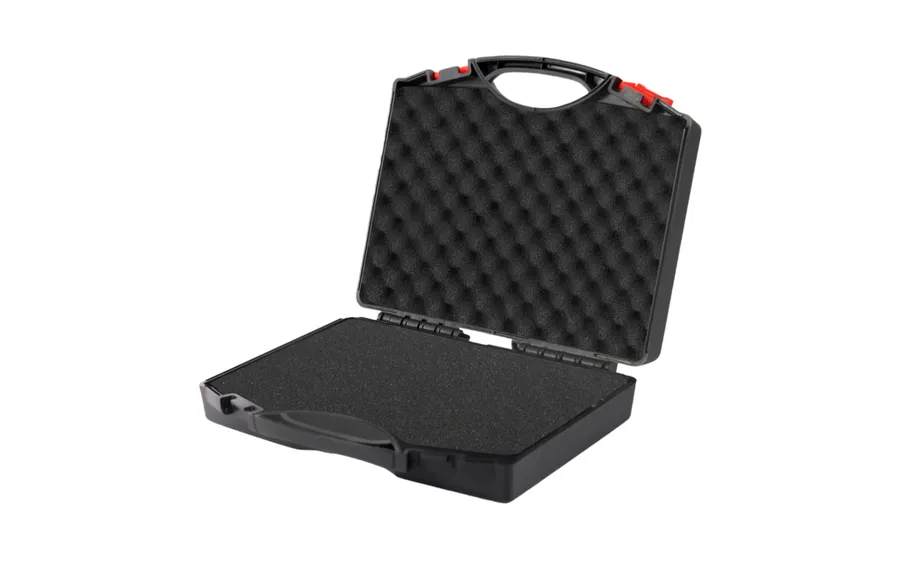
Two published numbers decide whether a stack is stable rather than merely tall. The first is the footprint: external footprints in the range we publish start at 120 by 90 mm and reach 843 by 592 mm, with heights from 40 mm to 415 mm, and one long model published at 1,356 mm along a single edge. A narrow, long shell stacked across its short axis presents a tipping problem that a square shell does not, and no stacking claim fixes that with strapping alone. The second is the lid and base depth split, because a deep lid is a compliant surface: WL8-8442 is published as 320 mm lid over 44 mm base, so an upper unit resting on that lid is resting on a tall, foam-filled closure rather than on a corner ring, while WL2005 at 20 plus 20 mm is a shallow shell that stacks on its own rim.
Nesting is a different question from stacking, and mixing the two words in an enquiry is the most common source of a wrong carton count. Nested transport means empty cases telescope or seat inside one another to cut return freight, which depends on the wall, the rim and whether lids come off. Stacked storage means closed units stand on each other with contents inside. Where nesting matters to you, say so explicitly and name the model, because the published lid and base split is what we read to answer it, and a stackable flag on its own tells you nothing about how many empty units fit on one deck.
Case-on-case, carton-on-carton, or palletised: three questions with three answers
| Question | What The Published Data Answers | Still Needed From You |
|---|---|---|
| Closed units stacked with contents | The stackable value per model, external height, and the lid and base split. | Layer count, clear height, and mass per unit in the stack. |
| Cartons stacked on each other | Carton dimensions published for 64 models, and pieces per carton published for 58 of them. | Deck size and the stacking plan your forwarder accepts. |
| Mixed-SKU pallets | Nothing fixed: pallet quantity is recorded as not measured and is calculated from carton footprint against your pallet. | The SKU mix per pallet, the layer pattern, and whether heavy lines must sit at the bottom. |
| One-layer loads of trolley models | 19 models published as not stackable, with wheels and telescopic handles. | Whether those lines travel loose in a container or on a dedicated deck. |
How the stacking answer moves the rest of the quotation
Once layer count is settled, it propagates. Pieces per carton are published for 58 models and run from 1 to 40; WL2005 ships 40 pieces in a 410 by 360 by 495 mm carton, while WL9-5419 ships one piece in a 550 by 485 by 755 mm carton. Sixty-four units of the first model is two cartons; of the second it is sixty-four cartons, and a tall single-unit carton may only allow one layer inside a 2,300 mm container door. Container loading for 20GP, 40GP and 40HQ is recorded as not measured per model and is supplied with the quotation once your packing plan is known, which is also why a stacking assumption stated late can invalidate a cube count stated early.
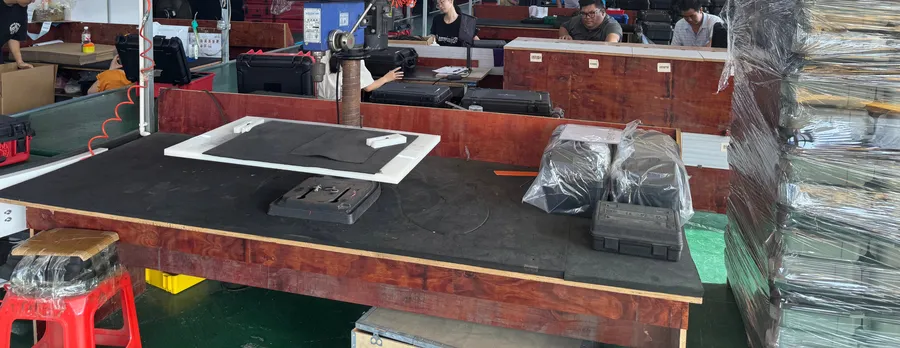
Freight terms change who owns that problem. On EXW you or your forwarder build the load plan and we pack to the deck size you name; on FOB we carry the packing and load plan to the port of shipment. We do not sell retail, do not quote door-to-door delivered-duty-paid packages, and hold no overseas warehouse, so any expectation of a local stocking pallet has to be re-planned before it reaches a price. Gross weight per model is not published; pallet mass is assembled at quotation stage from published net weights, which appear on 93 of 155 models, plus carton and pallet tare.
What to specify by series, using the published counts
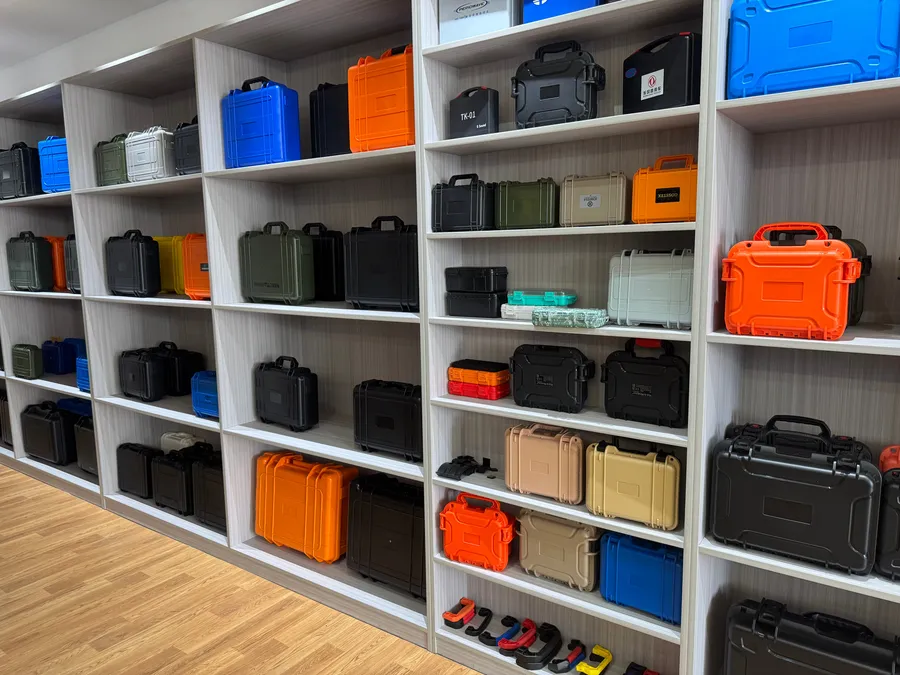
Our range is organised by series, and stacking behaviour follows that structure, so the fastest enquiry names the series as well as the model. The 8-series carries 62 models, the 0-series 23, the 6-series 20, the 9-series 18, the 1-series 7 and the 7-series 6; every one of them is published as stackable. The T-series carries 19 models, all published with wheels and not stackable. If your enquiry mixes series, ask for the stacking plan per series rather than one number for the order, because a single units-per-pallet figure across a mixed list is the most common way for a packing plan to be wrong on arrival.
Applications where the stacking data is read first
Electronics and instrumentation programmes are where stacking is scrutinised hardest, because the units are dense, the value per litre is high and the distribution pattern is usually a rack rather than a floor. For electronics field kits, industrial spares and medical distribution lines, the practical question is how many loaded cases fit a shelf beam and a doorway, which makes clear height and mass per unit the deciding inputs. In ammunition and field deployments the question flips: units move by hand and stack on vehicle decks, so footprint and the corner load path matter more than rack depth. Either way, say which of those two worlds you are in, and the stacking section of the quotation is written for that use rather than as a general promise.
Custom work: when stackability becomes a tooling decision
If the published rim on a model is not enough for your stacking plan, the change is a moulding change, not a packing change, and it belongs in the enquiry from the start. Published minimum quantities are one unit for standard goods and custom foam, 300 units where a logo, colour or OEM programme is involved, and 3,000 units for a custom mould. Lead time is 45 days for OEM work on an existing mould and 125 days for a new mould, with a 30 per cent deposit. A new mould also resets the stacking data: the rim, foot ring and lid depth of a new tool are recorded against that tool, so a stacking value inherited from a similar existing model is not transferable and we quote it from the new tool's own records.
What we do not claim, stated plainly
This page publishes stacking values, geometry and packing arithmetic. It does not publish a stack load in kilograms for any model, does not present a stacking figure as the result of a third-party conformity test we have not run, and does not extend one model's published geometry to the whole range. Where a field is recorded as not measured, the honest quotation route is to name the test, its scope and its cost as a separate package. Buyers who receive that structure - published value, arithmetic for their deck, and an explicit blank where no record exists - can put the numbers in front of a forwarder without later discovering that the load figure was never there.
Customisation
Everything described above is configurable on a standard shell: interior layout (pick-and-pluck, die-cut or CNC-cut), foam grade and thickness, colour, logo method, latch and lock count, pressure-equalisation valve, cable ports, document holder and identification plate. A bespoke exterior geometry requires a new mould — 125 days, from 3,000 units per moulded component.
Procurement considerations
| Question | What to send us |
|---|---|
| Which shell fits? | Equipment L × W × H as packed, plus required clearance per axis |
| What does it cost? | Order quantity and estimated annual quantity — the two drive different answers |
| Is tooling needed? | Whether an existing shell clears the envelope with usable foam depth |
| Lead time? | Your required delivery date, not just the order date |
| Certification? | The exact standard your tender names — we will say whether we can test to it |
| Freight? | Destination and preferred terms; carton and pallet data supplied with the quotation |
Comparison and selection guide
The tables on this page exist because a protective case is chosen by comparing three things: the envelope, the environment and the handling chain. Where no table applies, the rule below is.
| Situation | What To Do |
|---|---|
| Fastest | Standard shell plus CNC foam — typically 45 days from approved drawing. |
| Branded | Standard shell plus custom colour and logo — MOQ applies to the resin colour. |
| Bespoke geometry | New mould — 125 days, MOQ from 3,000 units per component. |
- Size on internal dimensions plus clearance, never on a product name.
- Choose the carrying method before the shell: it changes the series, not just the price.
- Specify the interior last, and decide up front whether the end user will reconfigure it.
What information should be provided about case stackability before a quotation? relates to Logistics & Packing Guide. Related families: Custom Protective Cases / Equipment Transport Cases / Electronics Cases / Tool Cases. Related sectors: field and industrial equipment. Continue in the Logistics & Packing Guide cluster.
This page is written from our own production data. If your requirement differs, send the dimensions and we will tell you which of the 155 models fits, or whether a custom route is needed.


