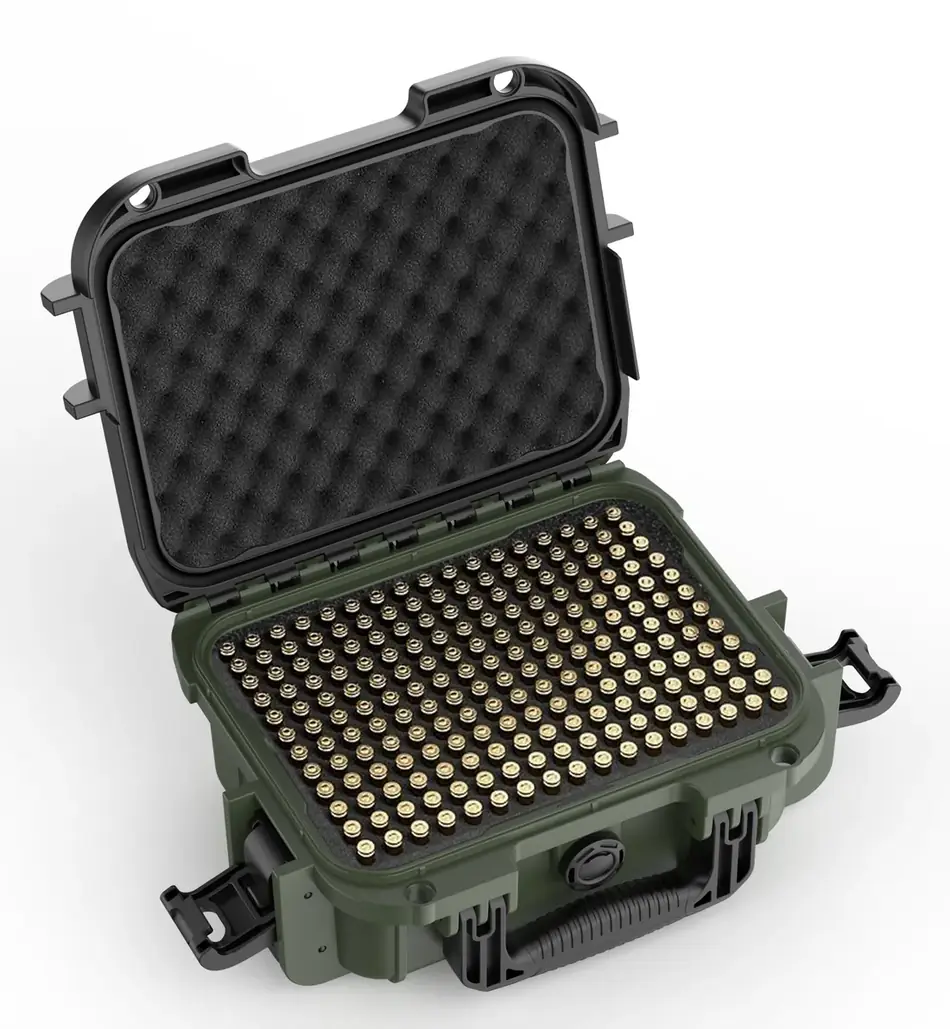
What is case palletization and why does it matter when buying a protective case?
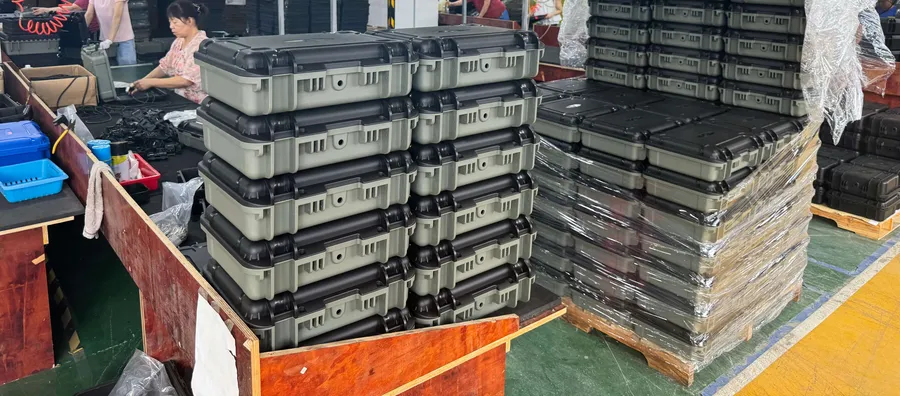
Case palletization is the practice of arranging packed cases into a single stable load on a pallet deck, so that a shipment is handled as one unit by forklift, rack and container instead of as loose cartons. It matters when you buy a protective case because the pallet is where freight cost, damage risk and receiving checks all meet: the deck area you pay for, the column height a shell can bear, and the count your warehouse can verify without unwrapping anything are all decided by the packing pattern, not by the case photo. The key point for a buyer is that pallet quantity is a property of the carton against your deck, not a property of the case. That is why none of our 155 catalogue models publishes a fixed pallet figure — the field is recorded as not measured, with the note that it is calculated from the carton footprint against your pallet size. What we do publish is the input: 64 models carry carton dimensions and 58 of those carry a pieces-per-carton figure, and external dimensions, wall thickness and net mass are published per model where recorded. Give us your deck size and order mix and the build comes back with the quotation.
Key points
- Palletization starts at the carton: deck grid, course height and unit count all come from the outer packing, not from the shell.
- No model in our 155-model catalogue publishes a pallet figure; it is calculated from the published carton footprint against your deck.
- Sixty-four catalogue models publish carton dimensions, and 58 of those publish pieces per carton, which is enough to do the maths.
- A 410 x 360 mm carton of the KX 2005 gives six cartons and 240 cases per course on a 1,200 x 1,000 mm deck.
- Build level courses of one model and one orientation; mixed orientation in a layer turns out of square by the third course.
- The 19 wheeled T Series shells are published without stackability, so they travel flat on their own deck rather than in a column.
The definition, and why it is a purchasing question
Palletizing means converting a purchase order into physical loads: cartons arranged on a deck, built in level courses, restrained so the pattern survives a truck, a terminal and a warehouse rack, and marked so the receiving team can verify it. Buying a protective case without thinking about this is how a freight saving turns into a product loss. The same order can arrive as three tidy loads or as six part-filled ones depending on choices made before production — which model was picked, how many units go in each carton, and whether the carton plan divides into the deck the buyer actually uses.
Two consequences show up immediately in a quotation. Freight is billed on the volume a shipment occupies, so a pattern that wastes a column of deck area is paid for anyway. And damage claims concentrate on loads that were never designed as loads: an overhanging carton crushes against the rack upright, a tall column of empty shells bows under the layer above it, and the bottom carton of an un-restrained pallet opens in transit. Both are packing-pattern problems rather than shell problems.
What our catalogue publishes, and what it deliberately leaves open
We publish the inputs, not a fixed pallet table. Across the 155 models, 64 carry outer carton dimensions in the packing field, and 58 of those carry a pieces-per-carton figure. Published carton footprints span 410 mm to 885 mm in length and 250 mm to 630 mm in width, with heights from 232 mm to 755 mm; the smallest plan in the catalogue is 475 x 285 mm, holding 20 units, and the largest is 730 x 630 mm. Published quantities per carton are 1, 3, 6, 8, 10, 12, 16, 20, 24, 32 and 40 units, and the most common single figure is 20. Where a model has no published carton line, it is packed to the order and that figure is agreed with the packing design at quotation.
The pallet quantity field itself is recorded as not measured for every model, with the standing note that it is calculated from the carton footprint against your pallet size. Container loading carries the same treatment: recorded as not measured, with 20-foot, 40-foot and high-cube figures supplied with the quotation. Net mass per case is published on 93 models, from 100 g to 15,320 g; gross carton mass is not a published catalogue field, so it comes on the packing list. Any supplier who prints a pallet figure for your deck without asking what your deck is, is guessing.
The grid maths, worked on published numbers
| Model | Carton Mm | Units Per Carton | On 1200 X 1000 Deck | On 1200 X 800 Deck |
|---|---|---|---|---|
| KX 2005 | 410 x 360 x 495 | 40 | 6 cartons per course, 240 units | 4 cartons per course, 160 units |
| KX 2305 | 480 x 370 x 470 | 40 | 6 cartons per course, 240 units | 4 cartons per course, 160 units |
| KX 2406 | 490 x 410 x 290 | 20 | 4 cartons per course, 80 units | 2 cartons per course, 40 units |
| KX 2805 | 570 x 470 x 435 | 32 | 4 cartons per course, 128 units | 2 cartons per course, 64 units |
| KX 3207 | 645 x 530 x 430 | 24 | 2 cartons per course, 48 units | 2 cartons per course, 48 units |
| KX 3218 | 645 x 530 x 550 | 12 | 2 cartons per course, 24 units | 2 cartons per course, 24 units |
How to read that table before you place an order
The arithmetic is division, and the only judgement is orientation. Take the carton length and width, lay them along both deck edges, and keep whichever whole count is larger; that is the course. Multiply by units per carton and you have units per course. Multiply by the number of courses that fit under your rack or container height limit and you have the pallet. The KX 2005 line shows why orientation matters: with 40 units inside, six cartons of 410 x 360 mm fit a 1,200 x 1,000 mm deck only when the 360 mm side runs along the 1,200 mm edge, giving three across and two deep.
The two deck columns also explain why we do not publish one pallet figure. The KX 3207 gives the same two cartons per course on a 1,200 x 1,000 mm deck and on a 1,200 x 800 mm one, because a 645 x 530 mm carton does not divide either deck well; but the deck area it wastes differs completely, so the per-unit freight penalty differs too. A published figure could only ever be true for one deck, and your deck is the one number we do not have.
Courses, tie layers, and the mixed-model pallet
Build in level courses and keep each course to one model and one orientation. A layer that mixes a 490 x 410 mm carton with a 645 x 530 mm carton produces a top surface that is not flat, and every course above inherits the error. Where two models must share a deck, separate them by height band and write the band map on the pallet label, so the receiving team knows which slice belongs to which order line. Put the heaviest and most regular units low, and finish the top flat with a board so the next pallet can sit on it if your forwarder double-stacks.
Restraint is a specification, not a habit. State the film gauge, the number of wraps, and whether corner boards are used; a spiral wrap with more turns at the base than at the crown holds moulded cases far better than a few turns around the top. Corner boards earn their cost wherever latch bosses or handle mountings stand proud of the carton face. Mark every carton with the order number, the line it satisfies, the model code and the quantity inside before the film goes on, because a wrapped pallet cannot be re-counted once it is at sea.
Stackability, nesting and the wheeled exception
Palletizing and stackability are the same problem viewed from two ends. One hundred and thirty-six of our 155 models are published as stackable, which is what lets empty shells travel rim-to-rim at a fraction of their in-service volume, and what lets a loaded column stay put when the deck itself is not the bearing surface. The nineteen models we do not list as stackable are the T Series shells fitted with wheels and a telescopic handle; their wheel housings and handle recesses are moulded into the base, so they go on the deck flat and never into a column. The largest example, the KX 8-8442 at 843 x 592 x 415 mm external and 15,320 g net, is a one-per-carton, one-per-deck item.
One caution belongs here rather than in a footnote. A stackable flag says the shell is built to locate on another shell; it is not a compression rating. The stack load field is recorded as not measured for all 155 models, so column height for a loaded pallet has to be set by your own rack limit, handling mass and transport leg, and agreed case by case if the mass above is significant.
Choosing models with the pallet in mind
Where two models both accept the equipment, prefer the one whose packing grids into your deck without an overhang, whose course height leaves room for a top board inside your rack or container limit, and whose external footprint belongs to a family with several depths. The 315 x 260 mm plan is the catalogue example of that logic: the KX 3207, KX 3213 and KX 3218 share it at 70, 128 and 180 mm external height, and all three ship in the same 645 x 530 mm carton plan at 24, 16 and 12 units, so one pallet pattern serves a whole range of kits and the receiving count differs only by units per carton. Repeating a plan across a programme is worth more than any single model being marginally cheaper.
The other lever is units per carton. Choosing 40 instead of 20 changes pallet count, handling mass and labelling, and it changes the arithmetic your warehouse does at the receiving door. Set a handling mass you are willing to lift twice per person, tell us the number, and we will set the carton quantity to match rather than defaulting to whatever the packing line normally uses.
Commercial terms and what to send with your enquiry
KeXin New Materials (Guangdong) Co., Ltd. supplies wholesale and OEM only, quoted EXW or FOB from the factory, with a thirty percent deposit and the balance before shipment. There is no retail sale, no DDP delivery and no overseas warehouse, so pallet and container figures in a quotation are calculated for your stated deck and your stated destination handling rather than copied from a fixed table. OEM first article on an existing mould runs 45 days; a new mould runs 125 days with a minimum of 3,000 pieces per component; colour, logo and hardware changes start at 300 pieces, and model selection and custom foam start at one.
Send four things and the build comes back quickly: the model codes or the equipment dimensions you want covered, your pallet deck size and any rack or container height limit, the target units per carton or a handling mass, and the order split by model across the programme. With those, the course map, pallet count and 20-foot, 40-foot and high-cube loading are calculated for your shipment and issued with the quotation.
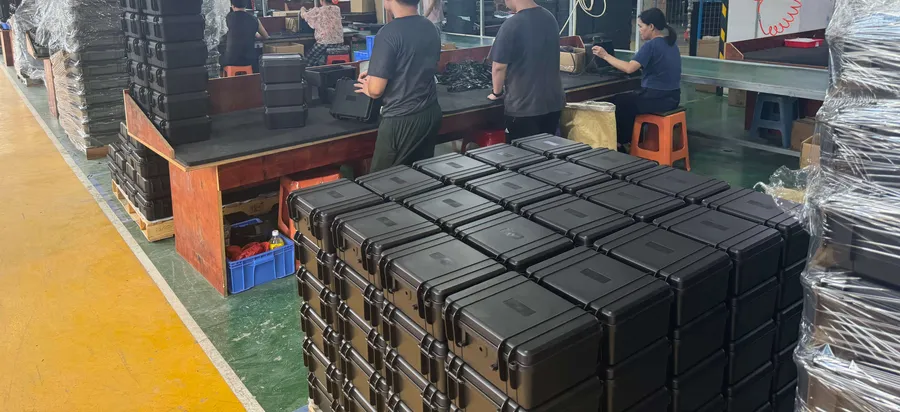
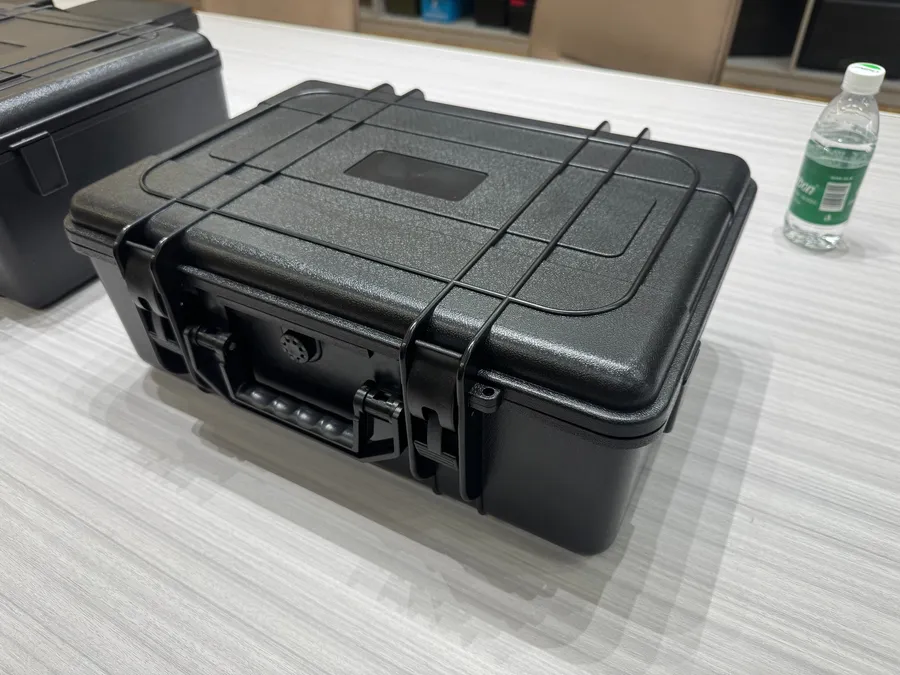
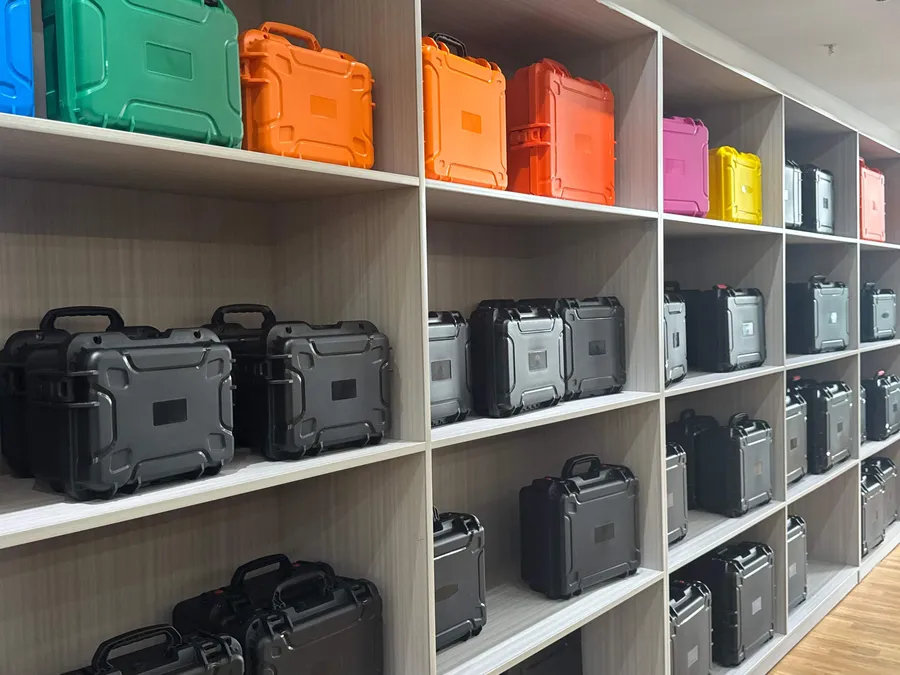
Customisation
Everything described above is configurable on a standard shell: interior layout (pick-and-pluck, die-cut or CNC-cut), foam grade and thickness, colour, logo method, latch and lock count, pressure-equalisation valve, cable ports, document holder and identification plate. A bespoke exterior geometry requires a new mould — 125 days, from 3,000 units per moulded component.
Procurement considerations
| Question | What to send us |
|---|---|
| Which shell fits? | Equipment L × W × H as packed, plus required clearance per axis |
| What does it cost? | Order quantity and estimated annual quantity — the two drive different answers |
| Is tooling needed? | Whether an existing shell clears the envelope with usable foam depth |
| Lead time? | Your required delivery date, not just the order date |
| Certification? | The exact standard your tender names — we will say whether we can test to it |
| Freight? | Destination and preferred terms; carton and pallet data supplied with the quotation |
Comparison and selection guide
The tables on this page exist because a protective case is chosen by comparing three things: the envelope, the environment and the handling chain. Where no table applies, the rule below is.
| Situation | What To Do |
|---|---|
| Fastest | Standard shell plus CNC foam — typically 45 days from approved drawing. |
| Branded | Standard shell plus custom colour and logo — MOQ applies to the resin colour. |
| Bespoke geometry | New mould — 125 days, MOQ from 3,000 units per component. |
- Size on internal dimensions plus clearance, never on a product name.
- Choose the carrying method before the shell: it changes the series, not just the price.
- Specify the interior last, and decide up front whether the end user will reconfigure it.
What is case palletization and why does it matter when buying a protective case? relates to Logistics & Packing Guide. Related families: Custom Protective Cases / Equipment Transport Cases / Ammunition Storage & Transport Boxes / Military Protective Cases / Tactical Equipment Cases / Outdoor Protective Cases. Related sectors: field and industrial equipment. Continue in the Logistics & Packing Guide cluster.
This page is written from our own production data. If your requirement differs, send the dimensions and we will tell you which of the 155 models fits, or whether a custom route is needed.