What is case stackability and why does it matter when buying a protective case?
Case stackability is the published fact that a closed case can sit in a column — another case, or a handled load, resting on its lid — without the shell, lid, or hardware failing under normal warehouse handling. It matters when buying a protective case because it decides your storage footprint and your freight: a stackable model turns a shelf row into a vertical column, while a non-stackable model forces single-height racking or carton palletising instead. In our catalogue, 136 of the 155 published models are marked stackable, and the 19 exceptions are one coherent family — the wheeled, telescopic-handle trolley cases — so the answer always starts on the model sheet. What we deliberately do not publish is a stack load figure: lid depth, wall thickness, feet, and external dimensions are stated per model; any load-bearing number a buyer needs comes from accredited testing quoted per configuration, not from an invented rating.
Key points
- Stackability is a per-model attribute, not a brand trait: 136 of 155 catalogue models publish as stackable and all 19 exceptions are wheeled trolley cases, so read the model sheet before planning any column.
- Stacking is geometry: published feet, lid depths from 16 mm to 320 mm, and wall thicknesses from 2.0 mm to 6.0 mm per model decide whether a column stays square and transfers load through the walls.
- No stack load figure is published on our sheets: before designing column heights, ask any supplier for the report behind the claim — load applied, duration, temperature, and sample serials.
- A wheeled case buys portability at the cost of stacking: casters concentrate load on four points and handle hardware stands proud of the lid, which is why our trolley models state stackable: no.
- Stackability feeds straight into freight: 64 models publish carton footprints and pieces-per-carton, and pallet layouts are calculated from those against your pallet size rather than a guessed tier height.
The plain definition of case stackability
Stacked storage is how protective cases actually live: in a store room, a container, a rack at a distribution centre. So when buyers ask what is case stackability and why does it matter when buying a protective case, the useful answer is structural rather than commercial. A stackable case has a lid and base geometry — feet, rim, and wall thickness — that lets the weight above travel down through the shell walls to the ground or the shelf, instead of pressing the lid surface into the equipment inside. Get that wrong and two visible problems follow: columns that creep, lean, or collapse in transit, and lower cases whose lids deform around the contents they were built to protect. Neither shows up in a photo; both show up in a warehouse three months later.
That is why stackability belongs in the buying decision next to dimensions and weight, not in a footnote. It changes how much floor space a fleet of cases occupies, whether mixed models can share one column, and whether the freight quote is built on stacked shells or on cartons that simply refuse to stand two high.
How stackability is built into a hard-shell case
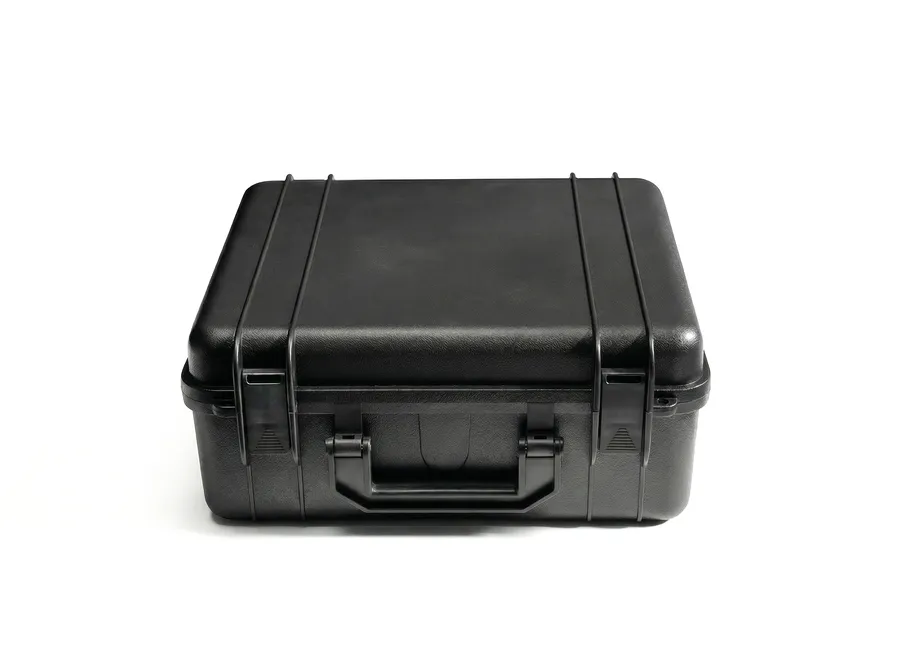
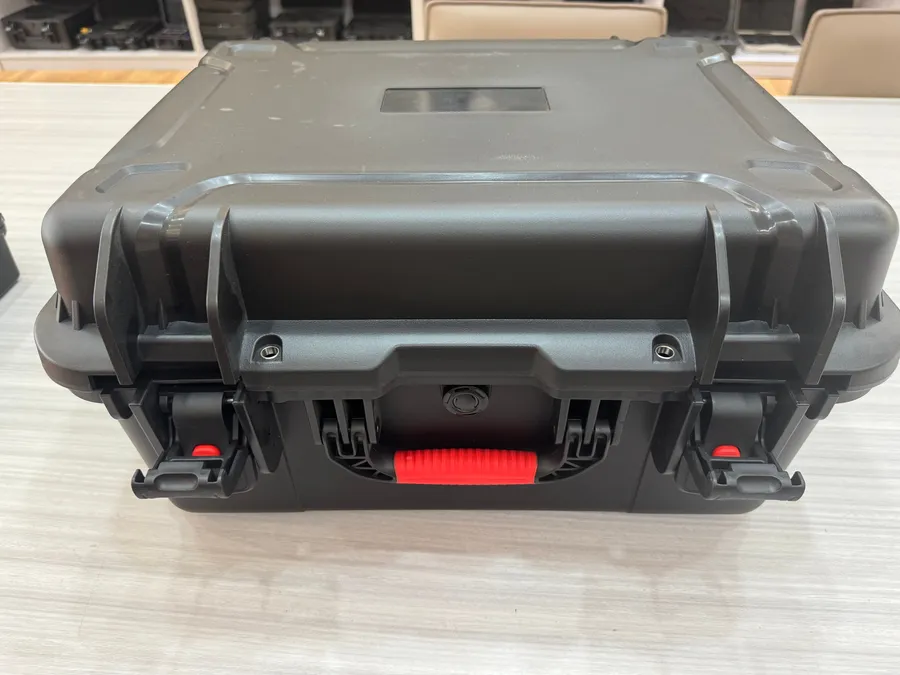
Three published features do the work. Feet: every one of our 136 stackable models lists moulded feet as measured equipment on its sheet, and those feet are what register the case below and carry its load into the base rather than across the lid. Lid and rim geometry: lid depth varies enormously by design — 16 mm on the KX-1204 against 320 mm on the KX-88442 — and a deep, ribbed lid rim behaves differently under a column than a shallow snap-over one. Wall thickness: the catalogue publishes per-model wall figures ranging from 2.0 mm on the smallest shells to 6.0 mm on the largest, and it is the walls, not the lid face, that want to be doing the carrying. When we talk about stackable case dimensions published per model, this is the trio to read together — external footprint, lid depth, and wall thickness — because a column is stable only when those line up between the cases you actually mix.
Stackability as our catalogue publishes it, model by model
Every figure in that table is the specification our own model sheets state, which is the standard a buyer should hold any supplier to: stackability recorded as a field on the model, with the dimensions and hardware that explain it — not a blanket line in a brochure claiming the whole range stacks.
| Model | External Mm | Net Weight G | Stackable | Published Details |
|---|---|---|---|---|
| KX-1204 | 120 × 90 × 40 | 100 | Yes | Moulded feet (measured); lid depth 16 mm; wall 2.6 mm |
| KX-3207 | 315 × 260 × 70 | 570 | Yes | Lid depth 32 mm; wall 3.0 mm |
| KX-4010 | 400 × 360 × 100 | 1,015 | Yes | Lid depth 44 mm; wall 3.0 mm |
| KX-86122 | 612 × 427 × 223 | — | Yes | Moulded feet (measured); lid depth 155 mm; wall 5.0 mm |
| KX-88442 | 843 × 592 × 415 | 15,320 | No | Wheels and telescopic handle fitted; trolley configuration |
Why wheeled cases are not listed as stackable
Our non-stackable list reads like a design statement rather than an oversight: all 19 of them are the trolley family — wheels plus telescopic handle, shells from about 4.9 kg to 15.3 kg net like the KX-85021 and the KX-88442. Explaining why wheeled cases are not listed as stackable is simple physics. Casters put the entire column load through four small contact points instead of a footed perimeter; the collapsed handle and its track stand proud of the lid, so the case above cannot sit square; and the locking hardware a trolley needs is mounted where stacking rims want to be clean. The trade is deliberate: these models buy one-person portability for heavy payloads at the cost of becoming stacking modules. If a fleet needs both, plan the column on the stackable models and route the trolleys flat, braced, and alone on the top tier.
What we do not publish — and what to ask any supplier for
The honest gap on every model sheet: what load a stack of cases can carry is not a number we print. Our protection fields record stack load as not measured, and we will not dress a moulded polypropylene shell in a rating it has not earned in a laboratory. Stacking claims you see elsewhere should be readable the same way: which load was applied, held for how long, at what temperature, on which configuration, with which sample serials, and by which independent laboratory. If a vendor cannot produce those five answers, the figure is marketing arithmetic — usually one carton drop survived, extrapolated to a warehouse. Where a project genuinely needs a stacking number — a tender clause, a rack design, an air-ULD adjacency — we say our sheets do not carry one yet, and we quote accredited third-party laboratory testing against the exact configuration you intend to order.
How to read stackability on a case datasheet
Learning how to read stackability on a case datasheet takes two minutes and saves a warehouse layout. First, find the explicit stackable field — if a datasheet only has a picture of stacked cases and no field, that is a photograph, not a specification. Second, check the hardware that makes stacking work: feet listed or drawn, lid rim shape, handle and latch height relative to the lid face. Third, cross-check the external footprint against what you will stack above and below, because mixed-model columns fail on mismatched rims long before they fail on load. Fourth, read the wall thickness and lid depth as a set: they tell you which member of the column is doing the carrying. And fifth, look for what the sheet refuses to say: if a load rating appears with no laboratory behind it, treat it as a question for the supplier rather than a fact about the case.
From stackable cases to freight: pallets, cartons, and containers
Stackability is where product choice meets logistics cost. Shipped cases palletise by their cartons: 64 models in our catalogue publish carton dimensions and pieces-per-carton — the KX-2005 ships 40 pieces in a 410 × 360 × 495 mm carton, for example — and our pallet layout is calculated from that carton footprint against your pallet size rather than a tier height copied from another customer. Container figures follow the same rule: 20GP, 40GP, and 40HQ quantities are supplied with each quotation, per configuration, because they move with carton choice. KeXin New Materials (Guangdong) Co., Ltd. works wholesale and OEM/ODM only, on EXW or FOB terms — no retail, no DDP, no overseas stocking — with samples on existing moulds in 45 days, new moulds in 125 days, a 30% deposit, balance after inspection, and third-party factory audits welcome. Talk to Fred Zhao or the KeXin Sales Team, or reach us on WhatsApp at +86 135 3588 0002, with your model list and your pallet size, and the stacking plan gets built on published numbers.

Customisation
Everything described above is configurable on a standard shell: interior layout (pick-and-pluck, die-cut or CNC-cut), foam grade and thickness, colour, logo method, latch and lock count, pressure-equalisation valve, cable ports, document holder and identification plate. A bespoke exterior geometry requires a new mould — 125 days, from 3,000 units per moulded component.
Procurement considerations
| Question | What to send us |
|---|---|
| Which shell fits? | Equipment L × W × H as packed, plus required clearance per axis |
| What does it cost? | Order quantity and estimated annual quantity — the two drive different answers |
| Is tooling needed? | Whether an existing shell clears the envelope with usable foam depth |
| Lead time? | Your required delivery date, not just the order date |
| Certification? | The exact standard your tender names — we will say whether we can test to it |
| Freight? | Destination and preferred terms; carton and pallet data supplied with the quotation |
Comparison and selection guide
The tables on this page exist because a protective case is chosen by comparing three things: the envelope, the environment and the handling chain. Where no table applies, the rule below is.
| Situation | What To Do |
|---|---|
| Fastest | Standard shell plus CNC foam — typically 45 days from approved drawing. |
| Branded | Standard shell plus custom colour and logo — MOQ applies to the resin colour. |
| Bespoke geometry | New mould — 125 days, MOQ from 3,000 units per component. |
- Size on internal dimensions plus clearance, never on a product name.
- Choose the carrying method before the shell: it changes the series, not just the price.
- Specify the interior last, and decide up front whether the end user will reconfigure it.
What is case stackability and why does it matter when buying a protective case? relates to Logistics & Packing Guide. Related families: Custom Protective Cases / Waterproof Cases / Electronics Cases / Tactical Equipment Cases / Military Protective Cases / Ammunition Storage & Transport Boxes. Related sectors: field and industrial equipment. Continue in the Logistics & Packing Guide cluster.
This page is written from our own production data. If your requirement differs, send the dimensions and we will tell you which of the 155 models fits, or whether a custom route is needed.


