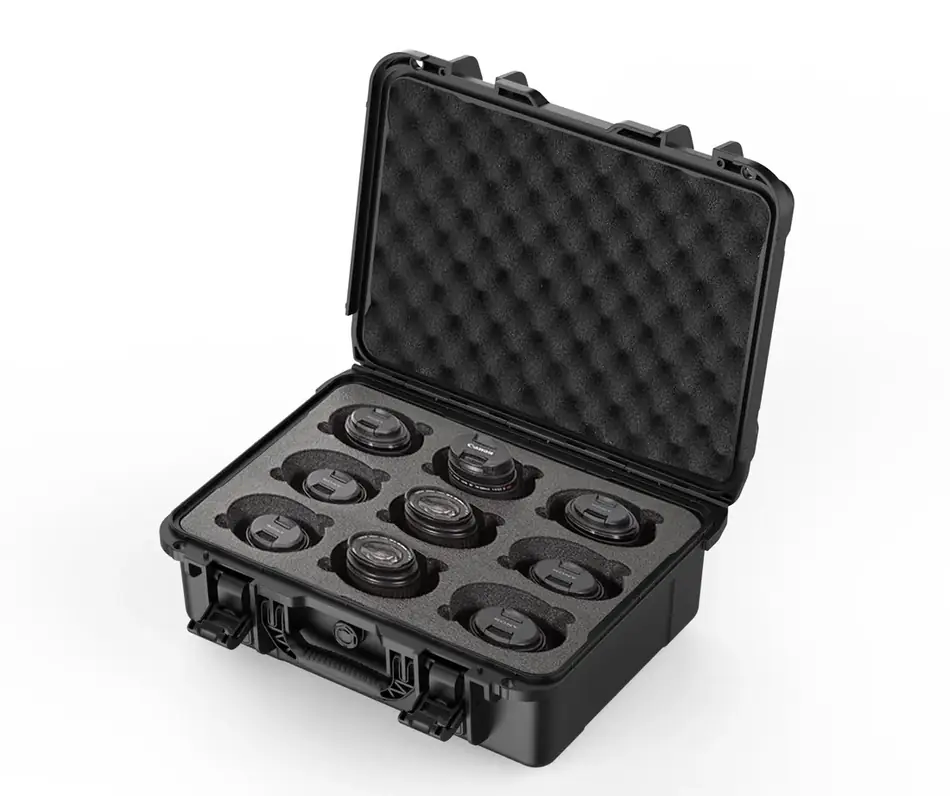
Photography Equipment Transport Packaging Solutions: Shell, Foam and Carton Data
Photography equipment moves in three layers, and a transport packaging solution has to specify all three: a moulded shell whose internal depth and narrow width suit the kit, a foam layout that fixes each item separately, and export carton data that lets you build a pallet plan. Our published model pages give external and internal dimensions, carton size and pieces per carton, net weight per unit, whether the shell stacks, and whether it carries wheels, so the packing decision is made from figures you can audit rather than from a phrase about being travel-proof.
Key points
- Plan three layers, not one: shell, foam layout and export carton. A case that fits the kit but ships loose in a master carton is still a transit risk.
- Use published carton dimensions and pieces per carton as the base of your pallet plan; both are model fields, so they change between sizes.
- Check the stackable field before you design a tier. Wheeled T Series shells such as KX-85022 are marked as not stackable and pack one piece per carton.
- Net weight per unit is published, gross weight is left blank unless measured, so quote a shipping mass as units times net plus your own carton tare.
- Foam is the transport component: a specified pocket layout holds position, while a shell alone is not a shock figure for any model we list.
- We ship EXW or FOB only, with no retail, no DDP and no overseas warehouse, so your forwarder owns the import leg and the customs file.
Photography Equipment Transport Packaging Solutions, Answered Directly
When buyers search for photography equipment transport packaging solutions they are almost always solving one of three problems: a kit that shifts inside a case between locations, a purchase order whose carton count nobody can verify, or a mixed shipment of bodies, glass, lighting and support gear that needs one packing plan. Each has a different answer. Movement inside the case is a foam layout problem, and we publish the lid and base depth split so the layout can be drawn rather than guessed. Carton count is a packing-data problem, and we publish carton dimensions with pieces per carton for the models where that record exists. Mixed shipments are a sizing problem, solved by choosing two or three shell footprints from one family instead of forcing everything into one oversized box. What we do not do is describe any of this as a tested transit rating; the protection fields on these models are recorded as not measured, and the honest version of the answer is the one that survives a claim.
Everything below is drawn from the same product data that appears on our model pages, in millimetres, grams and carton counts, and each figure can be traced to a specific shell rather than to the range as a whole. Where a packing record does not exist for a model, the field is shown as empty on its page instead of being filled with a neighbouring model's number, because an estimate dressed up as a specification is the thing that breaks a loading plan after the order is placed.
The three packaging layers and what each one is responsible for
The outer shell owns crush and handling: it is what survives being lifted by the handle, set down hard on a tailgate and stacked by someone who cannot see the label. It does not own the position of your lens. The foam owns position: each item sits in its own pocket, restrained on the sides, with a lid layer closing the top so nothing walks during a long drive. The carton owns unitisation: it is how eleven or sixteen cases become a countable, stackable quantity for freight, and how a receiving clerk reconciles a packing list. Confusing these layers is the most common sourcing error we see, because a buyer will ask for a tougher shell when what actually damaged the gear was an inch of unallocated depth above a camera body.
Published carton packing data for photography case models
Carton figures are model fields, not a house standard. KX-3213 ships in a 645 by 530 by 520 mm carton holding sixteen pieces, and with each shell at 860 g net that is 13.76 kg of product in one carton. KX-3308 uses a 670 by 550 by 425 mm carton of twenty pieces at 575 g each, so 11.5 kg. The 7 Series shells pack tighter or looser depending on size: KX-704 goes twenty to a 740 by 550 by 480 mm carton, KX-705 ten to a 645 by 435 by 595 mm carton, and KX-706 and KX-707 eight each. The thick-wall ABS models drop further, with KX-64114 at eight pieces and KX-64120 at six, because the shells are heavier and bulkier. Where a carton record does not exist for a model we say so on the page instead of publishing an estimate: KX-2614, KX-4610 and KX-92817 all carry empty packing fields today, and their volumes are simply calculated against your order quantity at quotation stage.
The depth ladder matters here too. KX-3607, KX-3608 and KX-3609 share a 730 by 630 mm carton base and rise 410, 480 and 550 mm, so a buyer comparing those three is comparing deck area, not wasted air.
| Model | Carton Mm | Pieces Per Carton | Net Each G | Product Mass Per Carton Kg |
|---|---|---|---|---|
| KX-3213 | 645 x 530 x 520 | 16 | 860 | 13.76 |
| KX-3308 | 670 x 550 x 425 | 20 | 575 | 11.50 |
| KX-704 | 740 x 550 x 480 | 20 | 630 | 12.60 |
| KX-712 | 635 x 585 x 455 | 16 | 710 | 11.36 |
| KX-2813 | 560 x 490 x 665 | 20 | 800 | 16.00 |
| KX-3113 | 635 x 595 x 540 | 16 | 1060 | 16.96 |
| KX-705 | 645 x 435 x 595 | 10 | 830 | 8.30 |
| KX-4012 | 725 x 420 x 580 | 10 | 1480 | 14.80 |
| KX-707 | 735 x 480 x 595 | 8 | 1360 | 10.88 |
| KX-64114 | 755 x 425 x 580 | 8 | 2100 | 16.80 |
| KX-64120 | 750 x 425 x 640 | 6 | 2640 | 15.84 |
| KX-85022 | 495 x 375 x 245 | 1 | 5012 | 5.01 |
Stackability, wheels and what they do to a pallet plan
Most of our shells are published as stackable, and that is what lets a carton be tiered rather than laid flat in a single layer. The exception is deliberate: the T Series wheeled models KX-85021, KX-85022, KX-5126 and KX-85424 are recorded as not stackable, because a telescopic handle, two wheels and a moulded base geometry make a stable column impossible. A buyer who specifies four of those for a camera department is therefore planning four footprints side by side, not a stack of four, and that changes both the carton count and the deck area. KX-85022 packs one piece to a 495 by 375 by 245 mm carton for exactly this reason. The smaller shells behave the other way: KX-3308 at 20 pieces and KX-704 at 20 pieces arrive as dense cartons that palletise conventionally.
Choose the wheeled option for how the case is moved by a person on a location, not for how it moves on a ship. Those are different decisions and they are frequently conflated in a specification, with the result that a buyer pays for a telescopic handle on a shell that will spend its life inside a stacked carton, and then discovers that the four units they bought cannot be tiered on one pallet footprint.
| Model | Wheels | Handle | Stackable | Seal Option |
|---|---|---|---|---|
| KX-2614 | 0 | Fixed folding | Yes | No |
| KX-3308 | 0 | Fixed folding | Yes | No |
| KX-3213 | 0 | Fixed folding | Yes | Yes |
| KX-4616 | 0 | Fixed folding | Yes | Yes |
| KX-64120 | 0 | Fixed folding | Yes | Yes |
| KX-85021 | 2 | Telescopic + fixed folding | No | Yes |
| KX-85022 | 2 | Telescopic + fixed folding | No | Yes |
| KX-85424 | 2 | Telescopic + fixed folding | No | Yes |
Foam layout is the transport component, and it is specifiable
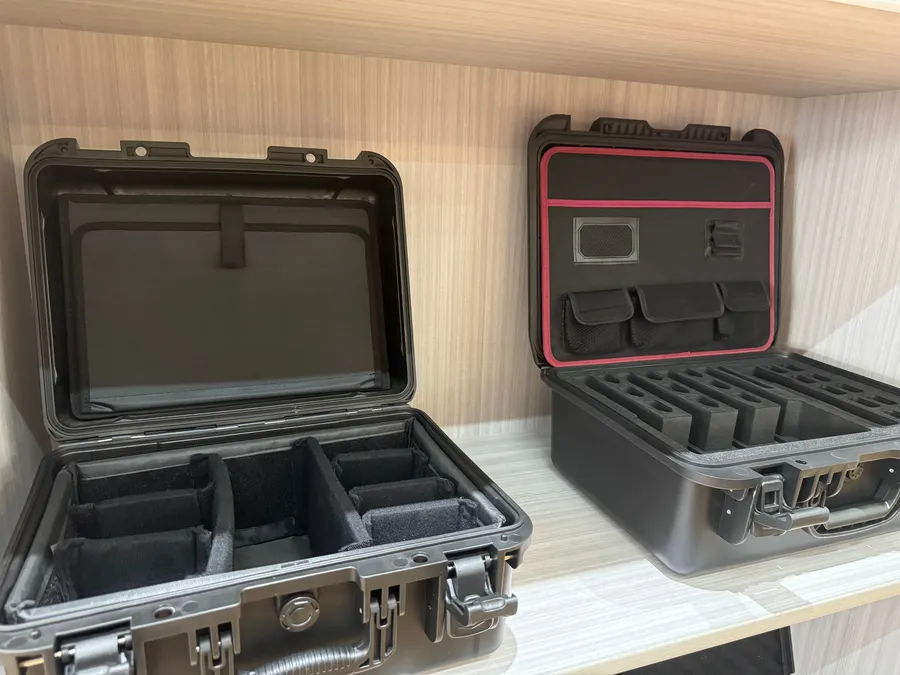
Interior options we list include pick and pluck, die-cut, CNC-cut, EVA, PE and EPE foam, in top, base, egg-crate, layered or custom-cut structures. For photography kits the practical distinction is between reconfigurable and fixed. Pick and pluck lets a crew change glass between shoots without a new insert; CNC-cut holds each item in a defined pocket, which is what you want for a shipped kit or a rental fleet with a standard load-out. Custom foam has a MOQ of one unit in our published terms, so a layout can be prototyped with the shell sample rather than after a production run. The lid and base split then decides whether a body and lens assembly lies flat or stands: KX-92817 puts 125 mm in the lid over a 27 mm base, KX-3213 puts 86 mm over 32 mm, while KX-2614 and KX-3308 split evenly at 60 and 38 mm respectively.
What we do not claim about transit protection
Transit is where datasheets get careless, so the limits are worth stating plainly. On these models the waterproof and dust-resistance fields are recorded as not measured, so we do not print an ingress code or describe a seal as keeping a container out. Impact resistance is recorded as a construction option tied to the published wall thickness, with no drop height stated unless a test is commissioned. Shock protection is recorded as dependent on the foam layout ordered, because the shell alone is not a shock figure. What is recorded as measured is narrower and more useful: that the shell material is a thermoplastic with no ferrous corrosion path, that hinges and moulded feet exist on the model, that the latch body accepts a standard padlock, and where applicable that a compressible gasket sits in a continuous moulded channel. If your contract needs a transit report, name the standard and procedure and we quote accredited testing as a separate work package rather than implying a result we do not hold.
Pallet and container planning: what is published versus what is calculated
Our product data carries pallet loading and container loading as not measured for these models, with the note that they are calculated from the carton footprint against your pallet size, and that 20GP, 40GP and 40HQ figures are supplied with the quotation. That is a deliberate split. The inputs are published and fixed: KX-3213 cartons are 645 by 530 mm on the deck, which is 0.342 m² of footprint, and twenty-piece cartons of KX-704 occupy 0.407 m². The outputs depend on variables we do not own, namely whether you load EUR-pallet at 1200 by 800 mm or standard at 1200 by 1000 mm, whether you tie and cap, and whether you mix model sizes on one deck. Ask for the calculation with your pallet dimensions stated and you will get tiers, cartons per pallet and a container count; ask us for a universal number and the honest answer is that no such figure exists.
Kits, mixed loads and multi-model shipments
A photography department rarely buys one size. The pattern that packs and unpacks cleanly is a family of two or three footprints that share an internal width logic: a shallow shell for bodies and glass lying flat, a mid shell for a kit with a gimbal or monitor, and a deep or wheeled shell for lighting and support. KX-3607, KX-3608 and KX-3609 hold one 360 by 310 mm deck at 60, 70 and 80 mm of internal depth, and KX-4610, KX-4613 and KX-4616 hold one 460 by 367 mm deck at 84, 116 and 148 mm. Ordering within a family keeps the carton deck area identical across the range, which is what makes a mixed pallet stable and a receiving count simple. For shipments where the case itself is the deliverable rather than the packaging, we also publish a document holder field as a configuration option, which is the cheapest way to keep an internal part number legible after the outer label has been destroyed in transit.
Commercial terms that apply to transport packaging
Our business is wholesale and OEM only. We sell EXW or FOB from Guangdong, we do not sell retail, we do not quote DDP and we hold no overseas warehouse, so the import leg, the customs clearance and any final-mile delivery are handled by your forwarder. Custom packaging and custom foam are OEM options and are listed as available on every model, with custom foam starting at one unit and logo, colour and OEM programmes starting at 300 units; a new mould starts at 3,000 units per component. Lead time is 45 days for OEM work on an existing mould and 125 days for a new mould, against a 30 percent deposit with the balance settled after inspection. Third-party factory inspection is welcome, and if you want carton markings, barcodes or a specific pallet configuration confirmed before production, put it in the drawing pack rather than in a message after the tooling is booked.
Customisation
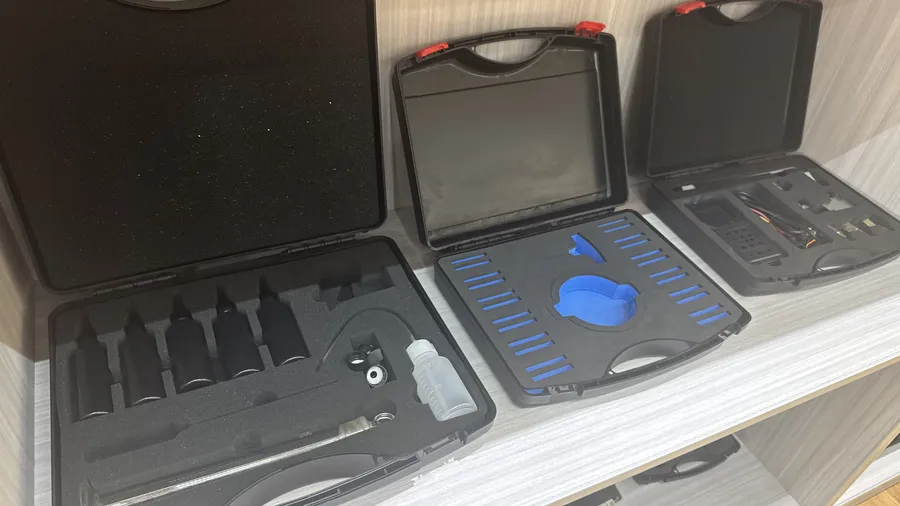
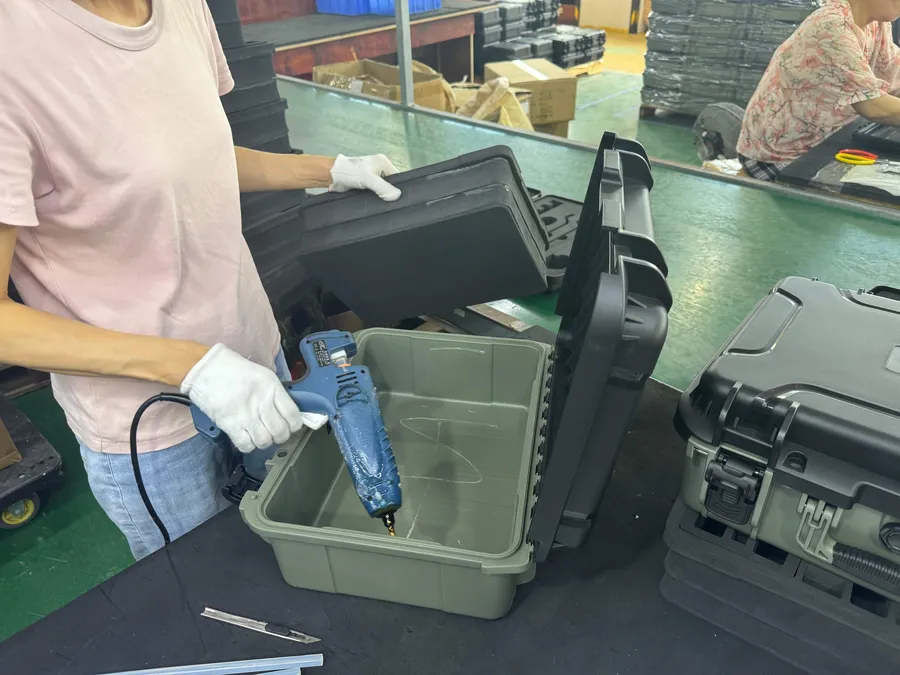
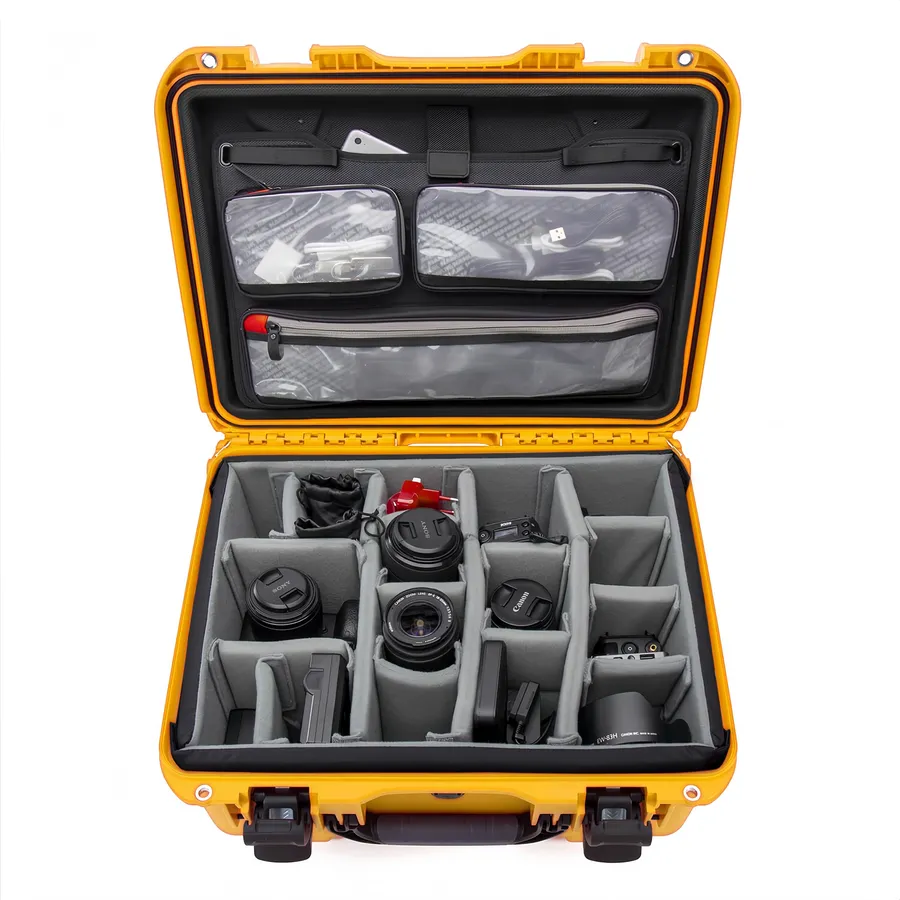
Everything described above is configurable on a standard shell: interior layout (pick-and-pluck, die-cut or CNC-cut), foam grade and thickness, colour, logo method, latch and lock count, pressure-equalisation valve, cable ports, document holder and identification plate. A bespoke exterior geometry requires a new mould — 125 days, from 3,000 units per moulded component.
Procurement considerations
| Question | What to send us |
|---|---|
| Which shell fits? | Equipment L × W × H as packed, plus required clearance per axis |
| What does it cost? | Order quantity and estimated annual quantity — the two drive different answers |
| Is tooling needed? | Whether an existing shell clears the envelope with usable foam depth |
| Lead time? | Your required delivery date, not just the order date |
| Certification? | The exact standard your tender names — we will say whether we can test to it |
| Freight? | Destination and preferred terms; carton and pallet data supplied with the quotation |
Comparison and selection guide
The tables on this page exist because a protective case is chosen by comparing three things: the envelope, the environment and the handling chain. Where no table applies, the rule below is.
| Situation | What To Do |
|---|---|
| Changing kits | Layered pluck foam, rebuilt by hand. |
| Fixed rental fleet | CNC silhouette with serial pockets and an inventory list. |
| Harsh locations | Sealed shell plus desiccant provision in the lid. |
- Size on internal dimensions plus clearance, never on a product name.
- Choose the carrying method before the shell: it changes the series, not just the price.
- Specify the interior last, and decide up front whether the end user will reconfigure it.
Photography Equipment Transport Packaging Solutions: Shell, Foam and Carton Data relates to Logistics & Packing Guide. Related families: Camera & Photography Cases / Equipment Transport Cases / Custom Protective Cases / Outdoor Protective Cases / Rolling Cases / Instrument & Equipment Cases / Electronics Cases. Related sectors: field and industrial equipment. Continue in the Logistics & Packing Guide cluster.
This page is written from our own production data. If your requirement differs, send the dimensions and we will tell you which of the 155 models fits, or whether a custom route is needed.