What information should be provided about case seals before a quotation?
Send six things about the seal and the quotation stops being a guess: which model listing or external envelope you are working from; whether that listing already records a gasket channel; what the gasket is made of and whether you want that material named on the order; how the closing system compresses the line and at what lid depth; whether the gasket has to be a spare item your own team can renew; and the quantity, term and destination you want priced. Our own file sets the boundary on the first three. Of 155 published models, 124 record a compressible gasket in a continuous moulded channel and 31 record no channel on that shell; the seal material is recorded as EPDM or equivalent compressible gasket as a configuration option on all 155; and water and dust figures are recorded as not measured on every listing. That is why the seal question has to arrive as a construction question. Ask us to build or verify a line and we can answer it field by field; ask us to print an ingress number on a datasheet and the honest answer is that no such record exists for this catalogue.
Key points
- Name the listing first: 124 of our 155 published models record a gasket channel and 31 record none, so the seal answer always depends on which shell you mean.
- Specify the gasket as a material and a mounting method on the order, not as a promise about water, because the seal material is recorded as a configuration option.
- State lid depth and latch count together: the closing system sets the compression on the line, and the lid depths we publish run from 16 mm to 320 mm.
- Say whether the gasket must be field-renewable, because a moulded-in channel and a groove your own team can re-fill are two different quotations and two different spares lists.
- Sealed listings publish wall thickness from 3.0 mm to 6.0 mm with a median of 4.2 mm; of the 31 unsealed listings, 24 publish 2.0 mm to 2.9 mm and 7 publish no figure.
- Put quantity, term and destination in the same mail: MOQ is 1 for stock, 300 for logo, colour or OEM, and 3,000 per component for a new mould, at 45 or 125 days.
Why a seal question needs six lines before anyone can price it
A seal is not a part you can order by name. It is the result of three decisions that sit in different places on a case: whether the shell was moulded with a channel, what compressible material sits in that channel, and how hard the closures press it down. A buyer who writes one line asking for a sealed case gets three different answers from three suppliers, and none of them are wrong, because the line did not say which of those three decisions mattered to you. The six lines above exist to make the answer comparable rather than merely polite.
The second reason is commercial. Quotations are priced from a configuration, and a seal configuration touches the shell tool, the closing hardware, the spares pack and sometimes a separate test request. Each of those has its own lead time and its own minimum order. When the seal line arrives vague, a supplier prices the cheapest reading of it and you discover the difference at inspection. When it arrives as six explicit lines, the same quotation can be read side by side against two other suppliers without anyone guessing what the competitor meant.
What our 155-model file records about seals
Every figure below is copied from our own published specification file, which holds 155 active models with external and internal dimensions in millimetres, wall thickness, lid and base depth split, net mass in grams and internal volume in litres. A blank in the file stays a blank here: where a field carries no published value we say so instead of inventing one, because a number that came from nowhere is worse than no number.
| Listing As Published | Seal Record On The Listing | Wall Thickness Mm | Lid Depth Mm | Base Depth Mm | Published Net Mass G | Shell Material |
|---|---|---|---|---|---|---|
| KX 8-8442, T Series telescopic rolling case | Compressible gasket in continuous moulded channel | 5.0 | 320.0 | 44.0 | 15,320 | PP |
| KX 8-8434, T Series telescopic rolling case | Compressible gasket in continuous moulded channel | 5.0 | 240.0 | 44.0 | 14,030 | PP |
| KX 8-5022, T Series telescopic rolling case | Compressible gasket in continuous moulded channel | 4.5 | not published | not published | 5,012 | Engineering PP |
| KX 6621, 9 Series deep-body heavy case | Compressible gasket in continuous moulded channel | 6.0 | 43.0 | 149.0 | 6,420 | Engineering PP |
| KX 3508, 1 Series small protective case | Compressible gasket in continuous moulded channel | 3.0 | 36.0 | 36.0 | 995 | Engineering PP |
| KX 6-2205, 6 Series mid-size equipment case | Compressible gasket in continuous moulded channel | 3.5 | not published | not published | 310 | ABS |
| KX 1204, 0 Series mini utility case | None offered on this shell | 2.6 | 16.0 | 16.0 | 100 | PP |
| KX 2005, 0 Series mini utility case | None offered on this shell | 2.0 | 20.0 | 20.0 | 175 | PP |
| KX 8-4814, 8 Series heavy-duty large case | None offered on this shell | not published | not published | not published | not published | PP |
Channel, gasket material and the compression path are three separate lines
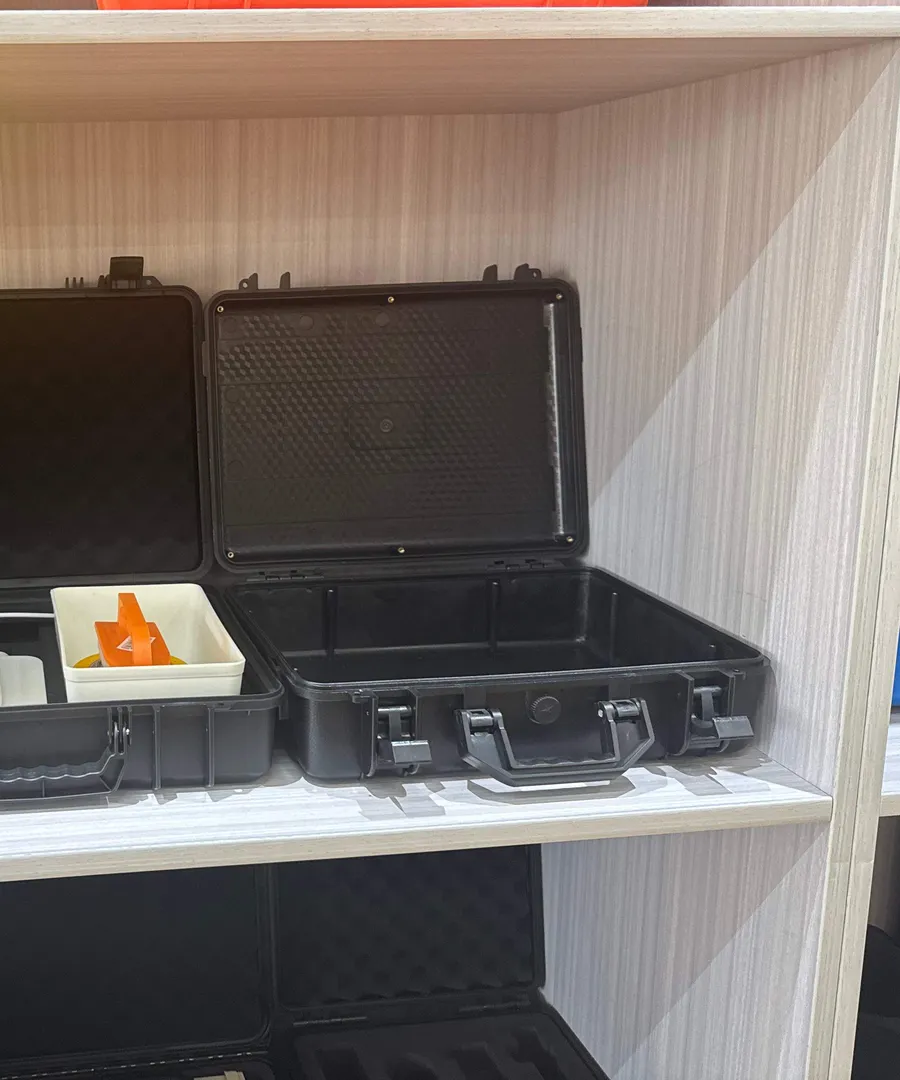
The first line is the channel. In our file it is a recorded, per-model field: 124 listings state that a compressible gasket sits in a continuous moulded channel, and 31 state that none is offered on that shell. This is the only seal field we can answer from the catalogue rather than from a conversation, because it is fixed by the mould. If the listing you are quoting does not carry the channel line, adding a sealed groove is tool work, not hardware work, and that changes the lead time.
The second line is the material. The file records EPDM or equivalent compressible gasket on all 155 models, flagged as a construction option we can supply rather than a measured property of the unit on your bench. That distinction matters at receiving inspection: equivalent is a category, not a compound, so if your maintenance store already buys a specific profile and compound, name it in the enquiry and we will confirm whether the channel geometry you are quoting accepts it.
The third line is the compression path, and it belongs to the closures, not to the seal. Latch count is recorded in our file as specified per configuration on all 155 models, with no count, position or force figure published, and the same applies to hinge and feet records. So the seal only behaves as the closing routine makes it behave: same channel, same gasket, one fewer latch, and the compression profile along the perimeter changes. Send the count and the positions along the front edge together with the lid depth they have to pull down.
One more field sits on this path and is worth naming early: a pressure equalisation valve is recorded on all 155 listings as an option with no published value. Say whether you want one fitted, supplied loose, or left out, rather than discovering the question at the drawing stage.
The seal line field by field: what we publish and what you send
The table is a working checklist for an enquiry. Column two is the state of our published file, taken model by model; column three is what the buyer has to supply for the line to be answerable. Anything in column two marked as not published is a genuine gap, and filling it from your side is what turns a seal request into a priced, inspectable configuration.
| Field | Status In Our Published File | What To Send In The Enquiry |
|---|---|---|
| Gasket channel on the shell | Recorded per model: 124 of 155 state a continuous moulded channel, 31 state none offered | The model listing or the external envelope, and whether an unsealed shell may be swapped for a sealed one |
| Gasket material | EPDM or equivalent compressible gasket, recorded as a construction option on all 155 | The compound you want named on the order if your store already buys a specific one, or say you accept our standard |
| Gasket cross-section and size | Not published on any listing | Profile and size if you have them from a sample or a drawing; otherwise the groove photograph or the physical part |
| Compression or deflection figure | Not published on any listing, and no closing force is recorded | The opening and closing routine the user follows, and the number of cycles a day the line has to survive |
| Continuous versus jointed length | The channel is recorded as continuous on the 124 sealed listings; corner treatment is not published | Whether a corner joint is acceptable, and where, if you have a repair routine for it |
| Latch count and positions | Specified per configuration on all 155; the latch body records as accepting a standard padlock | Count, spacing along the front edge, and whether a padlock has to be fitted at a specific station |
| Pressure equalisation valve | Recorded as an option with no published value on all 155 | Fitted, supplied loose, or left out, plus the altitude or pressure band that prompted the question |
| Renewability and spares | No gasket service life, replacement interval or spare part number is published | Whether your team renews the line in house, and how many spare metres or spare sets per hundred units |
How the seal decision moves with the way the case is used
Different handling patterns put pressure on different parts of the same line, and the useful thing to write in the enquiry is which pattern yours is, because it decides what gets quoted and what gets checked on arrival. Below is how we read the four patterns we are shown most often, against fields our file does publish.
| Use Pattern | What The File Shows | Seal Information To Send |
|---|---|---|
| One case, one vehicle, carried by hand most days | 136 of 155 listings are wheel-free and fixed-handle only; 19 carry wheels and a telescopic grip, 18 of those record a channel | Empty and loaded mass, and whether the lid is opened between handovers, since the line sees the most wear at the latch stations |
| Racked or stacked in a warehouse for long periods | 136 listings record as stackable; 106 of the 124 sealed listings are stackable; stack load in kilograms is recorded as not measured | Rack or stack height, whether the units sit closed for months, and whether you want the compression documented at handover |
| Palletised exports with cartons inside the container | Carton footprint published on 64 of 155, with 1 to 40 pieces per carton on 58 listings; pallet and container figures recorded as not measured | Your pallet size and the loading pattern, so we can calculate the carton plan and quote it rather than estimate it |
| Dusty or sandy site work with frequent opening | Dust figures are recorded as not measured on all 155; the channel record is a construction fact, not a dust result | How often the lid opens per shift and whether the closure path is checked by hand, so the inspection note matches the site |
| Deep lids and heavy bases on large shells | Lid depth published on 100 listings from 16 mm to 320 mm; 11 models are at 200 mm or deeper, 8 of them rolling and all 11 record a channel | The lid and base split you need, since the depth decides how far the closures have to pull the two faces together |
Where the seal record changes by product family
Within our own catalogue the channel is not spread evenly, and reading that distribution is the fastest way to know whether you are asking for a configuration or a new tool. All 20 ammunition storage listings record a channel. None of the 10 outdoor listings do, and all six members of the 7 Series record none. Four of the 12 tactical listings do, while 100 of the 113 military protective listings do. All 22 ABS-shell listings record a channel, and 18 of the 19 wheeled listings do.
There is a second pattern in the same file that a seal enquiry should notice: wall thickness. Every one of the 124 listings that record a channel also publishes a wall figure, running from 3.0 mm to 6.0 mm with a median of 4.2 mm, and 25 of them sit at exactly 5.0 mm. Of the 31 listings that record no channel, 24 publish a wall between 2.0 mm and 2.9 mm and 7 publish nothing at all. A groove needs material to hold it, so on a thin-wall shell the seal question is a shell question first.
Internal volume tells the same story from the other side. Only two sealed listings exceed 100 litres: the 8-8434 at 108.9 litres and the 8-8442 at 139.5 litres, both rolling shells with 5.0 mm walls and published masses above 14 kilograms. Most of the sealed file is far smaller, which is why a seal request that arrives with a size and a use case gets a different answer from one that arrives with only the word sealed.
Customising the seal: configuration on an existing tool versus a new mould
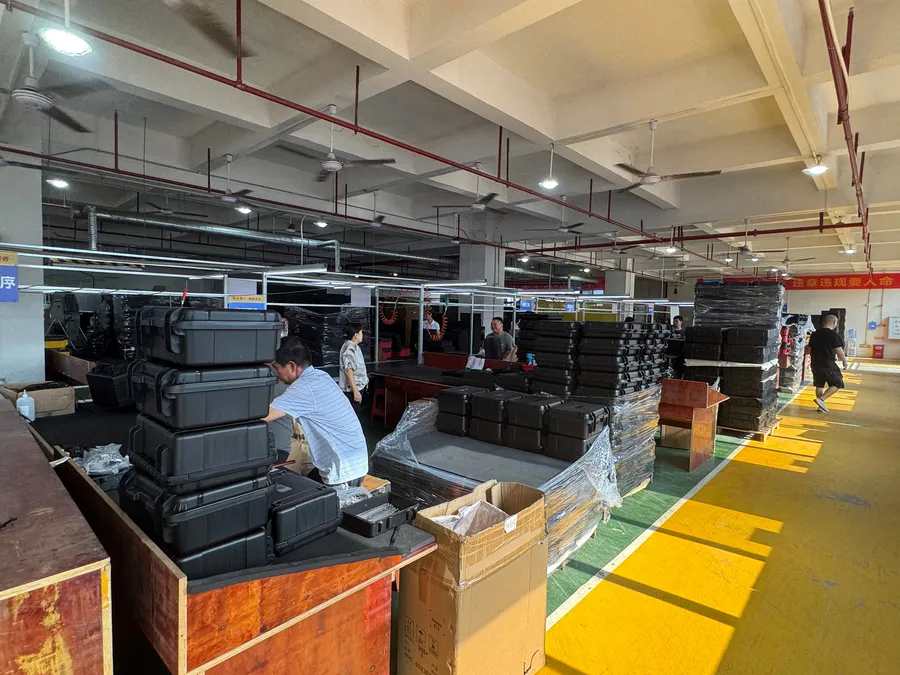
If the listing you are quoting already records a channel, the seal work in front of you is configuration: material named on the order, latch count and positions chosen, valve fitted or omitted, spares packed with the batch. Our file records custom hardware, custom colour, custom logo and custom packaging as available, with an OEM first sample from existing moulding tools at 45 days. Those are the numbers we quote against, and they are the reason we ask which listing you started from.
If the shell has no channel and you need one, that is mould work. A new mould is quoted at 125 days with a minimum of 3,000 pieces per component, and the same tool consequence applies to a new grip boss or a wheel channel. Between those two sits the grey zone buyers hit most often: a sealed gasket requested on a shell that carries none, where the honest answer is either the 3,000-piece tool route or a different listing from the 124 that already record a channel. Say which of those you would rather be quoted for and the first reply is useful instead of theoretical.
Purchasing notes to put next to the seal line
Four things belong in the same mail as the seal request, because each of them changes the arithmetic. Quantity, including the annual figure and the first order, so MOQ can be applied to the right line: 1 piece for stock items, 300 for logo, colour or OEM work, 3,000 per component for new moulding. The delivery term and destination, since we quote EXW or FOB only; we are a wholesale and OEM supplier, we do not sell retail, and we do not arrange DDP deliveries or ship from an overseas warehouse. A 30 percent deposit applies to custom work, and the balance is settled before dispatch under the term quoted.
The third is your inspection routine. Nothing about a seal line is verifiable from a datasheet in our catalogue, because water and dust figures are recorded as not measured, so the meaningful acceptance step is the one your own team performs at receiving: close and open the case a set number of times, check the line sits in the channel along its full length, and record the latch stations where it does not. Write that routine into the enquiry and it becomes a shared document instead of a dispute later. The fourth is the packed configuration those numbers describe: optic fitted or removed, cable set included, stand folded or detached, because the file records internal volume and not how your kit sits inside it.
What we do not state about seals on any listing, and why
This is the shortest section in the piece and the one that saves the most time. On all 155 listings in our file, water resistance, dust resistance, ultraviolet resistance, temperature range, stack load and load capacity are recorded as not measured, and no CAD file is published. The consequence is that we do not print an ingress figure, a standard name or a test result on a seal, and we do not add one to a quotation because a tender template asked for a box to be ticked. Shock protection is recorded as requiring a specified foam layout, since the shell alone is not a shock rating, and impact notes on each listing give the wall thickness with no drop height claimed in the absence of a test.
Two things we can still do. First, quote the construction you describe: channel, material, closure count, valve, spares, and a drawing or a sample to work from, since our file records that a drawing, a photograph of the packed kit, or a physical sample is required before foam or hardware work starts. Second, if your purchasing process needs laboratory evidence, we can commission accredited third-party testing against a method you name as a separate work package with its own cost and lead time. What we will not do is hand you a number that came from a brochure instead of a bench.
Customisation
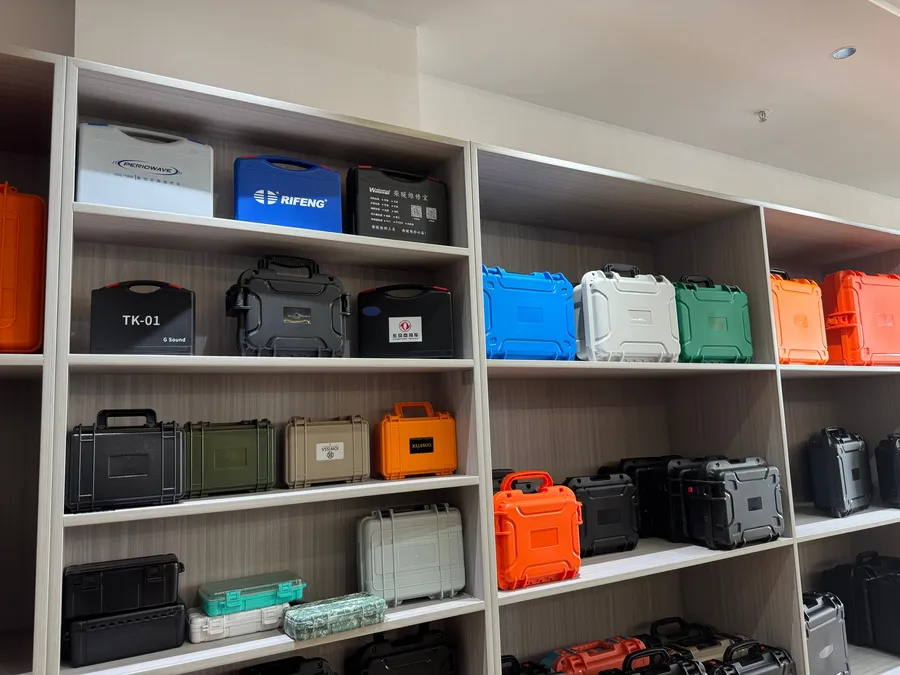
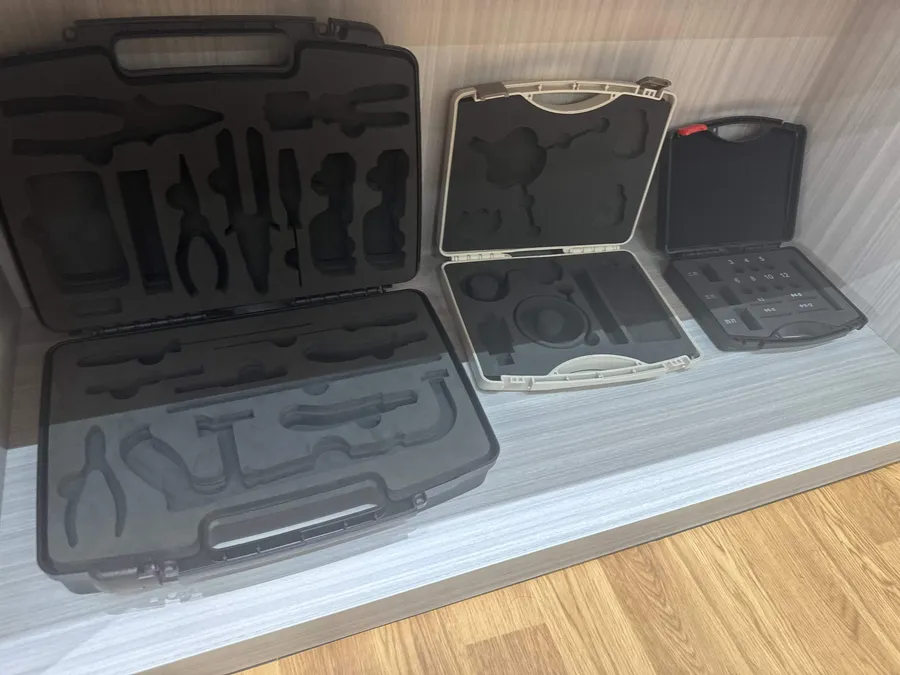
Everything described above is configurable on a standard shell: interior layout (pick-and-pluck, die-cut or CNC-cut), foam grade and thickness, colour, logo method, latch and lock count, pressure-equalisation valve, cable ports, document holder and identification plate. A bespoke exterior geometry requires a new mould — 125 days, from 3,000 units per moulded component.
Procurement considerations
| Question | What to send us |
|---|---|
| Which shell fits? | Equipment L × W × H as packed, plus required clearance per axis |
| What does it cost? | Order quantity and estimated annual quantity — the two drive different answers |
| Is tooling needed? | Whether an existing shell clears the envelope with usable foam depth |
| Lead time? | Your required delivery date, not just the order date |
| Certification? | The exact standard your tender names — we will say whether we can test to it |
| Freight? | Destination and preferred terms; carton and pallet data supplied with the quotation |
Comparison and selection guide
The tables on this page exist because a protective case is chosen by comparing three things: the envelope, the environment and the handling chain. Where no table applies, the rule below is.
| Situation | What To Do |
|---|---|
| Fastest | Standard shell plus CNC foam — typically 45 days from approved drawing. |
| Branded | Standard shell plus custom colour and logo — MOQ applies to the resin colour. |
| Bespoke geometry | New mould — 125 days, MOQ from 3,000 units per component. |
- Size on internal dimensions plus clearance, never on a product name.
- Choose the carrying method before the shell: it changes the series, not just the price.
- Specify the interior last, and decide up front whether the end user will reconfigure it.
What information should be provided about case seals before a quotation? relates to Logistics & Packing Guide. Related families: Custom Protective Cases / Equipment Transport Cases / Military Protective Cases / Waterproof Cases / Ammunition Storage & Transport Boxes / Tactical Equipment Cases / Instrument & Equipment Cases. Related sectors: field and industrial equipment. Continue in the Logistics & Packing Guide cluster.
This page is written from our own production data. If your requirement differs, send the dimensions and we will tell you which of the 155 models fits, or whether a custom route is needed.


