How should case gaskets be specified in a protective case RFQ?
Specify a case gasket as five fields on one page, never as the single word sealed. Write, in order: the listing or external envelope the gasket belongs to and whether that listing records a channel; the material, named as a compound rather than as an equivalence; the profile and size, or the sample or drawing that stands in for them; the retention path, meaning the channel, the lid and base depth split, the wall the closures bite into and the latch count and positions that load the line; and the renewal terms, meaning whether your own team replaces it and how many spare metres or sets ship with the batch. Our file bounds the first and the last. 124 of 155 published models record a compressible gasket in a continuous moulded channel and 31 record that none is offered on that shell, while gasket profile, cross-section, length, joint method, compression figure, service life and spare part number are published on no listing at all. Those seven blanks are exactly what your RFQ has to fill, because a gasket line with blanks in it is priced by the supplier's assumption rather than by your requirement, and the assumption is what you find out at receiving.
Key points
- Open the gasket field with the listing code: 124 of our 155 models record a continuous moulded channel and 31 record none, and that one fact decides whether you are specifying a part or commissioning tool work.
- Name the material as a compound. Our file records EPDM or equivalent compressible gasket on all 155 models as an option, and equivalent is a category that two suppliers can fill differently.
- Seven gasket fields carry no published value on any of the 155 listings: profile, cross-section, length, joint method, compression, service life, part number. Write them or send a sample.
- Write the gasket and the closures in the same paragraph. Latch count is specified per configuration on all 155 models, and published lid depths run from 16 mm to 320 mm across 100 listings.
- Tie the line to wall thickness, since a groove needs material to hold it: all 124 channelled listings publish 3.0 mm to 6.0 mm, median 4.2 mm; 7 of the 31 others publish no wall figure.
- End the field with renewal and quantity: whether your team replaces the line, how many spares per hundred units, the first-order and annual volume, and the term, since we quote EXW or FOB only.
Why the word sealed is not a specification
A gasket is a defined piece of material in a defined groove, held by a defined closure load, and every one of those four things is a separate line in a document. Written as the word sealed, none of them exist. A supplier who reads sealed as a moulded channel with our standard strip answers with one product; a supplier who reads it as a glued-in round cord in a shell they already have answers with another; and both quotations look compliant on the comparison sheet until the cases are side by side on a bench.
The RFQ exists to remove that freedom. Case gasket specification is therefore not a technical appendix but a document discipline: five fields that a competitor is also able to answer, so the comparison is about construction and price rather than about who interpreted your one word most generously. Everything below is written so it can be pasted into an enquiry as a numbered block.
What our published file proves about gaskets, and what it leaves blank
Before writing the five fields it helps to know what a supplier can and cannot answer from a catalogue. We keep 155 active models with their specification fields, and the gasket-related record splits cleanly into facts we publish per model, an option we publish across the whole range, and a long column of fields that no listing states. The table is our own honest inventory of that split; the same shape is what you should expect from any other supplier's data sheet.
| Gasket Field | Listings Publishing It | What That Proves | What To Write In The Rfq |
|---|---|---|---|
| Channel present on the shell | 124 of 155 record a compressible gasket in a continuous moulded channel; 31 record none offered | That the mould carries a groove, which is a fixed construction fact and the only gasket fact readable from a catalogue without a conversation | The listing code, plus whether substituting a channelled listing is acceptable if the one you quoted carries none |
| Gasket material | EPDM or equivalent compressible gasket, recorded as a construction option on all 155 | That a compressible strip is available, not which compound arrives on your order | The compound you want named on the purchase order, or an explicit statement that our standard is accepted |
| Profile and cross-section | No listing publishes a profile, a cross-section dimension or a size code | Nothing; this is a blank in our file, not a hidden value | Profile and size from your sample or drawing, or offer to send a short length and a photograph of the groove |
| Continuous length and corner treatment | The channel is recorded as continuous on the 124 sealed listings; the joint method is published nowhere | That the groove runs in one piece, which is not the same as proving how the strip is joined at the corners | Whether a corner joint is acceptable, and if so at which positions, so your repair routine matches the build |
| Compression or deflection figure | Not published on any listing; no closing force is recorded either | Nothing about how hard the line is loaded | The opening and closing routine, the cycles per day, and the latch count and positions along the front edge |
| Service life and replacement interval | Not published on any listing | Nothing; anyone quoting you a gasket lifespan is extrapolating | Your own renewal interval and the number of spare sets per hundred units you want packed |
| Spare part number | No gasket part number appears in the file for any model | That spares are a specification conversation rather than a catalogue lookup | Length or set quantity, plus the listing code and a groove photograph for every case type you hold |
| Water and dust figures | Recorded as not measured on all 155 listings | That our catalogue cannot be used to accept a gasket against a protection number | Your receiving check, or a request for accredited third-party testing as a separate priced work package |
The retention path: write the gasket with the shell and closures around it
A gasket does not seal; a retention path does. The path is the groove in the shell, the two faces the groove sits between, the wall thickness that holds the groove, and the closures that pull those faces down. Our file publishes the dimensional half of that path and leaves the force half blank, which is precisely why the RFQ should state both. Below are real rows from the catalogue so you can see how differently the same sentence reads against a 6.0 mm wall with a 149 mm base and against a 2.1 mm shallow shell.
| Listing | Wall Thickness Mm | Lid Depth Mm | Base Depth Mm | Gasket Record | Published Net Mass G | What The Rfq Line Should Say |
|---|---|---|---|---|---|---|
| KX 6621, 9 Series deep-body heavy case | 6.0 | 43.0 | 149.0 | Channel recorded | 6,420 | State that the closures sit on the shallow lid while most of the depth is in the base, so the loaded edge and the gasket edge are not the same faces |
| KX 8-87336, T Series telescopic rolling case | 5.0 | 260.0 | 50.0 | Channel recorded | 10,660 | Name the latch count and positions for a 260 mm lid, since the pull-down distance decides the compression profile along the perimeter |
| KX 8-5017, 8 Series heavy-duty large case | 4.5 | not published | not published | Channel recorded | not published | Ask for the lid and base split and the mass before fixing an acceptance method; three of our published fields are blank on this listing |
| KX 3218, 0 Series mini utility case | 3.0 | 86.0 | 86.0 | Channel recorded | 900 | On an even 86 mm and 86 mm split, say whether the line has to survive being carried by the lid with the base hanging |
| KX 2811, 9 Series deep-body heavy case | 5.0 | 71.0 | 27.0 | Channel recorded | 890 | Give the stack or rack arrangement: 106 of the 124 channelled listings record as stackable, and stacked units load the line while closed for months |
| KX 4710, 1 Series small protective case | 2.5 | 45.0 | 45.0 | No channel offered on this shell | 1,370 | If you quoted this listing for a gasket, expect either a different listing from the 124 or new tooling at 125 days and 3,000 pieces per component |
| KX 701, 7 Series large equipment case | 2.1 | 38.0 | 38.0 | No channel offered on this shell | 350 | None of the six 7 Series listings records a channel, so a gasket request here is a shell choice, not a hardware option |
Five wordings buyers use, and the field that should replace each
This is the part of the RFQ that is worth editing twice, because most gasket lines fail not by being wrong but by being incomplete. Each row below is a phrasing we are sent, what it permits a supplier to do, and the single field that closes the gap. Nothing here is a demand for a number our own file does not hold; the point is to make the requirement answerable in writing.
| Rfq Wording | What It Permits | Field To Add |
|---|---|---|
| Sealed case required | Any construction the supplier already stocks, including a strip pressed into a groove that was designed for a different profile | The listing code and its recorded channel status, plus the profile or the sample that defines the fit |
| EPDM gasket | Our standard strip, since the catalogue records EPDM or equivalent as an option without a size | Compound plus profile and size, or the sentence stating that our standard section is accepted for this order |
| Gasket all round | A jointed line with corners the receiving check was never told about | Corner positions where a joint is permitted, and where it is not, together with the repair method you use |
| Must not leak | An argument about a test result neither side holds, since water figures are recorded as not measured on all 155 listings | Your own acceptance check at receiving, written as steps, or a priced request for accredited third-party testing |
| Rubber seal to supplier standard | A different material on order two, and no route to renew it in your own store | Renewal terms, spares per hundred units, and whether the line has to be removable without tools |
| One gasket line, whole order | Pricing that hides the difference between existing-tool configuration work and new moulding | Quantity split by listing, plus the term and destination, and an explicit tool-versus-configuration question |
Choosing the specification depth to match the duty
Not every enquiry needs all five fields written at the same length, and writing them evenly is itself a waste of attention. Where the cases are opened daily by the same small team, the renewal and spares fields matter most, because the line will be handled by your own people long before it fails. Where the cases are racked for months and issued occasionally, the retention path matters more than the spares list: state the lid and base split, the closure count and the stack arrangement, and leave the compound on our standard.
Where the enquiry carries a real environmental question, write the duty in plain operating terms rather than in search of a number. Say the case goes on a vehicle roof or in an air hold, that it is opened in dust or in rain, that it sits closed through a season. Those sentences decide what we quote, because our file records the construction fields and not the environmental results: dust figures are not measured, ultraviolet resistance is not measured, temperature range is not measured, and impact notes on each listing give the wall thickness with no drop height claimed without a test.
A useful rule of thumb from the catalogue itself: if your quoted listing is one of the 124 that record a channel, write the fields as a configuration specification and expect a first sample in 45 days on OEM terms. If it is one of the 31 that do not, write the same fields but add the question of whether you want a different listing or new tooling, and price the answer before the drawing stage.
How the gasket line reads by product family and sector
Within our 155 models the channel record is clustered, and that clustering tells you which families need a specification and which ones simply need a listing swap. All 20 ammunition storage listings record a channel, so a gasket line there is about compound, profile and spares. All 22 ABS-shell listings record one as well. None of the 10 outdoor listings do, and none of the six 7 Series listings do, so an outdoor gasket request is answered first with a different shell rather than with a different strip.
In the mid-range families the split is where the drafting care goes. 100 of the 113 military protective listings record a channel and 13 do not; four of the 12 tactical listings do. Eighteen of the 19 wheeled listings carry a channel, and the one that does not is a 510 by 395 by 257 mm shell with no published wall thickness, which is the kind of row an RFQ must treat as an open question rather than as a photograph. Write the family, the listing, and the fields in that order and the reply arrives comparable.
Customising gaskets: on-tool configuration versus a new mould
The line between the two is where quotations diverge, so put it in the enquiry as a question. If the listing already records a channel, then naming the compound, changing the strip section within the existing groove, adding or omitting a pressure equalisation valve, and packing spares with the batch are configuration steps. Our file records custom hardware, custom colour, custom logo, custom packaging and private labelling as available, with an OEM first sample from existing moulding tools at 45 days, and logo, colour and OEM work carries a minimum of 300 pieces.
If the shell was moulded without a groove, a sealed channel is tool work: 125 days and a minimum of 3,000 pieces per component, the same order of magnitude as a new grip boss or a wheel channel. A third route sits in between and is worth asking about explicitly, since it is the cheapest one buyers overlook: take one of the 124 channelled listings whose published envelope fits your kit. Stock listings and custom foam both carry a minimum of 1 piece, and our file records that a drawing, a photograph of the packed kit or a physical sample is required before cutting work starts.
Acceptance at receiving: writing a gasket clause that can actually be checked
Because water and dust results are recorded as not measured, an RFQ that accepts a gasket on a datasheet value has no inspection basis behind it. What does have a basis is a clause describing what your own team does at receiving, and it costs nothing to add: close and open the case a stated number of times; check the strip sits in the groove along its full length and at every corner; record the latch stations where it does not sit; and note the closing effort the routine takes. Write those as numbered steps in the enquiry and they become a shared document that both sides can price and both sides can argue about in the same places.
The packing and quantity fields belong in the same block, because gasket complaints are almost always about a batch rather than a prototype. Our file publishes a carton footprint on 64 of 155 listings, with pieces per carton on 58 listings ranging from 1 to 40, while pallet quantity and container loading are recorded as not measured and are calculated from the carton footprint against your pallet size and supplied with the quotation. So give the pallet dimensions you actually use, the first-order quantity and the annual volume, and expect the reply to be priced EXW or FOB, with a 30 percent deposit on custom work.
What we do not claim about gaskets, stated plainly
Our catalogue publishes a construction record and not a results record. Water resistance, dust resistance, ultraviolet resistance, temperature range, stack load and load capacity are recorded as not measured on all 155 listings, and no CAD file is published. Shock protection is recorded as requiring a specified foam layout, because the shell alone is not a shock rating, and impact notes give the wall thickness with no drop height claimed in the absence of a test. We do not print a protection number, a standard name or a laboratory result on a gasket line, and we will not add one because a tender template has an empty box beside it.
What we will do is answer a construction specification line by line, and what we will do next is quote testing as its own package: accredited third-party testing against a method you name, with its own cost, quantity and lead time, commissioned when your purchasing process genuinely needs laboratory evidence rather than when a form asks for a tick. We work on wholesale and OEM terms only, quoted EXW or FOB; we do not sell retail, we do not arrange DDP deliveries and we do not hold stock in an overseas warehouse. Say which of those you need and the gasket line stops being an argument about words.
Customisation
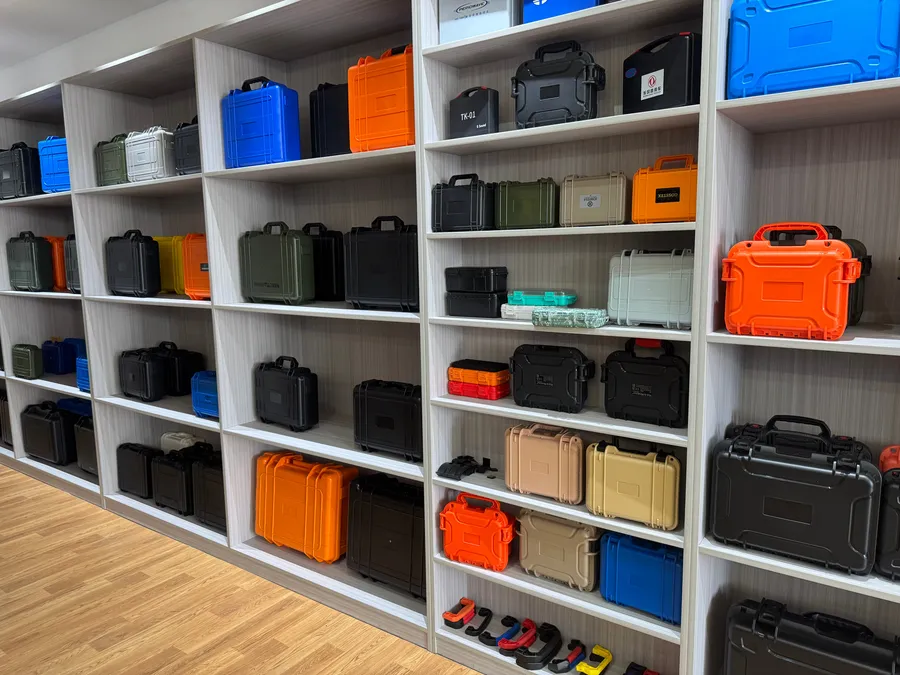
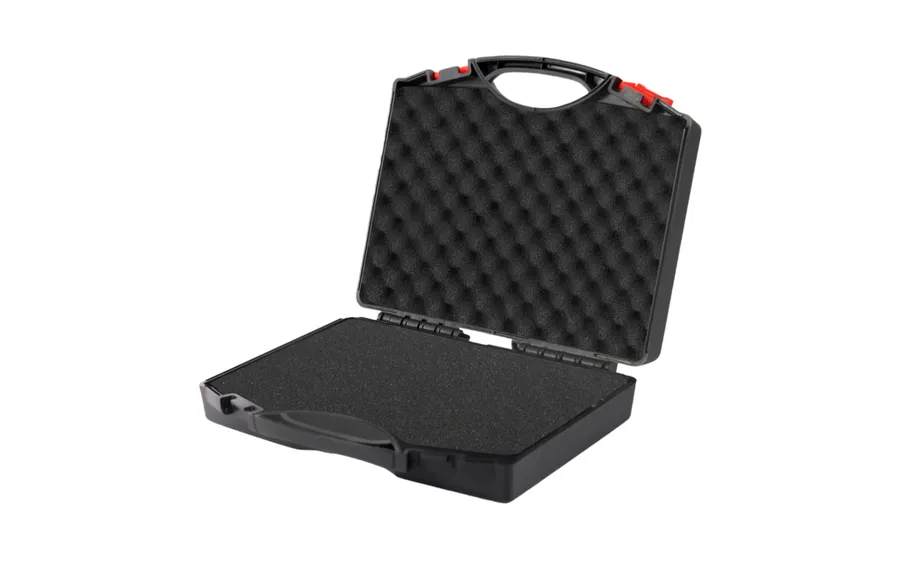
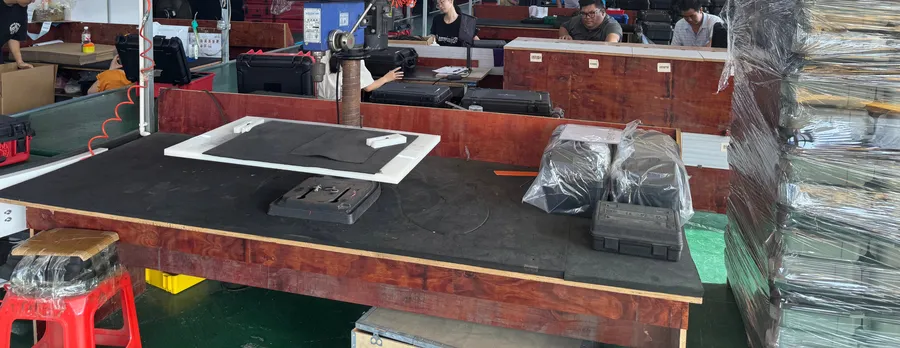
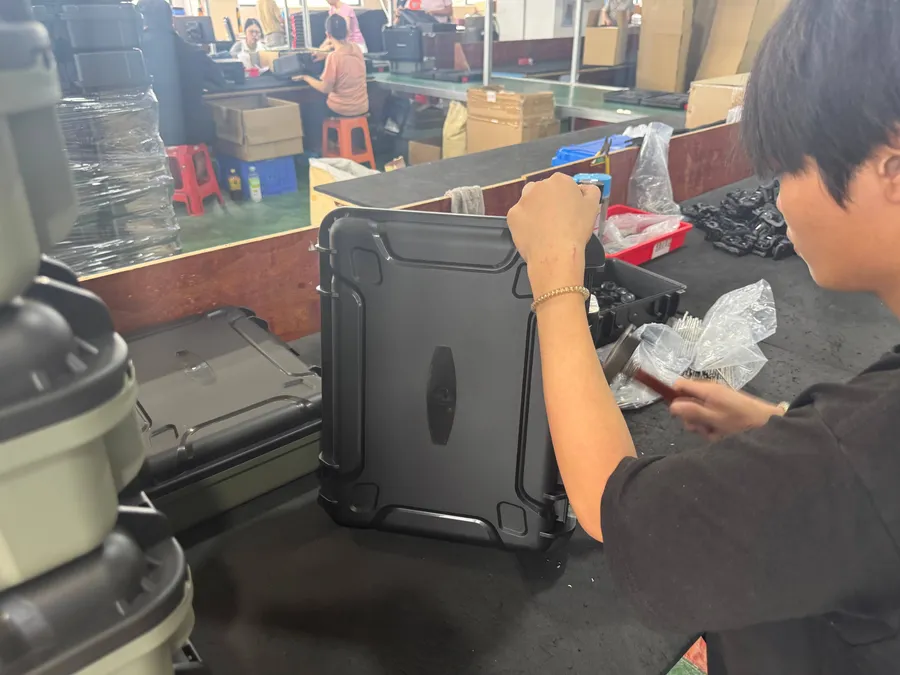
Everything described above is configurable on a standard shell: interior layout (pick-and-pluck, die-cut or CNC-cut), foam grade and thickness, colour, logo method, latch and lock count, pressure-equalisation valve, cable ports, document holder and identification plate. A bespoke exterior geometry requires a new mould — 125 days, from 3,000 units per moulded component.
Procurement considerations
| Question | What to send us |
|---|---|
| Which shell fits? | Equipment L × W × H as packed, plus required clearance per axis |
| What does it cost? | Order quantity and estimated annual quantity — the two drive different answers |
| Is tooling needed? | Whether an existing shell clears the envelope with usable foam depth |
| Lead time? | Your required delivery date, not just the order date |
| Certification? | The exact standard your tender names — we will say whether we can test to it |
| Freight? | Destination and preferred terms; carton and pallet data supplied with the quotation |
Comparison and selection guide
The tables on this page exist because a protective case is chosen by comparing three things: the envelope, the environment and the handling chain. Where no table applies, the rule below is.
| Situation | What To Do |
|---|---|
| Fastest | Standard shell plus CNC foam — typically 45 days from approved drawing. |
| Branded | Standard shell plus custom colour and logo — MOQ applies to the resin colour. |
| Bespoke geometry | New mould — 125 days, MOQ from 3,000 units per component. |
- Size on internal dimensions plus clearance, never on a product name.
- Choose the carrying method before the shell: it changes the series, not just the price.
- Specify the interior last, and decide up front whether the end user will reconfigure it.
How should case gaskets be specified in a protective case RFQ? relates to Logistics & Packing Guide. Related families: Custom Protective Cases / Equipment Transport Cases / Military Protective Cases / Waterproof Cases / Ammunition Storage & Transport Boxes / Tactical Equipment Cases / Outdoor Protective Cases. Related sectors: field and industrial equipment. Continue in the Logistics & Packing Guide cluster.
This page is written from our own production data. If your requirement differs, send the dimensions and we will tell you which of the 155 models fits, or whether a custom route is needed.


