What is internal vs external dimensions and why does it matter when buying a protective case?
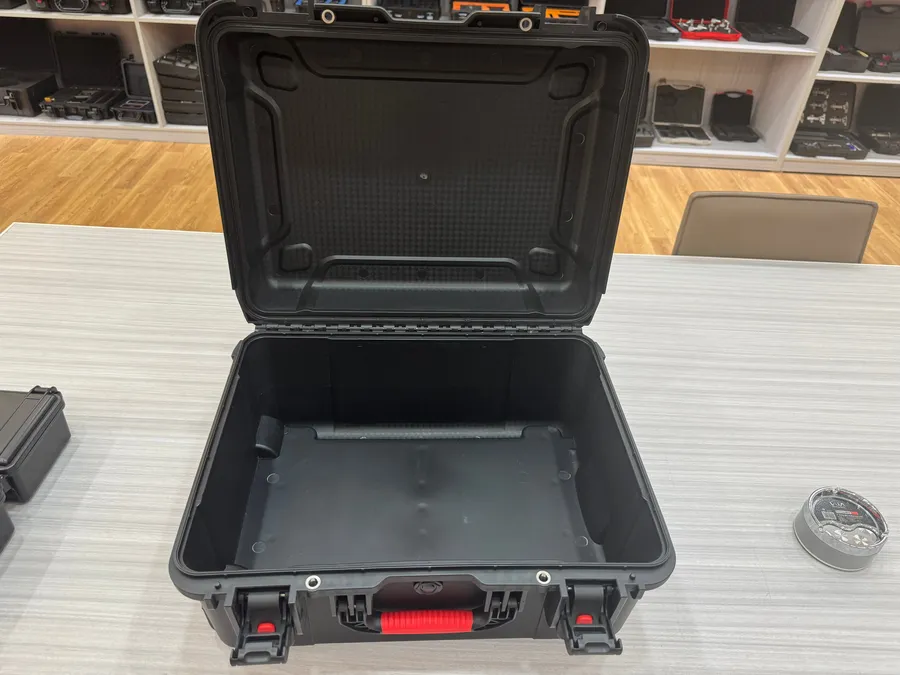
Internal vs external dimensions are the two different envelopes printed on the same model sheet, and they answer two different questions. Internal dimensions are the empty space inside the shell: on KX-1204 that is 115 x 78 x 32 mm, and it is the number that decides whether your device, its cabling and its foam actually fit. External dimensions are the outside of the closed case: 120 x 90 x 40 mm for the same model, and it is the number that decides cartons, pallet footprints, stacking and freight volume. The gap between them is not slack; on our published sheets it ranges from 5 mm on the length axis of a small utility shell to 130 mm on the length axis of KX-97227, and it is consumed by wall thickness, the moulded rim, latch and handle recesses, wheel housings and tapered corners. Buying against the wrong set is the single most common dimension error we see: a buyer who sizes to the external numbers gets a case that will not close over the kit, and a buyer who ships to the internal numbers pays freight on air.
Key points
- Size the equipment against internal dimensions and size the shipment against external dimensions; the two numbers are not interchangeable.
- On our published sheets the internal minus external delta runs from 5 mm on a small shell length axis to 130 mm on KX-97227 length.
- Lid depth plus base depth equals the published internal height, so 320 + 44 mm gives the 364 mm interior of KX-88442.
- Where a sheet publishes a narrow internal width, it is the real limit: 70 mm against 78 mm on KX-1204 and 127 mm against 135 mm on KX-2005.
- Model sheets print three volumes, external, internal and usable interior, and usable is the one to compare with a packed kit.
- Freight is quoted on the carton, not on the interior: KX-2805 ships 32 shells of 280 x 230 x 53 mm in one 570 x 470 x 435 mm carton.
The two envelopes printed on one model sheet
Internal dimensions measure the cavity you can put things into. External dimensions measure the object your supplier, your forwarder and your warehouse all handle. Both are printed on every model sheet we publish, on all 155 models in the product data, because they are used by different people for different decisions. The equipment engineer needs the internal length, width and height, plus whatever the interior actually offers once foam is in place. The purchasing and logistics team needs the external length, width and height, the net weight, and the carton that the shells nest into. A third group, the people who build racks, trolleys and vehicle fittings, usually needs both: the external size to know the case will sit in the bay, and the internal size to know the bay is worth building. When a buyer quotes only one number to us, most of the rest of the specification conversation is spent working out which envelope they actually meant, which is why this pair deserves its own page rather than a footnote.
Internal vs external dimensions on real published model sheets
The table below takes the figures exactly as they are published in our product data and shows the subtraction, because the subtraction is the teaching point. Every line is a real model, not a composite, and nothing here is generalised to the rest of the range.
| Model | External Mm | Internal Mm | Delta Length Width Height Mm | Wall Thickness Mm | Lid And Base Mm |
|---|---|---|---|---|---|
| KX-1204 (0 Series, PP) | 120 x 90 x 40 | 115 x 78 x 32 | 5 / 12 / 8 | 2.6 | 16 + 16 |
| KX-2005 (0 Series, PP) | 195 x 170 x 46 | 190 x 135 x 40 | 5 / 35 / 6 | 2.0 | 20 + 20 |
| KX-3113 (9 Series, engineering PP) | 313 x 282 x 129 | 296 x 258 x 121 | 17 / 24 / 8 | 2.9 | 83 + 38 |
| KX-83612 (8 Series, PP) | 364 x 320 x 118 | 330 x 260 x 103 | 34 / 60 / 15 | 3.3 | 75 + 28 |
| KX-6621 (9 Series, engineering PP) | 662 x 495 x 210 | 587 x 434 x 192 | 75 / 61 / 18 | 6.0 | 43 + 149 |
| KX-97227 (T Series, engineering PP, 2 wheels) | 720 x 500 x 270 | 590 x 435 x 210 | 130 / 65 / 60 | 6.0 | 42 + 168 |
| KX-88442 (T Series, PP, 2 wheels) | 843 x 592 x 415 | 740 x 518 x 364 | 103 / 74 / 51 | 5.0 | 320 + 44 |
| KX-85835 (T Series, PP, 2 wheels) | 588 x 475 x 353 | 500 x 400 x 305 | 88 / 75 / 48 | 5.0 | 260 + 45 |
Where the missing millimetres actually go
The difference is not waste, and reading it is a skill. Two walls face each other on every axis, so a 2.0 mm wall on KX-2005 accounts for roughly 4 mm of the 5 mm length delta, and the rest is the moulded rim that the lid seals against. Width usually loses more than length, because that is where latches, hinge bosses and corner ribs sit: KX-2005 gives up 35 mm of width to a 5 mm loss on length, and KX-83612 gives up 60 mm of width against 34 mm of length. Height is governed by the lid and base geometry rather than by the wall, which is why our sheets publish lid depth and base depth separately: lid depth plus base depth equals the internal height, so 83 + 38 mm is the 121 mm interior of KX-3113, 42 + 168 mm is the 210 mm interior of KX-97227, and 320 + 44 mm is the 364 mm interior of KX-88442. On the wheeled transporters the delta jumps again, because wheel housings, a handle column and a deeper corner profile all sit outside the cavity. KX-97227 loses 130 mm of length and 60 mm of height to its hardware, and its published telescopic height of 485 mm shows a third envelope that exists only when the case is being moved rather than stored.
The narrow internal width is the number that catches buyers
A rectangular cavity is not rectangular all the way up. Injection-moulded shells draft their walls for release, carry corner ribs, and often run a step where the lid meets the base, so several of our sheets publish a narrow internal width alongside the internal width. On KX-1204 that is 70 mm against an internal width of 78 mm; on KX-2005, 127 mm against 135 mm; on KX-3508, 240 mm against 268 mm; on KX-2805, 175 mm against 190 mm; on KX-712, 220 mm against 250 mm. If your device is a block of known width, you must clear the narrow figure at the height where the device sits, not the maximum figure at the mouth of the shell. This is also where foam changes the arithmetic: a die-cut layout that fills the corner radius recovers part of a tapered section, while an egg-crate lid laid flat over a tapered cavity does not. When a buyer tells us an instrument is 76 mm wide and the internal width is 78 mm, the honest answer is that the fit depends on the narrow width and the foam drawing, not on the headline number.
Three volumes, and only one of them is usable
Our sheets print external volume, internal volume and usable interior volume in litres, and the spread between them explains most disappointment. KX-1204 publishes 0.4 litres external, 0.3 litres internal and 0.3 litres usable. KX-3113 publishes 11.4, 9.2 and 7.9. KX-6621 publishes 68.8, 48.9 and 39.1. KX-88442 publishes 207.1, 139.5 and 111.6, and KX-85835 publishes 98.6, 61.0 and 48.8. External volume is what the forwarder measures. Internal volume is the geometric cavity. Usable interior volume is the space that is realistically available after the shell geometry and a normal foam build are accounted for, and it is the figure a buyer should compare with the packed kit rather than with the bare device. A purchaser who sizes a 90 litre kit against the 139.5 litre internal volume of KX-88442 will be surprised, because the usable figure is 111.6 litres before anything else is added to the cavity. Compare volumes the way you compare dimensions: with the number that describes the space you will actually occupy.
Why the distinction costs money at freight time
Cartons are built from external dimensions, and pack quantities follow from that arithmetic. KX-2805 nests thirty-two shells of 280 x 230 x 53 mm into a 570 x 470 x 435 mm carton: two long, two wide, eight high. KX-2005 puts forty shells of 195 x 170 x 46 mm into 410 x 360 x 495 mm. KX-3508 ships twenty shells of 350 x 300 x 79 mm in a 730 x 615 x 428 mm carton, and KX-63912 ships ten shells of 389 x 295 x 120 mm in 625 x 405 x 635 mm. Larger models ship one or three to a carton: KX-97227 ships one in 715 x 515 x 280 mm, KX-96127 one in 640 x 625 x 280 mm, and KX-6621 and KX-65522 three each in cartons of 665 x 500 x 650 mm and 565 x 450 x 665 mm. This is why an interior change is nearly always free at the freight desk while an exterior change is not. We publish pallet quantities as calculated from the carton footprint against your pallet size rather than as one fixed number, and 20GP, 40GP and 40HQ loading figures are supplied with the quotation, because both depend on the configuration you order.
Which set to use for which buying decision
| Decision | Use This Number | Why |
|---|---|---|
| Will the device fit at all? | Internal length, width and height, then the narrow internal width where published | The cavity is the only envelope the equipment enters |
| Will the kit fit with foam? | Usable interior volume in litres, plus the foam drawing | Internal volume is geometric; usable volume is what a filled shell offers |
| Will it sit in a rack, bay or trolley? | External dimensions, plus telescopic height where a handle is published | The bay receives the outside of the case, not the cavity |
| What will we pay to ship it? | Carton size and pieces per carton, derived from external dimensions | Freight and pallet footprint are calculated on the packed carton |
| Can we stack cases in the store? | External height and the published stackable flag for that model | Stacking is a shell and lid geometry question, and stack load is not measured on our sheets |
How to state both sets so an enquiry can be answered once
A short example makes the difference concrete. A buyer with a 300 x 250 x 110 mm analyser and its charger is not looking for a case with 300 mm of internal length on a marketing photograph; they are looking for a published internal set that clears 300 x 250 x 110 mm with foam allowance added, a narrow internal width above 250 mm where the sheet states one, and a carton that their forwarder can group. On the numbers above, KX-3113 gives 296 x 258 x 121 mm internal, which is 4 mm short on length for that kit, so the right answer is either a re-oriented layout, a different model, or a conversation about tooling. Sending the actual three numbers in that format is what lets us give that answer in one reply instead of four.
What we do not measure, and why that is separate from size
Dimensional data and performance data come from different files in our product data, and we keep them apart deliberately. Every model sheet publishes external and internal dimensions, wall thickness, lid and base depth, narrow internal width where it exists, the three volumes and net weight, and those are the fields a fit decision can be built on. The protection fields on the same sheets are recorded as not measured, no IP code is stated, and the impact note for a model gives its wall thickness with no drop height claimed without a test; stack load and load capacity are likewise recorded as not measured. Where a buyer needs a laboratory report, accredited third-party testing is quoted per configuration. If you are comparing two models on dimensional grounds, use the dimensional fields. If a tender asks for a performance statement, ask us for the testing route rather than reading one into a wall thickness figure.
Who asks this question, and how to send us your numbers
This comes up most often on electronics and instrument programmes, where a device specification is finished before anyone has thought about transport, and on distributor catalogues, where the printed size has to serve both the shelf and the carton. KeXin New Materials (Guangdong) Co., Ltd. supplies wholesale buyers and runs OEM and ODM programmes on EXW or FOB terms; we do not sell retail, do not offer DDP and hold no overseas warehouse stock. Published commercial parameters are 45 days for OEM work on an existing mould, 125 days for a new mould with MOQ from 3,000 per component, MOQ 1 for standard units and for custom foam, and payment as 30 percent deposit with the balance after inspection; third-party factory audits are welcome. Send the two sets of numbers you already have and tell us which decision they serve. Fred Zhao or the KeXin Sales Team will confirm which published model clears your kit, and WhatsApp +86 135 3588 0002 reaches the same desk.
Customisation
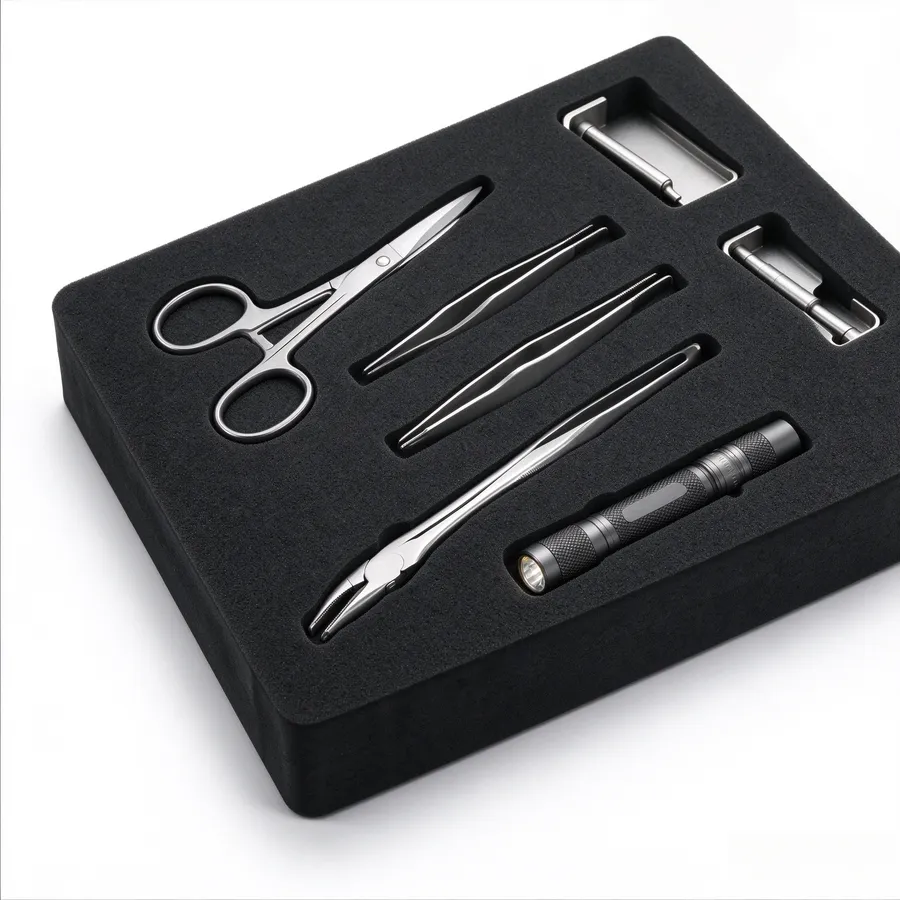
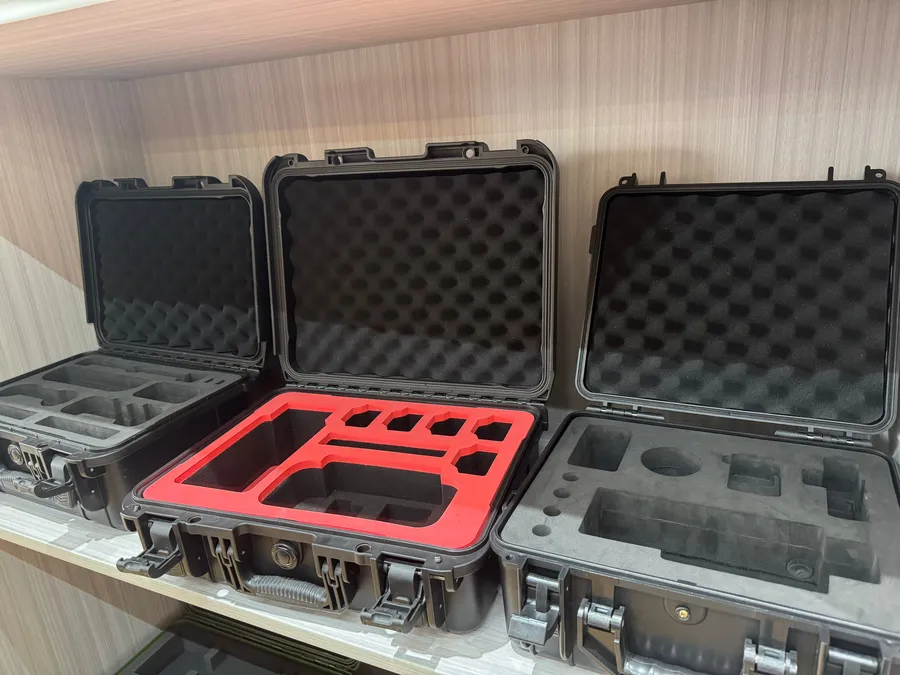
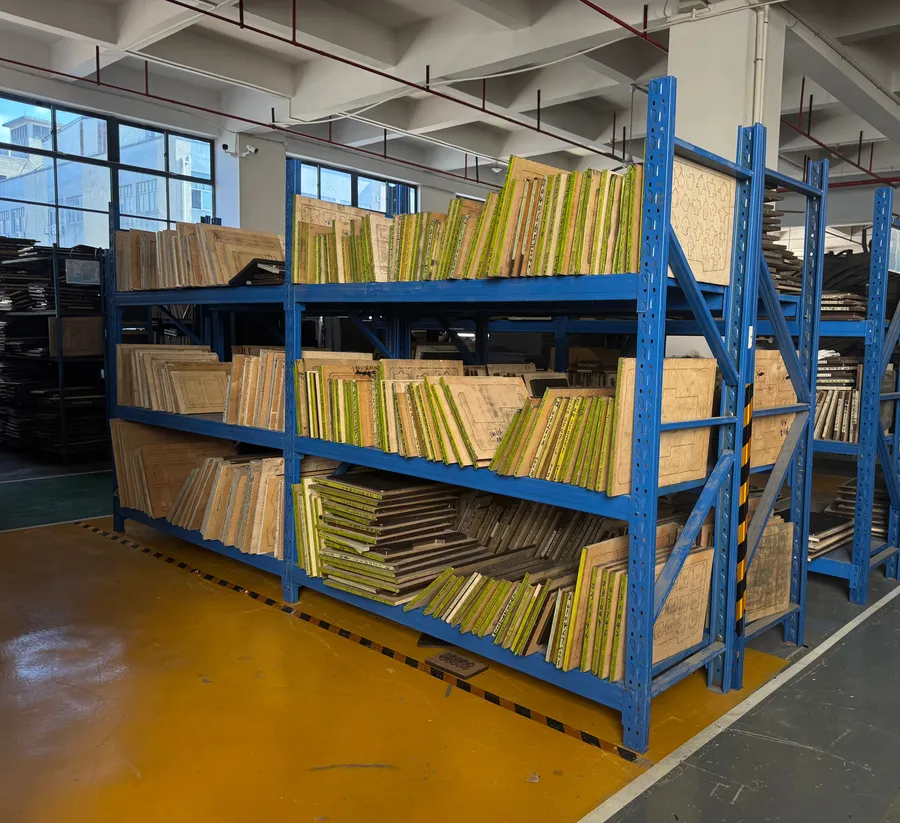
Everything described above is configurable on a standard shell: interior layout (pick-and-pluck, die-cut or CNC-cut), foam grade and thickness, colour, logo method, latch and lock count, pressure-equalisation valve, cable ports, document holder and identification plate. A bespoke exterior geometry requires a new mould — 125 days, from 3,000 units per moulded component.
Procurement considerations
| Question | What to send us |
|---|---|
| Which shell fits? | Equipment L × W × H as packed, plus required clearance per axis |
| What does it cost? | Order quantity and estimated annual quantity — the two drive different answers |
| Is tooling needed? | Whether an existing shell clears the envelope with usable foam depth |
| Lead time? | Your required delivery date, not just the order date |
| Certification? | The exact standard your tender names — we will say whether we can test to it |
| Freight? | Destination and preferred terms; carton and pallet data supplied with the quotation |
Comparison and selection guide
The tables on this page exist because a protective case is chosen by comparing three things: the envelope, the environment and the handling chain. Where no table applies, the rule below is.
| Situation | What To Do |
|---|---|
| Fastest | Standard shell plus CNC foam — typically 45 days from approved drawing. |
| Branded | Standard shell plus custom colour and logo — MOQ applies to the resin colour. |
| Bespoke geometry | New mould — 125 days, MOQ from 3,000 units per component. |
- Size on internal dimensions plus clearance, never on a product name.
- Choose the carrying method before the shell: it changes the series, not just the price.
- Specify the interior last, and decide up front whether the end user will reconfigure it.
What is internal vs external dimensions and why does it matter when buying a protective case? relates to Logistics & Packing Guide. Related families: Custom Protective Cases / Instrument & Equipment Cases / Electronics Cases / Equipment Transport Cases. Related sectors: field and industrial equipment. Continue in the Logistics & Packing Guide cluster.
This page is written from our own production data. If your requirement differs, send the dimensions and we will tell you which of the 155 models fits, or whether a custom route is needed.


