Packaging Solutions for Laboratory Equipment?
Packaging solutions for laboratory equipment are a three-layer system rather than a single box: a moulded hard shell that sets the internal volume, a cut-foam interior that holds each instrument in place, and an outer carton that lets the packed case stack on a pallet. The decision that decides whether a balance, microscope or sampler arrives intact is the fit between the instrument and the foam, not the shell alone. As the factory that moulds these shells we publish measured internal and external dimensions, wall thickness and net weight per model, so a lab buyer can size the cavity from the datasheet instead of guessing, and we quote a cut-foam layout against a drawing, a photograph of the packed kit, or a physical sample.
Key points
- Size the case from the published internal dimensions (L x W x H in mm) of one named model, not from its external footprint.
- Ask for a cut-foam layout before a price: the interior, not the shell, is what stops an instrument shifting in transit.
- Pick lid-to-base depth by the tallest assembled item; several models publish lid depths above 70 mm on a 455 mm base.
- Thicker PP and ABS walls raise mass, not a rating; we publish wall thickness in millimetres per model and nothing more.
- Protection ratings are recorded as not measured; we will arrange accredited testing on request as a separate work package.
- We supply wholesale and OEM/ODM only on EXW or FOB terms, with a 30% deposit and the balance settled after inspection.
Packaging Solutions for Laboratory Equipment: What the Term Covers
In a hard-case catalogue, packaging solutions for laboratory equipment means the whole unit that leaves the factory: the moulded shell, the interior that cradles the device, and the outer carton that protects the shell itself during export handling. It does not mean a rating printed on a label. What we can state for each model are measured figures - internal length, width and height, wall thickness, and net weight - taken from our own production data, and we publish them per model so a lab or a distributor can match a cavity to a specific instrument rather than to an average case.
The Three Layers, and the One That Decides the Outcome
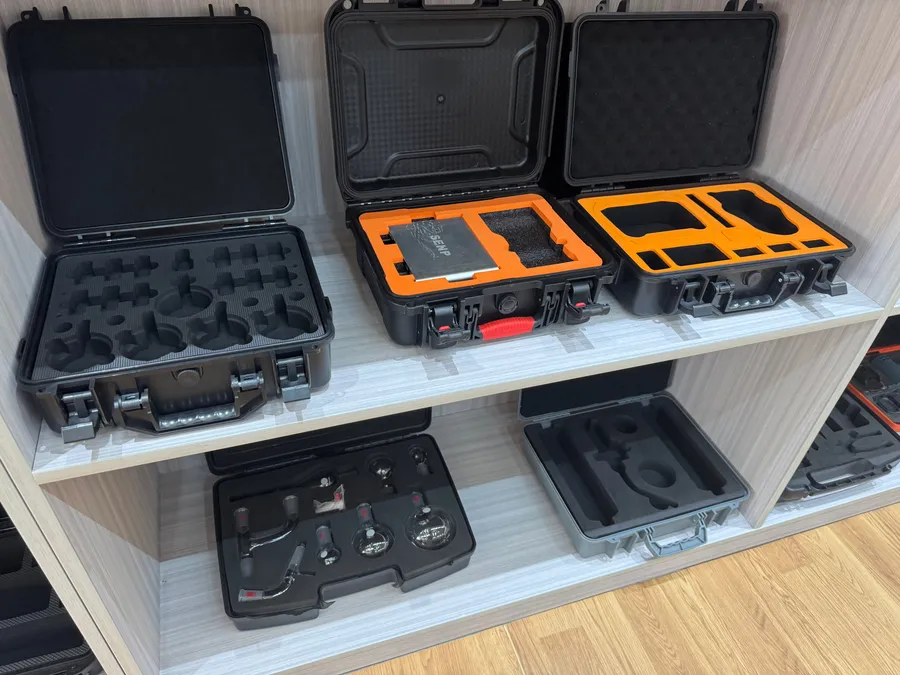
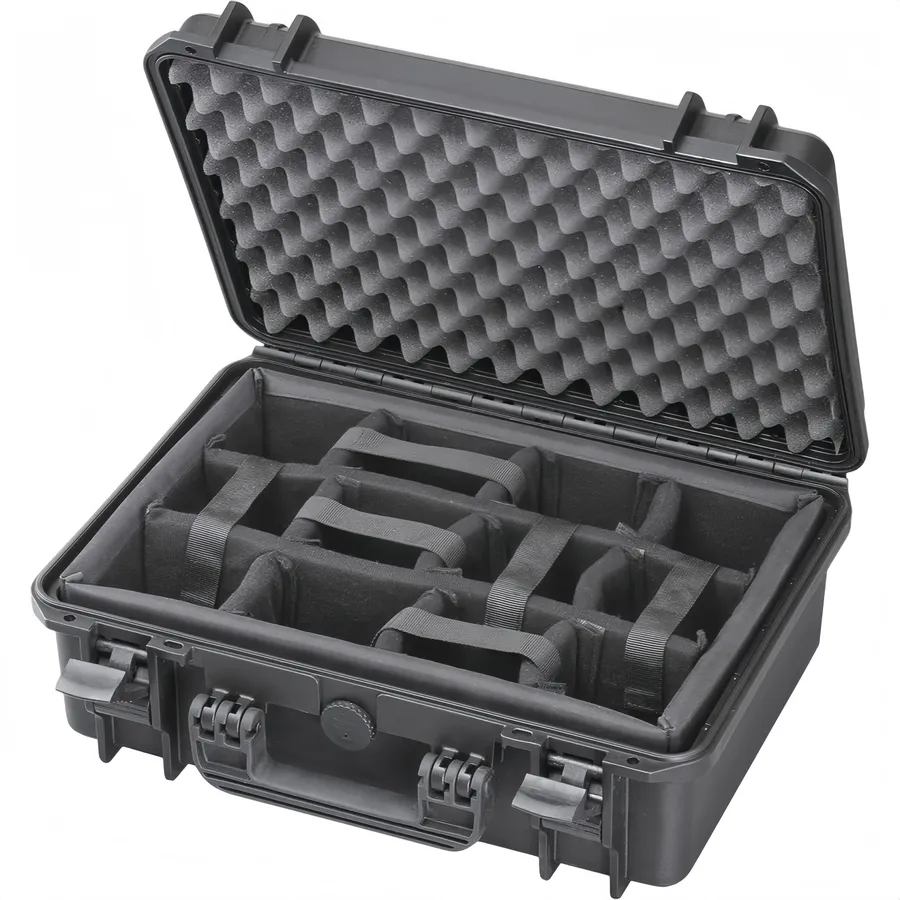
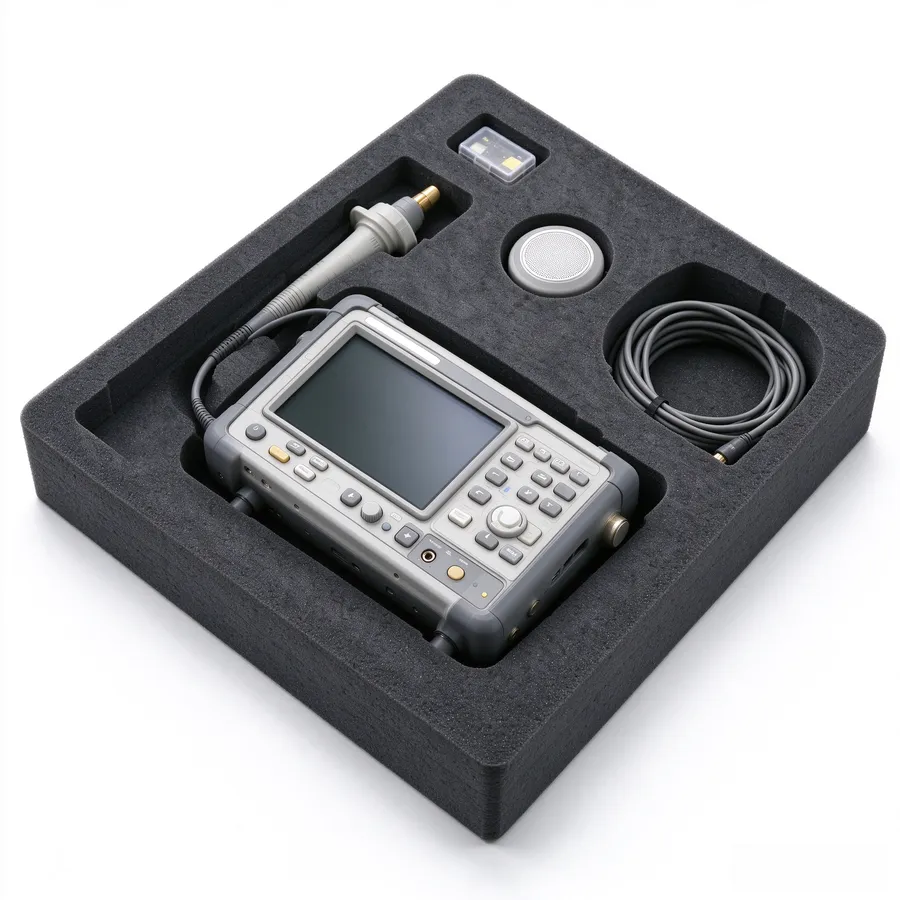
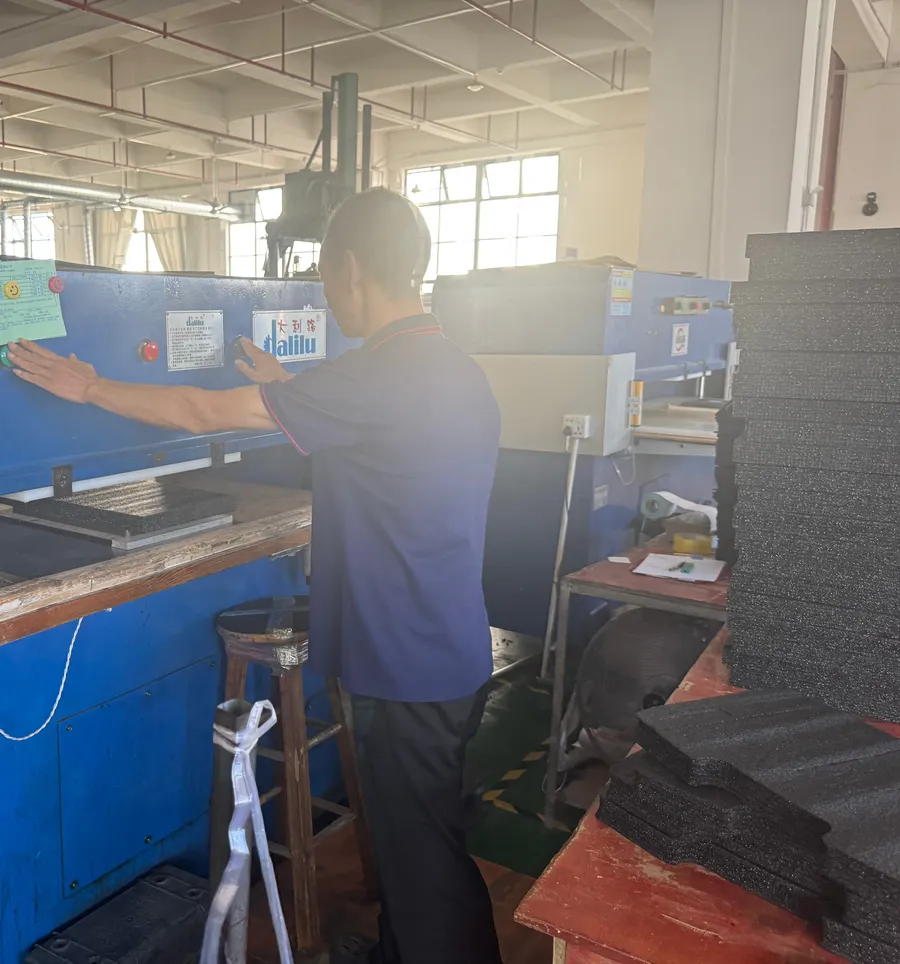
Layer one is the shell: injection-moulded polypropylene on most small and mid models, and ABS on the deeper instrument shells, with wall thickness we record in millimetres. Layer two is the cut-foam interior, chosen in cross-linked PE, EVA or EPS by zone, and cut by pick-and-pluck, die-cut or CNC to the outline of the actual device. Layer three is the outer carton, which carries the pallet stack mark and lets cases sit square against each other. The layer that decides whether a sensitive instrument survives is the second one; a correctly cut interior holds the mass still, spreads any point load across a face, and keeps two instruments from touching.
Published Internal Sizes for Representative Instrument Listings
These figures are published per model and describe that model as it leaves us; they are not a range applied to the whole line. Use the internal height column first: on a 455 mm base, KX-4610 gives an 84 mm cavity while KX-4616 gives 148 mm, which is the difference between a flat-packing a set of analysers and standing them up. Wall thickness and net weight rise together as the shell deepens, so a heavier case is a deeper or thicker shell, not an automatic claim of a higher protection class.
| Model | Internal L X W X H (Mm) | Wall (Mm) | Net Weight (G) | Internal Volume (L) |
|---|---|---|---|---|
| KX-2614 | 240 x 200 x 120 | 2.2 | 460 | 5.8 |
| KX-3308 | 325 x 236 x 76 | 2.3 | 575 | 5.8 |
| KX-4610 | 455 x 338 x 84 | 3.0 | 1115 | 12.9 |
| KX-4616 | 455 x 338 x 148 | 3.0 | 1395 | 22.8 |
| KX-64114 | 378 x 307 x 120 | 4.0 | 2100 | 13.9 |
| KX-64120 | 378 x 307 x 187 | 4.0 | 2640 | 21.7 |
| KX-85827 | 500 x 400 x 220 | 5.0 | 7800 | 44.0 |
How to Choose a Case for One Piece of Lab Equipment
Start with the assembled footprint of the instrument, including anything that cannot be taken apart, then add a foam margin on every face rather than a single number. Measure the tallest item to decide the lid-to-base split; several models publish an unbalanced split, for example a 74 mm lid over a 74 mm base on KX-4616, which suits a device that stands, while a shallow 42 mm base on KX-4610 suits flat trays. Decide whether accessories share the cavity or travel in a second case, because a sampler packed with its reagent rack needs a different interior from the sampler alone. Finally weigh the loaded case against the handling it will face on site.
Sealing, Condensation, and What We Do Not Claim
Some shells are offered with a compressible gasket as a configuration option; where a model lists a seal, the gasket is EPDM or an equivalent, and where it lists none, we do not print a rating for it. We record ingress and impact protection as not measured for these models and state no test value we have not run. What we do publish is dimensional and mass data. If a procurement requires a stated protection class, we will quote accredited third-party testing against a named standard as a separate work package, and report the result that comes back rather than assuming it.
Customising the Packaging for a Single Instrument
Custom work is the normal route for a lab line rather than the exception. We cut foam to a drawing, a photograph of the packed kit, or a physical sample, and we can add a logo or a body colour on a custom shell. Tooling and minimums are fixed business parameters: a custom-foam layout can start from a single case, while a logo or a colour change carries a minimum of 300 units, an existing-mould OEM build runs on a 45-day lead time, and a brand-new mould runs to 125 days with a minimum from 3,000 pieces per component. None of this changes the published dimensions; it changes the interior and the finish.
Procurement Notes and the Figures We Do Not Publish
We are a wholesale and OEM/ODM supplier and quote on EXW or FOB terms only; we do not sell retail, do not offer DDP, and do not hold overseas stock. Payment is a 30% deposit with the balance settled after your inspection, and third-party factory audits are welcome. Carton, pallet-quantity and container-loading numbers are supplied with your quotation and computed from the carton footprint against your pallet size, so we do not print a one-size figure here. For sizing and a quote, contact Fred Zhao or the KeXin Sales Team, or reach us on WhatsApp +86 135 3588 0002.
Customisation
Everything described above is configurable on a standard shell: interior layout (pick-and-pluck, die-cut or CNC-cut), foam grade and thickness, colour, logo method, latch and lock count, pressure-equalisation valve, cable ports, document holder and identification plate. A bespoke exterior geometry requires a new mould — 125 days, from 3,000 units per moulded component.
Procurement considerations
| Question | What to send us |
|---|---|
| Which shell fits? | Equipment L × W × H as packed, plus required clearance per axis |
| What does it cost? | Order quantity and estimated annual quantity — the two drive different answers |
| Is tooling needed? | Whether an existing shell clears the envelope with usable foam depth |
| Lead time? | Your required delivery date, not just the order date |
| Certification? | The exact standard your tender names — we will say whether we can test to it |
| Freight? | Destination and preferred terms; carton and pallet data supplied with the quotation |
Comparison and selection guide
The tables on this page exist because a protective case is chosen by comparing three things: the envelope, the environment and the handling chain. Where no table applies, the rule below is.
| Situation | What To Do |
|---|---|
| Benchtop mass | Firm base carrier, 50 mm minimum, with a soft contact layer. |
| Optical head | Suspend the body and clear the lenses entirely; never let foam touch a coated surface under load. |
| Field kit | CNC base for the instrument, pluck-foam top for probes and consumables. |
- Size on internal dimensions plus clearance, never on a product name.
- Choose the carrying method before the shell: it changes the series, not just the price.
- Specify the interior last, and decide up front whether the end user will reconfigure it.
Packaging Solutions for Laboratory Equipment? relates to Logistics & Packing Guide. Related families: Instrument & Equipment Cases / Custom Protective Cases / Equipment Transport Cases / Medical Equipment Cases / Rolling Cases. Related sectors: field and industrial equipment. Continue in the Logistics & Packing Guide cluster.
This page is written from our own production data. If your requirement differs, send the dimensions and we will tell you which of the 155 models fits, or whether a custom route is needed.


