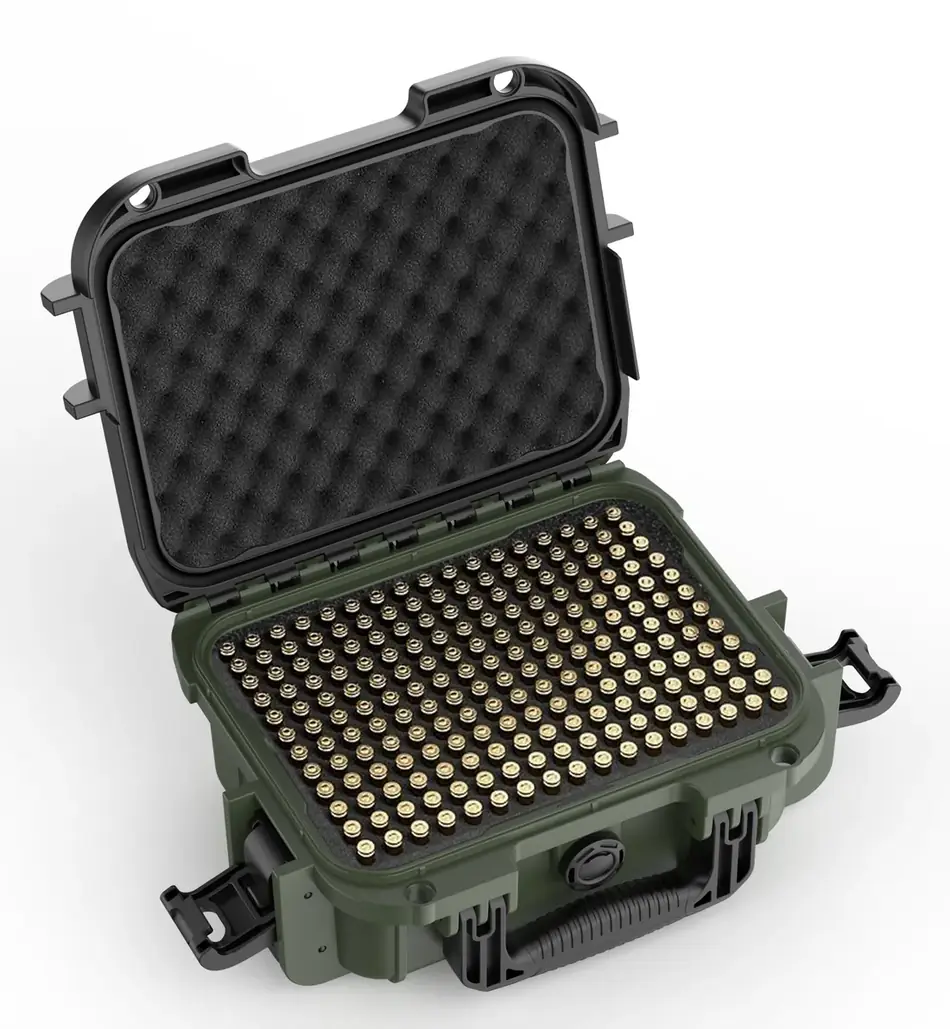
What is case latches and why does it matter when buying a protective case?
A case latch is the closure that holds the lid against the base, and it is the part that decides whether the case stays shut under handling, whether a gasket is compressed evenly, and whether the equipment can be secured with a padlock. On our file of 155 models, the latch is one of the most quietly specified components: 155 of 155 listings carry the hardware note that the latch body accepts a standard padlock, recorded as measured, while the same 155 listings publish the latch itself as count specified per configuration - meaning no numeric latch count exists on any listing. That combination is why latches matter when buying. A closure that cannot be counted, graded or compared from a catalogue has to be settled in the order text, and the published geometry that drives it is available: lid and base depth on 100 of 155 listings, wall thickness from 2.0 mm to 6.0 mm on 148, and internal volume from 0.3 L to 139.5 L across the range.
Key points
- A latch does three jobs at once - holds the parting plane closed, compresses the seal where one exists, and provides the security interface for a padlock.
- 155 of 155 listings state that the latch body accepts a standard padlock, recorded as measured; no padlock supply is implied by that field.
- Latch count is published as specified per configuration on 155 of 155 listings, so a numeric count from any supplier catalogue is an assumption.
- Rim length is the number you can check instead: published longest edges run from 120 mm to 1,356 mm and internal volume from 0.3 L to 139.5 L.
- On 124 of 155 shells the latch works against a compressible gasket in a continuous moulded channel; on 31 there is no seal to compress.
- Custom hardware is available on 155 of 155 listings, so changing a latch type or count is an order-text decision rather than a special request.
What case latches are, in plain terms
If the hinge is the reference edge of a protective case, the latch is the force that keeps that reference honest. It is the fitting, usually on the edge opposite the pivot, that pulls the lid down onto the base and holds it there. Three things depend on it. The first is retention: a case in transit is shaken, bumped and occasionally dropped onto its corners, and the latch is the only component whose job is to stay closed through that. The second is the seal line, because on the shells that have one, the lid is only as tight as the compression the closures put into it. The third is security, and that is the latch attribute our file does publish uniformly - on 155 of 155 listings the hardware section records that the latch body accepts a standard padlock, entered as measured.
That last point is worth separating from marketing. A padlock-ready latch is an interface: a hasp or body shaped so a shackle can pass through it and a chain or padlock can close the case. It says nothing about the strength of the fitting, the material grade or the tool used to open it, none of which our listings publish either. It does mean the security conversation is possible on any model in the range, which for distributors selling into depot, law-enforcement or field-service use is a practical baseline rather than a feature.
What a buyer asks about latches, and what our file can answer
Read as a set, those rows say something useful about the market rather than only about us. Latches are the closure category where buyers most often assume a specification exists, because every catalogue shows a photograph of them. What a catalogue cannot show is the count on your shell, the material grade, the spacing or whether the fitting is bolted or riveted - and on our file none of those four is a published number. Where a purchase decision genuinely depends on them, it belongs in the order text, confirmed against the exact model rather than the series page.
| Buyer Question | What Our File Publishes | Why It Matters When Buying | What To Confirm In Writing |
|---|---|---|---|
| How many latches are on the case? | Count specified per configuration on 155 of 155 listings; a numeric count on 0 | Number and spacing decide how evenly the lid is pulled down | Latch count and positions for the exact shell being ordered |
| Can the case be locked? | Latch body accepts a standard padlock on 155 of 155 listings, measured | Chain of custody, depot storage and border or yard inspection | Whether padlocks are supplied, and by whom |
| What are the latches made of? | Hardware material as metal or polymer by configuration; no grade published | Corrosion at the release spring is what seizes a closure | Material and finish for the service environment |
| Do they compress a seal? | Compressible gasket in a continuous moulded channel on 124 of 155; 31 state no seal offered | Uneven closure force leaves one corner of a seal line unloaded | Whether your shell is one of the 124 or the 31 |
| How much wall do they grip? | Wall thickness on 148 of 155 listings, 2.0 mm to 6.0 mm, median 3.9 mm | A latch loads the moulding around its fixing, not the latch alone | Wall thickness and boss arrangement on the shipped batch |
| Can a broken latch be replaced? | Fixing method and serviceability on 0 of 155 listings | Determines whether a fleet case is repaired or written off | Fixing type and whether spares are stocked for your shell |
Latch count is a rim-length question, and here is the number you can check
Because our listings publish latch count as a configuration answer, the honest way to reason about closures is geometry, which we do publish. Across the 155 models, published internal volume runs from 0.3 L on KX 1204 to 139.5 L on KX 88442, with a median of 17.5 L, and the longest external edge across the file runs from 120 mm to 1,356 mm with a median of 432 mm. Rim length is what a closure system has to hold down, so a 120 mm utility box and an 843 mm trolley are not in the same conversation. Two further fields do the rest of the work: wall thickness, published on 148 listings from 2.0 mm to 6.0 mm, tells you how much moulding a latch fixing can bite into, and the lid-and-base split on 100 listings tells you how deep the engaged wall is behind the closure - base depth runs from 15 mm to 168 mm with a median of 44 mm.
The engineering reason spacing matters more than the count is that a lid is a stiff panel held down at discrete points. Between two closures the rim deflects, and the further apart they are, the more the parting line opens under load - which is exactly where a gasket stops being compressed. That is why we treat latch count as a drawing item alongside the hinge edge: on 124 of 155 listings there is a continuous moulded channel to compress all the way around, and the closures are what hold it shut. On the 31 shells that state no seal is offered, the same question becomes simpler: retention only, with no compression path to protect.
Five published shells, five different closure briefs
The spread is the point. KX 1204 and KX 88442 are both latch-present shells in the same catalogue, but the second is fifty times the volume and more than a hundred times the empty shell mass at 15,320 g, with a lid depth of 320 mm that no small box ever asks of a closure. KX 97227 shows the opposite failure of intuition: it is one of only 6 listings where the base is the deeper half, so the closures are retaining a shallow lid over a deep, heavy body whose contents sit below the parting plane. KX 3315, at 1,670 g empty with a 100 mm lid, is the shape most buyers actually order, and it is the size where an assumed single-point closure starts to matter, because the lid acts as a lever whenever the case is carried by its top edge.
| Model | External Mm | Lid + Base Mm | Wall Mm | Net Weight G | Internal L | What The Closure Has To Do |
|---|---|---|---|---|---|---|
| KX 1204 | 120 x 90 x 40 | 16 + 16 | 2.6 | 100 | 0.3 | Short rim, shallow lid; one closure keeps a light cover seated |
| KX 3607 | 360 x 310 x 70 | 30 + 30 | 3.0 | 800 | 6.0 | Even split and a published gasket channel needing even compression |
| KX 2811 | 280 x 225 x 111 | 71 + 27 | 5.0 | 890 | 4.5 | Thick wall on a small footprint; the lid is the deeper half |
| KX 3315 | 334 x 287 x 150 | 100 + 35 | 4.1 | 1,670 | 9.2 | A 100 mm lid means the closure resists a lever, not just a lift |
| KX 97227 | 720 x 500 x 270 | 42 + 168 | 6.0 | 10,000 | 53.9 | Long rim, thick wall, deep base carrying the contents; shallow lid |
| KX 88442 | 843 x 592 x 415 | 320 + 44 | 5.0 | 15,320 | 139.5 | Deepest published lid in the file, on a trolley that is not stackable |
Latch families a buyer will be told about, and what we do not state
In this category a buyer will usually be offered four families. Draw-buckle or tension-buckle closures use a catch pulled tight by a lever and are what people mean when they talk about compression on a sealed lid. Over-centre toggle latches lock mechanically past their dead point and resist opening from vibration, but transmit every impact into their fixing. Simple flip or snap catches are quick and cheap, need no clearance around the handle, and are the common choice on shallow utility shells. Lever or butterfly closures sit between the two, giving a larger grip for gloved hands. On top of these, a padable hasp or a latch body shaped to accept a shackle is what turns any of the four into a securable closure - and that interface, as noted, is the one latch attribute our file states across all 155 models.
We do not state which of those families is fitted to any of the 155 models, because our listings do not record it; latch type, material grade, spring design and release tool are absent from the file in the same way latch count is. What we can specify is what you want fitted, since custom hardware is available across the catalogue. That inversion is worth remembering when comparing suppliers: whoever answers latch type from a series name is reading a photograph, and whoever asks for your service conditions before answering is treating it as an engineering item.
Choosing the closure by how the case is really used
Start from the handling profile rather than the fitting. A case that spends its life stacked in a truck or a container is loaded from above, and here the published fields help: 136 of 155 listings are marked stackable, all 155 carry a fixed folding handle, and the remaining 19 - the trolley shells that add two wheels and a telescopic handle - are the only listings marked not stackable. A stacked case needs closures that keep the lid seated while the shell above carries weight on the lid itself. A trolley, by contrast, is tilted and pulled, which puts a peeling force on the closure at the top edge, and that is where a mechanical over-centre arrangement or a buckle earns its extra seconds of opening time.
Then layer on the operational facts. Field and communication crews open cases with gloves and in wind, so the release action and the grip size matter more than the grade. Depot, ammunition-transport and custody use starts from the padlock interface, which is uniform across the range, and moves to how many closure points the shell has. Medical and laboratory use asks about cleanability - a lever with crevices is a different day from a flush catch. And high-frequency access, such as a drone ground station opened twenty times a shift, is the case where serviceability should be specified up front, because no open-close cycle figure is published on any of our 155 models and a repairable fixing is worth more than an unverifiable number.
What the latch does to the seal line
The interaction people under-weight is between the closures and the gasket. On 124 of 155 listings our file records a compressible gasket in a continuous moulded channel, described as EPDM or equivalent by configuration, and the word that does the work is continuous: the seal path runs all the way around, past the hinge edge and behind every latch. Compression is what makes that path tight, and compression comes from closure force spread along the rim. Too few points, or points set too far apart, and the rim between them relaxes; too much force on one corner of a thin-walled shell, and the moulding deforms instead of the gasket seating. Neither failure is visible on the day the cases arrive, and both look like a seal problem afterwards.
On the 31 listings that state no seal is offered, none of this applies, and the closure is a pure retention question - simpler to specify, and cheaper, which is why the count of sealed versus unsealed shells belongs in a buyer's comparison from the start. The practical conclusion is that a latch question and a seal question are one conversation. If your brief mentions dust, damp, a wash-down or a custody seal, say so next to the shell, and we will answer closure count, gasket presence and hinge edge on the same drawing rather than as three separate catalogue features.
Customising closures, and what it costs in the schedule
For latches, as for hinges, the boundary is tool steel. Changing the fitting - type, count, material and finish, the release action, or a padable body - is a hardware specification on an existing moulding, and our listings record custom hardware as available on 155 of 155 models. That route runs against an OEM minimum of 300 pieces with first samples in 45 days. Anything that needs new bosses, a relocated rim or a different parting plane is a moulding decision: 125 days from 3,000 pieces per component. Logo and colour are also 300-piece items, foam keying starts from a single piece, and a standard catalogue shell can be ordered from one piece for evaluation, which is the cheapest way to test a closure brief before committing to a tool.
Commercially we are a wholesale and OEM or ODM manufacturer only, quoted on EXW or FOB terms, with no retail sales, no delivered-duty-paid pricing and no overseas warehouse stock. Production opens with a 30 per cent deposit and the balance settled after inspection, and third-party inspection or a factory visit is welcome at any point. Send the equipment list, the internal size you need or a photograph of the packed kit to Fred Zhao or the KeXin Sales Team, or reach us on WhatsApp +86 135 3588 0002 - KeXin New Materials (Guangdong) Co., Ltd.
What we do not claim about case latches
This page is meant to be usable as a benchmark, so the boundary of our record is stated plainly. We publish that a latch is part of the hardware on every model, that its body accepts a standard padlock on 155 of 155 listings, and that hardware material is metal or polymer by configuration. We publish no latch count, no latch type, no material grade, no pull-out strength, no release-cycle figure and no corrosion salt-spray result for any model, because none of those fields exists on our file. On the protection side the position is the same: the protection rating on all 155 listings is recorded as not measured and no ingress-protection code is stated, so we do not describe a closure as producing one, and where a procedure needs a figure we quote accredited third-party work on the exact shell as a separate package rather than narrating a result we have not obtained.
What we do publish, and what a buyer can hold us to, are the structural and commercial numbers used throughout this page: 155 models, external dimensions on all 155, lid and base depth on 100, wall thickness on 148 from 2.0 mm to 6.0 mm, net weight on 93 from 100 g to 15,320 g, internal volume from 0.3 L to 139.5 L, a seal offered on 124 shells, stackability on 136, and 19 trolley models with wheels and a telescopic handle. Ask us anything beyond that set and the correct answer is not measured, which is also the answer that keeps a specification honest.
Customisation
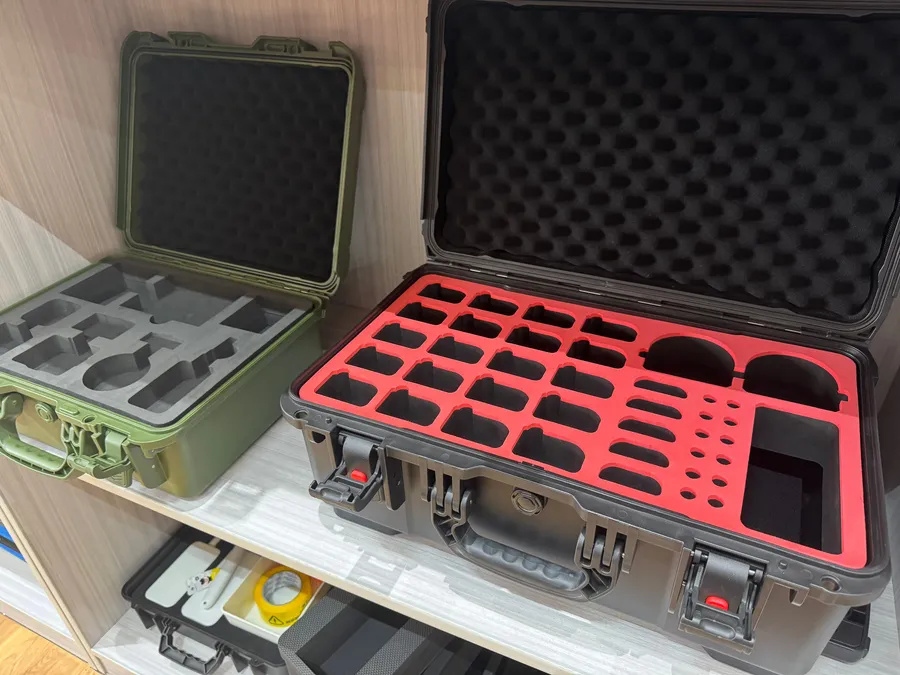
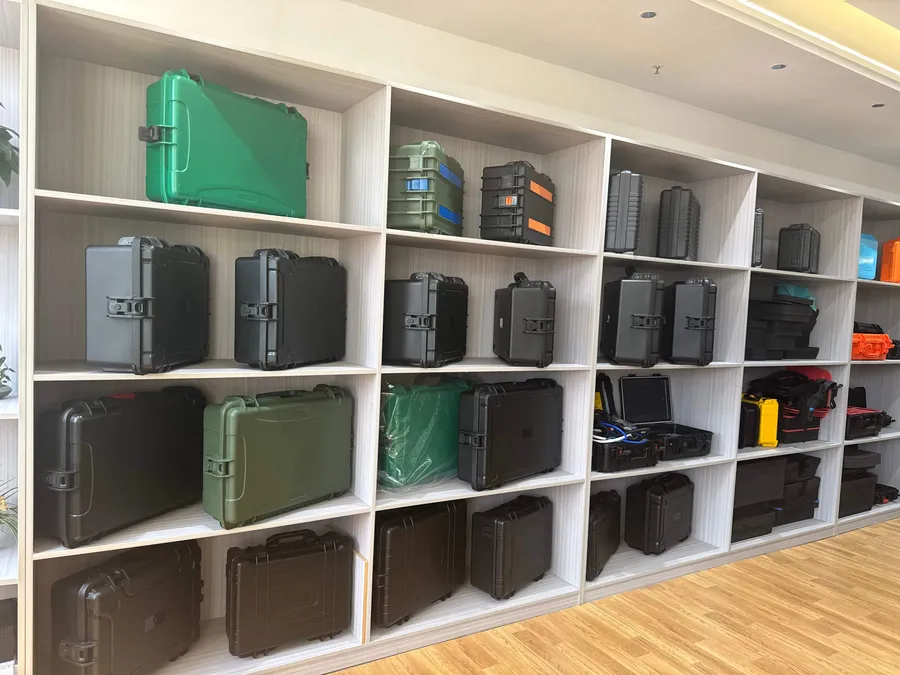
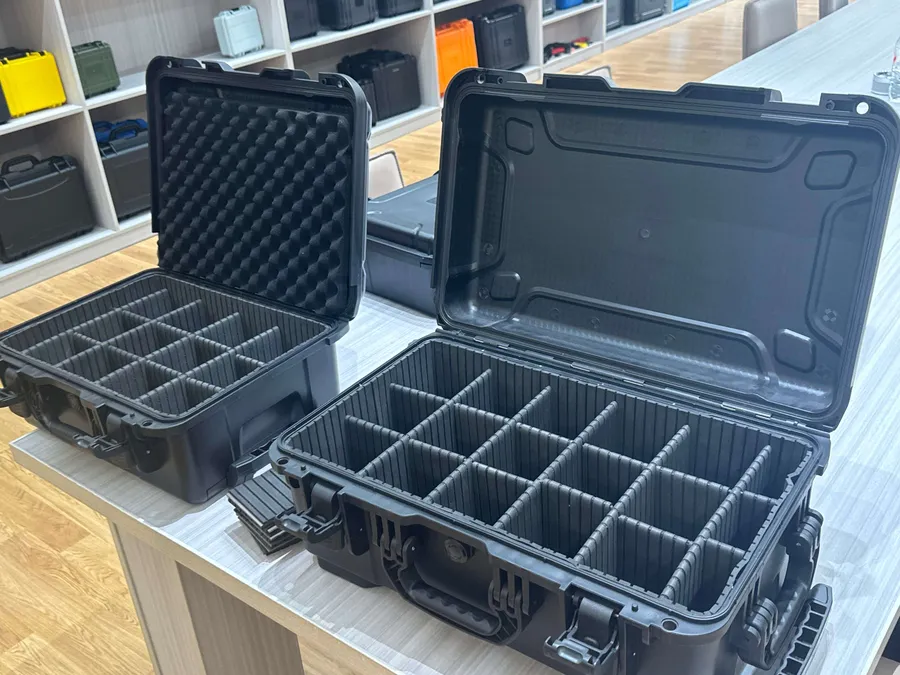
Everything described above is configurable on a standard shell: interior layout (pick-and-pluck, die-cut or CNC-cut), foam grade and thickness, colour, logo method, latch and lock count, pressure-equalisation valve, cable ports, document holder and identification plate. A bespoke exterior geometry requires a new mould — 125 days, from 3,000 units per moulded component.
Procurement considerations
| Question | What to send us |
|---|---|
| Which shell fits? | Equipment L × W × H as packed, plus required clearance per axis |
| What does it cost? | Order quantity and estimated annual quantity — the two drive different answers |
| Is tooling needed? | Whether an existing shell clears the envelope with usable foam depth |
| Lead time? | Your required delivery date, not just the order date |
| Certification? | The exact standard your tender names — we will say whether we can test to it |
| Freight? | Destination and preferred terms; carton and pallet data supplied with the quotation |
Comparison and selection guide
The tables on this page exist because a protective case is chosen by comparing three things: the envelope, the environment and the handling chain. Where no table applies, the rule below is.
| Situation | What To Do |
|---|---|
| Fastest | Standard shell plus CNC foam — typically 45 days from approved drawing. |
| Branded | Standard shell plus custom colour and logo — MOQ applies to the resin colour. |
| Bespoke geometry | New mould — 125 days, MOQ from 3,000 units per component. |
- Size on internal dimensions plus clearance, never on a product name.
- Choose the carrying method before the shell: it changes the series, not just the price.
- Specify the interior last, and decide up front whether the end user will reconfigure it.
What is case latches and why does it matter when buying a protective case? relates to Logistics & Packing Guide. Related families: Custom Protective Cases / Equipment Transport Cases / Ammunition Storage & Transport Boxes / Electronics Cases. Related sectors: field and industrial equipment. Continue in the Logistics & Packing Guide cluster.
This page is written from our own production data. If your requirement differs, send the dimensions and we will tell you which of the 155 models fits, or whether a custom route is needed.