Can case load capacity be customised for a specific piece of equipment?
Yes. Customising case load capacity for a specific piece of equipment is normal OEM work, and in most enquiries it is done on an existing mould - by choosing the shell, the wall section, the interior layout and the hardware set, not by inventing a number. What has to be true first is that the requirement is stated as a duty. Case load capacity is one phrase covering three different loads: content mass, the stack load a case receives in a rack or a container, and the handling load put through the handle, latches, hinges and wheels when someone lifts or drags it. Each of those is settled by a different part of the build. Our specification file publishes the fields that decide them for 155 models - internal boxes from 115 x 78 x 32 mm on KX-1204 to 740 x 518 x 364 mm on KX-88442, walls from 2.0 mm to 6.0 mm on 148 models, net weight on 93, and a stackable record on 155 with 136 recorded stackable. What it does not publish is a stack or payload figure in kilograms, because those fields are recorded as not measured. Where a tender needs one, we say so and put the specific build through an accredited laboratory against the method you name.
Key points
- Case load capacity is three loads, not one: content mass, stack load and handling load. Name which one you mean before asking for a figure.
- Our file publishes the load path for 155 models - internal box, wall from 2.0 to 6.0 mm, net weight on 93, stackable on 136 - but no stack or payload value.
- Deeper does not mean weaker: KX-3207, KX-3213 and KX-3218 share a 315 x 260 mm plan and differ only in height at 70, 128 and 180 mm.
- Send one physical unit with the drawing. A load answer built from a photograph and a weight is a guess with a quotation attached.
- The interior, not the shell, carries content mass. Foam structure and thickness are specified per configuration, and custom foam starts at 1 unit.
- Wheels and stacking are mutually exclusive in our data: the 19 models recorded with wheels are exactly the 19 recorded as not stackable.
- Hardware is the handling-load path: hinge, lock and feet are recorded as measured on all 155 models, while latch count is set per configuration.
- Load work on an existing mould sits inside the 45-day OEM sample route; only a new mould moves the clock to 125 days.
Yes - against a stated duty, not a borrowed figure
The question usually arrives as: my instrument weighs this much, my warehouse stacks four high, can you make a case that handles it. The honest answer is yes, and the work is mostly selection and configuration rather than engineering a new property into a moulding. Case load capacity is not a dial we turn on a drawing. It is the consequence of five decisions that are all visible in the published data: which mould, which wall section, which interior layout, which hardware set, and what the case is asked to sit under in your store. Change those five and the load behaviour changes with them. Promising a kilogram figure before those five are fixed is how a buyer ends up with a datasheet number that nobody in the chain can defend.
Two of those five decisions - stack load and payload in kilograms - are not fields we publish, because they are not fields we have measured. We will say that plainly in a tender response rather than write down a figure that came out of a sales conversation. What we can do is put the specific build through an accredited laboratory against a test method you name, and print what the report says about the configuration you actually ordered. That distinction is the whole of this page: customise the load path from published geometry, then prove the one build that matters, instead of borrowing a number from a catalogue.
Customising case load capacity for a specific piece of equipment: what the requirement has to contain
A load requirement becomes engineerable only when it carries six items. First, the equipment mass with its distribution: a 12 kg item whose mass sits at one end is not the same problem as a 12 kg item that is evenly loaded, and moulded feet plus a foam cradle respond to that difference. Second, the centre of gravity and any lift points the operator will actually use. Third, the handling regime - one-person lift, two-person lift, ramp, tail lift, or a case dragged across a yard. Fourth, the stowage plan expressed as a stack height and a stack mass: what sits above the case, and how high. Fifth, the environment, because whether the case lives on an indoor shelf, in a vehicle, or outdoors decides the seal and valve options rather than the load. Sixth, the number of configurations and the annual quantity, since a duty that appears in one build is solved with foam, while a duty that appears across a product family is solved with geometry or tooling.
Send those six and you get three things back: a model shortlist drawn from published fields, a list of what still has to be verified because it is not measured, and a quotation that separates shell, interior, hardware and, where you need it, third-party testing for that configuration. Send only a weight and a photograph and you get a price for a box, which is the failure mode this page exists to prevent. The reason is structural: content mass is answered by the interior, stack load by rim and lid geometry plus the stackable record, and handling load almost entirely by the hardware set. Three different parts of the case, three different evidence trails.
What our published model records state about load - and what they deliberately leave blank
Read the status column, not just the value column, in the table below. It is taken from the same geometry, hardware and protection records printed on our model pages, and it is the reason we do not quote a stack figure from a catalogue. Two fields that a buyer expects to carry a load number are recorded as not measured across all 155 listings. We are not going to convert an empty cell into a specification.
| Record Field | Status In Our File | Range | What It Decides |
|---|---|---|---|
| Internal box (L x W x H, mm) | Published for 155 of 155 models | 115 x 78 x 32 mm to 740 x 518 x 364 mm | The envelope your content mass has to fit inside, plus the foam clearance around it |
| Shell wall thickness | Published for 148 models | 2.0 mm to 6.0 mm, median 3.9 mm | The section the load travels through; the first line of any stack or crush discussion |
| Net weight of the empty shell | Published for 93 models | 100 g (KX-1204) to 15,320 g (KX-88442) | Handling load: the mass someone lifts before your equipment is added to it |
| Internal volume | Published for 155 models | 0.3 L to 139.5 L | The normaliser - mass per litre is the only fair way to compare two different moulds |
| Stackable | Published yes/no for 155 models | 136 recorded stackable | Whether your rack plan is allowed at all; it is geometry, not a kilogram value |
| Hinge, lock and feet | Recorded as measured on 155 models | Latch body accepts a standard padlock; latch count is a configuration option | Handling load - a lifted lid takes the whole content mass through these fittings |
| Wheels | Published per model in the hardware record | 2 wheels recorded on 19 transporter models, none on the other 136 | Which of the three loads dominates: rolling duty moves it off the handle onto wheels and axle |
| Stack load (kg) | Not measured on all 155 listings | No value published | Nothing here - commission it against your named method and configuration if a tender requires it |
| Load capacity (kg) | Not measured on all 155 listings | No value published | Nothing here - we describe content capability from geometry and interior, not from a rating |
| Shock and impact | Recorded as a configuration option on 155 models | Requires a specified foam layout; no drop height claimed without a test | Whether your shock problem is an interior question or a laboratory question |
| Ingress protection level | Recorded as not measured on all 155 listings | Seal type is recorded: a compressible gasket in a continuous moulded channel on 124 models | Nothing on this page - load and sealing are separate conversations with separate evidence |
| Pallet and container loading | Not measured in the file | Carton size and pieces per carton published for 64 models | Logistics load: calculated from the carton footprint against your pallet size, per order |
Same plan, different load problem: what the geometry columns let you change
This is the pattern our own file teaches most clearly. Three small shells share one footprint and differ only in height, and their published figures run in a clean line, so you can see which lever is actually moving. KX-3207 is 70 mm high with a 4.5-litre interior and a published net weight of 570 g; KX-3213 is 128 mm high, 8.4 litres, 860 g; KX-3218 is 180 mm high, 12.2 litres, 900 g. Going from the shallowest to the deepest of that family adds 110 mm of external height, 330 g of shell and 7.7 litres of room on the same plan area. If your equipment is tall rather than heavy, that is the route - not a heavier wall, and certainly not a new mould.
The same shape appears in the 466 x 387 mm family: KX-4710 at 102 mm high publishing 1,370 g over 14.2 litres, KX-4713 at 132 mm and 1,420 g over 19.0 litres, KX-4716 at 162 mm and 1,680 g over 23.7 litres. Depth is inexpensive in mass. What depth does not buy you is strength, and that is where the wall column earns its keep - but only read together with volume. KX-6621 is drawn at a 6.0 mm wall, publishes 6,420 g and encloses 48.9 litres, a dense thick-section box. KX-97227 is drawn at the same 6.0 mm wall, publishes 10,000 g across 53.9 litres, and is one of the 19 wheeled transporters, so it is a rolled-duty case at the same nominal section. That pair is the clearest argument in this entire page against selling wall thickness as if it were a load number.
Foam is where content mass actually lands
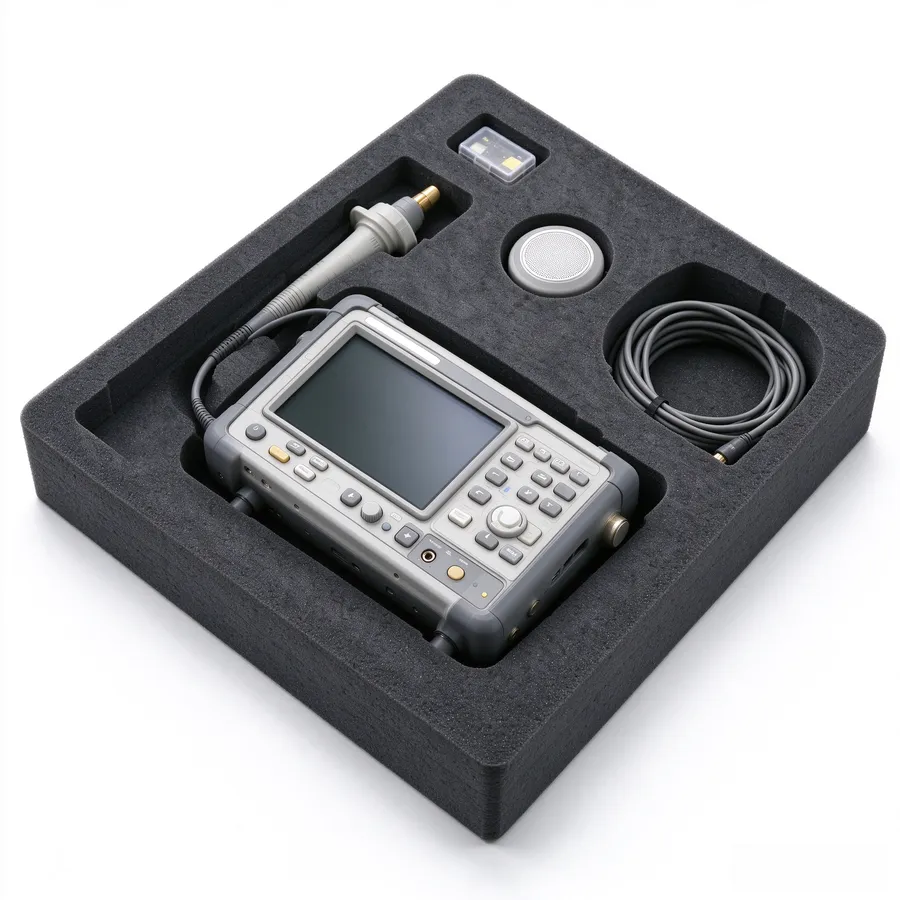
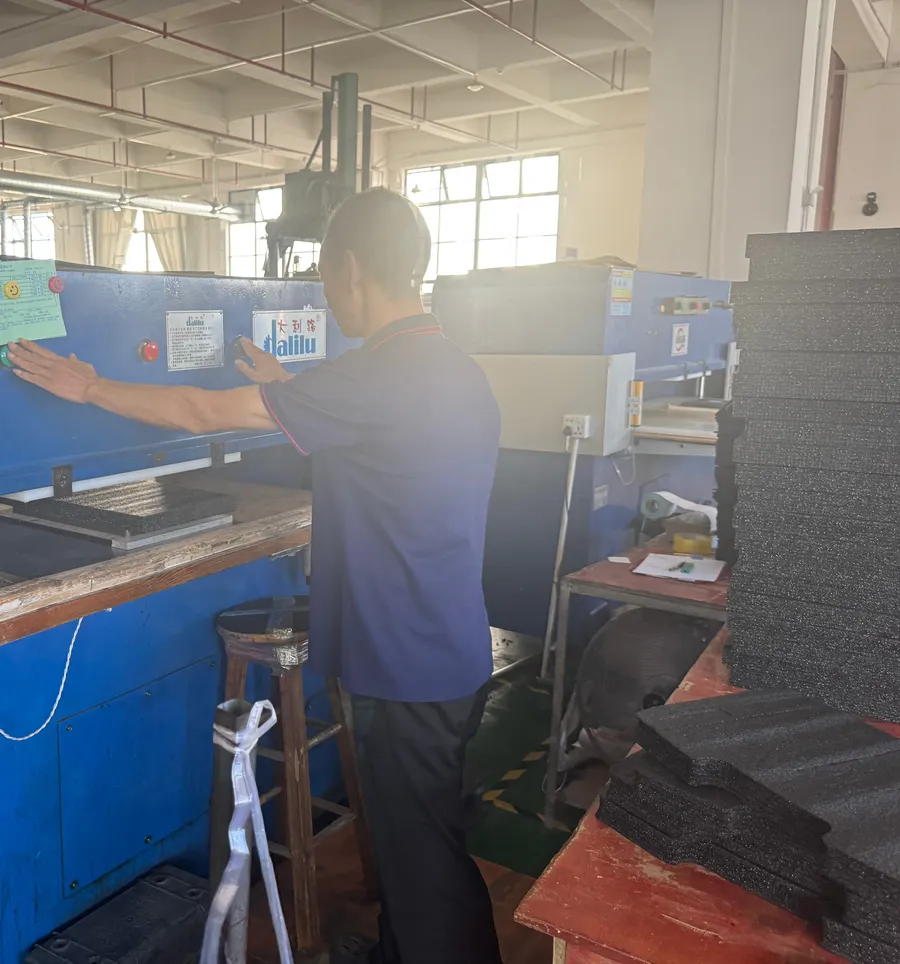
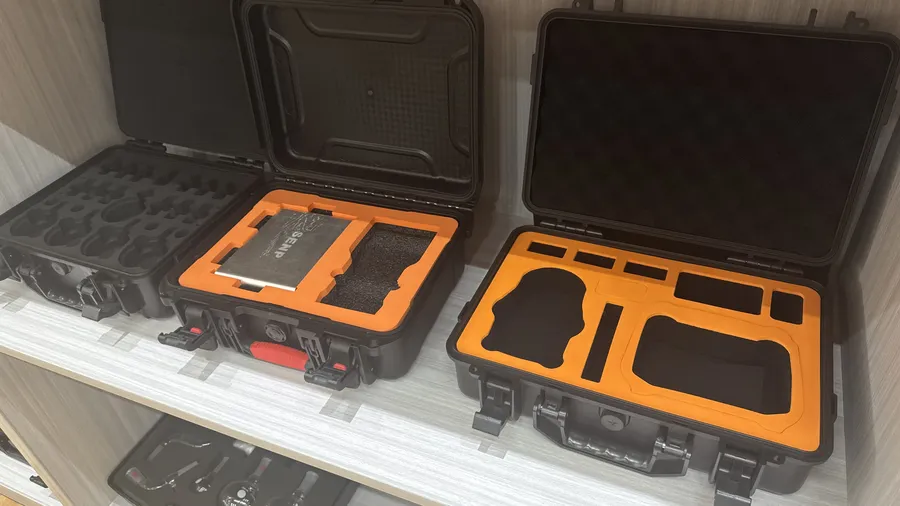
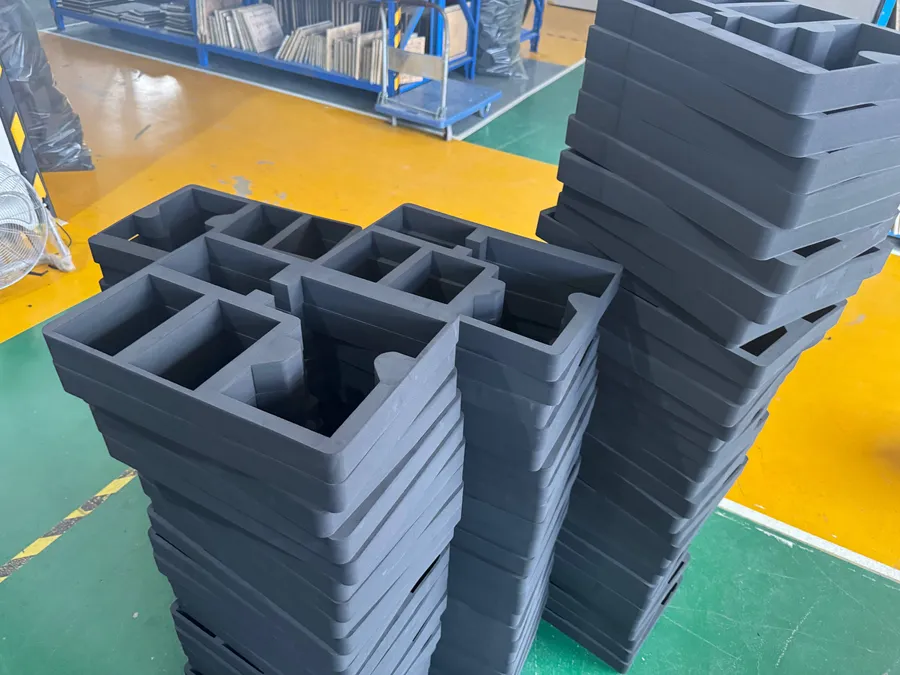
The interior, not the shell, is what your equipment sits on, and it is the most-customised part of any load conversation we have. Custom foam is quoted and sampled from 1 unit against a drawing, and the recorded structures are top foam, base foam, egg-crate or convoluted, custom cut and layered, with die-cut, CNC-cut and pick-and-pluck routes and configurable thickness and shape. Read that list as a load-control toolkit. A cradle that captures the body of your instrument spreads content mass across a wide bearing area, so the shell sees a distributed load instead of a point. A firm base layer under a heavy sub-assembly stops the item travelling downward when the case is lifted by its handle. A convoluted top layer limits lateral movement, which matters because a loose item turns every handling event into an impact that the shell alone cannot absorb.
Stacking, wheels and handling: the three load decisions that come from your site
Stackability is a published yes or no field on every listing, and the pattern in our data is instructive rather than decorative. 136 of 155 models are recorded stackable. The 19 that are not are exactly the 19 models recorded with two wheels - the transporter bodies from KX-85021 through KX-88442, 463 mm to 843 mm of external length. Nobody wrote that as a marketing rule. It falls out of the geometry: a wheeled shell carries wheels, an axle and a telescopic handle on one face, and that face is not a stacking surface. So the first thing your site has to answer is not which case, but which stow path. A pallet column, a rack or a shelf is a stacking problem and points at the 136. A platform, a vehicle boot or an airport ramp is a rolling problem and points at the 19.
Handling load is the third of them, and it lands on hardware. Hinge, lock and feet are recorded as measured on all 155 models, the latch body accepts a standard padlock, and the latch count itself is specified per configuration. That matters because when a case is lifted by its handle, the content mass travels through the handle fixings, the lid rim and the hinges rather than through the wall. A heavy lid full of optics is a hardware question before it is a shell question. Net weight is where you start that arithmetic: it is published for 93 models, and the wheeled bodies carry the heaviest published shells in the file, from 4,912 g on KX-85021 to 15,320 g on KX-88442. Whoever lifts it to tilt it is lifting that mass plus your equipment, and that total is the number a one-person handling limit actually binds.
Logistics load: what a carton of shells weighs, from the published columns
Sixty-four of the 155 models publish a carton size and a pieces-per-carton figure, and every one of those also publishes a net weight, so shells-only mass per carton is arithmetic rather than a claim. Four real lines, worked in front of you. KX-2005 packs 40 pieces to a 410 x 360 x 495 mm carton at 175 g each, which is 7.0 kg of shells. KX-2406 packs 20 pieces to a 490 x 410 x 290 mm carton at 330 g each, which is 6.6 kg. KX-2805 packs 32 pieces to a 570 x 470 x 435 mm carton at 340 g each, which is 10.9 kg. At the other end of the file, KX-4321 ships 12 pieces in an 885 x 515 x 650 mm carton at 2,330 g each - 28.0 kg of shells, which is a two-person or trolley handling question before it is a freight question. The wheeled transporters pack one unit to a carton, so their shells-only mass is simply the published shell: 5,012 g for KX-85022 and 10,000 g for KX-97227. None of these figures include dividers, interior pieces or your equipment, and gross weight is recorded for none of the 155 models, so we do not print a packed-carton mass at all. Your packing list is the source for that, and we build it from the configuration you order.
| Model | Carton Mm | Pieces Per Carton | Published Net Weight Each | Shells-Only Mass |
|---|---|---|---|---|
| KX-2005 | 410 x 360 x 495 | 40 | 175 g | 7.0 kg |
| KX-2406 | 490 x 410 x 290 | 20 | 330 g | 6.6 kg |
| KX-2805 | 570 x 470 x 435 | 32 | 340 g | 10.9 kg |
| KX-4321 | 885 x 515 x 650 | 12 | 2,330 g | 28.0 kg |
| KX-85022 (wheeled) | 495 x 375 x 245 | 1 | 5,012 g | 5.0 kg |
| KX-97227 (wheeled) | 715 x 515 x 280 | 1 | 10,000 g | 10.0 kg |
Which route your load requirement lands on: selection, configuration, or tooling
Route one is selection against published geometry. You send the equipment envelope and the duty; we return the models whose internal box, wall thickness and stackable record already suit it. This is the fastest and the cheapest, and it answers most enquiries, because 155 published models with interiors from 0.3 to 139.5 litres already cover a great deal of equipment. Route two is configuration on an existing shell: interior layout and foam structure, hardware set and latch count, seal and pressure-valve option, colour and logo. Custom foam starts at 1 unit, custom hardware is available, and logo, colour or OEM programmes start at 300 units. Route three is tooling, and a load requirement should rarely force it: a custom mould is recorded as available from 3,000 units per component. A fourth route exists and is the one buyers forget to budget for - testing one finished build, which changes nothing about the product and everything about the paperwork you can file with it.
| Route | What Changes | Typical Load Lever | Moq In Our File | Clock |
|---|---|---|---|---|
| Selection against published geometry | Model choice only | Internal box, wall section, stackable record | 1 unit on standard listings | Immediate, from published data |
| Interior and hardware configuration | Foam, latches, hinges, feet, seal, valve | Bearing area, handling path, lid support | 1 unit for custom foam; 300 units for logo, colour or OEM | 45 days to first sample on an existing mould |
| New mould | Shell geometry, rim and rib layout themselves | Section and stacking surface design | 3,000 units per component | 125 days |
| Third-party testing of one build | Nothing in the product; everything in the documentation | A figure you can put in a tender file | Quoted per configuration, not per order | Quoted with the sample plan |
How to ask any supplier about load, so the answers are comparable
This section is written for buyers comparing us with other factories, and we would rather you used it on us first. Ask four things of every quotation. One: which of the three loads the stated number refers to - content mass, stack load, or handling load. Two: what evidence sits behind it - a laboratory report naming the test method, the specimen description and the conditioning, or an internal estimate. Three: what condition the specimen was in - empty shell, shell with interior, or shell loaded to a stated mass - because a stack figure on an empty case and a stack figure on a loaded one are not the same measurement. Four: whether the figure survives the accessories, because the same shell with a seal channel, a hand hole or a valve is not automatically the same body under compression.
If a supplier cannot answer those, the correct response is a method and a specimen, not a number. That is also what we offer: name the method and the configuration and we will arrange accredited third-party testing and publish the resulting report for the model you order. Anything told to you about a moulding without a report behind it should be treated as a design opinion. Where your specification names a level or a standard we have not tested on your build, we say so in the bid rather than nodding along, because a compliance line written before the evidence exists is the fastest way to lose a shipment and a customer in the same week.
What we do not state about case load capacity
Four blanks are worth naming before you build a plan around a number. We state no stack load value and no payload value in kilograms for any of the 155 listings, because both fields are recorded as not measured. We state no drop height and no shock figure for a shell, because impact behaviour is recorded as a configuration option that depends on a specified foam layout rather than the moulding alone. We state no packed-carton gross weight, because it depends on dividers and interior pieces decided after the model is chosen, and the gross weight field is empty for all 155. And we do not convert wall thickness into a strength claim: 148 models publish a wall figure between 2.0 mm and 6.0 mm, and the two bodies at 6.0 mm discussed above - KX-6621 and KX-97227 - differ by 3,580 g of shell and by their entire duty profile. Where a number is missing, tell us the duty and we will tell you whether published geometry already answers it, or whether a test report is the honest next step.
Customisation
Everything described above is configurable on a standard shell: interior layout (pick-and-pluck, die-cut or CNC-cut), foam grade and thickness, colour, logo method, latch and lock count, pressure-equalisation valve, cable ports, document holder and identification plate. A bespoke exterior geometry requires a new mould — 125 days, from 3,000 units per moulded component.
Procurement considerations
| Question | What to send us |
|---|---|
| Which shell fits? | Equipment L × W × H as packed, plus required clearance per axis |
| What does it cost? | Order quantity and estimated annual quantity — the two drive different answers |
| Is tooling needed? | Whether an existing shell clears the envelope with usable foam depth |
| Lead time? | Your required delivery date, not just the order date |
| Certification? | The exact standard your tender names — we will say whether we can test to it |
| Freight? | Destination and preferred terms; carton and pallet data supplied with the quotation |
Comparison and selection guide
The tables on this page exist because a protective case is chosen by comparing three things: the envelope, the environment and the handling chain. Where no table applies, the rule below is.
| Situation | What To Do |
|---|---|
| Sea freight | Sealed configuration plus desiccant; salt spray is a handling issue, not a material issue. |
| Air freight | Mass and external dimensions drive cost more than volume. |
| Repeated movement | Replaceable latches, hinges and gaskets; keep a spares kit with the first order. |
- Size on internal dimensions plus clearance, never on a product name.
- Choose the carrying method before the shell: it changes the series, not just the price.
- Specify the interior last, and decide up front whether the end user will reconfigure it.
Can case load capacity be customised for a specific piece of equipment? relates to Logistics & Packing Guide. Related families: Equipment Transport Cases / Custom Protective Cases / Military Protective Cases / Rolling Cases / Instrument & Equipment Cases. Related sectors: field and industrial equipment. Continue in the Logistics & Packing Guide cluster.
This page is written from our own production data. If your requirement differs, send the dimensions and we will tell you which of the 155 models fits, or whether a custom route is needed.


