What is case hinges and why does it matter when buying a protective case?
Case hinges are the hardware that fixes which edge a lid rotates about, and therefore which edge carries the latches, where the gasket line runs and how much wall the closure can grip. On our file of 155 models the hinge is one of the flattest published fields we have: 155 of 155 listings state a hinge as present, recorded as measured. What is not published on any listing is hinge type, hinge material, pin replaceability or a cycle figure - those are configuration answers. It matters when buying because the hinge line sits at the parting plane, and 100 of 155 listings publish how deep each half of that plane is: lid depth from 16 mm to 320 mm with a median of 97.5 mm against a median base depth of 44 mm. Buy the geometry before you buy the hardware, because a 320 mm lid and a 16 mm lid put completely different demands on the same hinge.
Key points
- Case hinges are the closure reference edge: they fix the latch side, the seal line and where a lid can be gripped, which is why a hinge question is really a geometry question.
- A hinge is stated as present on 155 of 155 listings in our file and recorded as measured - it is one of the few hardware fields that is uniform across the range.
- Hinge type, material, pin replaceability and any cycle figure are published on 0 listings, so a supplier quoting them from a series name is guessing.
- Lid depth is the number that decides hinge load: 100 of 155 listings publish a lid and base split, from 16 mm to 320 mm lid depth, median 97.5 mm.
- On 124 of 155 shells the hinge runs alongside a compressible gasket in a continuous moulded channel; on 31 there is no seal, so the hinge only locates the lid.
- The 19 wheeled trolley models are the only non-stackable listings in the file, which changes how much a hinge is asked to carry during storage and road freight.
What case hinges are, in plain terms
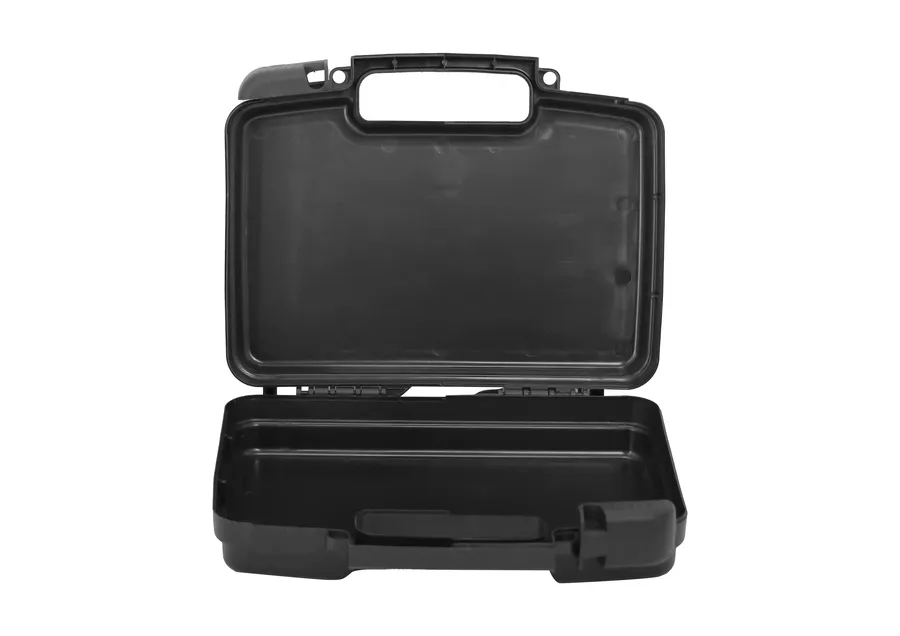
A hinge on a moulded protective case is the pivot that turns the lid into something you can open repeatedly without separating it from the base. It does three jobs at once. It fixes the reference edge, so the other three edges can be described relative to it. It takes the weight of the lid whenever the case is open at an angle, which is the moment most damage to a closure actually happens. And it holds the two halves of the shell in register when closed, so the latches meet their platforms and a gasket, where there is one, is compressed along a predictable line.
That third job is the one buyers under-weight. A case is not a box with hardware attached; the lid and the base are two mouldings that must meet at the same plane every time. Everything else in the closure specification - latch count, hasp position, seal channel, stacking rims - is written relative to the hinge line. Change the hinge arrangement and you change the drawing for every other part, which is why it appears in our RFQ guidance before any hardware grade is discussed.
Why the hinge matters more than it looks on a spec sheet
The pattern in that table is the honest picture of this component. One hinge field - presence - is published uniformly across the range, while the four fields that would let a buyer compare two suppliers are configuration answers that no catalogue carries. That is not unusual for hardware on a moulded shell, but it does mean the hinge conversation belongs in the order text rather than in an email about features.
| Buyer Question | What Our File Publishes | Why It Decides The Buy | What To Confirm In Writing |
|---|---|---|---|
| Which edge opens? | A hinge is stated present on 155 of 155 listings, measured | Sets the latch side, the handle side and where a label or stacking rim can sit | Orientation of the hinge edge on the packing list and on the case itself |
| How deep is the lid? | 100 of 155 listings publish lid and base depth; lid 16 mm to 320 mm, base 15 mm to 168 mm | A deep lid puts cantilever load into the pivot and grips only lid wall behind the latch | Lid and base split for the exact shell being ordered, not a series average |
| Is the hinge continuous or discrete? | Hinge type on 0 of 155 listings | Continuous hardware spreads load along the edge; discrete fittings concentrate it at two or three points | Type, length or centre spacing, and the fixing method on the shipped batch |
| Can the pin be replaced? | Pin serviceability on 0 of 155 listings | Determines whether a worn case is repairable in the field or scrap | Whether the pivot is a replaceable pin, a moulded knuckle or a rivet |
| What does the hinge wear out against? | Hardware material as metal or polymer by configuration on 155 of 155 listings; no grade published | Corrosion at the pivot and abrasion at the knuckle are what actually seize a lid | Material and finish for the environment the fleet will see |
| Does the hinge side seal? | Compressible gasket in a continuous moulded channel on 124 of 155; 31 state no seal offered | On the sealed half the hinge runs along the same rim the gasket occupies | Whether the channel is uninterrupted past the pivot on your shell |
Lid depth is the hinge number that actually matters
Across our file, 100 of 155 listings publish both a lid depth and a base depth, and on all 100 of those listings the two figures add back to the published internal height within one millimetre. So the parting plane - the plane the hinge sits in - is knowable before anyone talks about hardware. The distribution is uneven in a way that changes the hinge question: the lid is the deeper half on 65 listings, the base is deeper on 6, and 29 are split evenly. Median lid depth is 97.5 mm against a median base depth of 44 mm, and 29 listings carry a lid 150 mm or deeper.
A lid that deep is not a cover, it is a box. When it swings up on one edge, its own weight becomes a bending load at the pivot, and the moulding behind the fixing is lid wall only. That is the single most common reason a hinge area fails in service, and the reason we look at lid depth first when a buyer asks what hinges are for on their case.
Five published shells, five very different hinge demands
Put those five rows beside each other and a hinge question stops being about hardware quality. KX 1204 and KX 97227 both have shallow lids but differ by two orders of magnitude in shell mass, with published wall thickness of 2.6 mm and 6.0 mm respectively. KX 88442 has a 320 mm lid, the deepest published split in the file, on a shell whose own empty weight is stated at 15,320 g. Any answer that treats all five as one hinge problem is a marketing answer.
| Model | External Mm | Internal Mm | Lid + Base Mm | Wall Mm | Net Weight G | Hinge Demand In Service |
|---|---|---|---|---|---|---|
| KX 1204 | 120 x 90 x 40 | 115 x 78 x 32 | 16 + 16 | 2.6 | 100 | Pocket-size lid, negligible cantilever; the pivot mostly locates the cover |
| KX 3607 | 360 x 310 x 70 | 355 x 280 x 60 | 30 + 30 | 3.0 | 800 | Even split, shallow lid, gasket published; pivot keeps a flat rim aligned |
| KX 83815 | 384 x 366 x 148 | 350 x 300 x 130 | 95 + 35 | 4.2 | not published | Lid depth 95 mm of a 130 mm internal height; fixed handle, stackable, no wheels |
| KX 88442 | 843 x 592 x 415 | 740 x 518 x 364 | 320 + 44 | 5.0 | 15,320 | Deepest published lid in the file on a trolley; wheels and telescopic handle, not stackable |
| KX 97227 | 720 x 500 x 270 | 590 x 435 x 210 | 42 + 168 | 6.0 | 10,000 | One of only 6 listings where the base is deeper; the lid is a shallow cover on a thick-walled body |
Hinge type: what buyers will see quoted, and what we do not state
In this market a buyer will typically meet three descriptions: a continuous piano-type hinge along the whole edge, discrete butt-type fittings at two or three positions, and moulded knuckles where the pivot is formed in the polymer itself with a metal pin. Each has a real trade-off. Continuous hardware spreads load and gives a straight reference edge but needs a clean, straight rim to fix to. Discrete fittings are cheap to replace locally but concentrate the bending load at a small number of points. Moulded knuckles remove a separate parts list but transfer wear into the shell, so the repair question becomes a shell question.
We do not state which of those arrangements is on any of the 155 models, because our file does not record it: hinge type appears on 0 listings, alongside hinge material, centre spacing and pin serviceability. What we do state is that a hinge is present on all 155 listings, measured, and that hardware material is given as metal or polymer by configuration. If a comparison hinges - pardon the word - on knowing the type, ask each supplier to name it for the exact shell and lid they are quoting, and treat a series-level answer as an assumption you are being asked to carry.
Fatigue, serviceability and what to put in the order text
Nobody should accept a cycle-life number that was not produced on the configuration being bought, and our listings publish none: there is no open-close cycle figure on any of the 155 models. What can be pinned down instead is serviceability. Ask whether the pivot is a replaceable pin, a rivet or a moulded knuckle; ask what tool removes it; ask whether a replacement hardware kit is stocked for the shell you ordered and at what quantity. Those four answers decide whether a worn case in a five-year fleet is a repair or a replacement, and they cost a supplier nothing to give truthfully.
Put the same five items in the order text and the hinge stops being a guessing game: the hinge edge named on the drawing, the lid and base split for the shell, the hardware material and finish for the service environment, the fixing method, and the spare-parts arrangement. On the moulding side, custom hardware is recorded as available on 155 of 155 listings, so relocating a pivot or changing its fixing is a normal engineering conversation rather than a favour.
How the hinge interacts with gaskets, stacking and trolleys
On 124 of 155 listings a compressible gasket in a continuous moulded channel is published as a measured feature, and the word doing the work there is continuous: the seal line passes the pivot, so whatever the hinge does to the rim alignment, the seal feels it. On the 31 listings where the shell states no seal is offered, the hinge only has to locate a lid, and the dust conversation moves to the parting line itself. Neither arrangement is better in the abstract, which is exactly why a hinge question without the seal question is incomplete.
Storage and transport complete the picture. Feet are published as present on 155 of 155 listings, a fixed folding handle on all 155, and 136 listings are marked stackable. The other 19 - the trolley shells that add wheels and a telescopic handle - are the only models in the file marked not stackable, and they are also where lid depth peaks: on 14 of those 19 the split is published, and the range reaches the 320 mm lid of KX 88442. A trolley lid stands open at angles a stacked box never sees, so the pivot there is loaded differently every day of its life.
What we do not claim about hinges
To keep this page useful as a benchmark rather than as brochure copy, here is the boundary of our own published record. We state that a hinge is present on all 155 listings and that hardware material is metal or polymer by configuration. We state no hinge type, no hinge length or centre spacing, no pin design, no material grade, no lubrication requirement and no open-close cycle figure, because none of those is on our file. We also publish no ingress-protection code for any model - the protection rating on all 155 listings is recorded as not measured - and where a procedure needs a figure we quote accredited third-party testing against the exact configuration as a separate work package rather than describing a result we have not obtained.
Two structural figures are published and legitimately relevant here: wall thickness, given on 148 of 155 listings from 2.0 mm to 6.0 mm with a median of 3.9 mm, and the lid-and-base split on 100 listings. Those bound how much material a pivot can be fixed into. Net weight is published on 93 listings, from 100 g to 15,320 g with a median of 1,480 g, and the longest external edge across the file runs from 120 mm to 1,356 mm with a median of 432 mm. That is the real spread a hinge specification has to survive, and it is why we answer per drawing.
Buying with the hinge in mind: terms, timing and who to ask
We work wholesale and OEM or ODM only, on EXW or FOB terms; no retail sales, no delivered-duty-paid pricing and no overseas warehouse stock. For hinge and closure changes that do not touch tool steel, the OEM minimum is 300 pieces with first samples in 45 days on an existing tool. Where a pivot boss or a relocated hinge line has to be moulded, that is a new-mould decision: 125 days from 3,000 pieces per component. Foam is available from a single piece, which makes a re-laid interior the fast half of any hardware redesign, and a 30 per cent deposit opens production with the balance settled after inspection. Third-party inspection and factory visits are welcome at any stage.
If you are working through a hardware comparison, the pages that go deeper on this component are what case hinges should be specified as in a protective case RFQ, how buyers compare case hinges across protective case suppliers, and the failure list on what are the common mistakes in case hinges for equipment transport cases. For the wider set, case hardware latches hinges wheels covers how the pivot, the closures and the wheels share the load path. Send us the internal size, a photograph of the packed kit or a drawing and we will come back with the hinge edge, the lid split and the closure layout on paper. Talk to Fred Zhao or the KeXin Sales Team, or reach us on WhatsApp +86 135 3588 0002 - KeXin New Materials (Guangdong) Co., Ltd.
Customisation
Everything described above is configurable on a standard shell: interior layout (pick-and-pluck, die-cut or CNC-cut), foam grade and thickness, colour, logo method, latch and lock count, pressure-equalisation valve, cable ports, document holder and identification plate. A bespoke exterior geometry requires a new mould — 125 days, from 3,000 units per moulded component.
Procurement considerations
| Question | What to send us |
|---|---|
| Which shell fits? | Equipment L × W × H as packed, plus required clearance per axis |
| What does it cost? | Order quantity and estimated annual quantity — the two drive different answers |
| Is tooling needed? | Whether an existing shell clears the envelope with usable foam depth |
| Lead time? | Your required delivery date, not just the order date |
| Certification? | The exact standard your tender names — we will say whether we can test to it |
| Freight? | Destination and preferred terms; carton and pallet data supplied with the quotation |
Comparison and selection guide
The tables on this page exist because a protective case is chosen by comparing three things: the envelope, the environment and the handling chain. Where no table applies, the rule below is.
| Situation | What To Do |
|---|---|
| Fastest | Standard shell plus CNC foam — typically 45 days from approved drawing. |
| Branded | Standard shell plus custom colour and logo — MOQ applies to the resin colour. |
| Bespoke geometry | New mould — 125 days, MOQ from 3,000 units per component. |
- Size on internal dimensions plus clearance, never on a product name.
- Choose the carrying method before the shell: it changes the series, not just the price.
- Specify the interior last, and decide up front whether the end user will reconfigure it.
What is case hinges and why does it matter when buying a protective case? relates to Logistics & Packing Guide. Related families: Custom Protective Cases / Equipment Transport Cases / Military Protective Cases / Electronics Cases. Related sectors: field and industrial equipment. Continue in the Logistics & Packing Guide cluster.
This page is written from our own production data. If your requirement differs, send the dimensions and we will tell you which of the 155 models fits, or whether a custom route is needed.


