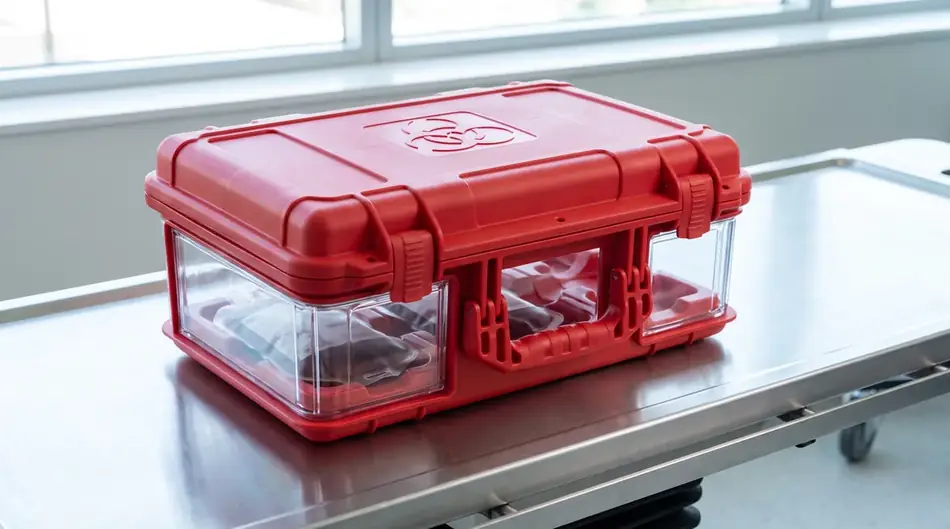
Medical Equipment Packaging Solutions?
Medical equipment packaging, from the side of the factory that moulds the shell, is three layers rather than one: a moulded thermoplastic case, a cut foam interior matched to the device, and an outer shipping carton. KeXin New Materials (Guangdong) Co., Ltd. supplies the first two as a wholesale and OEM package on EXW or FOB terms. Our product file lists 155 active models, and 71 of them are carried under the medical equipment cases category, where the published internal cavity runs from 20.2 to 139.5 litres and the internal longest axis from 378 mm to 1,280 mm. What we do not sell is a rating. Wall thickness, internal and external dimensions, lid and base depth and whether a gasket is offered are published per model; water, dust, ultraviolet, stack load and load capacity are recorded as not measured, and where a tender names a test we quote accredited third-party work per configuration as a separate line.
Key points
- Specify medical packaging as three layers: shell, cut foam and outer carton. A request that names only one of them cannot be priced accurately.
- 71 of our 155 active models are listed under medical equipment cases, with published internal cavities from 20.2 to 139.5 litres.
- Match the lid and base split to your tallest component, because internal height is two cavities that do not share their depth.
- A gasket is offered on 64 of those 71 listings; the remaining seven are plain-shell bodies, so check the model row rather than the family.
- Only 36 of the 71 medical listings publish a net weight, so ask for the figure you need instead of inferring mass from wall thickness.
- Custom foam starts at one piece, while an OEM build on existing tooling is quoted at 45 days to first sample from 300 pieces.
- A new external envelope is tooling: 125 days, from 3,000 pieces per moulded component, with a 30 percent deposit opening the slot.
- We work wholesale and OEM only, on EXW or FOB, with no retail channel, no DDP quotation and no overseas warehouse stock.
What medical equipment packaging means on a hard-case catalogue
Most buyers arrive at this subject with a word in mind rather than a specification. Packaging is used to mean the box, the foam, the carton, the printed label and sometimes the regulatory dossier that travels with a device. From the factory side these are four different deliverables made by three different processes, and only two of them are ours to quote. The moulded shell comes off our tooling. The interior comes off a cutting or skiving line matched to a drawing of the packed device. The outer carton is a corrugated shipping container with a published footprint and a published number of pieces inside it. The dossier, the biocompatibility position and the sterility claim belong to the device manufacturer, and no case supplier can borrow them.
That separation is the reason a medical packaging conversation on this site starts with dimensions rather than with adjectives. Our medical listings are not a special moulding; they are the same 155-model catalogue, with 71 models carried under the medical equipment cases category because their cavity, sealing option and handling hardware suit portable and mid-size instruments. The internal longest axis on those 71 runs from 378 mm to 1,280 mm, the internal volume from 20.2 litres on KX-707 to 139.5 litres on KX-88442, and the published wall thickness from 2.5 mm to 6.0 mm. Those are catalogue facts per model, not a statement that any shell suits any device.
The three layers, and the one that decides whether the device arrives
The shell decides the envelope. It is a thermoplastic moulding, and on our medical listings the material of record is polypropylene on 42 models, an engineering polypropylene on 20, acrylonitrile butadiene styrene on 8 and one hybrid polypropylene and acrylonitrile butadiene styrene body. The shell gives you the internal length, width and height, the parting line where the lid meets the base, the wall section, and the flat rim that a closing surface needs. It does not by itself decide what happens at the moment an impact arrives, because a rigid shell transmits load to whatever is behind it.
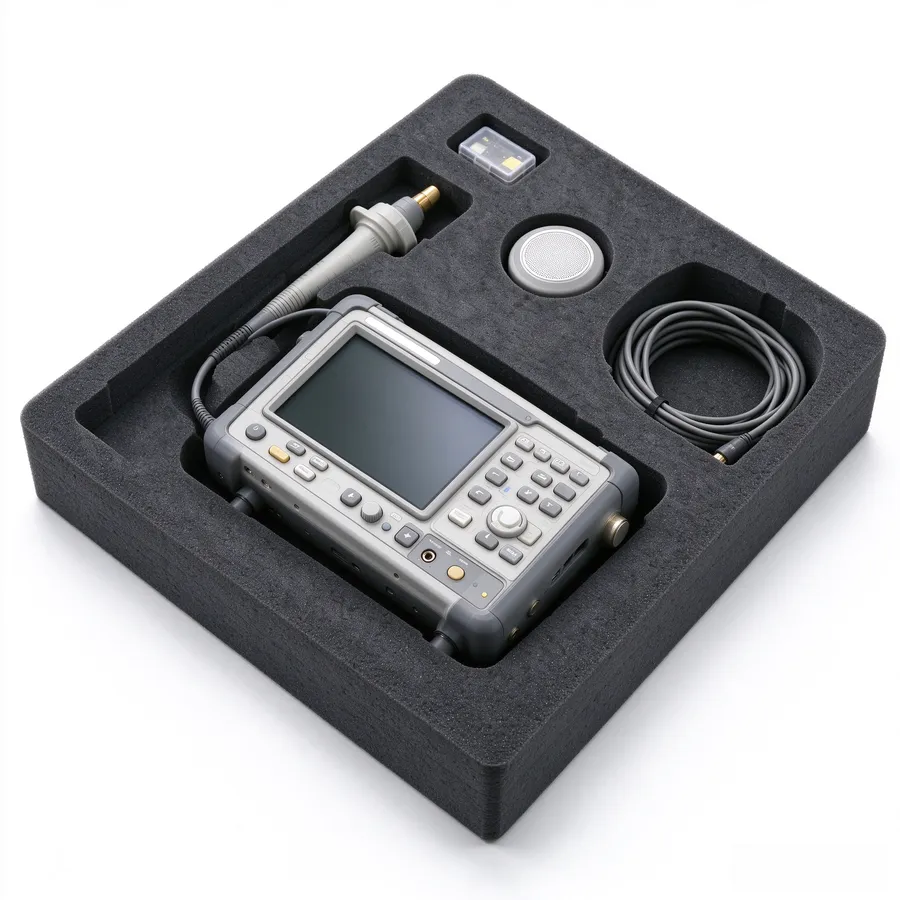
The interior decides the outcome. A cut foam pocket holds the device off the shell wall, spreads a point load across a face, and stops the instrument from walking around inside the cavity when the case is lifted or tilted. The working clearance we design to is at least 20 mm per axis between the packed envelope and the cavity wall, which is why an interior drawing is a specification rather than an accessory. The outer carton decides the freight. It is published as a footprint on 19 of the 71 medical listings and as a pieces-per-carton figure on 18 of them, ranging from one piece for the large bodies to eight for the mid-size shells, and those two numbers are what a pallet plan and a volumetric freight quote are built from.
Published packaging figures for representative medical listings
The rows below are copied from our product file, not assembled from a family average. Every figure is a published value for the named model, which is the only honest way to read a size band: a cavity of 307 mm of internal width means something different on an acrylonitrile butadiene styrene shell with a 4.0 mm wall than it does on a polypropylene shell with a 5.0 mm wall, because the wall is where the latch bosses, the hinge seats and the gasket channel live.
| Model | Material | Internal Mm | External Mm | Wall Mm | Net G | Volume L | Gasket Offered | Stackable |
|---|---|---|---|---|---|---|---|---|
| KX-707 | Engineering PP | 465 x 310 x 140 | 470 x 360 x 148 | 2.5 | 1360 | 20.2 | no | yes |
| KX-64120 | ABS | 378 x 307 x 187 | 405 x 362 x 195 | 4.0 | 2640 | 21.7 | yes | yes |
| KX-4616 | PP | 455 x 338 x 148 | 460 x 367 x 155 | 3.0 | 1395 | 22.8 | yes | yes |
| KX-4821 | Engineering PP | 447 x 312 x 194 | 475 x 363 x 210 | 4.5 | 3670 | 27.1 | yes | yes |
| KX-5021 | ABS | 465 x 315 x 196 | 495 x 374 x 206 | 3.7 | 3430 | 28.7 | yes | yes |
| KX-65522 | ABS | 507 x 385 x 190 | 545 x 440 x 215 | 5.3 | 4860 | 37.1 | yes | yes |
| KX-85827 | PP | 500 x 400 x 220 | 588 x 475 x 267 | 5.0 | 7800 | 44.0 | yes | no, wheeled body |
| KX-88442 | PP | 740 x 518 x 364 | 843 x 592 x 415 | 5.0 | 15320 | 139.5 | yes | no, wheeled body |
How to choose a case for a medical device
Start from the packed envelope, not from the instrument datasheet. Lay out the device as it will actually travel: probe and cable coiled at its natural bend radius, power supply in the same cavity, print media or reagent block included if it ships together. Measure that envelope on three named axes in millimetres, then add the 20 mm working clearance per axis and read the result against the internal figures. The next step is the split, not the total. On our medical listings a lid depth is published on 46 of 71 models, and the numbers vary widely: KX-84430 records 230 mm of lid against 45 mm of base, while KX-5321 records 43 mm of lid against 149 mm of base. The tallest single item has to sit in the deeper half, and that one check eliminates more candidates than volume does.
Then check the three figures that buyers most often skip. Narrow internal width is published on only 3 of our 71 medical listings, because it belongs to tapered bodies rather than to the flat-walled instrument shells, and it is the number that decides whether a bracket-carrying device passes in a cavity that narrows toward the base. Handling hardware comes next: 19 of the 71 models carry wheels and a telescopic pull, with recorded pull heights of 240, 295, 310, 385 and 485 mm, and every one of our 19 wheeled models is recorded as not stackable. Finally, the mass you are allowed to lift. Net weight is published on 36 of the 71 medical listings and gross weight on none of our 155 models, so a manual-handling limit has to be checked against a named model on a sample rather than against a catalogue average.
Where each packaging layer is used in practice
Portable diagnostic instruments, patient monitors of the mid-size class, infusion and analysers units that travel between sites, and veterinary or field clinic equipment make up the bulk of what buyers describe to us for this category. What these have in common is not a clinical setting but a shape problem: a rectangular instrument with a display on one face, connectors on another, and a cable set that must not be coiled tighter than its bend radius allows. That profile fits the flat-walled bodies in the table above, where internal height sits between 140 mm and 220 mm and the cavity is wide enough to accept the display face without a cut into the wall.
The wheeled bodies answer a different problem. A cart-based or heavy bench instrument cannot be carried to a vehicle by one person, so the packaging moves on wheels and the case becomes a handling aid rather than a container. KX-88442 illustrates the trade: 740 by 518 by 364 mm of internal cavity and 139.5 litres, with a published net weight of 15,320 g for the empty shell. Before any device is loaded, the case itself is already a 15 kg object, and the stackability consequence of the wheel mount means it travels as a single unit rather than in a column. For instrument sets that are unpacked and repacked daily, a shallow stackable body with a pick-and-pluck or CNC-cut interior is usually the better answer.
Sealing, condensation and what we do not claim
A gasket is a feature we can describe factually. On 64 of our 71 medical listings the product file records a compressible gasket seated in a continuous moulded channel, and on the remaining seven no seal is offered on that shell. What we do not do is turn that construction into a performance number. The water, dust, ultraviolet, temperature range, stack load and load capacity fields in our file are recorded as not measured for these models, and no ingress code is printed for any of the 155. The reason is straightforward: a closing surface is a property of the moulding, the gasket compression and the latch spacing together, and a figure for one model cannot be transferred to a neighbour in the same family.
Condensation is the related effect that packaging is often blamed for. A cold case brought into a warm room pulls moisture out of the air onto the shell and onto whatever is inside it, and a closed gasket slows the exchange rather than preventing it. Where a buyer needs to manage this we discuss it as a build question: whether a pressure equalisation fitting is added, how the foam is sealed or open-celled, and how the packed device is allowed to reach room temperature before the lid is lifted. That conversation is a configuration decision, quoted with the case, and we do not describe any of those measures as a protection rating, because the testing behind one has not been done on our shelf stock.
Customising the packaging for one device
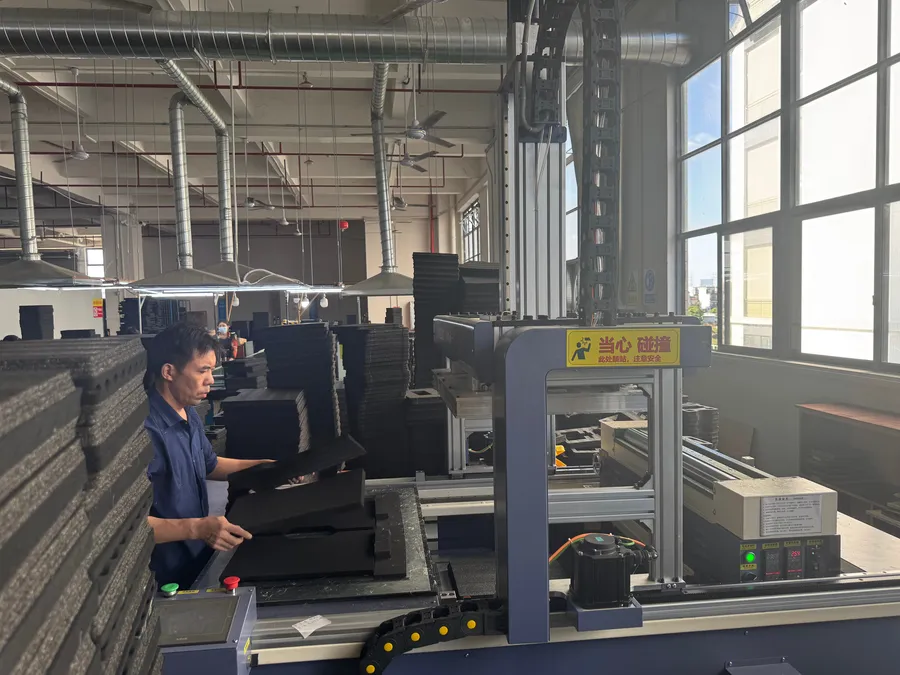
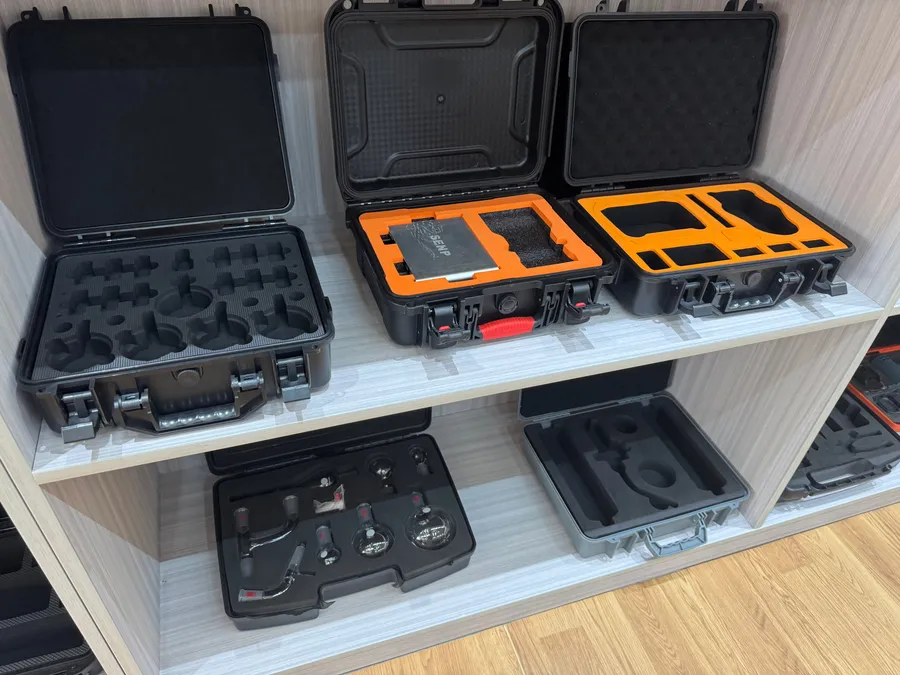
Three levels of change are available and they cost very differently. The first is the interior. Custom foam carries a minimum of one piece, which means a single sample can be built with a CNC-cut layout against a drawing or a physical device, and that is the route we push buyers toward first because it is reversible. The second is the shell as-built: colour, a printed or moulded logo, hardware choice, and an OEM specification against existing tooling. That is quoted at 45 days to first sample, from a minimum of 300 pieces. The third is a new external envelope, which needs its own mould: 125 days, from 3,000 pieces per moulded component, with a 30 percent deposit opening the tooling slot.
The order of those steps matters more than the prices. Buyers who start at the mould usually discover at the sample stage that the cavity they needed already existed in a model they had not measured, and that the tooling spend was bought to solve a stowage problem. What a useful first request looks like: the packed envelope on named axes, the lid and base split you need, a photograph or drawing of the device as it will travel, the maximum external envelope your shelf or vehicle accepts, the carton footprint your pallet can take, and any test your tender actually names. With those, a reply can be a model number, a foam layout, and an honest statement of what remains unmeasured.
Procurement notes and the figures we do not publish
Commercial terms are fixed and worth stating early: wholesale and OEM only, EXW or FOB, no retail channel, no DDP quotation and no overseas warehouse. Payment is a 30 percent deposit with the balance after inspection, and third-party factory inspection is welcome. Because the terms are shipment-terms rather than delivered-service terms, the carton footprint, the pieces-per-carton figure and the net weight on a quotation are the numbers your own forwarder will price, not a service we manage end to end.
Three absences should be read as part of the offer rather than as gaps in it. No tolerance band is published on any of our 155 model listings, so a fit that depends on a millimetre is settled on a sample. No pallet quantity is published, because it is calculated from the carton footprint against your deck, and a 1,200 by 1,000 mm pallet and a 1,200 by 800 mm pallet give different answers on the same carton. And no protection rating is printed for any model. Where a medical procurement requires a stated test result, tell us which test and against what procedure, and we will quote accredited third-party work for the named configuration as a separate package rather than writing a figure into a catalogue.
Customisation
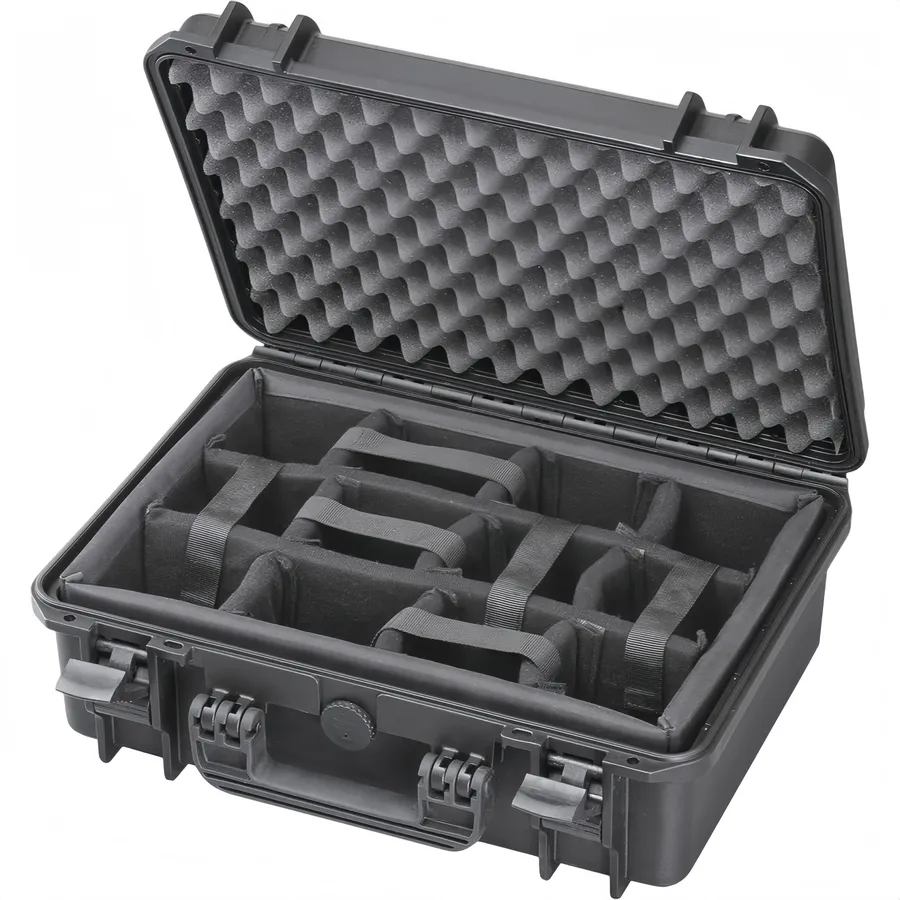
Everything described above is configurable on a standard shell: interior layout (pick-and-pluck, die-cut or CNC-cut), foam grade and thickness, colour, logo method, latch and lock count, pressure-equalisation valve, cable ports, document holder and identification plate. A bespoke exterior geometry requires a new mould — 125 days, from 3,000 units per moulded component.
Procurement considerations
| Question | What to send us |
|---|---|
| Which shell fits? | Equipment L × W × H as packed, plus required clearance per axis |
| What does it cost? | Order quantity and estimated annual quantity — the two drive different answers |
| Is tooling needed? | Whether an existing shell clears the envelope with usable foam depth |
| Lead time? | Your required delivery date, not just the order date |
| Certification? | The exact standard your tender names — we will say whether we can test to it |
| Freight? | Destination and preferred terms; carton and pallet data supplied with the quotation |
Comparison and selection guide
The tables on this page exist because a protective case is chosen by comparing three things: the envelope, the environment and the handling chain. Where no table applies, the rule below is.
| Situation | What To Do |
|---|---|
| Clinical environment | Closed-cell foam or a wipeable tray; no open-cell pluck foam. |
| Emergency use | Latches that open with one hand and a lid that stays up unaided. |
| High-value device | Deeper base foam, a separate transducer zone, and a documented drop test if required. |
- Size on internal dimensions plus clearance, never on a product name.
- Choose the carrying method before the shell: it changes the series, not just the price.
- Specify the interior last, and decide up front whether the end user will reconfigure it.
Medical Equipment Packaging Solutions? relates to Logistics & Packing Guide. Related families: Medical Equipment Cases / Custom Protective Cases / Instrument & Equipment Cases / Equipment Transport Cases / Rolling Cases / Field Equipment Cases. Related sectors: field and industrial equipment. Continue in the Logistics & Packing Guide cluster.
This page is written from our own production data. If your requirement differs, send the dimensions and we will tell you which of the 155 models fits, or whether a custom route is needed.