What is case wheels and why does it matter when buying a protective case?
Case wheels means the pair of moulded wheels and the matching telescopic handle fitted to a transport case so it can be tipped and rolled instead of carried - and it matters when buying a protective case because it changes three decisions at once: whether the case can be stacked, who lifts it and how, and what the load travels through. In our product data it is a recorded field, not an adjective: 19 of the 155 active models carry 2 wheels in the hardware record, and the other 136 carry none. All 19 of those are also the only models recorded with a telescopic plus fixed folding handle, and none of the 19 is recorded as stackable, while every one of the 136 non-wheeled models is. Their published shells run from 463 mm to 843 mm in external length, enclose 22.1 to 139.5 litres, and weigh from 4,912 g (KX-85021) to 15,320 g (KX-88442) empty. What we do not publish is a wheel or axle load value, a rolling distance, or any durability claim for the wheel fitting, because those fields are not measured in our file. This page sets out what the option does to the specification, and exactly what to ask any supplier before you accept case wheels on a quotation.
Key points
- Case wheels is a recorded field in our data, not a style: 2 wheels on 19 of 155 models, none on the other 136, and every one of the 19 is a two-wheel trolley layout.
- Wheels and stacking are exclusive here: all 19 wheeled models are recorded not stackable, and all 136 non-wheeled models are recorded stackable - decide your stow path first.
- A wheeled shell is a heavy shell: published net weight runs 4,912 g to 15,320 g, median 8,500 g, against a 1,200 g median among the 74 non-wheeled models that publish net weight.
- Handle height is published for only 11 of the 19 - 240, 295, 310, 385 and 485 mm - and the eight blanks are named, so ask before you assume an operator can pull it upright.
- Long does not mean wheeled: 43 models exceed 500 mm on their longest axis, but only 17 of them carry wheels, so a long case may be a carry-and-stack case instead.
- Ask for the wheel component's own documentation and fixing detail, because a castor or axle load figure belongs to that part, not to our moulding.
- We state no wheel load value, rolling resistance or durability claim: those are not measured, and a named test method on your build is the honest route to a number.
- Wheels are hardware on our existing shells; a mould change to add them is 125 days and 3,000 units per component, while the 19 published trolleys need only interior work.
What case wheels means when buying a protective case
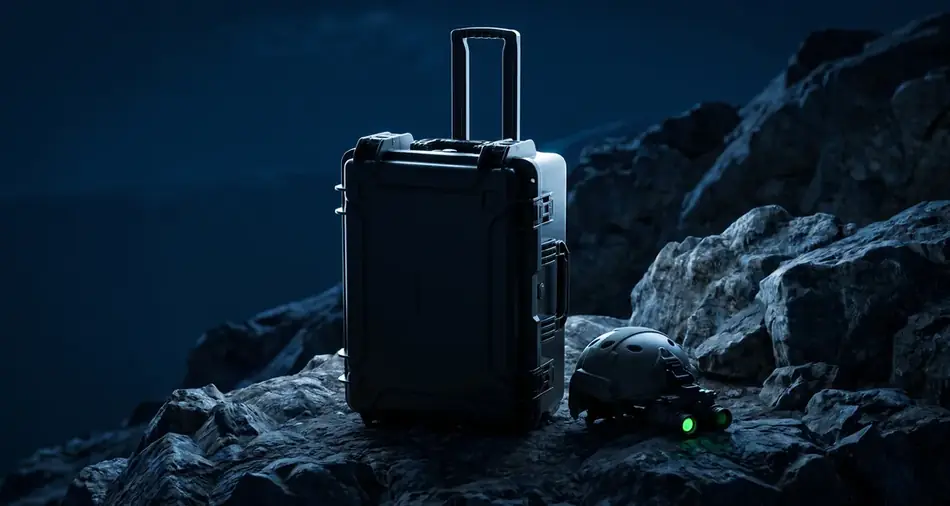
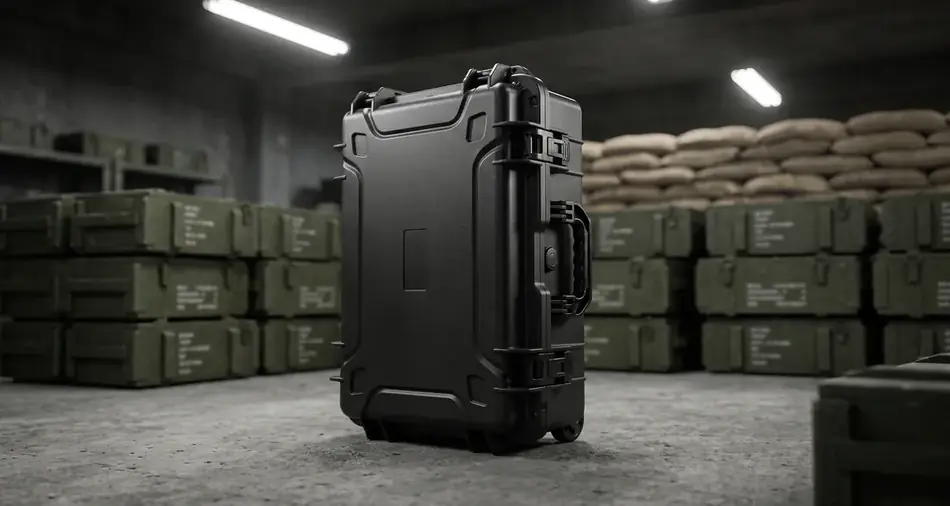
Case wheels is the trade shorthand for the wheel-and-handle set that turns a transport case into a trolley. Two layouts exist and they behave differently. The first, and the only one in our range, is the two-wheel trolley: a pair of moulded wheels set into one short face on a common axle, with a telescopic handle on the same face, so the case is tipped back onto the wheels and pulled at an angle. The second is the four-castor base: four swivel castors under the floor, so the case rolls upright and is steered rather than tilted. Four-castor bases are common on shallow flight cases that must move through a corridor; they are rare on deep injection mouldings, because the floor has to be raised clear of the castor and the stackable rim is lost.
It matters when buying a protective case because wheels are not a fitting bolted onto a finished decision - they reorganise the whole specification. They move the handling load from a person's arms onto the wheel, axle and handle fixings. They take one face of the case out of service as a stacking surface. They add shell mass, which is what somebody has to lift to tip the case in the first place. And they change the packing arithmetic, because a wheeled shell is usually packed one piece to a carton rather than twenty. If you treat case wheels as a catalogue tick box, you will get a case that is right for the vehicle and wrong for the warehouse, which is the single most common complaint we hear on resale.
The 19 models our file records with case wheels, line by line
Every row below is a live published line from our product data, sorted by external length, with nothing rounded or averaged. Read the last two columns together: the stacking record is what your rack plan has to accept, and the carton column is what your freight has to accept. Eleven models publish a handle height and eight do not; where a figure is absent we say so instead of inventing one.
| Model | External Mm | Internal Mm | Internal Volume | Published Net Weight | Wall Thickness | Shell Material | Handle Height | Stackable Record | Carton Data |
|---|---|---|---|---|---|---|---|---|---|
| KX-85022 | 463 x 370 x 230 | 437 x 308 x 180 | 24.2 L | 5,012 g | 4.5 mm | Engineering PP | not published | no | 495 x 375 x 245 mm, 1 piece |
| KX-85021 | 495 x 370 x 210 | 437 x 308 x 164 | 22.1 L | 4,912 g | 4.5 mm | Engineering PP | not published | no | not published |
| KX-5126 | 510 x 395 x 257 | 460 x 335 x 210 | 32.4 L | 5,610 g | not published | PP | not published | no | 520 x 405 x 270 mm, 1 piece |
| KX-85427 | 535 x 423 x 270 | 483 x 363 x 220 | 38.6 L | 6,100 g | 4.5 mm | PP | not published | no | not published |
| KX-85424 | 540 x 430 x 240 | 483 x 363 x 190 | 33.3 L | 6,000 g | 4.5 mm | PP | not published | no | not published |
| KX-85726 | 576 x 363 x 257 | 520 x 296 x 210 | 32.3 L | 5,600 g | 4.2 mm | PP | 385 mm | no | not published |
| KX-85827 | 588 x 475 x 267 | 500 x 400 x 220 | 44.0 L | 7,800 g | 5 mm | PP | 295 mm | no | not published |
| KX-85835 | 588 x 475 x 353 | 500 x 400 x 305 | 61.0 L | 8,520 g | 5 mm | PP | 295 mm | no | not published |
| KX-96027 | 600 x 415 x 265 | 502 x 337 x 214 | 36.2 L | 6,110 g | 5 mm | Engineering PP | not published | no | 580 x 250 x 415 mm, 1 piece |
| KX-96127 | 610 x 610 x 270 | 545 x 545 x 210 | 62.4 L | 8,540 g | 4.8 mm | PP | not published | no | 640 x 625 x 280 mm, 1 piece |
| KX-86136 | 612 x 427 x 355 | 530 x 360 x 304 | 58.0 L | 8,500 g | 5 mm | PP | 295 mm | no | not published |
| KX-66232 | 615 x 440 x 320 | 507 x 385 x 290 | 56.6 L | 7,940 g | 5.3 mm | ABS | not published | no | 620 x 465 x 355 mm, 1 piece |
| KX-86830 | 677 x 535 x 304 | 595 x 460 x 255 | 69.8 L | 10,160 g | 4.8 mm | PP | 310 mm | no | not published |
| KX-86836 | 677 x 535 x 364 | 595 x 460 x 315 | 86.2 L | 10,600 g | 4.8 mm | PP | 310 mm | no | not published |
| KX-97227 | 720 x 500 x 270 | 590 x 435 x 210 | 53.9 L | 10,000 g | 6 mm | Engineering PP | 485 mm | no | 715 x 515 x 280 mm, 1 piece |
| KX-87336 | 733 x 505 x 357 | 650 x 430 x 310 | 86.6 L | 10,660 g | 5 mm | PP | 240 mm | no | not published |
| KX-88337 | 830 x 445 x 374 | 723 x 368 x 329 | 87.5 L | 10,866 g | 5 mm | PP | 240 mm | no | not published |
| KX-88434 | 843 x 592 x 335 | 740 x 518 x 284 | 108.9 L | 14,030 g | 5 mm | PP | 295 mm | no | not published |
| KX-88442 | 843 x 592 x 415 | 740 x 518 x 364 | 139.5 L | 15,320 g | 5 mm | PP | 295 mm | no | not published |
What wheels change in the rest of the specification
Start with stacking, because it is the decision buyers most often discover too late. In our file, stackable is recorded as yes on 136 models and no on 19, and those 19 are exactly the wheeled ones. That is geometry rather than policy: the wheel face carries the axle, the moulded wheel housings and the handle channel, so it cannot sit flat as a stacking surface. A pallet column, a warehouse rack or a shelf of cases is a stacking problem and points you at the non-wheeled range. A vehicle boot, a loading platform or an airport ramp is a rolling problem and points you at these 19.
Then mass. All 19 wheeled models publish a net weight, from 4,912 g on KX-85021 to 15,320 g on KX-88442, with a median of 8,500 g; among the 74 non-wheeled models that publish net weight the median is 1,200 g. That difference is not a defect - the wheel housings, the axle, the handle channel and the thicker section needed around them are what make a trolley a trolley. But it is the number that matters when someone has to lift the case onto a tail lift, because tilting a trolley means lifting its whole empty shell plus your equipment off one edge. Wall thickness tells the same story: 18 of the 19 publish a wall figure between 4.2 mm and 6.0 mm, against a 2.0 mm to 6.0 mm range across the file, and KX-5126 publishes no wall figure at all, so we name that gap rather than fill it.
The five questions to ask about case wheels - of us or of anyone
A wheel is a component with its own supplier, and the honest way to buy one is to separate the case data from the component data. Our file records the fact of the wheels and their count; it does not record a load value for them, and we will not borrow one from a component brochure and present it as a property of the case. Use these five questions on every quotation you receive, ours included.
| Question To Ask | Why It Matters | What We Can Answer Today |
|---|---|---|
| Is it a two-wheel trolley or a four-castor base? | Tilting and pulling versus upright steering; it decides aisles, lifts and who can move the case. | All 19 wheeled models are recorded as two-wheel trolleys with a telescopic handle. |
| How is the wheel fixed to the shell, and what does the fixing do to the wall? | Axle pins, bolt-through plates and rivets each behave differently, and through-wall fixings interact with any sealing requirement. | Wheels are recorded as fitted hardware per model; the fixing detail is confirmed on the drawing for your configuration. |
| Whose load value is on the datasheet - the case's or the castor's? | A component rating printed next to a case is not a case rating; the shell, the rim and the axle boss carry the load. | We state no wheel or axle load value, because none is measured in our file; we will supply the component's own documentation on request. |
| What floor was it rolled on, and at what mass? | Smooth epoxy and broken yard tarmac are different problems; wheel diameter and tyre material decide much of it. | We quote the wheel set for the duty you describe and state which parts of that duty are unverified. |
| What does the handle retract to, and does the case still stack or fit? | Handle height sets the pulling angle and the vehicle or rack clearance; a tall handle changes what fits under a shelf. | Published handle height exists on 11 of the 19, from 240 mm to 485 mm; the eight models without a figure are named below. |
Handle height: published on 11 of the 19, blank on eight
This is the field buyers ask about most and publish least, so here is exactly where our file stands. Five distinct telescopic handle heights are published across the wheeled range: 240 mm on KX-87336 and KX-88337, 295 mm on KX-85827, KX-85835, KX-86136, KX-88434 and KX-88442, 310 mm on KX-86830 and KX-86836, 385 mm on KX-85726, and 485 mm on KX-97227. Eight models carry no published figure at all: KX-85021, KX-85022, KX-5126, KX-85424, KX-85427, KX-96027, KX-96127 and KX-66232. For those we confirm the height against the mould drawing when you order, and we do not print a number we cannot show you a record for.
The spread is worth reading as a design point rather than a curiosity. A 240 mm extended handle on a 733 mm-long shell pulls at a shallow angle and suits a person walking beside the case; a 485 mm handle on a 720 mm shell lets a taller operator stand more upright but raises the packed profile. Neither is better in the abstract - they answer different corridors, different tail lifts, and different people. Send the operator's height range and the route the case travels, and the choice becomes arithmetic on the shell length.
Long does not mean wheeled: matching the option to the duty
Forty-three of our 155 models exceed 500 mm on their longest axis, and only 17 of those 43 carry wheels; the other 26 long shells are fixed-handle cases that stack. Two of the 19 wheeled models are shorter than 500 mm - KX-85022 at 463 mm and KX-85021 at 495 mm - so the option is not simply a function of size. The pattern reflects duty. A long rifle or tripod case that lives in an armoury rack or on a pallet is built to stack. A server, medical or test-equipment case that travels between sites by one person is built to roll. Where a buyer needs both in one unit - rolling to the vehicle, then stacking in the bay - that is a genuine conflict in injection-moulded shells, and the correct answer is usually two accessories rather than one impossible case: a wheeled transporter for the journey, or a stackable shell plus a separate dolly.
Specifying case wheels on a custom build
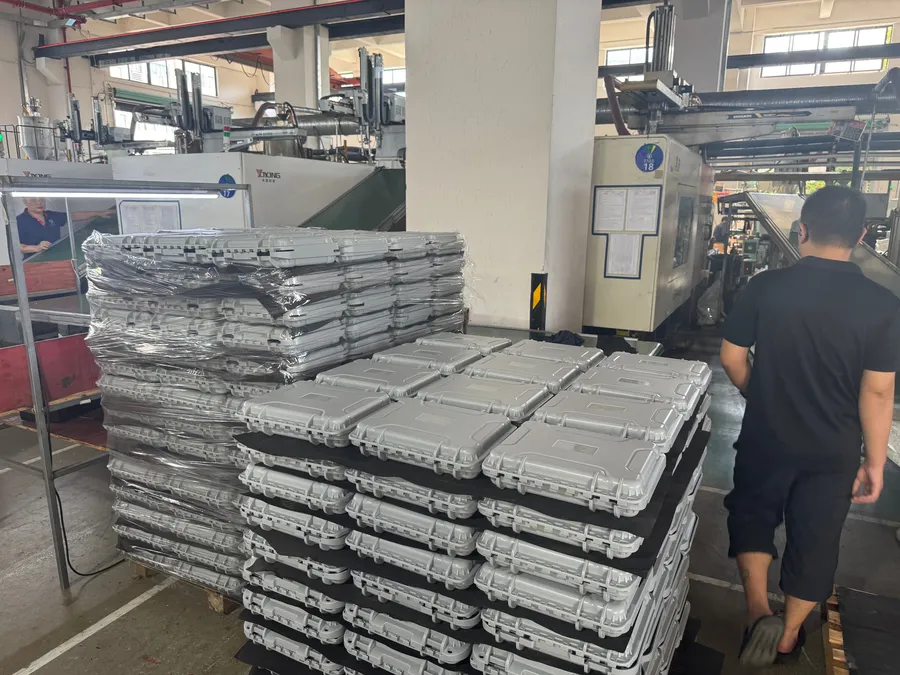
Wheels, handle, latches, feet and foam are configurable on our existing shells, and custom hardware is recorded as available across the range. Interior work - die-cut or CNC-cut foam against your equipment drawing - is quoted and sampled from 1 unit, which is the fast route when the wheeled shell is already right and only the cradle has to change. Logo, colour and OEM programmes start at 300 units, first sample on an existing mould is 45 days from confirmed drawing and deposit, and a new mould is 125 days with 3,000 units per component. Adding wheels to a shell that was not moulded for them is a tooling conversation, not a hardware swap, because the axle bosses, the wheel housings and the handle channel are formed in the mould.
Commercial terms are the same as the rest of our programme: wholesale and OEM or ODM only, on EXW or FOB, with a 30% deposit and the balance cleared after your inspection. We do not sell retail, do not quote DDP, and hold no overseas warehouse stock. Third-party factory audits are welcome at any stage. For a wheeled enquiry, send the equipment dimensions and mass, the route the case travels, the stow arrangement, and the quantity, and we will answer from the published table above - or say plainly which part of your duty our data cannot cover.
What we do not state about case wheels
Four blanks, named before you plan around them. We publish no wheel load value and no axle load value, because neither is measured in our product data; if a specification requires one, we will quote accredited third-party testing against the method you name for the exact build. We publish no rolling distance, no caster-swivel cycle count and no durability claim for the wheel fitting, and we make no claim about a wheeled case surviving a particular floor, kerb or aircraft ramp, because that is a test outcome rather than a moulding property. We publish no ingress level for any model: the protection rating field is recorded as not measured on all 155 listings, and the 124 models with a recorded seal describe a compressible gasket in a continuous moulded channel, which is a construction detail rather than a measured result. And eight of the 19 handle heights are simply absent, listed above rather than estimated.
Where the wheeled range normally goes
The 19 sit at the point in our catalogue where mass has outgrown carrying. Test sets and analyser racks, communications and broadcast kits with cabling stowed inside, medical devices on multi-site service rounds, survey and metrology instruments, and electronics assemblies that a single technician has to move from vehicle to bench and back. In each of those, the wheel is what makes the case usable by one person, and the trade is the loss of stacking plus a heavier lift at the tail lift. If your duty is instead shelf storage, container palletisation or a rack bay, the stackable non-wheeled range is the cheaper and better answer - and the published internal boxes from 115 x 78 x 32 mm to 740 x 518 x 364 mm cover a wider spread of equipment than most buyers expect.
Customisation
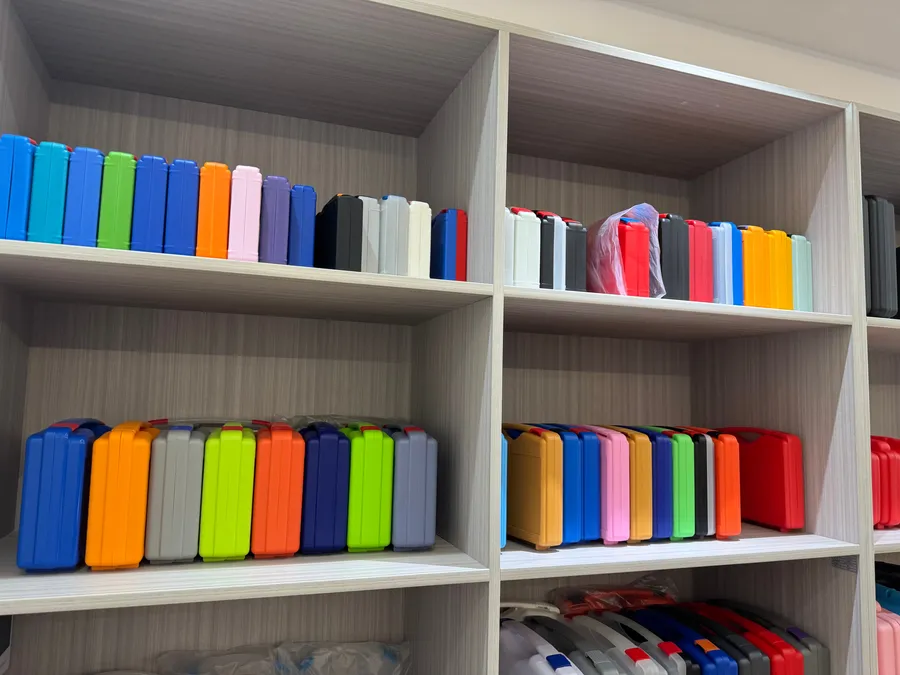
Everything described above is configurable on a standard shell: interior layout (pick-and-pluck, die-cut or CNC-cut), foam grade and thickness, colour, logo method, latch and lock count, pressure-equalisation valve, cable ports, document holder and identification plate. A bespoke exterior geometry requires a new mould — 125 days, from 3,000 units per moulded component.
Procurement considerations
| Question | What to send us |
|---|---|
| Which shell fits? | Equipment L × W × H as packed, plus required clearance per axis |
| What does it cost? | Order quantity and estimated annual quantity — the two drive different answers |
| Is tooling needed? | Whether an existing shell clears the envelope with usable foam depth |
| Lead time? | Your required delivery date, not just the order date |
| Certification? | The exact standard your tender names — we will say whether we can test to it |
| Freight? | Destination and preferred terms; carton and pallet data supplied with the quotation |
Comparison and selection guide
The tables on this page exist because a protective case is chosen by comparing three things: the envelope, the environment and the handling chain. Where no table applies, the rule below is.
| Situation | What To Do |
|---|---|
| Airport and road transfer | Check the external dimensions against cabin and boot constraints, not just the internal volume. |
| Rough ground | Larger wheels and a wider track matter more than shell volume. |
| Stored upright | Confirm the case can stand on its base with the handle retracted in your racking. |
- Size on internal dimensions plus clearance, never on a product name.
- Choose the carrying method before the shell: it changes the series, not just the price.
- Specify the interior last, and decide up front whether the end user will reconfigure it.
What is case wheels and why does it matter when buying a protective case? relates to Logistics & Packing Guide. Related families: Rolling Cases / Equipment Transport Cases / Military Transport Cases / Custom Protective Cases / Electronics Cases. Related sectors: field and industrial equipment. Continue in the Logistics & Packing Guide cluster.
This page is written from our own production data. If your requirement differs, send the dimensions and we will tell you which of the 155 models fits, or whether a custom route is needed.