Logistics & Packing Guide · Knowledge

What is case handles and why does it matter when buying a protective case?

Quick answer

Case handles are the part of a protective case you touch first, and on this catalogue they resolve into two configurations. Every one of the 155 published models ships with a fixed folding handle, and nineteen of them add a telescopic pull handle on top, always paired with a wheel pair. That single fact answers most handle questions before a quotation even starts: a case carried by hand has the folding handle, and a case meant to be rolled has both. What we publish is the handle type for each model, not a handle material figure or a carry rating, because grip layout, shoulder-strap fitment and pull height are settled against the specific tooling rather than assumed from a brochure.

Key points

  • All 155 published models list a fixed folding handle, so every case leaves the line with a hand grip.
  • Nineteen models add a telescopic pull handle, and those are exactly the nineteen models with a wheel pair.
  • The catalogue records the handle as a type, not as a material figure, so grip material is agreed per build.
  • A shoulder strap is listed as a manufacturer option, not a fitted part, so we confirm it model by model.
  • Handles sit in the OEM-variable hardware group, so placement and count follow the chosen tooling.

What case handles mean on this catalogue

A case handle is a carrying interface, and on this catalogue it is recorded as a hardware type rather than a marketing adjective. The hardware.handle field reads one of two values across the 155 published models: fixed folding, or telescopic plus fixed folding. There is no third family and no per-model handle count printed, which keeps the specification honest: you can see what kind of grip a model ships with, and you treat the exact number of grip points, their position and any overmould as an engineering decision made at tooling stage.

The two handle configurations you will see

Splitting the range by handle type shows the same line that splits it by wheels. The overwhelming majority of models are carried by hand and use a single fixed folding handle, while a small trolley subset carries both a folding handle and a telescopic pull so the operator can grip a standing case or lift it flat.

Handle ConfigurationModel CountTypical Use
Fixed folding136 of 155Carried by hand
Telescopic plus fixed folding19 of 155Rolled on a wheel pair

Every model has a fixed folding handle, and why it matters

It is easy to overlook, but the fixed folding handle is the one feature present on all 155 models. That matters for logistics because a case without any hand grip cannot be lifted into a rack, passed over a bench or loaded by one person into a vehicle. A folding profile keeps the grip flush when stacked or palletised and folds out only when a hand is needed, which is why it is the default carry interface across the whole catalogue rather than an add-on you have to request.

Telescopic pull handles: which models and which heights

The telescopic pull handle appears on the nineteen models that also carry a wheel pair, because a rolling case needs something to steer it by. Eleven of those nineteen publish a telescopic height, gathered at 240 mm on two models, 295 mm on five, 310 mm on two, and 385 mm and 485 mm on one model each. The other eight list the handle but leave its extended height blank, and we do not fill that gap with an assumed figure; the working height is agreed against the operator and the route the case travels.

Handle material, grip and shoulder straps: what the data leaves open

The catalogue is deliberate about where it stops. The handle is recorded as a type, and there is no published handle-material value per model, so a soft overmould, a bare plastic grip or a webbing strap are configuration choices we confirm rather than numbers you can read off the sheet. The shoulder strap field is marked as a manufacturer option across the line, meaning it is available on request but is not a fitted part on any given model unless the build asks for it. Treating these as open items is what keeps a quotation accurate instead of decorative.

Choosing handles around how the case is actually carried

Handle choice follows the carrying motion, so start from a simple test: is the case lifted flat by hand, tilted and rolled, or pulled upright over distance. Flat lifting favours the fixed folding handle that every model has. Rolling or pulling favours the telescopic subset, where you then check whether a published pull height suits the person who will use it, or whether a blank-height model needs the handle set during tooling. For heavy trolley bodies, the relevant figure is the empty weight, which runs up to about 15,320 g on the largest wheeled model, not an invented carry rating.

OEM customisation of handles and carry options

Handles are part of the OEM-hardware group, and the oem.custom_hardware field is set to true for all 155 models, so grip type, position and any additional carry feature can be configured to the equipment rather than accepted off the shelf. Practically, an existing-tooling OEM run with a handle change is quoted at a forty-five day first-sample lead time, while a change that needs new moulding, such as a reinforced grip boss, is a one-hundred-and-twenty-five day path with its own tooling minimum order.

Figures we do not publish for handles

We keep the handle page free of numbers that were never measured. There is no published pull-force rating, no static carry load for the grip, no handle material grade and no drop figure attached to a handle on this catalogue; those fields are recorded as not measured or as manufacturer options. What we can state as measured is narrower and per model: empty case weight, wall thickness from 2.0 mm to 6.0 mm depending on model, and a thermoplastic shell with no ferrous corrosion path. If a project needs a documented handle load, we arrange third-party laboratory testing on the specific build and report the result.

Procurement notes: MOQ, lead time and commercial terms

The commercial frame is the same as the rest of the range because this is a wholesale and OEM operation. A single sample piece is available at the one-piece stage, an OEM run on existing tooling carries a three-hundred piece MOQ, and a custom-mould programme carries three thousand. A thirty percent deposit opens production, with the balance settled against inspection before shipment. We quote EXW or FOB, we do not sell at retail, we do not quote DDP landed prices and we hold no overseas warehouse stock; third-party factory audits and inspections are welcome.
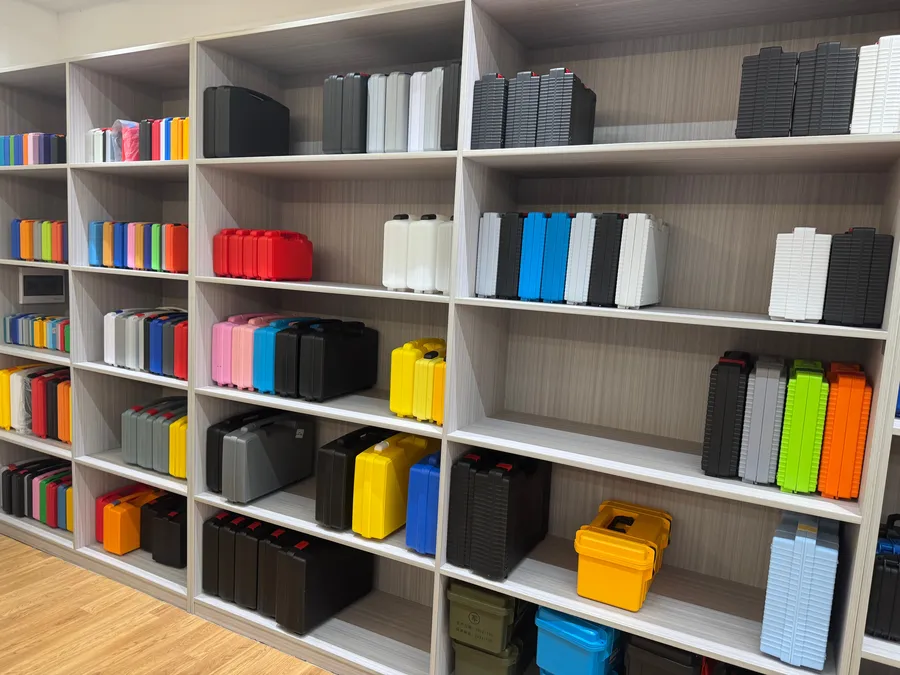
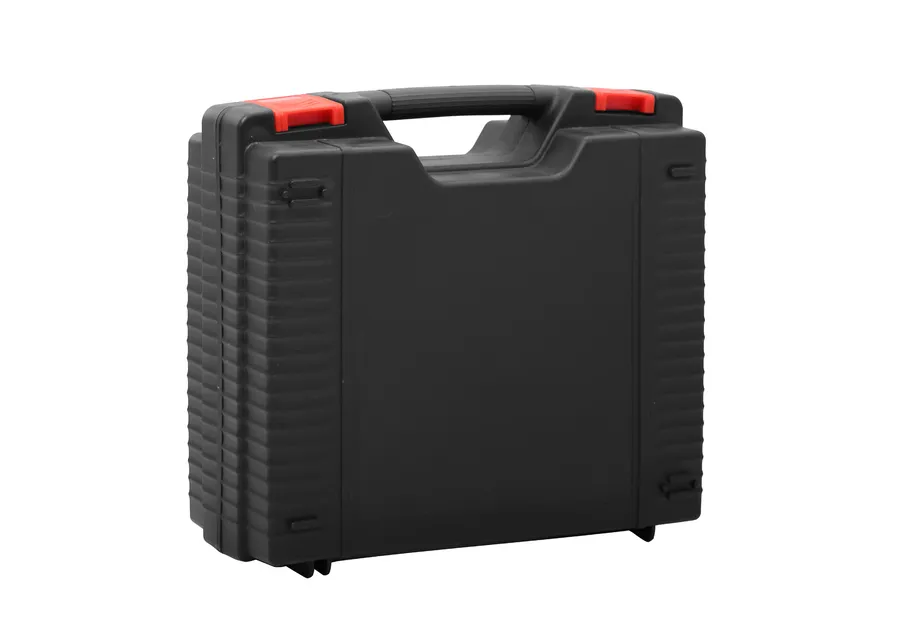
Tool case with hand tools stored inside
Black plastic case side view with red latches and ribbed walls on white background
Tool case with hand tools stored inside

Customisation

Everything described above is configurable on a standard shell: interior layout (pick-and-pluck, die-cut or CNC-cut), foam grade and thickness, colour, logo method, latch and lock count, pressure-equalisation valve, cable ports, document holder and identification plate. A bespoke exterior geometry requires a new mould — 125 days, from 3,000 units per moulded component.

Procurement considerations

QuestionWhat to send us
Which shell fits?Equipment L × W × H as packed, plus required clearance per axis
What does it cost?Order quantity and estimated annual quantity — the two drive different answers
Is tooling needed?Whether an existing shell clears the envelope with usable foam depth
Lead time?Your required delivery date, not just the order date
Certification?The exact standard your tender names — we will say whether we can test to it
Freight?Destination and preferred terms; carton and pallet data supplied with the quotation

Comparison and selection guide

The tables on this page exist because a protective case is chosen by comparing three things: the envelope, the environment and the handling chain. Where no table applies, the rule below is.

SituationWhat To Do
Sea freightSealed configuration plus desiccant; salt spray is a handling issue, not a material issue.
Air freightMass and external dimensions drive cost more than volume.
Repeated movementReplaceable latches, hinges and gaskets; keep a spares kit with the first order.
  • Size on internal dimensions plus clearance, never on a product name.
  • Choose the carrying method before the shell: it changes the series, not just the price.
  • Specify the interior last, and decide up front whether the end user will reconfigure it.
Entity relationships

What is case handles and why does it matter when buying a protective case? relates to Logistics & Packing Guide. Related families: Equipment Transport Cases / Rolling Cases / Tool Cases / Custom Protective Cases. Related sectors: field and industrial equipment. Continue in the Logistics & Packing Guide cluster.

Next step

This page is written from our own production data. If your requirement differs, send the dimensions and we will tell you which of the 155 models fits, or whether a custom route is needed.

Talk To The Manufacturer→Find the Right Case

FAQ

Frequently asked on this topic

Does every case have a handle?

Yes. All 155 published models record a fixed folding handle, so a hand grip is standard rather than an optional extra. Where a case is meant to be rolled, the same model also lists a telescopic pull handle, giving an upright grip for steering in addition to the folding handle for lifting it flat.

What is the difference between a fixed folding handle and a telescopic one?

A fixed folding handle sits flush against the case and folds out when a hand is needed, which suits lifting and carrying a case flat. A telescopic handle slides out to a standing height so the case can be pulled or rolled upright. On this catalogue the telescopic type only appears on the nineteen models that also carry a wheel pair.

Is a handle material or load rating published?

No handle material grade and no pull or carry load rating are published, because those were not measured and recorded for the grip on this catalogue, and we do not add a figure that was not tested. The handle is stated as a type. If your application depends on a documented handle load, we arrange accredited third-party testing on the chosen build.

Can the handles be customised for our equipment?

Handles fall inside the OEM-variable hardware group, which is marked available for all 155 models, so grip type, position and extra carry points can be configured to the equipment. A change on existing tooling is quoted at the forty-five day sample lead time, while a change requiring new moulding moves to the one-hundred-and-twenty-five day tooling path.

Do the cases come with a shoulder strap?

A shoulder strap is listed as a manufacturer option across the line, not as a part that arrives fitted on a specific model. That means it can be included when a build calls for it and confirmed model by model at quotation, instead of being assumed for every shell in the range.

Related

Continue in Logistics & Packing Guide

TECHNICAL

Internal Versus External Dimensions

TECHNICAL

How To Measure Equipment For A Case

PROCUREMENT

Container Loading For Protective Cases

KNOWLEDGE

How To Read A Protective Case Datasheet

TECHNICAL

Stacking and Palletising Protective Cases

KNOWLEDGE

How can protective cases improve equipment organization?

PROCUREMENT

What Factors Affect Shipping Costs for Protective Cases?

LOGISTICS

How Can Case Size Affect Logistics Efficiency?

LOGISTICS

How Should Equipment Cases Be Palletized? A Carton-First Method

LOGISTICS

What factors affect protective case selection for logistics?

COMPARISON

How Do Buyers Compare Protective Case Dimensions Across Suppliers? A Field-by-Field Method

COMPARISON

How do buyers compare case weight across protective case suppliers?

COMPARISON

How Do Buyers Compare Case Handles Across Protective Case Suppliers? A Field-by-Field Method

COMPARISON

How Do Buyers Compare Case Seals Across Protective Case Suppliers? A Field-by-Field Method

COMPARISON

How Do Buyers Compare Case Gaskets Across Protective Case Suppliers? The Bead, The Channel, The Closure

COMPARISON

How Do Buyers Compare Case Hinges Across Protective Case Suppliers? A Field-by-Field Method

COMPARISON

How Do Buyers Compare Case Latches Across Protective Case Suppliers? A Closure-Geometry Method

COMPARISON

How Do Buyers Compare Case Load Capacity Across Protective Case Suppliers? A Field-by-Field Audit

COMPARISON

How Do Buyers Compare Case Wheels Across Protective Case Suppliers? A Published-Field Audit

COMPARISON

How Do Buyers Compare Case Stackability Across Protective Case Suppliers? A Field-by-Field Guide

COMPARISON

How Do Buyers Compare Case Palletization Across Protective Case Suppliers? A Field-by-Field Guide

TECHNICAL

How Should Field Research Equipment Be Transported? A Packing Method From The Factory

TECHNICAL

What Affects Protective Case Dimensions for a Hard-Shell Equipment Case?

KNOWLEDGE

Common Mistakes in Protective Case Dimensions for Equipment Transport Cases

COMPARISON

What Affects Internal vs External Dimensions for a Hard-Shell Equipment Case?

KNOWLEDGE

Common Mistakes in Internal vs External Dimensions for Equipment Transport Cases

TECHNICAL

What Affects Case Weight for a Hard-Shell Equipment Case?

PRODUCT

What Affects Case Load Capacity for a Hard-Shell Equipment Case?

KNOWLEDGE

What Are The Common Mistakes In Case Load Capacity For Equipment Transport Cases?

PRODUCT

What affects case wheels for a hard-shell equipment case

KNOWLEDGE

What are the common mistakes in case wheels for equipment transport cases

PRODUCT

What affects case handles for a hard-shell equipment case

KNOWLEDGE

What are the common mistakes in case handles for equipment transport cases

KNOWLEDGE

What are the common mistakes in case weight for equipment transport cases

PRODUCT

What affects case hinges for a hard-shell equipment case

KNOWLEDGE

What are the common mistakes in case latches for equipment transport cases

KNOWLEDGE

Common Mistakes in Case Hinges for Equipment Transport Cases: An Eight-Point Field Guide

PRODUCT

What Affects Case Latches for a Hard-Shell Equipment Case? Eight Published Factors

KNOWLEDGE

What are the common mistakes in case seals for equipment transport cases

PRODUCT

What affects case gaskets for a hard-shell equipment case

PRODUCT

What affects case stackability for a hard-shell equipment case

KNOWLEDGE

What are the common mistakes in case stackability for equipment transport cases

LOGISTICS

What affects case palletization for a hard-shell equipment case

KNOWLEDGE

Common Mistakes in Case Palletization for Equipment Transport Cases

PROCUREMENT

How Should Protective Case Dimensions Be Specified In A Protective Case RFQ?

PROCUREMENT

What Information Should Be Provided About Protective Case Dimensions Before a Quotation?

PROCUREMENT

How Should Case Weight Be Specified In A Protective Case RFQ?

PROCUREMENT

How should case load capacity be specified in a protective

PROCUREMENT

What information should be provided about case load

KNOWLEDGE

Industrial Tool Transport Case: Sizes, Foam, Mobility

KNOWLEDGE

Cold Chain Equipment Case: What a Shell Can Prove

KNOWLEDGE

Automotive Equipment Transport Packaging Solutions

KNOWLEDGE

Communication Equipment Transport Packaging Solutions

KNOWLEDGE

Drone Equipment Transport Packaging

COMPARISON

Internal vs External Dimensions Before a Quotation

PROCUREMENT

Specifying Case Wheels in a Protective Case RFQ

KNOWLEDGE

How To Measure Usable Interior Dimensions

COMPARISON

Internal vs External Dimensions in a Protective Case RFQ

PROCUREMENT

What information should be provided about case hinges

PROCUREMENT

How should case latches be specified in a protective RFQ

PROCUREMENT

What to Send About Case Handles Before a Quotation

PROCUREMENT

How to Specify Case Locks in a Protective Case RFQ

PROCUREMENT

What to Provide About Case Wheels Before a Quote

PROCUREMENT

How to Specify Case Handles in a Protective Case RFQ

PROCUREMENT

What information should be provided about case locks

PROCUREMENT

How to specify case hinges in a protective case RFQ

PROCUREMENT

What to provide about case latches before a quote

PROCUREMENT

How should case seals be specified in a case RFQ

PROCUREMENT

What to Send About Case Seals Before a Quotation

PROCUREMENT

How to Specify Case Gaskets in a Protective Case RFQ

PROCUREMENT

Case Gaskets: What to Provide Before a Quotation

PROCUREMENT

Case Stackability in a Protective Case RFQ

PROCUREMENT

Case Stackability Info to Give Before a Quotation

PROCUREMENT

Case Palletization in a Protective Case RFQ

PROCUREMENT

What to Provide About Case Palletization Before a Quote

KNOWLEDGE

What Are Protective Case Dimensions and Why They Matter

OEM

Can Protective Case Dimensions Be Customised?

KNOWLEDGE

Internal vs External Dimensions: Why It Matters

COMPARISON

Customising Case Dimensions For One Device

KNOWLEDGE

Case Weight: What the Published Numbers Mean

KNOWLEDGE

Medical Equipment Packaging Solutions

KNOWLEDGE

Industrial Equipment Transport Packaging Solutions

KNOWLEDGE

Packaging Solutions for Laboratory Equipment

KNOWLEDGE

Photography Equipment Transport Packaging Solutions

OEM

Can Case Weight Be Customised for Your Equipment?

KNOWLEDGE

What Is Case Load Capacity and Why Does It Matter?

OEM

Can case wheels be customised for specific equipment?

OEM

Can Case Handles Be Customised for Your Equipment?

KNOWLEDGE

What Are Case Locks, and Why Do They Matter When Buying?

OEM

Customising Case Load Capacity for One Device

KNOWLEDGE

Case Wheels: What Buyers Should Check Before Ordering

OEM

Can Case Locks Be Customised for Your Equipment?

KNOWLEDGE

What Are Case Hinges and Why Do They Matter?

OEM

Can Case Hinges Be Customised for Your Equipment?

KNOWLEDGE

What Are Case Latches and Why They Matter When Buying?

OEM

Can Case Latches Be Customised for Your Equipment?

KNOWLEDGE

What Are Case Seals and Why Do They Matter When Buying?

OEM

Can Case Seals Be Customised for Your Equipment?

KNOWLEDGE

What Are Case Gaskets and Why Do They Matter?

OEM

Can Case Stackability Be Customised for an Item?

KNOWLEDGE

What Is Case Palletization and Why Does It Matter?

OEM

Can Case Palletization Be Customised for One Item?

OEM

Can Case Gaskets Be Customised for Your Equipment?

KNOWLEDGE

What Is Case Stackability and Why It Matters?

Equipment Transport Cases
PRODUCT FAMILY

Equipment Transport Cases

Rolling Cases
PRODUCT FAMILY

Rolling Cases

Tool Cases
PRODUCT FAMILY

Tool Cases