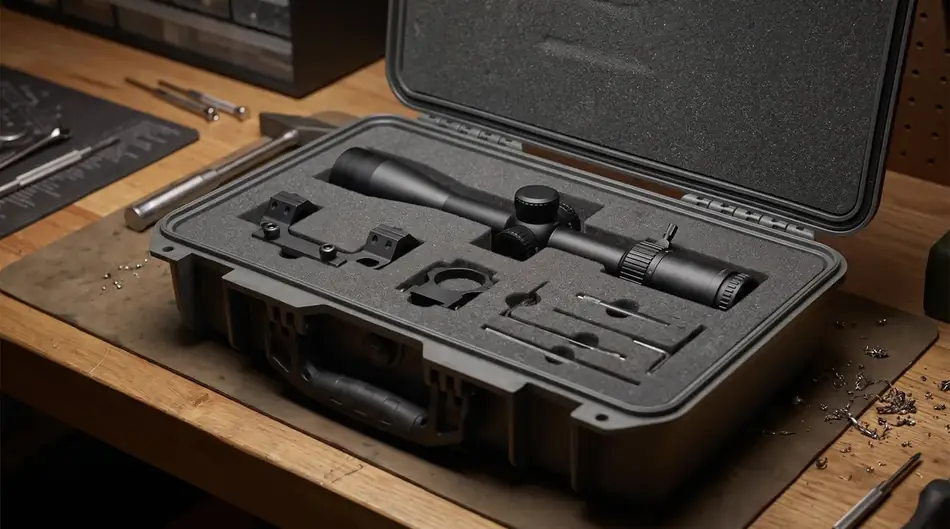
Industrial Equipment Transport Packaging Solutions?
Industrial equipment transport packaging solutions are a system, not one box: a published shell size, a fixed interior, a carton with a per-carton figure, a unit-load method, and paperwork that matches the order. On our sheet, 155 case models are published; 71 carry the equipment-transport tag, of which 64 offer a seal as a compressible gasket, 66 record a wall thickness between 2.5 mm and 6.0 mm, 19 are trolley models with wheels and a telescopic handle, and 64 models publish a carton size with a pieces-per-carton figure. Working load, stack load, temperature, UV and any ingress code are recorded as not measured, and pallet quantity and container loading are calculated per buyer pallet and quoted with the order rather than printed as a fixed number. This page sets out the published numbers, the interior and carton decisions, what we deliberately do not claim, and the OEM terms.
Key points
- Treat the case, the interior, the carton and the unit load as one specification; pricing a shell alone hides the cost of the other three.
- 71 of 155 models carry the equipment-transport tag, 64 of those are sealed and 66 record a wall thickness from 2.5 mm to 6.0 mm.
- 64 models publish a carton size and pieces-per-carton figure; pallet and container figures are calculated per buyer pallet, not printed as fixed.
- Interior choice (pick and pluck, die-cut or CNC-cut foam in EVA, PE or EPE) decides handling time more than shell colour ever will.
- No ingress code, defence-standard test result or certification is claimed for these models; measurement is quoted as a separate scope.
- Order terms are wholesale and OEM only: EXW or FOB, 45 days for OEM samples, 125 days for a new mould, 30 percent deposit before production.
Industrial Equipment Transport Packaging Solutions: what the term covers
In practice, Industrial Equipment Transport Packaging Solutions are judged at the receiving dock, not in the catalogue. A buyer is not purchasing a plastic shell; they are purchasing a repeatable way to move an instrument, a pump, a metrology head or a set of tooling from a workshop to a site and back without a new damage claim each time. That system has four layers: the case shell with its published internal size, the interior that holds the item, the carton and unit load that carry the case in bulk, and the documents that travel with the consignment.
Each layer fails in a different way. A shell that is too shallow for the lid to close on the item is a design error; a foam interior cut too loosely lets the item move and is a fit error; a carton that is not matched to the case leaves the shell unprotected in transit; and a unit load built without a stated pallet footprint creates a warehouse problem the buyer only discovers on arrival. Because the four layers are priced and specified separately, the cheapest way to buy is rarely the cheapest way to own. This page takes each layer in turn and states what we publish, what we do not, and how the order is placed.
Published case sizes for industrial equipment transport
Sizes below are copied from the model sheet, internal dimensions first, because internal size decides whether the equipment fits while external size decides the carton and the pallet. The models shown are tagged for equipment transport and are offered with a seal as a compressible gasket in a continuous moulded channel. Net weight is the empty case as published per model. Carton data is printed only where the sheet records it, so an empty carton cell means the figure is not published for that model rather than zero.
| Model | Internal Size, Mm | Wall, Mm | Net Weight | Carton And Per-Carton |
|---|---|---|---|---|
| Model | Internal size, mm | Wall, mm | Net weight | Carton and per-carton |
| KX-88442 | 740 x 518 x 364 | 5.0 | 15.3 kg | not published |
| KX-88434 | 740 x 518 x 284 | 5.0 | 14.03 kg | not published |
| KX-88337 | 723 x 368 x 329 | 5.0 | 10.87 kg | not published |
| KX-87336 | 650 x 430 x 310 | 5.0 | 10.66 kg | not published |
| KX-86836 | 595 x 460 x 315 | 4.8 | 10.6 kg | not published |
| KX-86136 | 530 x 360 x 304 | 5.0 | 8.5 kg | not published |
| KX-97227 | 590 x 435 x 210 | 6.0 | 10 kg | 715 x 515 x 280, 1 per carton |
| KX-5321 | 481 x 373 x 192 | 5.8 | 4.81 kg | 530 x 440 x 635, 3 per carton |
Carton and unit-load figures the sheet publishes
A transport packaging plan lives or dies on the carton. The sheet publishes a carton size and a pieces-per-carton figure for 64 of the 155 models; the rest are quoted with the carton on request. The examples below are real published figures, and they show why the carton cannot be guessed from the case size: two models with almost the same external length can take different quantities per carton because the carton is built around a nested or upright orientation.
Pallet quantity and container loading are a separate matter. For every model the sheet records these as not measured, with the note that they are calculated from the carton footprint against the buyer's pallet size, and that the 20 ft, 40 ft and 40 ft high-cube figures are supplied with the quotation. That wording matters: a pallet load is only true for a stated pallet dimension and a stated stack height, so printing one universal number would be misleading. Buyers who run a fixed pallet standard should send it with the enquiry and we will quote the unit load against it.
| Model | Case External, Mm | Carton, Mm | Pieces Per Carton | Pallet / Container |
|---|---|---|---|---|
| Model | Case external, mm | Carton, mm | Pieces per carton | Pallet / container |
| KX-4010 | 400 x 360 x 100 | 710 x 410 x 500 | 10 | calculated per buyer pallet |
| KX-3207 | 315 x 260 x 70 | 645 x 530 x 430 | 24 | calculated per buyer pallet |
| KX-2808 | 275 x 230 x 82 | 560 x 445 x 415 | 20 | calculated per buyer pallet |
| KX-62810 | 275 x 226 x 100 | 480 x 293 x 550 | 10 | calculated per buyer pallet |
| KX-64619 | 456 x 340 x 186 | 740 x 485 x 615 | 6 | calculated per buyer pallet |
| KX-65522 | 545 x 440 x 215 | 565 x 450 x 665 | 3 | calculated per buyer pallet |
Interior, sealing and the rating words buyers ask about
The interior is where an industrial packaging plan either saves handling time or costs it. Three options are common on our models: pick and pluck foam, where the buyer removes pre-cut blocks to form a cavity; die-cut foam, where a tool cuts the exact outline of the equipment; and CNC-cut foam, which is the most repeatable for a kit with several items. Foam is offered in EVA, PE and EPE, and the choice is driven by how much the item can move, how heavy it is, and whether the cavity has to survive repeated opening and closing rather than a single shipment.
Sealing is a gasket question. On the models marked as sealed, the seal is a compressible gasket set in a continuous moulded channel, which is a mechanical feature and not a rating. Buyers often arrive with rating words from another datasheet, such as a two-digit ingress code, a defence-standard test method, a drop height or an electrostatic claim. Those words describe a test result obtained under a stated configuration, not a property of the plastic, and the only honest answer is to ask for the report behind the word. Our sheet records water, dust, temperature, UV, stack load and working load as not measured, and no ingress code is printed for these models. Where a buyer needs a measured result, we quote testing against an agreed method at a recognised laboratory as a separate scope.
What we do not claim
It is more useful to state the limits than to decorate a page with badges. We do not claim an ingress code, a defence-standard test result, a drop height, an electrostatic rating or a third-party conformity result for these models unless a specific order has commissioned that test and the report is attached to it. We do not publish customer names, order volumes, field failure rates or performance rankings, because none of those are ours to publish on a product page. The sheet numbers in this article are the published case, wall, weight and carton figures; anything beyond them is a quotation line, not a claim.
This is not modesty, it is procurement hygiene. A buyer who needs a measured figure should ask for the test, the laboratory, the sample configuration and the date, and should expect the answer to be specific. A supplier who answers a rating question with a slogan has told you something useful about how the rest of the specification will be handled. Our position is simple: we publish what we measure per model, we mark the rest as not measured, and we quote the test when a programme needs it.
OEM, MOQ and lead times for industrial packaging programmes
We supply wholesale and OEM or ODM only. We do not sell single units at retail, we do not ship DDP, and we hold no overseas warehouse; terms are EXW or FOB from our factory. For an OEM programme the sample lead time is 45 days from approved artwork and specification, and a new mould is 125 days. Payment is 30 percent deposit, with the balance settled after inspection and before shipment. Buyers who want a third-party factory audit before placing an order are welcome to arrange one.
The practical consequence for a packaging programme is that the specification should be frozen before tooling, because the four layers above interact. A change to the case depth after the mould is cut is a tooling change, not a cosmetic one; a change to the foam layout after the sample is approved is a re-cut, not a reprint. Buyers who bring a packed sample, a measured item and a pallet standard to the first conversation usually reach a firm quotation in one round, while buyers who bring only a litre figure usually need two or three. Colour and logo come last, after the fit, the carton and the unit load are settled.
Shortlisting a transport packaging system: a buyer's checklist
Start with the heaviest single item and its longest dimension, then read the internal size of the shortlisted models against it with a margin for foam. Next, decide the handling route: a case that is lifted by one person, a case that is trolleyed across a yard and a case that is forklifted as part of a unit load are three different briefs, and the trolley models in the sheet are a separate choice from the plain shells. Then choose the interior by how often the case is opened: a one-way shipment can use a simpler cavity than a case opened twice a day for years.
Only after those three decisions should the carton and the unit load be fixed, because the carton is built around the case and the pallet is built around the carton. Finally, list the documents the receiving site needs and the measurements the programme requires, and treat any test as a quoted scope rather than an assumption. A checklist answered in that order produces a specification that can be quoted once and built once, which is the whole point of buying a packaging system rather than a box.
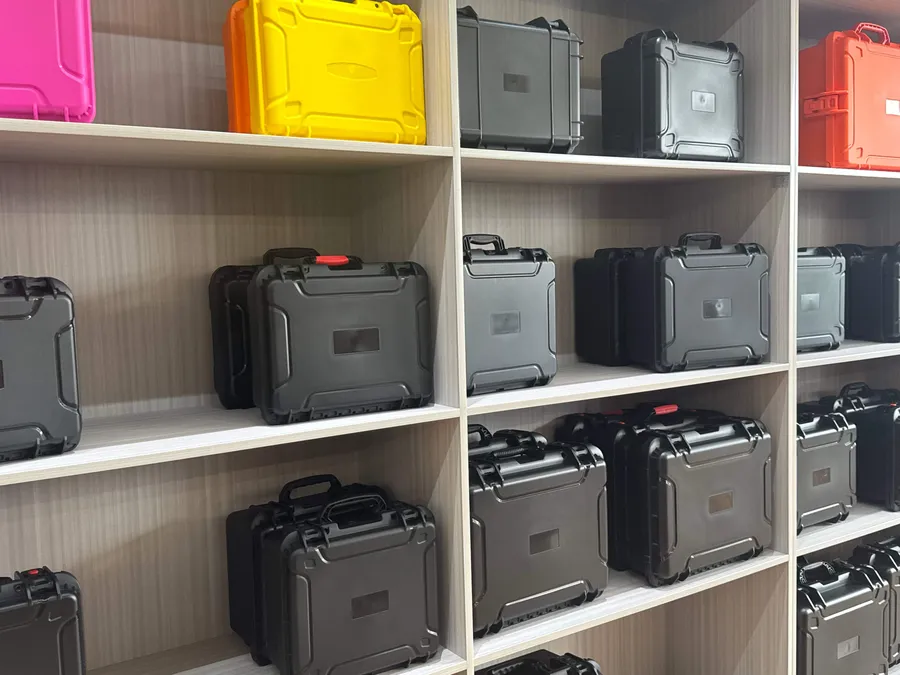
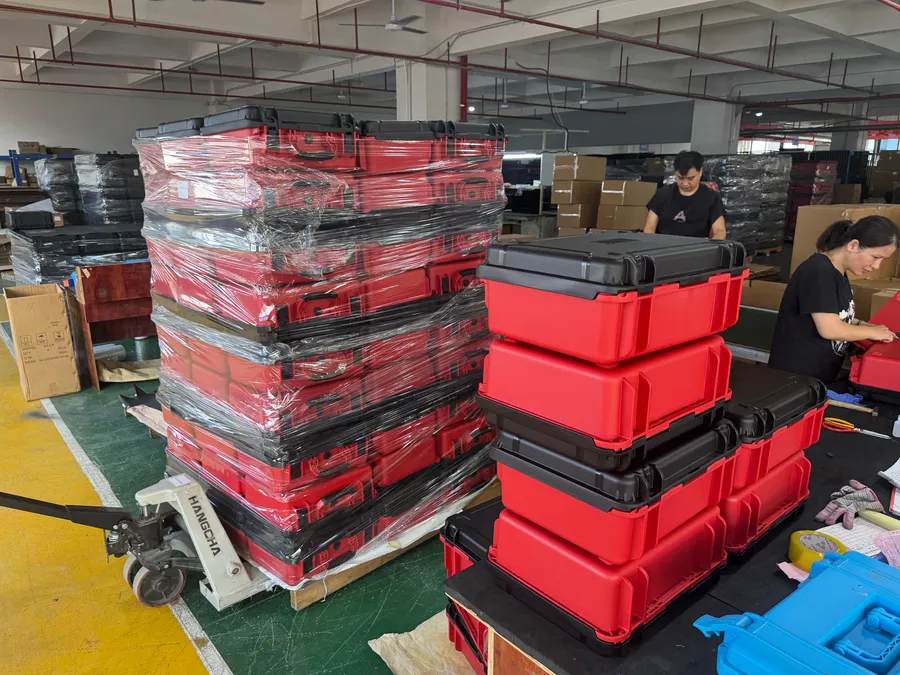
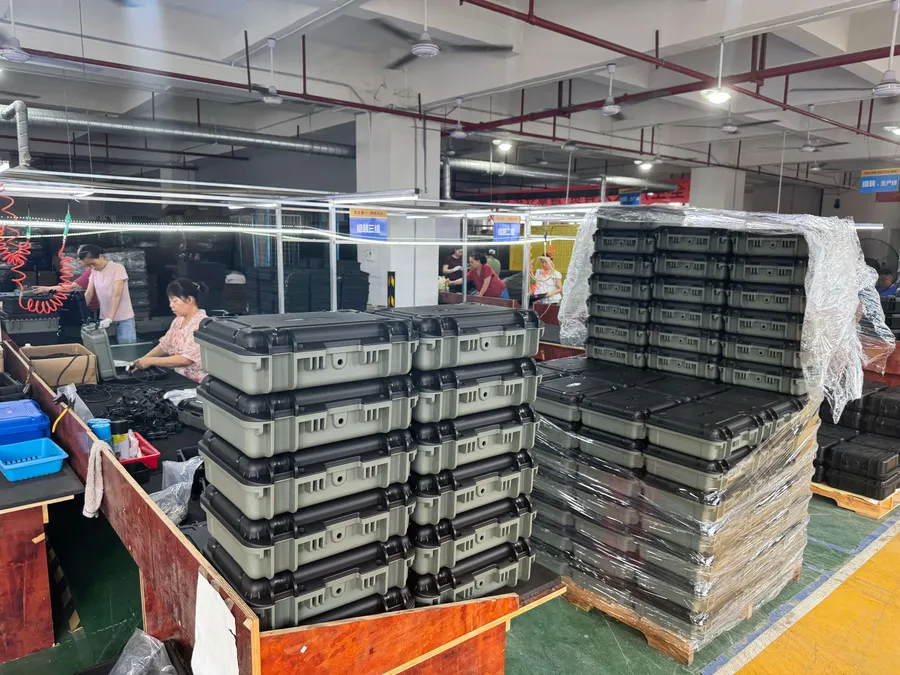
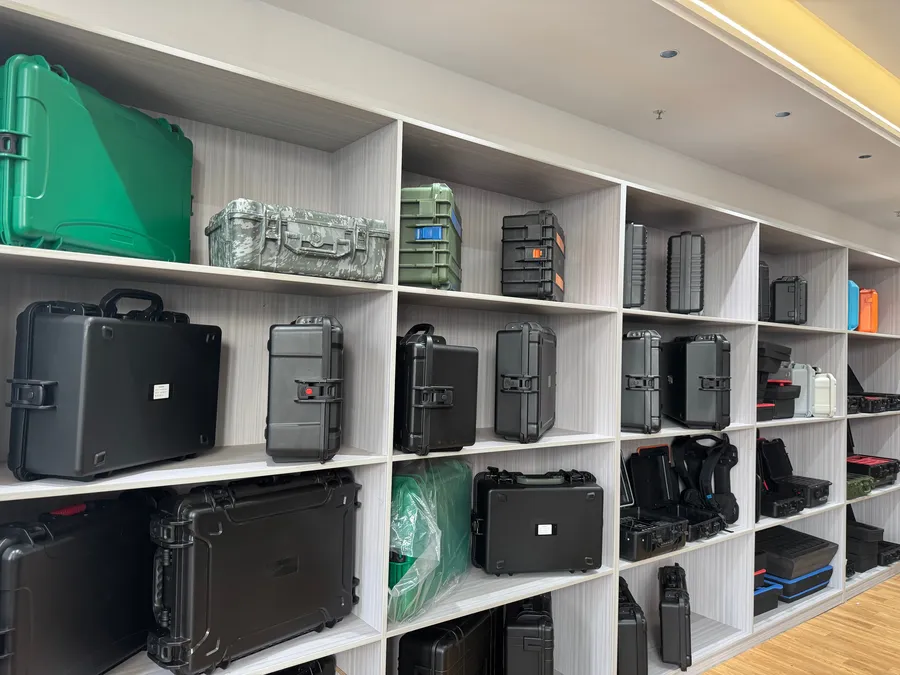
Customisation
Everything described above is configurable on a standard shell: interior layout (pick-and-pluck, die-cut or CNC-cut), foam grade and thickness, colour, logo method, latch and lock count, pressure-equalisation valve, cable ports, document holder and identification plate. A bespoke exterior geometry requires a new mould — 125 days, from 3,000 units per moulded component.
Procurement considerations
| Question | What to send us |
|---|---|
| Which shell fits? | Equipment L × W × H as packed, plus required clearance per axis |
| What does it cost? | Order quantity and estimated annual quantity — the two drive different answers |
| Is tooling needed? | Whether an existing shell clears the envelope with usable foam depth |
| Lead time? | Your required delivery date, not just the order date |
| Certification? | The exact standard your tender names — we will say whether we can test to it |
| Freight? | Destination and preferred terms; carton and pallet data supplied with the quotation |
Comparison and selection guide
The tables on this page exist because a protective case is chosen by comparing three things: the envelope, the environment and the handling chain. Where no table applies, the rule below is.
| Situation | What To Do |
|---|---|
| Sea freight | Sealed configuration plus desiccant; salt spray is a handling issue, not a material issue. |
| Air freight | Mass and external dimensions drive cost more than volume. |
| Repeated movement | Replaceable latches, hinges and gaskets; keep a spares kit with the first order. |
- Size on internal dimensions plus clearance, never on a product name.
- Choose the carrying method before the shell: it changes the series, not just the price.
- Specify the interior last, and decide up front whether the end user will reconfigure it.
Industrial Equipment Transport Packaging Solutions? relates to Logistics & Packing Guide. Related families: Equipment Transport Cases / Instrument & Equipment Cases / Tool Cases. Related sectors: field and industrial equipment. Continue in the Logistics & Packing Guide cluster.
This page is written from our own production data. If your requirement differs, send the dimensions and we will tell you which of the 155 models fits, or whether a custom route is needed.